IC Markets





































Lagarde Says the Energy Shock Is Too Large to Look Through, but Keeps a Measured Tone
In a written statement to the IMF on Saturday, the ECB President flagged upside inflation risks and tighter financing ahead of the 29 October decision.
 WriterAbir KhanWriterWrites the guides · checks every figure against primary sources View profileAbout Abir →

 Market analysisTanbir Habib RiyadForex & Crypto AnalystForex and crypto analyst · technical and fundamental analysis View profileAbout Tanbir →

 Fact-checking & riskJannatul FerdaushFact-Checker & Risk AnalystFact-checks every figure · risk analysis · Applied Statistics, University of Dhaka View profileAbout Jannatul →

 Trading reviewJowel RanaCo-Founder & Forex TraderCo-founder · forex trader · reviews guides from a trader's view View profileAbout Jowel →

 Final approvalRanjan NiskrityFounder, Owner & Forex TraderFounder and owner · forex trader · signs off every guide View profileAbout Ranjan →

European Central Bank President Christine Lagarde has given a fresh guide to how the bank is thinking before its 29 October decision. In a written statement to the International Monetary and Financial Committee, published by the ECB on Saturday 17 October during the IMF Annual Meetings, she said the energy shock hitting Europe is “too large to ‘look through’ but a measured response remains appropriate to keep inflation in check”.
That one sentence sums up the ECB's position after two rate rises this year. Officials do not want to ignore the jump in energy prices, because it is lifting inflation well above their 2% target. Yet they also see reasons to move slowly: wages have not reacted, other prices have not caught fire, and borrowing costs in markets have already risen sharply, doing part of the bank's job for it.
Monday's session is the first chance for currency markets to trade on the statement. EUR/USD opened the week little changed, at about 1.1227 at 03:04 UTC, against Friday's close of 1.1244.
| Statement | Christine Lagarde to the IMFC, 17 October 2026 |
|---|---|
| Deposit facility rate | 2.50% (since 16 September 2026) |
| Main refinancing rate | 2.65% |
| Rate rises in 2026 | 25 basis points in June and September |
| Euro area inflation, September | 3.8% headline, 2.5% core |
| ECB staff growth projections | 0.9% (2026), 1.4% (2027), 1.5% (2028) |
| Next ECB decision | Thursday 29 October, 14:15 Frankfurt |
| EUR/USD | about 1.1227 at 03:04 UTC, 19 October |
What Lagarde said about inflation
The statement sets out the inflation backdrop plainly. Headline inflation in the euro area rose to 3.8% in September, mostly because of a surge in energy prices and, to a smaller degree, higher food and services inflation. Core inflation, which strips out energy and food, rose slightly to 2.5%. According to Lagarde, the range of underlying measures stayed broadly stable and wages “have so far shown no material response to the energy shock”.
Looking ahead, she expects higher energy prices to keep headline inflation well above target into the first half of 2027 and to feed gradually into core and food prices. Inflation should then decline after the first quarter as energy inflation falls, returning to around 2% towards the end of 2027. That is a long time above target by the ECB's standards, and it explains why the bank has already raised rates twice.
Risks lean one way. Lagarde said the risks to the inflation outlook are to the upside, citing the conflict in the Middle East and Russia's war against Ukraine. A more intense or longer energy shock could strengthen second-round effects, where higher costs feed into wages and then into other prices. Extreme weather could push food prices up. In the other direction, a lasting resolution of the conflicts, weaker pass-through from energy or more risk-averse financial markets could lower inflation.
Why the response stays measured
The ECB says its rate decisions rest on three tests: the inflation outlook, the trend in underlying inflation and how strongly its policy is reaching the economy. Lagarde walked through all three in the statement, and they did not all point the same way.
On the first, the outlook points to higher inflation, especially in the short term. As for underlying inflation, she said there is “no evidence at this stage of significant pass-through of energy prices to other prices and wages, beyond what we have already included in our projections”. Transmission was the third test, and here she noted that financing conditions have tightened, with long-term interest rates “rising notably” since the September meeting. That tightening, she wrote, will slow growth and reduce pass-through by more than the bank projected in September.
Put together, the statement reads as a bank that wants to keep the option of another rise open without promising one. The phrase “measured response” suggests small steps rather than a rush, and the emphasis on higher bond yields hints that markets may already have done some of the tightening. Lagarde said future decisions will follow “a comprehensive assessment of the incoming data”, the usual ECB formula for keeping every option available.
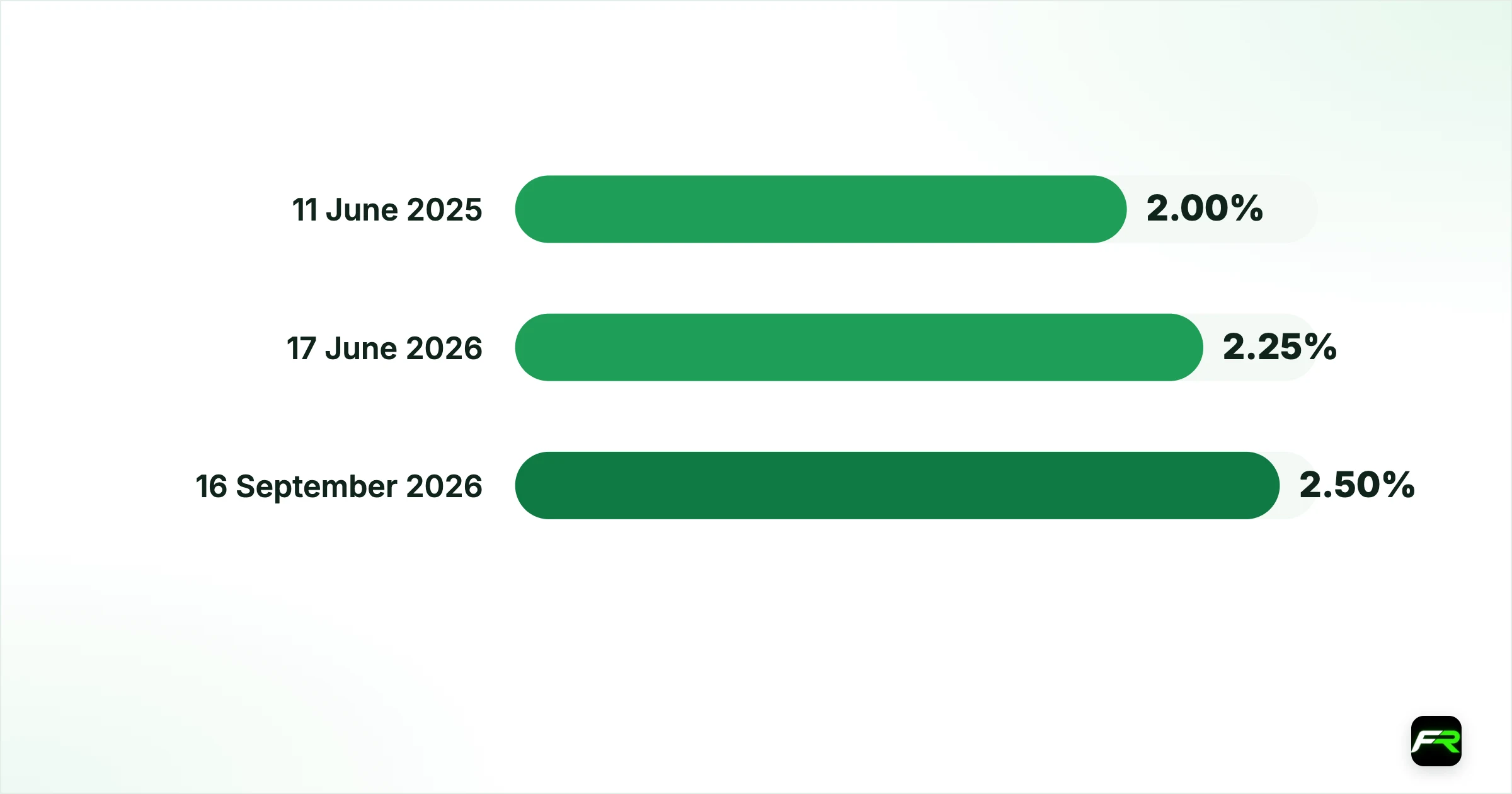
| Effective date | Deposit facility | Main refinancing | Marginal lending |
|---|---|---|---|
| 11 June 2025 | 2.00% | 2.15% | 2.40% |
| 17 June 2026 | 2.25% | 2.40% | 2.65% |
| 16 September 2026 | 2.50% | 2.65% | 2.90% |
Source: European Central Bank, key ECB interest rates. Each change takes effect the week after the Governing Council's decision.
Growth, debt and private credit
Lagarde described the euro area economy as resilient so far, with broad-based growth across most countries and sectors in the first half of 2026. The September staff projections she cited see growth of 0.9% this year, 1.4% in 2027 and 1.5% in 2028, helped by recovering real incomes as energy inflation fades, government spending on infrastructure and defence, and investment in artificial intelligence. Risks to growth, she said, are to the downside.
Her message to governments was direct. Any fiscal response to the energy shock should be “temporary, targeted and tailored”, and countries with high debt should consolidate and rebuild buffers. For currency traders, that matters because heavy borrowing by euro area governments can push up bond yields in weaker member states and unsettle the euro.
On financial stability, she flagged stress in private credit markets, where some funds have reported outflows and reactivated redemption gates that limit withdrawals. Euro area institutions have limited direct exposure, she wrote, so private credit on its own is unlikely to threaten stability in the region. She also listed concentrated AI-related exposures among non-bank lenders and rising cyber risks from new AI models as concerns.
The statement included two items for the longer term. More than 30 central banks have expressed interest in EUREP, the Eurosystem's repo facility that lends euros to other central banks against collateral, which the ECB says supports the international role of the euro. Lagarde also confirmed plans for a 12-month internal pilot of the digital euro in the second half of 2027.
What it means for EUR/USD
The euro has had a firm few days. EUR/USD rose from about 1.1163 at the close on 12 October to 1.1244 by Friday, helped by a fall in US Treasury yields after the September US inflation report. Since then, the statement adds a second support: an ECB that sounds willing to act again if energy costs spread further. The Federal Reserve, which raised its target range to 3.75% to 4.00% in September, decides the day before the ECB, on 28 October.
Even so, the words “measured” and “tightened” cap how hawkish this message can be read. Lagarde made clear that higher market rates are already slowing the economy, which is the kind of comment that tends to cool bets on a series of rapid rises. The next test is data: incoming figures on wages and prices will show whether her view of limited pass-through still holds.
Before the meeting, the ECB enters its usual quiet period, when policymakers stop giving speeches on policy. That leaves this statement, and earlier comments, as the main guide until 29 October. Our earlier story on euro area inflation at 3.8% explains how the energy surge built up.
What it means for traders
Central bank statements move markets through small changes in wording. These points can help you trade this one with care.
- Note the balance. “Too large to look through” leans hawkish, while “measured response” and tighter financing lean the other way. Expect the market to price a modest chance of another rise, not a sure thing.
- Watch European bond yields. If long-term rates keep climbing, the ECB has more reason to wait, and that can weigh on the euro.
- Plan around 28 and 29 October. The Fed and the ECB announce within about 24 hours of each other, so EUR/USD can swing twice in two days.
- Keep an eye on oil. Brent crude futures traded near $108 a barrel early on Monday; a further jump would strengthen the case Lagarde set out for acting against energy inflation.
- Use smaller positions into the decision. Spreads widen and moves can reverse sharply after a press conference.
Say you buy EUR/USD at 1.1227 ahead of the ECB, with a stop at 1.1167, 60 pips away. A standard lot is worth about $10 a pip, so the stop costs about $600 per lot. On an $8,000 account with a 1% limit of $80, the right size is about 13,000 units, roughly 0.13 lots. If the ECB holds rates on 29 October and the euro falls through your stop, accept the loss rather than adding to the trade.
For levels, see our daily EUR/USD analysis and the longer view in our EUR/USD forecast. The IMF meeting where Lagarde's statement was filed is covered in our IMF story, and the position size calculator works out trade size for you.
Rate decisions and central bank statements can move currencies sharply, and spreads often widen around announcements. Leverage magnifies losses as well as gains, so trade only with money you can afford to lose.
Quotes and figures come from Christine Lagarde's statement to the International Monetary and Financial Committee, published by the European Central Bank on 17 October 2026, and from the ECB's key interest rates page. The Fed's target range is from the Federal Reserve. Currency and oil levels are market data built from hourly bars to 03:04 UTC on 19 October and differ slightly between providers. Our reading of what the statement means for policy is FX Recap's own view, not the ECB's. This is news, not investment advice.
Frequently asked
What did Christine Lagarde say about the energy shock?
In her 17 October 2026 statement to the IMF's policy committee, Lagarde said the energy shock is too large to look through, but that a measured response remains appropriate to keep inflation in check.
What is the ECB deposit rate now?
The ECB's deposit facility rate is 2.50%, in effect since 16 September 2026 after a 25 basis point rise. Its main refinancing rate is 2.65% and the marginal lending rate 2.90%.
When is the next ECB rate decision?
The Governing Council announces its next decision on Thursday 29 October 2026 at 14:15 Frankfurt time, followed by the President's press conference.
Does the ECB expect inflation to fall?
Yes, but slowly. Lagarde said headline inflation should stay well above target into the first half of 2027, start to decline after the first quarter and return to around target towards the end of 2027.
Sources: European Central Bank: IMFC Statement by Christine Lagarde (17 October 2026) · European Central Bank: Key ECB interest rates · European Central Bank: Monetary policy meetings calendar · Federal Reserve: FOMC meeting calendars and statements
The team behind this guide
Researched, checked and approved by five forex specialists
Every guide is written, fact-checked and edited before it goes live, and updated when the facts change. Spotted an error? Tell us.