IC Markets

































Offshore vs Locally-Regulated Brokers for Asian Traders
The trade-off is local recourse against pricing, access and leverage. Here is how to weigh it, and which countries even have a local option to weigh.
 WriterAbir KhanWriterWrites the guides · checks every figure against primary sources View profileAbout Abir →
 Market analysisTanbir Habib RiyadForex & Crypto AnalystForex and crypto analyst · technical and fundamental analysis View profileAbout Tanbir →
 Fact-checking & riskJannatul FerdaushFact-Checker & Risk AnalystFact-checks every figure · risk analysis · Applied Statistics, University of Dhaka View profileAbout Jannatul →
 Trading reviewJowel RanaCo-Founder & Forex TraderCo-founder · forex trader · reviews guides from a trader's view View profileAbout Jowel →
 Final approvalRanjan NiskrityFounder, Owner & Forex TraderFounder and owner · forex trader · signs off every guide View profileAbout Ranjan →
Key takeaways
- Most of Asia has no local retail forex licence; Japan, Singapore and Indonesia are the main exceptions.
- A local licence buys a home regulator, domestic client-money rules and a usable dispute process.
- It costs higher minimums, wider spreads, lower leverage and fewer products.
- India allows only exchange-traded rupee derivatives; China, Vietnam and others offer no retail option.
Across most of Asia, a “locally-regulated forex broker” is not something you can choose, because it does not exist, outside a few developed markets like Japan and Singapore, both of which licence retail forex domestically. Where a local option does exist elsewhere in the region, mainly in Indonesia, it comes with real trade-offs. This guide gives you a framework for the decision, and a country-by-country note on what is available. Our top forex brokers list is where the vetted shortlist lives.
What a local licence buys you
- A regulator in your own country, in your own language, that can compel a broker to act.
- Client money held at domestic banks under domestic rules.
- A dispute process you can realistically use without hiring a lawyer abroad.
- Marketing and conduct rules that make outright scams harder to run.
What you give up for it
- Higher minimum deposits, often the single biggest barrier.
- Wider spreads and fewer platforms.
- Lower leverage caps.
- Fewer products: no Islamic account variations, no cent accounts, limited instruments.
Where a local option even exists
| Country | Local retail forex option? | Notes |
|---|---|---|
| Indonesia | Yes | Bappebti-licensed brokers, higher minimums, JFX-cleared |
| Japan | Yes | FSA-licensed brokers only, retail leverage capped at 25:1 |
| Singapore | Yes | MAS CMS-licensed brokers, retail leverage capped around 20:1 |
| India | Exchange only | SEBI-regulated currency derivatives on NSE/BSE, not OTC margin |
| Malaysia | Bank / Bursa only | No licensed retail OTC margin broker |
| Philippines | No | No BSP or SEC licence for retail forex |
| Vietnam | No | Reserved for licensed banks; retail floors illegal |
| Thailand | No | No SEC licence for retail forex |
| China | No | PBOC/SAFE prohibit retail margin trading; a personal USD 50,000/year FX quota, and offshore brokers are routinely blocked |
| Pakistan | No | No framework |
| Bangladesh, Sri Lanka, Nepal | No | Restricted or prohibited for residents |
If your own country is not in this table, treat “no local option” as the regional default rather than the exception, and confirm it yourself: check whether your central bank or securities regulator publishes a licensed-broker register or a warning list, the way Vietnam, Pakistan and the Philippines each do in their own guides on this site, before assuming either way.
For most readers, then, the honest question is not “offshore or local”. It is “which offshore regulator, and which entity of that broker”.
It is also worth noting how narrow the local options are even where they exist. Indonesia’s licensed brokers cover spot forex and futures but not the full product range an international broker offers. India’s exchange route is currency derivatives only, and recent rules have tilted it toward hedgers. So even a trader who wants to stay onshore often finds the local product does not match what they are trying to do, and ends up offshore by process of elimination rather than choice.
Choosing among offshore regulators
Not all offshore is equal. An FCA, ASIC or CySEC entity gives you meaningful protection: capital requirements, segregated funds, and a compensation scheme in some cases. A Seychelles, Vanuatu or Mauritius entity gives you higher leverage and much less else. If a broker offers you 1:1000, you are almost certainly on a light-touch entity, whatever the homepage advertises.
Aisha wanted the strongest protection she could get. She picked a broker with a CySEC entity, checked the client agreement to confirm she was onboarded to it rather than the Seychelles arm, and accepted the lower 1:30 leverage that came with it. Her position sizing does not need 1:500, and she would rather have the EU-level safeguards. A friend on the same broker’s Seychelles entity has 1:500 and, on paper, far weaker recourse.
The recourse question, honestly
It is worth being realistic about what “recourse” means with an offshore broker, because the marketing on both sides oversells it. A CySEC entity has an investor compensation fund, but it is capped, claims take time, and it only pays if the firm fails rather than just treats you badly. An ASIC or FCA complaint is a real process, but pursued from Jakarta or Lahore over a few hundred dollars, most people give up before the end.
So the practical protection from a strong offshore licence is less about “I can get my money back” and more about “this broker is less likely to be the kind that steals it in the first place”. The rules on segregation, capital and conduct filter out a lot of bad actors before you ever need to complain. That filtering is the real value, and it is a good reason to pay the lower-leverage, stricter-onboarding price of a top-tier entity.
A simple way to decide
- If you have a local licensed option and are funding a large account for infrequent trades, use it.
- If not, or if the local minimum is out of reach, choose an offshore broker on the strongest regulator you can (FCA, ASIC, CySEC), and verify you are on that entity.
- Only step down to a light-touch entity if you specifically need something it offers, and understand what you are trading away.
- Whichever you pick, test a withdrawal before you scale up.
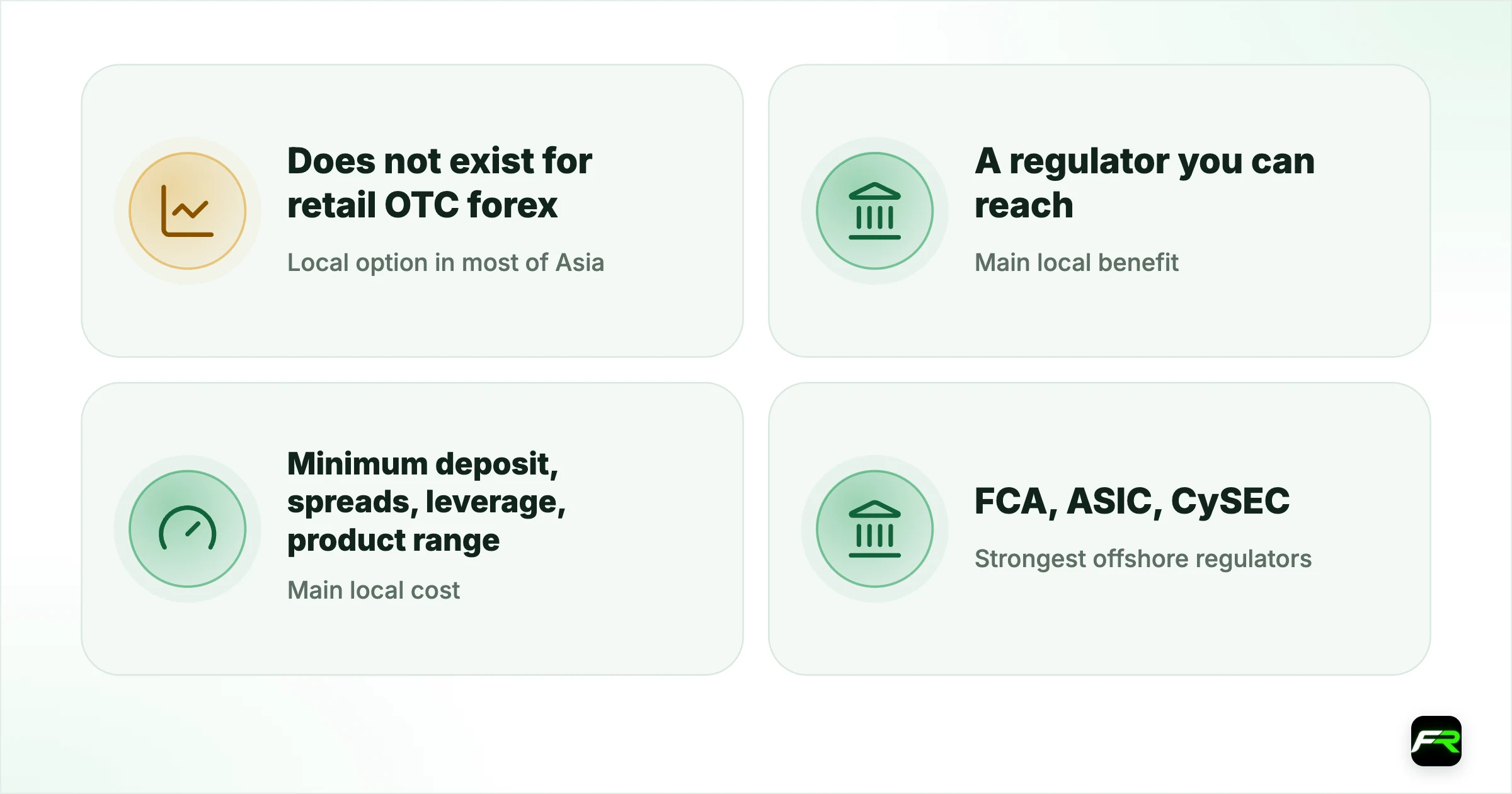
| Local option in most of Asia | Does not exist for retail OTC forex |
|---|---|
| Main local benefit | A regulator you can reach |
| Main local cost | Minimum deposit, spreads, leverage, product range |
| Strongest offshore regulators | FCA, ASIC, CySEC |
| Sign of a light-touch entity | Leverage of 1:500 or 1:1000 |
The single most common mistake is being sold on a broker’s FCA or ASIC licence and then onboarded to its offshore entity. Always read the client agreement you sign.
Frequently asked
Is a locally-regulated forex broker safer?
It gives you a regulator in your own country that can act on your behalf, which is a real advantage. The trade-offs are higher minimums, wider spreads, lower leverage and fewer products. Whether that is worth it depends on your account size and how you trade.
Which countries in Asia have a locally-regulated retail forex option?
Mainly Indonesia, through Bappebti-licensed brokers. India has SEBI-regulated exchange-traded currency derivatives but not OTC margin. Most other countries in the region have no local retail option at all.
Which offshore regulator should I choose?
FCA, ASIC and CySEC give the strongest protection. Seychelles, Vanuatu and Mauritius are light-touch: higher leverage, weaker safeguards. Check which entity of the broker you are signed up with.
Why does my broker offer 1:1000 leverage if strong regulators cap it?
Because you are almost certainly onboarded to a light-touch offshore entity. Strong regulators cap retail leverage far lower, so very high leverage is a reliable sign of weak oversight.
Can I choose which entity of a broker I sign up with?
Sometimes. Some brokers let you pick a jurisdiction; others assign one based on your country. Either way, the client agreement names the entity and regulator, so read it before you deposit.
Is a locally-regulated broker always the safer choice?
It gives you a regulator you can reach in your own country, which is a real benefit. But if the local minimum deposit is out of reach, or the local product does not match what you want to trade, a strong offshore licence you have verified is a sound alternative.
The team behind this guide
Researched, checked and approved by five forex specialists
Every guide is written, fact-checked and edited before it goes live, and updated when the facts change. Spotted an error? Tell us.