Best Forex Brokers in Singapore (2026) - FX Recap Best Forex Brokers in Singapore (2026) - FX Recap
Verified Review

Best Forex Brokers in Singapore (2026)

4.5 /5
★★★★☆ 4.5 / 5
Excellent

Singapore ranks as the third-largest forex trading centre in the world, with daily volume averaging US$1.485 trillion as of April 2025, according to the MAS Triennial Central Bank Survey. Retail traders here operate under one of the strictest regulatory frameworks globally, where any broker offering leveraged forex or CFD products must hold a Capital Markets Services licence from the Monetary Authority of Singapore. This page reviews the best forex brokers available to Singapore residents, verified against official MAS licensing records, broker websites, and independent research.

Updated 4 months ago
23 min read
270 views
Tanbir Riyad
Written by Forex Analysis & Editorial
Ranjan Niskrity
Fact-checked by Crypto & Forex Expert
Abir Khan
Researched by Crypto & Forex Expert
Jannatul Ferdaush
Forex Analyst Customer Risk Analyst
🕐 Updated: 4 months ago
Share Facebook LinkedIn Twitter
Top Forex Brokers
#1
4.8/5

Exness

★★★★★★★★★★
Regulation:Yes
Min. Deposit:$10
Spread:0.0 pips
Leverage:1:2000
#2
4.5/5

XM

★★★★★★★★★★
Regulation:Yes
Min. Deposit:$5
Spread:0.8 pips
Leverage:1:1000
#3
4.5/5

IC Markets

★★★★★★★★★★
Regulation:Yes
Min. Deposit:$200
Spread:0.0 pips
Leverage:1:1000
4
4.5/5

LiteFinance

★★★★★★★★★★
Regulation:Yes
Min. Deposit:$50
Spread:0.0 pips
Leverage:1:1000
5
4.8/5

FP Markets

★★★★★★★★★★
Regulation:Yes
Min. Deposit:$100
Spread:0.0 pips
Leverage:1:500
6
4.5/5

AvaTrade

★★★★★★★★★★
Regulation:Yes
Min. Deposit:$100
Spread:0.9 pips
Leverage:1:400
7
4.4/5

Octa

★★★★★★★★★★
Regulation:Yes
Min. Deposit:$25
Spread:0.2 pips
Leverage:1:1000
8
4.3/5

RoboForex

★★★★★★★★★★
Regulation:Yes
Min. Deposit:$10
Spread:0.0 pips
Leverage:1:2000

Disclosure: "Visit Broker" links are partner (affiliate) links. FX Recap may earn a commission at no cost to you. Trading involves significant risk of loss. T&Cs apply.

Singapore sits as the third-largest forex trading centre globally and the single largest in the Asia-Pacific. Daily trading volume in Singapore averaged approximately US$1.485 trillion in April 2025, according to the Monetary Authority of Singapore’s Triennial Central Bank Survey. That figure places it ahead of Tokyo, Hong Kong, and Sydney in the region’s pecking order, reflecting both the depth of local liquidity and the number of international banks operating out of the city-state.

For retail traders based in Singapore, this environment translates into tight spreads during Asian session hours, access to the SGD across major pairs, and a regulatory framework that ranks among the world’s strictest. The MAS does not tolerate unregulated brokers operating in its jurisdiction, and 2025 saw coordinated action between MAS and the Singapore Police Force to block platforms that were offering leveraged trading without a Capital Markets Services licence.

That regulatory posture is important context before you put any capital to work. The broker you choose shapes your costs, the quality of execution, and what happens to your money if something goes wrong. Below, FX Recap has reviewed and ranked the best forex brokers available to Singapore residents, verified against MAS licensing records, official broker websites, and data from independent research houses.

Quick Picks at a Glance

For those who need a fast reference before reading full reviews:

BrokerBest ForMin. DepositEUR/USD SpreadMAS Licensed
IG MarketsOverall & TrustS$0~0.6 pips (std)Yes
CMC MarketsLowest Trading CostsS$0~0.5 pip (FX Active)Yes
OANDABeginnersS$0~1.0 pip (std)Yes
Saxo MarketsProfessional TradersS$3,000~0.4 pip (SaxoTraderGO)Yes
PepperstoneECN / Low SpreadsS$0~0.1 pip (Razor)No (offshore)
IC MarketsScalpers & AlgosS$200~0.1 pip (Raw)No (offshore)
Plus500CFD SimplicityS$100Variable (spread-only)Yes
City IndexMT4 + Full SuiteS$150~0.5 pip (std)Yes

EUR/USD spreads shown are typical averages and vary by session and account type. MAS licensing refers to whether the broker’s Singapore entity holds a CMS licence. Always verify directly at the MAS Financial Institutions Directory before depositing.

MAS Regulation: What It Means for Your Money

The Monetary Authority of Singapore was established in 1971 and performs a dual role. It acts as Singapore’s central bank and as the primary regulatory body overseeing all financial markets activity in the country. Any broker offering leveraged forex or CFD trading to Singapore residents must hold a Capital Markets Services (CMS) licence issued under the Securities and Futures Act.

What MAS Requires of Licensed Brokers

  • Client funds must be held in segregated accounts, separate from the broker’s own capital, across multiple top-tier banks.
  • Brokers must maintain adequate capital to cover their client obligations, even in adverse market conditions.
  • All disclosures around spreads, commissions, and overnight financing must be transparent and accessible before you open an account.
  • Customer knowledge assessments are mandatory before CMS-licensed brokers can onboard retail traders into leveraged products.
  • Robust risk management systems, margin call policies, and internal controls must be documented and active.

Leverage Limits in Singapore

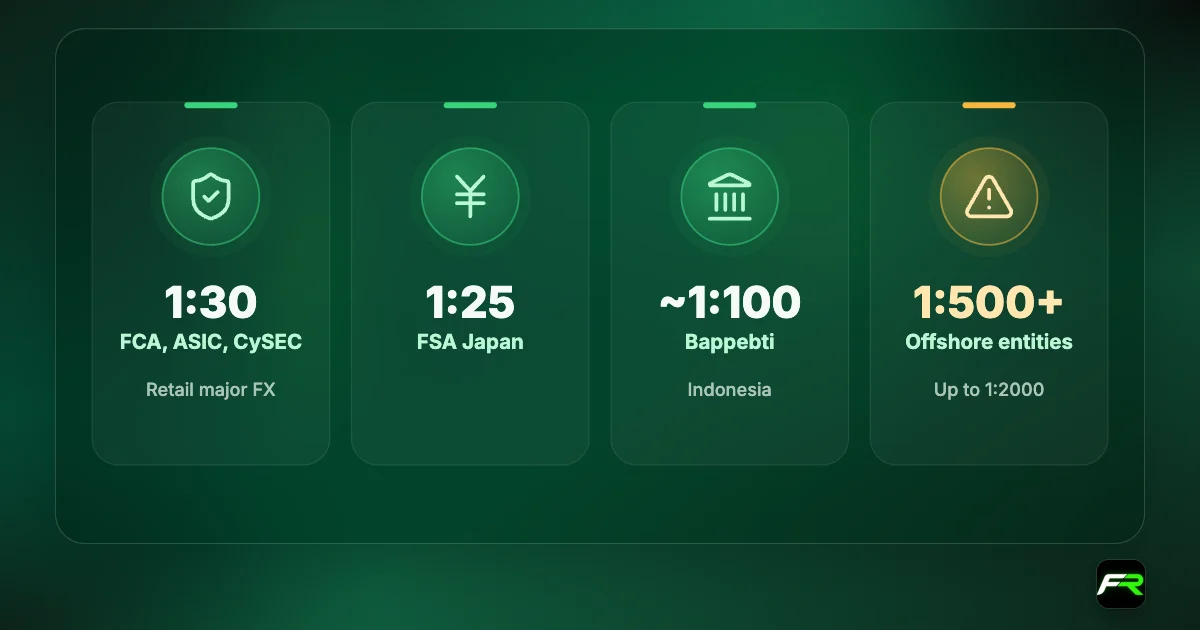
MAS caps retail leverage at 1:20 for most currency pairs. For major pairs involving SGD, USD, EUR, JPY, and GBP, the ceiling is 1:50 for retail clients who qualify as Accredited Investors. That status requires meeting at least one of the following:

  • Cash or financial assets exceeding S$1 million
  • Net personal assets above S$2 million
  • Annual income of more than S$300,000

Prior to 2019, some brokers in Singapore offered leverage of up to 500:1. MAS progressively tightened those limits to their current levels, also raising the margin requirement from 2% to 5%. In September 2022, MAS introduced a ban on marketing leveraged forex and CFD products to retail investors. Copy trading services were prohibited the following month in October 2022.

No Compensation Scheme in SingaporeUnlike the UK’s FSCS or Australia’s CSLR, Singapore does not operate a formal investor compensation scheme for forex broker insolvency. Your protection rests entirely on the broker’s fund segregation obligations and MAS capital requirements. This makes choosing a well-capitalised, locally licensed broker particularly important.

How to Verify a Broker’s MAS Licence

Go directly to the MAS Financial Institutions Directory at mas.gov.sg. Search by company name or licence type. A legitimate CMS licence for dealing in capital markets products will appear there. Do not rely on a broker’s own website claim of being ‘MAS regulated’ without checking the register directly. In June 2025, MAS and Singapore Police Force blocked two unregulated platforms that had been marketing leveraged trading to Singapore residents without CMS licences.

Full Broker Reviews: Singapore’s Best in 2025

1. IG Markets Singapore

MAS Licence: Yes (IG Asia Pte Ltd, CMS Licence)

Minimum Deposit: S$0

EUR/USD Spread (Std): ~0.6 pips

Platforms: IG Web Platform, MT4, ProRealTime, IG mobile app

Currency Pairs: 97 pairs

Trust Score (ForexBrokers.com): 99/99

IG has operated in Singapore since 2007 through IG Asia Pte Ltd and holds a CMS licence under the Securities and Futures Act. Globally, the group is authorised by eight Tier-1 regulators, making it one of the most heavily regulated brokers in existence. The group holds over US$498 billion in client assets as of mid-2023, which gives a clear picture of the capital scale involved.

The IG Web Platform is one of the better proprietary platforms in the retail forex space. Charting is rich, execution is direct, and the in-platform research spans daily market commentary, economic calendars, Reuters news, and a suite of technical indicators. MT4 is also available for traders who prefer that environment.

For Singapore-based traders, IG is strong on educational material, covering everything from basic currency concepts through to advanced options strategies. The IG Academy has structured courses tied to trading simulations, a practical tool for newer traders who want to build confidence before going live.

Costs sit at mid-range on IG’s standard account. EUR/USD spreads average around 0.6 pips during the main trading hours. Active traders can access the Forex Direct (DMA) account with tighter raw spreads and a commission structure, though it requires a minimum balance.

ProsCons
99/99 Trust Score, 8 Tier-1 regulatorsWider spreads than ECN-focused competitors on standard account
Strong proprietary platform with deep research toolsDMA account requires higher minimum balance
No minimum deposit for standard accountFewer currency pairs (97) versus CMC Markets (141)
Excellent educational content for all experience levels 
Listed on London Stock Exchange (transparency) 

2. CMC Markets Singapore

MAS Licence: Yes (CMC Markets Asia Pacific Pte Ltd)

Minimum Deposit: S$0

EUR/USD Spread (FX Active): ~0.5 pip all-in

Platforms: Next Generation, MT4

Currency Pairs: 141 pairs

Trust Score (ForexBrokers.com): 98/99

CMC Markets was founded in 1989 and has been publicly traded on the London Stock Exchange since 2016. Its Singapore entity holds a CMS licence from MAS. The broker offers 141 currency pairs, the highest count across the major CMS-licensed brokers in this review. For traders who frequently move between major, minor, and exotic pairs, that breadth is a real differentiator.

The Next Generation platform is CMC’s in-house charting and trading environment. It stands out for its customisable layout, the volume of technical indicators (over 115), and the depth of market research built directly into the interface. A dedicated research team produces weekly webinars and daily commentary that working traders actually read.

On costs, CMC prices sharply against the competition. The standard CFD account uses spread-only pricing with EUR/USD averaging around 0.61 pips. The FX Active account charges $2.50 per side commission in exchange for minimum spreads from 0.0, bringing the all-in EUR/USD cost to around 0.5 pip. A Price Plus scheme further reduces effective spreads at higher volume tiers.

CMC does not offer negative balance protection in Singapore. Guaranteed Stop-Loss Orders (GSLOs) are available, but they carry a premium. Inactivity fees apply after 12 months of dormancy.

ProsCons
141 currency pairs, most across CMS-licensed brokers reviewedNo negative balance protection in Singapore
FX Active account brings all-in EUR/USD costs near 0.5 pipGSLO carries extra charge
Next Generation platform has exceptional research integrationNext Generation learning curve steeper than simpler platforms
Publicly listed company; financial transparency above averageInactivity fee after 12 months
No minimum deposit required 

3. OANDA Singapore

MAS Licence: Yes (OANDA Asia Pacific Pte Ltd, Co. Reg. No. 200704926K)

Minimum Deposit: S$0

EUR/USD Spread (Std): ~1.0 pip

Platforms: OANDA Web, MT4, MT5, TradingView

Currency Pairs: 69 pairs

Min Trade Size: 1 unit (micro-lot capable)

OANDA has been MAS-regulated in Singapore for over a decade and is consistently rated as one of the more accessible forex brokers for people newer to the market. There is no minimum deposit, and traders can open positions as small as a single unit of currency, meaning you can actually test strategies with very small sums without the forced exposure of a full micro-lot.

The TradingView integration is a practical advantage for Singapore traders who already use TradingView as their main charting environment. Instead of switching between two platforms, you place and manage orders directly from the TradingView interface while drawing on OANDA’s liquidity.

OANDA’s education centre is organised clearly, covering topics from what a pip is through to reading candlestick patterns and building a trading plan. The Algo Lab feature lets traders experiment with automated strategies without advanced programming skills, handy for those exploring automation before committing to an EA-heavy setup.

Where OANDA costs you is spread width. Default spreads are wider than alternatives like CMC or Pepperstone. EUR/USD averages around 1.0 pip on the standard account. Core pricing, which adds a commission to bring the spread down, requires a $10,000 minimum deposit at some tiers. For high-volume traders, this is workable; for smaller accounts, the spread cost compounds over time.

OANDA won the Educational Materials and Customer Service categories in the Investment Trends 2025 Singapore Leverage Trading Report. Named ‘Best for Beginners’ independently across multiple third-party reviews.

ProsCons
No minimum deposit; trade from 1 unitDefault spreads wider than ECN-focused competitors
Direct TradingView integration for charting and executionCore pricing requires minimum deposit to access
Winner: Education & Customer Service (Investment Trends 2025 Singapore)69 currency pairs, fewer than CMC or Saxo
Clear, accessible onboarding for first-time forex tradersNo negative balance protection in Singapore
MT4, MT5, and proprietary web platform all included 

4. Saxo Markets Singapore

MAS Licence: Yes (Saxo Capital Markets Pte Ltd, CMS Licence)

Minimum Deposit: S$3,000

EUR/USD Spread: From ~0.4 pip (SaxoTraderGO)

Platforms: SaxoTraderGO, SaxoTraderPRO

Instruments: 185 currency pairs, 71,000+ total instruments

Account Types: Classic, Platinum, VIP

Saxo Bank is a Danish investment bank established in 1992. Its Singapore entity holds a CMS licence from MAS. For traders who want access to financial instruments beyond the standard forex menu, Saxo sits in a different category altogether. It provides access to over 185 currency pairs alongside stocks, bonds, mutual funds, ETFs, commodities, and options across more than 71,000 instruments in total.

SaxoTraderGO is the web and mobile platform, while SaxoTraderPRO is the desktop offering aimed at professional traders who need L2 market data and full order book visibility. Both platforms publish granular spread data by order size and time of day, a rare level of pricing transparency in the retail space.

Pricing gets meaningfully tighter at higher account tiers. The Platinum and VIP accounts reduce spreads and commissions noticeably compared to Classic. At larger volume, the rebate structure brings effective costs in tight. On lower volumes, the Classic account pricing does not pull ahead of CMC or IG.

The S$3,000 minimum deposit makes Saxo inaccessible to those starting with a very small capital base. The platform complexity also implies a steeper learning curve. This is best positioned for experienced traders already comfortable with institutional-grade interfaces who want a multi-asset setup under one CMS-licensed roof.

ProsCons
185 currency pairs; 71,000+ total instrumentsS$3,000 minimum deposit excludes smaller account holders
CMS-licensed investment bank with institutional-grade platformsComplex platform with steeper learning curve
Spread data published by order size; rare pricing transparencyClassic account costs less compelling for low-volume traders
Multi-asset access (forex, stocks, bonds, options, ETFs)Pricing tiers can be confusing to navigate initially
Platinum and VIP rebate tiers reward volume traders 

5. Pepperstone

MAS Licence: No (Australian ASIC + FCA-regulated; accepts Singapore clients)

Minimum Deposit: S$0

EUR/USD Spread (Razor): ~0.1 pip + $3.50 per lot per side

Platforms: MT4, MT5, cTrader, TradingView

Currency Pairs: 90+ pairs

Trust Score (ForexBrokers.com): 94/99

Pepperstone does not hold a direct MAS licence, but it is regulated by ASIC (Australia) and the FCA (United Kingdom), both Tier-1 regulators. It accepts Singapore residents and is widely used here. Traders should understand this distinction clearly: you have strong regulatory oversight and client protection, but it sits under Australian and UK frameworks, not MAS. Check what this means for dispute resolution before depositing.

Where Pepperstone separates itself is execution quality and spread pricing. The Razor account (available on MT4, MT5, cTrader, and TradingView) delivers average EUR/USD spreads of around 0.1 pip during liquid sessions, with a commission of $3.50 per lot per side. For scalpers and high-frequency traders, that all-in cost sits near the lower end of what retail traders can access anywhere.

The platform selection is the most diverse of any broker in this review. Traders can use MT4, MT5, cTrader, or TradingView, with algorithmic trading supported across all of them. Pepperstone also integrates Autochartist pattern recognition directly into the platform at no extra cost.

Customer support is available 24/5, which matches standard forex market hours. Pepperstone does not charge inactivity fees. Educational content is solid, though it leans more toward depth than the structured beginner courses offered by OANDA or IG.

ProsCons
0.1 pip EUR/USD on Razor account; lowest all-in retail cost availableNot MAS-licensed; regulatory coverage under Australian and UK frameworks
Supports MT4, MT5, cTrader, and TradingView simultaneouslyCommission on Razor account adds to cost calculation
Regulated by ASIC and FCA (both Tier-1 regulators)Standard account spreads wider at ~1.0 pip
No minimum deposit; no inactivity feeNo SGD base currency account option
Autochartist integration at no extra cost 

6. IC Markets

MAS Licence: No (ASIC + FSA Seychelles regulated; accepts Singapore clients)

Minimum Deposit: S$200

EUR/USD Spread (Raw): ~0.1 pip + $3.50 per lot per side

Platforms: MT4, MT5, cTrader, TradingView

Execution Speed: Under 40 milliseconds average

Currency Pairs: 65+ pairs

IC Markets was founded in 2007 and is headquartered in Sydney. Like Pepperstone, it operates under ASIC and does not hold a MAS licence for Singapore. It does accept Singapore-based clients, and is popular among the local scalping and algorithmic trading community because of its execution infrastructure.

Average trade execution on IC Markets runs under 40 milliseconds, with no requote policy and no minimum order distance restrictions. For scalpers taking positions measured in seconds or minutes, this matters materially. The Raw Spread accounts price EUR/USD at around 0.1 pip with a commission of $3.50 per lot per side, broadly in line with Pepperstone’s Razor pricing.

IC Markets supports over 2,200 instruments across MT4, MT5, cTrader, and TradingView. Algorithmic traders have built extensive libraries of EAs specifically tested on IC Markets’ infrastructure, and the broker’s virtual private server (VPS) offering keeps automation running 24 hours without needing a personal machine online.

The educational offering is thinner than OANDA or IG. If you are a newer trader, IC Markets will expect you to bring most of the foundational knowledge yourself. The platform suite is feature-rich, but getting the most out of cTrader or setting up EAs on MT4 takes time to learn.

ProsCons
Sub-40ms average execution; zero requote policyNot MAS-licensed in Singapore
Raw Spread EUR/USD from 0.1 pipEducational resources limited for newer traders
MT4, MT5, cTrader, TradingView all fully supportedS$200 minimum deposit (low, but not zero like some competitors)
Strong VPS service for algo and EA traders65 currency pairs, narrower range than CMC or Saxo
No minimum order distance restrictions 

7. Plus500 Singapore

MAS Licence: Yes (Plus500SG Pte Ltd, Co. Reg. No. 201422211Z)

Minimum Deposit: S$100

EUR/USD Spread: Variable (spread-only, no commission)

Platforms: Plus500 Trader (web, desktop, mobile)

Customer Support: 24/7 via live chat, email, WhatsApp, local phone

Negative Balance Protection: Yes

Plus500 is listed on the London Stock Exchange and holds a CMS licence from MAS through Plus500SG Pte Ltd, issued in 2014. It operates a single account type for Singapore retail clients with a maximum leverage of 1:20, in line with the MAS retail ceiling.

The Plus500 Trader platform is proprietary and refreshingly simple. If the platforms discussed in other reviews feel intimidating, Plus500 offers a much cleaner entry point. There are no complicated account tier decisions to make, no choice of execution model, and no commission structures to calculate alongside spread costs. You pay a spread and that is it.

Plus500 offers negative balance protection, meaning you cannot lose more than your deposited balance. Not all MAS-regulated brokers in Singapore provide this, so it is worth flagging explicitly. The 24/7 customer support including local Singapore phone numbers is also above the market norm.

Where Plus500 falls short is charting depth and platform options. It is a CFD provider, and its analysis tools are functional but not at the level of CMC, IG, or Saxo for traders who rely heavily on technical analysis. There is also no MT4 or MT5 support. Inactivity fees apply after just 3 months of dormancy, the shortest threshold in this review.

ProsCons
MAS-licensed with negative balance protectionInactivity fee after just 3 months dormancy
24/7 customer support including local Singapore phone lineNo MT4/MT5 support
Clean, approachable platform for traders new to CFDsCharting tools less comprehensive for technical traders
Listed on London Stock Exchange; publicly transparent financialsSingle account type limits customisation
S$100 minimum deposit; spread-only pricing, no commission mathWider spreads than ECN alternatives

8. City Index Singapore

MAS Licence: Yes (StoneX Financial Pte Ltd, Co. Reg. No. 201130598R, CMS Licence 2011)

Minimum Deposit: S$150

EUR/USD Spread (Std): ~0.5 pip

Platforms: Web Trader, MT4, Mobile

Account Types: Standard, MT4 Account (individual or corporate)

Accredited Investor Leverage: Up to 1:50

City Index operates in Singapore under StoneX Financial Pte Ltd and has held its CMS licence since 2011. StoneX Group is a publicly listed US financial services company with substantial institutional infrastructure behind it. This is relevant for traders who weight institutional backing when assessing broker counterparty risk.

City Index supports both a standard web trading platform and MT4, which is useful for traders who have built strategies, indicators, or EAs on the MetaTrader 4 ecosystem and want to keep using them under a CMS-licensed environment. Corporate account opening is also supported, which is less commonly offered across the locally licensed broker set.

City Index’s standard account prices EUR/USD at around 0.5 pip. There is no negative balance protection, which means losses can in theory exceed your deposited balance on open positions. Margin calls are in place to prevent this, but the absence of a formal ceiling is worth keeping in mind.

City Index Singapore does not accept retail clients who want to establish themselves as Accredited Investors at up to 1:50 leverage unless they meet the qualifying criteria. Standard retail accounts are capped at 1:20 in line with the MAS retail ceiling.

ProsCons
MAS-licensed since 2011 under StoneX, a publicly listed groupNo negative balance protection in Singapore
MT4 support for traders with existing EA setups1:20 leverage ceiling for retail clients
Corporate account opening availablePlatform range narrower than multi-platform rivals
EUR/USD standard spread around 0.5 pipLess educational content than OANDA or IG
S$150 minimum deposit; lower than Saxo 

How to Choose the Right Broker for Your Situation

There is no single answer to which broker is best in Singapore. The right choice depends on what you actually need: your experience level, trading frequency, preferred instruments, and how much weight you give to MAS licensing versus raw execution quality.

Prioritise Regulation First

For any trader who is newer to the market or who values formal regulatory protection, sticking to MAS-licensed brokers is the clearest path. IG, CMC Markets, OANDA, Saxo, Plus500, and City Index all hold CMS licences. Client fund segregation obligations apply directly in Singapore jurisdiction. If you ever need to raise a complaint with MAS, you have standing as a client of a locally licensed entity.

For experienced traders who primarily care about execution speed and spread costs, regulated offshore brokers like Pepperstone (ASIC + FCA) and IC Markets (ASIC) provide outstanding trading conditions. They are subject to rigorous regulation, just not through MAS directly.

Match the Account to Your Trading Style

Trading StylePriorityBest Match
Beginner / learningEase of use + educationOANDA, Plus500
Scalper / intradayRaw spreads + fast executionPepperstone (Razor), IC Markets (Raw)
Swing / position traderPlatform quality + researchIG, CMC Markets
High-volume professionalVolume rebates + instrumentsSaxo Markets (Platinum/VIP), CMC FX Active
Multi-asset / diversifiedInstrument breadthSaxo Markets, CMC Markets
CFD-focused / simpleEase + cost transparencyPlus500
Algo / EA traderMT4/MT5/cTrader + VPSIC Markets, Pepperstone

Key Factors That Actually Affect Your Bottom Line

Spreads vs. Commission Accounts

Many traders compare brokers on the headline spread without accounting for whether a commission applies. On a commission account, the published spread may be 0.0 to 0.1 pip, but you also pay $3.50 to $7.00 per lot round turn. On a spread-only account, the spread may be 0.8 to 1.2 pips but there is no commission.

For traders doing fewer than 10 lots per month, a tight spread-only account often works out cheaper. For traders doing 50+ lots per month, commission accounts with raw spreads typically reduce total costs. Run the maths on your own volume before selecting an account type.

Overnight Swap Rates

Swap rates, the cost or credit of holding a position overnight, are often ignored when comparing brokers upfront but can materially affect returns on swing trades and position trades held for days or weeks. Most brokers publish their swap tables on their websites. Always check the overnight rate on your target pairs before placing a trade you plan to hold past the 5pm New York close.

Platform and Execution Quality

Slippage, requotes, and order rejection rates are harder to measure than spreads, but they matter significantly in fast-moving markets. Brokers like IC Markets and Pepperstone publish execution statistics. IG and CMC Markets have enough market depth that execution quality is generally consistent. If you are trading news events or volatile sessions, execution quality is at least as important as the quoted spread.

Deposit and Withdrawal Methods

All major CMS-licensed brokers in Singapore accept bank transfers and card deposits. Local payment methods like PayNow are increasingly supported, with OANDA and CMC Markets both accepting it. Check withdrawal processing times on the broker’s website, as some methods settle in 1 to 2 business days while others take longer. Also check whether the broker charges withdrawal fees for card or e-wallet transactions.

SGD Account Currency

If your base currency is SGD, look for brokers that allow SGD as the account base currency. This removes the currency conversion cost on deposits and withdrawals. Saxo, OANDA, and several others support SGD as a base currency. Brokers that only offer USD-denominated accounts will apply a conversion spread every time you deposit or withdraw in Singapore dollars.

What to Watch Out For

Unregulated Brokers

In June 2025, MAS and the Singapore Police Force jointly blocked two unregulated online trading platforms that had been marketing leveraged forex and CFD products to Singapore residents without CMS licences. These platforms had attracted deposits from local retail traders before action was taken. If a broker is not on the MAS Financial Institutions Directory and is offering leveraged trading, do not deposit.

Offshore Entities with Local-Looking Names

Some offshore brokers operate websites that look locally tailored but route Singapore clients to an entity incorporated in Seychelles, Vanuatu, or St. Vincent and the Grenadines. Always identify the specific regulated entity you are being onboarded to and verify its regulator’s licence number directly on that regulator’s website.

Bonus Promotions Tied to Withdrawal Restrictions

Deposit bonuses with strings attached, typically withdrawal conditions or minimum trading volume requirements, are prohibited under MAS’s marketing restrictions for retail investors. If a broker is actively offering you deposit bonuses in Singapore, that is a compliance red flag worth investigating before putting money in.

Copy Trading in Singapore As of October 2022, MAS has prohibited brokers from offering copy trading services to Singapore retail clients. If a broker is currently marketing copy trading to you as a Singapore resident, they are operating outside MAS rules. This applies regardless of whether the broker holds a CMS licence.

FAQs

Is forex trading legal in Singapore?

Yes. Forex trading is fully legal for Singapore residents provided they trade through a broker that holds a CMS licence from MAS, or through a foreign broker regulated by an equivalent Tier-1 authority. Trading itself is not restricted; it is the unregulated offering of leveraged products that MAS prohibits.

Are forex gains taxable in Singapore?

Singapore does not impose capital gains tax. Profits from personal forex trading are generally not taxable. If trading is your primary source of income or is conducted in a business capacity, different rules may apply. Consult a licensed tax professional for your specific situation. This is not tax advice.

What is the maximum leverage available to retail traders in Singapore?

1:20 for most currency pairs, set by MAS. If you qualify as an Accredited Investor (net worth above S$2 million, or annual income above S$300,000, or liquid assets above S$1 million), some brokers can offer up to 1:50. On offshore platforms outside MAS jurisdiction, higher leverage may technically be available but carries greater regulatory risk.

Do I need a minimum amount to start trading forex in Singapore?

Several CMS-licensed brokers have no stated minimum deposit. IG, CMC Markets, and OANDA all allow account opening without a deposit threshold. Practically speaking, the amount you need depends on the lot sizes you want to trade and the margin requirements on your chosen pairs. Trading micro-lots of 0.01 standard lot on a major pair requires a few hundred Singapore dollars to trade meaningfully with any buffer against normal market movement.

How do I check if a broker is really MAS-regulated?

Visit mas.gov.sg and use the Financial Institutions Directory. Search by the company name that your broker gives you as its Singapore operating entity. A valid CMS licence for dealing in capital markets products or for dealing in over-the-counter derivatives will be listed there. Do not take a broker’s own marketing claim at face value.

What happens to my money if my broker goes insolvent?

MAS-regulated brokers must keep client funds segregated from their own operating capital, held across multiple banks. In the event of insolvency, those segregated funds are theoretically protected from the broker’s creditors. However, Singapore has no formal compensation scheme equivalent to the UK’s FSCS. The practical outcome of an insolvency would depend on the specific circumstances and the ability of the liquidator to separate and return client assets.

FX Recap’s Final Take

Singapore’s forex market is well-regulated, deep, and attractively priced for retail traders. The presence of MAS as a strict, actively enforced regulator means traders have meaningful protection when they use licensed brokers, and meaningful risk when they do not.

For most retail traders in Singapore, IG or CMC Markets sit at the top of the shortlist because of their MAS licensing, tight pricing, and the breadth of platform and research features. Beginners should look at OANDA for its no-minimum approach and structured educational resources. Professionals running volume through disciplined strategies will find Saxo or CMC’s FX Active account more cost-effective at scale.

Traders who are comfortable with ASIC and FCA regulation and want the tightest possible execution costs will find Pepperstone and IC Markets in a different tier for raw spread quality and execution speed. Direct MAS protections do not extend to offshore-registered entities, which is a trade-off worth understanding before you deposit.

Whichever broker you go with, verify the licence on mas.gov.sg before depositing, compare the all-in cost for your specific trade frequency and lot size, and check whether the platform actually fits how you trade rather than how it looks in a screenshot.

Our Rating

5.0
Trust & Fairness
4.0
Games & Software
4.0
Bonuses & Promotions
5.0
Customer Support
4.5/5
Overall Rating
★★★★☆
#AD
Unlimited Cashback on your trades
Your capital is at risk. *T&Cs apply.
Ends August 15th
Start Earning Your capital is at risk.
© Copyright 2026 FX Recap
Powered by WordPress | Mercury Theme