IC Markets






































Fed Preview: One More Hike Is Pencilled In for 2026. Will It Come on 28 October?
September projections put one more quarter-point rise on the table by December. Weak hiring and 3.7% inflation make Wednesday a close call.
 WriterAbir KhanWriterWrites the guides · checks every figure against primary sources View profileAbout Abir →

 Market analysisTanbir Habib RiyadForex & Crypto AnalystForex and crypto analyst · technical and fundamental analysis View profileAbout Tanbir →

 Fact-checking & riskJannatul FerdaushFact-Checker & Risk AnalystFact-checks every figure · risk analysis · Applied Statistics, University of Dhaka View profileAbout Jannatul →

 Trading reviewJowel RanaCo-Founder & Forex TraderCo-founder · forex trader · reviews guides from a trader's view View profileAbout Jowel →

 Final approvalRanjan NiskrityFounder, Owner & Forex TraderFounder and owner · forex trader · signs off every guide View profileAbout Ranjan →

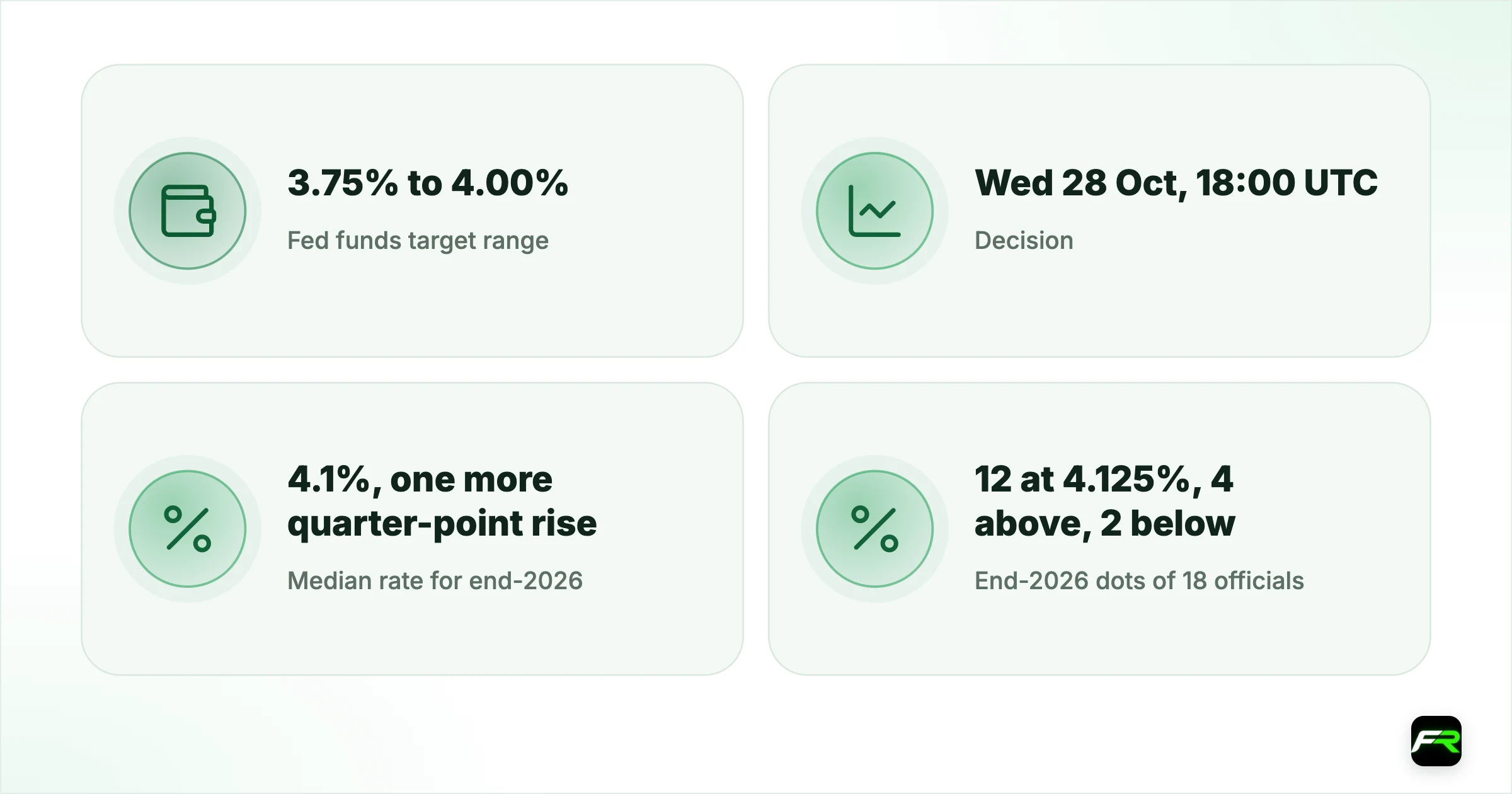
The Federal Reserve announces its next decision on Wednesday 28 October at 14:00 New York time, which is 18:00 UTC. At its last meeting, on 16 September, it raised the target range for the federal funds rate by a quarter point to 3.75% to 4.00%, with all 12 voters in favour. Projections published that day showed most officials expected to go one step further before the end of 2026, and only two meetings remain: this one and 9 December.
So the question for Wednesday is timing, not direction. A rise now would take the range to 4.00% to 4.25%, the level 12 of the 18 participants wrote down for the end of the year. A pause would leave December, which comes with fresh projections, to finish the job. Data since September give both camps something to point to: inflation has climbed further, while hiring has nearly stalled.
Markets go into the week with the dollar firmer than after the September decision. The dollar index closed Friday at 101.75, against 100.27 at the end of 16 September. Meanwhile the 2-year Treasury yield, the maturity most sensitive to Fed expectations, stood at 4.69% on Friday, slightly below the 4.74% recorded on the day of the last hike, according to the US Treasury.
| Fed funds target range | 3.75% to 4.00% (raised 16 Sep, vote 12-0) |
|---|---|
| Decision (14:00 New York) | Wed 28 Oct, 18:00 UTC |
| Median rate for end-2026 (Sep projections) | 4.1%, one more quarter-point rise |
| End-2026 dots of 18 officials | 12 at 4.125%, 4 above, 2 below |
| CPI, September (BLS) | 3.7% y/y, core 2.6% |
| PCE prices, August (BEA) | 3.4% y/y |
| Payrolls, September (BLS) | +29,000; unemployment 4.2% |
| 2-year Treasury yield, 23 Oct | 4.69% |
What the Fed said in September
The September statement was short and firm. The committee said economic activity “is expanding at a solid pace”, that domestic spending has been resilient and that job gains “have kept pace with the workforce”. On prices it was blunt: “Inflation remains elevated.” The rise in rates, it added, “will support a timelier return to the Committee's 2 percent goal”, and the statement closed with a single sentence: “The Committee will deliver price stability.”
Minutes of that meeting, published three weeks later, went further. They recorded that “most participants assessed that another increase in the target range for the federal funds rate would likely be appropriate by year end”. That same passage stressed that officials approach “each meeting with an open mind”, so neither October nor December was promised. Our story on the minutes covers the discussion in more detail.
What the dot plot shows
Each quarter, the 18 participants, Board governors and Reserve Bank presidents of whom only some vote, write down where they think the rate should be at the end of each year. In September, 12 placed it at a midpoint of 4.125%, which is the range 4.00% to 4.25% and means one more quarter-point rise. Four went higher, to 4.375%, implying two more moves. Two put it at 3.875%, the current midpoint, so they saw no further rise.
That median of 4.1% for 2026 was up from 3.8% in June, a big shift in three months. Officials also pushed rate cuts further out: the median for the end of 2027 is still 4.1%, falling only to 3.9% in 2028 and 3.6% in 2029. Their longer-run rate, the level they see as neither boosting nor slowing the economy, was 3.2%.
| Median projection, September 2026 | 2026 | 2027 | 2028 |
|---|---|---|---|
| Federal funds rate (year end) | 4.1% | 4.1% | 3.9% |
| PCE inflation | 3.7% | 2.3% | 2.1% |
| Core PCE inflation | 3.4% | 2.5% | 2.2% |
| Real GDP growth | 2.3% | 2.4% | 2.2% |
| Unemployment rate | 4.1% | 4.1% | 4.1% |
Source: Federal Reserve, Summary of Economic Projections, 16 September 2026. Growth and inflation are measured fourth quarter on fourth quarter; the rate is the year-end midpoint.
No new projections arrive this week. The Fed publishes them four times a year, and the next set comes with the 9 December decision. On Wednesday, markets will judge the committee only on its statement, the vote and the Chair's press conference, which normally begins 30 minutes after the statement.
The case for a rise on Wednesday
Inflation has moved the wrong way since September. The US Bureau of Labor Statistics reported that consumer prices rose 0.6% in September and 3.7% over the year, up from 3.4% in August, as our CPI story explained. Gasoline was the main driver, up 34.2% from a year earlier. Producer prices jumped 1.3% in the month and 6.3% over the year, which points to more cost pressure in the pipeline.
Spending is holding up as well. Retail sales rose 0.8% in September according to the Census Bureau, after an upwardly revised 1.3% in August. Officials who wrote 4.375% for year end may see little reason to wait, and a promise to “deliver price stability” is hard to square with standing still while inflation climbs.
Moving now would also keep December free. If the committee raises on Wednesday, it can pause in December with new projections in hand, which gives it room to react to the GDP, PCE and jobs figures due in between.
The case for waiting until December
Hiring is the main argument for patience. Payrolls rose only 29,000 in September, the BLS said, well short of the 90,000 forecast, and revisions cut July and August by a combined 60,000. Unemployment edged up to 4.2%, already above the 4.1% the Fed projected for the end of the year, and average hourly earnings rose just 0.1% in the month.
Underlying inflation is also calmer than the headline. Core CPI, which leaves out food and energy, was 2.6% over the year in September, far below the 3.7% headline. That gap supports the view that energy, not broad demand, is doing most of the damage, and higher interest rates do little to bring down petrol prices.
Bond markets have done some tightening too. According to the US Treasury, the 10-year yield closed at 5.31% on 5 October, its highest close this year, before easing to 5.00% on Friday. Higher borrowing costs for mortgages and companies slow the economy without a Fed move, and some officials may prefer to see how that plays out before adding another rise.
Three ways Wednesday could go
These are our own scenarios, not forecasts from the Fed, and the reactions described are typical patterns rather than predictions.
- Hike to 4.00% to 4.25%, with a steady tone. This would deliver the median projection one meeting early. The dollar could firm at first, but if the statement hints that this may be the last step, the move might fade by the end of the press conference.
- Hold, with a clear signal for December. If the statement keeps the language about elevated inflation and the Chair points to December, the dollar may dip briefly and recover. Watch for dissents: officials voting for an immediate rise would be a strong hint.
- Hold, with softer language. Leaning on the weak jobs data and dropping the line about delivering price stability would make traders doubt a December rise too. That outcome would likely weigh most on the dollar against the yen and the euro.
Thursday adds a second test. At 08:30 New York time (12:30 UTC), the Bureau of Economic Analysis publishes its first estimate of third-quarter GDP and the September PCE price index, the inflation gauge the Fed targets. PCE prices were up 3.4% in the year to August. A strong pair of numbers the morning after a pause would revive talk of December; a weak pair after a hike could leave markets asking whether the Fed went too far.
What it means for traders
This decision lands in a week with four other central banks, so the dollar can be pushed around from several directions at once. Our week-ahead guide lists every event with its time, and our Bank of Japan preview covers Friday's yen risk.
- Mind the clock. UK and EU clocks went back on Sunday 25 October, while US clocks change on 1 November, so 14:00 in New York is 18:00 in London this week, not 19:00.
- Read the vote and any dissents as closely as the rate. A split after September's 12-0 tells you how divided the committee has become.
- Expect two waves: one at 18:00 UTC with the statement and another from about 18:30 UTC when the press conference starts. Initial moves often reverse during the questions.
- Keep positions small into Thursday's 12:30 UTC data, which comes 45 minutes before the ECB decision.
- Place stops beyond the day's range rather than just next to the price, because spreads widen sharply in the seconds after 18:00 UTC.
Say you plan to buy USD/JPY at 156.80 after the statement, with a stop at 156.00, 80 pips away. One pip on 10,000 units of USD/JPY is 100 yen, about $0.64 at that price, so 80 pips cost about $51 per 10,000 units. On a $5,000 account with a 1% limit of $50, a size of about 9,500 units keeps the loss near $49. If the spread widens to 3 pips in the first minute, wait for it to settle before you enter.
Levels for the main dollar pairs are in our daily EUR/USD analysis and USD/JPY analysis, which carry Friday's close over the weekend. Use the position size calculator to set your size before the announcement.
Rate decisions can move currencies by large amounts within seconds, and prices can gap between quotes. Leverage magnifies losses as well as gains, so trade only with money you can afford to lose.
The rate, vote and statement wording come from the Federal Reserve's 16 September 2026 statement, the projections from its Summary of Economic Projections and the quote on another increase from the minutes of that meeting. Consumer prices, producer prices and jobs data are from the Bureau of Labor Statistics, retail sales from the Census Bureau and PCE prices from the Bureau of Economic Analysis. Yields are the US Treasury's daily par rates. Dollar index levels are market data built from hourly bars and differ slightly between providers. Scenarios are FX Recap's reading, not a forecast. This is news, not investment advice.
Frequently asked
When is the Fed decision in October 2026?
The Federal Open Market Committee meets on 27 and 28 October and publishes its statement on Wednesday 28 October at 14:00 New York time, which is 18:00 UTC. The press conference normally starts 30 minutes later.
What rate do Fed officials expect by the end of 2026?
In the September projections, the median official saw the federal funds rate at 4.1% at the end of 2026, a range of 4.00% to 4.25%. That is one quarter-point rise above the current 3.75% to 4.00%.
Will the Fed publish new projections on 28 October?
No. The Summary of Economic Projections comes four times a year, and the next one is due with the decision on 9 December 2026.
What data come right after the Fed decision?
On Thursday 29 October at 12:30 UTC, the Bureau of Economic Analysis publishes the advance estimate of third-quarter GDP and the September PCE price index. PCE prices rose 3.4% in the year to August.
Sources: Federal Reserve: FOMC statement, 16 September 2026 · Federal Reserve: Summary of Economic Projections, September 2026 · Federal Reserve: minutes of the FOMC meeting, 15-16 September 2026 · Federal Reserve: FOMC meeting calendar · US Bureau of Economic Analysis: PCE price index · US Treasury: daily par yield curve rates
The team behind this guide
Researched, checked and approved by five forex specialists
Every guide is written, fact-checked and edited before it goes live, and updated when the facts change. Spotted an error? Tell us.