IC Markets





























Bank of Korea Holds Its Rate at 3.00% but Keeps Further Rises on the Table
All seven board members voted to wait after two hikes, yet the bank flagged faster growth and stubborn inflation, while the won sits near a two-week high.
 WriterAbir KhanWriterWrites the guides · checks every figure against primary sources View profileAbout Abir →

 Market analysisTanbir Habib RiyadForex & Crypto AnalystForex and crypto analyst · technical and fundamental analysis View profileAbout Tanbir →

 Fact-checking & riskJannatul FerdaushFact-Checker & Risk AnalystFact-checks every figure · risk analysis · Applied Statistics, University of Dhaka View profileAbout Jannatul →

 Trading reviewJowel RanaCo-Founder & Forex TraderCo-founder · forex trader · reviews guides from a trader's view View profileAbout Jowel →

 Final approvalRanjan NiskrityFounder, Owner & Forex TraderFounder and owner · forex trader · signs off every guide View profileAbout Ranjan →

The Bank of Korea left its Base Rate unchanged at 3.00% on Thursday 22 October, with all seven members of its Monetary Policy Board voting for the hold. It said it wanted time to judge the effects of its two earlier rate rises and the risks from the Middle East conflict and from policy in major economies. Its statement ended with a clear signal: the board will decide the timing and pace of further increases in the Base Rate as it watches inflation, growth and financial stability.
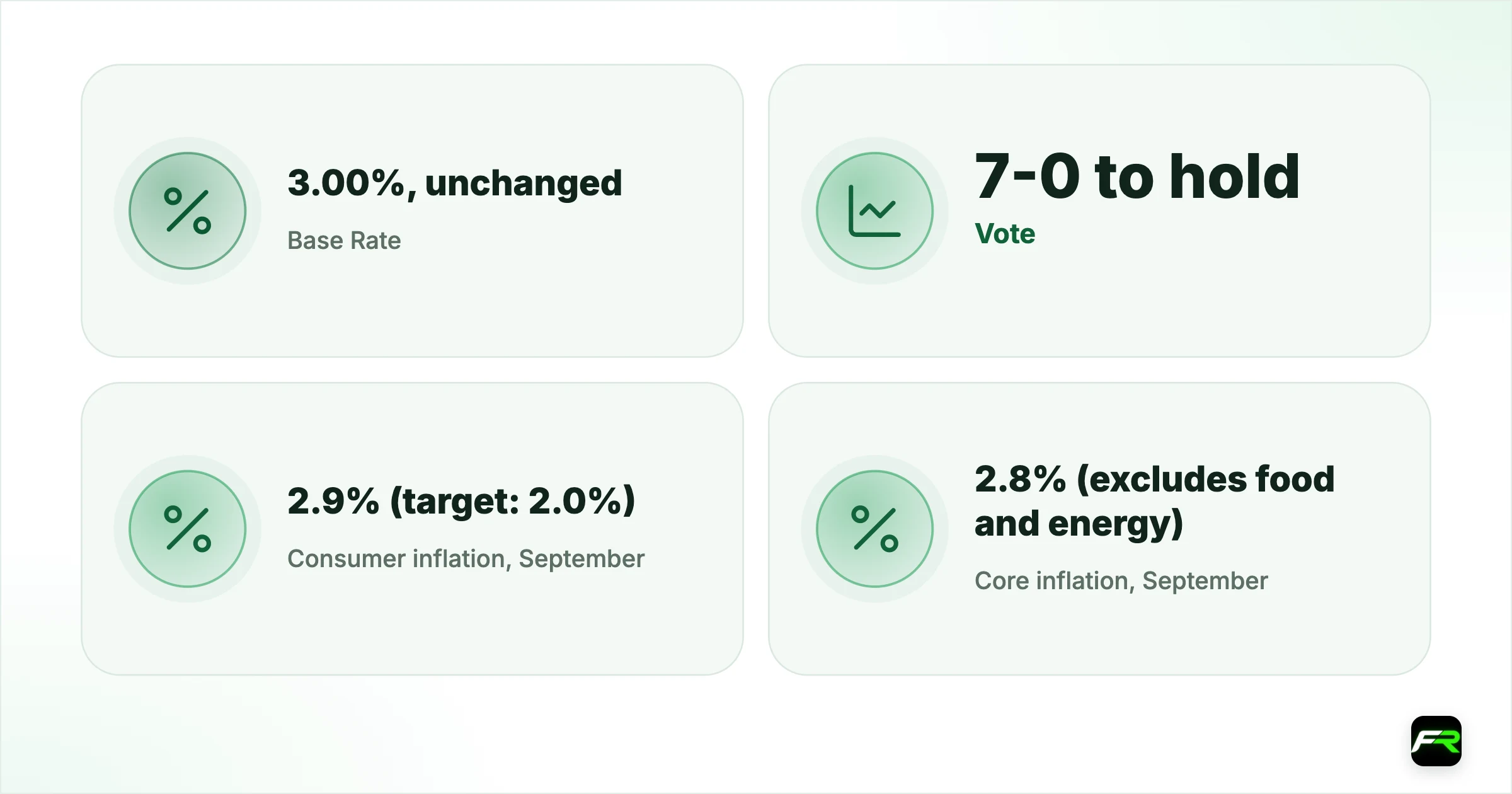
The economic case for more tightening is strong in the bank's own words. Growth has run faster than expected on exports and investment, and the board now expects growth this year and next to be considerably higher than its August forecasts of 3.3% and 2.9%. Consumer inflation was 2.9% in September and core inflation 2.8%, both above the 2.0% target, and the bank expects prices to stay above target for a considerable time.
The won held its ground. USD/KRW traded near 1,325.7 at 01:00 UTC, early in the Seoul trading day, and drifted lower to about 1,322.8 by 03:20 UTC. That leaves the dollar down from 1,340.5 at the close on 15 October and from an intraday high of about 1,347.7 on 16 October, so the won is near its strongest level in two weeks.
| Base Rate | 3.00%, unchanged |
|---|---|
| Vote | 7-0 to hold |
| Consumer inflation, September | 2.9% (target: 2.0%) |
| Core inflation, September | 2.8% (excludes food and energy) |
| Growth forecast, August | 3.3% for 2026, 2.9% for 2027 (now seen considerably higher) |
| Inflation forecast, August | 2.7% for 2026, 2.3% for 2027 (2027 now seen higher) |
| USD/KRW, 03:20 UTC | about 1,322.8 (15 Oct close: 1,340.5) |
| Next decision | 26 November 2026 |
What the Bank of Korea decided
The board described an economy that is doing better than it expected. Exports and investment led growth, the number of people in work rose moderately, mostly in services, and consumption is likely to recover gradually as incomes improve. A strong semiconductor sector should keep exports and investment growing at a high pace, the statement said.
Inflation is the bank's main worry. Consumer prices and core prices both rose in the upper 2% range in September, and short-term inflation expectations among the public stayed there too. The board expects this year's inflation to be broadly in line with its August forecasts of 2.7% for headline and 2.5% for core. For next year it now expects both to exceed the earlier forecasts of 2.3% and 2.5%, as past cost increases pass through and demand strengthens.
Financial stability is the third strand. Household loans fell in total as other loans were repaid, but housing-related lending kept rising, and the board said house prices in Seoul and the surrounding area had started to rise faster again. It named the housing market there and household debt as financial imbalance risks it needs to keep watching, a reason central banks often give for keeping rates higher.
Why the board chose to wait
The board gave two reasons for holding. First, there is uncertainty abroad: tensions in the Middle East, higher energy prices and shifts in monetary and fiscal policy in major economies, including the United States. Second, the effects of the two earlier hikes are still working through the economy, and the board wants to see more of them before acting again.
The statement also described a rough period in global markets. Long-term government bond yields rose significantly, it said, because of higher inflation, expectations of rate hikes in major economies, worries about fiscal soundness and the supply of AI-related corporate bonds. The US dollar strengthened, and stock prices became more volatile on concerns about a slowdown in AI investment, even as company earnings kept growing.
At home, Korean government bond yields rose considerably on the Middle East tensions and higher oil prices, though much of that rise later reversed. Korean share prices fell sharply on concerns about slowing profitability in the chip sector. Those swings help explain why the board preferred to pause, rather than add another shock while markets were already volatile.
| Measure | Latest | Bank of Korea view |
|---|---|---|
| Base Rate | 3.00% | Further rises to be decided |
| Consumer inflation, September | 2.9% | Above target for a considerable time |
| Core inflation, September | 2.8% | 2027 forecast to be raised |
| Growth forecast for 2026, August | 3.3% | Considerably higher |
| Growth forecast for 2027, August | 2.9% | Considerably higher |
| Inflation target | 2.0% | Medium-term goal |
Source: Bank of Korea, Monetary Policy Decision, 22 October 2026, and the Bank of Korea website.
What it means for the won
The won has firmed through October. In its statement the bank noted that, even with the dollar firm, the won-dollar exchange rate fell significantly, meaning fewer won per dollar, because supply and demand in the currency market improved with a large current account surplus. A central bank that is still talking about rate rises adds to that support.
A hold rather than a hike can take a little shine off the currency in the short run, and the won did not jump on the news. Over the coming weeks, the more important signals are the inflation data and the bank's updated forecasts, which the statement said will be higher for growth. If the board raises rates again on 26 November, the gap between Korean and US policy rates would narrow further, since the Fed's target range is 3.75% to 4.00%.
Elsewhere in Asia, Bank Indonesia also left its main rate alone this week. Its board kept the BI-Rate at 5.75% at its 20-21 October meeting and held the lending facility at 6.50%, while raising the deposit facility rate to 5.00%, according to the central bank's press release. Both banks are holding the line on the headline rate while keeping their options open.
What traders can take from it
Few retail traders deal in the won directly, so most follow it through USD/KRW quotes, related Asian pairs or the broader dollar. These points can help.
- Read the last paragraph of the statement first. The phrase about the timing and pace of further increases tells you the bias is still toward higher rates.
- Watch chip news. The bank ties both growth and share prices to semiconductors, so big moves in the sector can feed into the won.
- Follow US yields. With long Treasury yields near their highs, any further rise tends to lift the dollar against Asian currencies.
- Expect wider spreads. Brokers that offer USD/KRW often quote it with much wider spreads than major pairs, so check the cost before you trade.
- Mark 26 November. That is the next Bank of Korea decision, and it comes with new forecasts that the board has already said will change.
Say a trader expects the won to keep firming and sells USD/KRW at 1,323 with a stop at 1,330, seven won higher. On a position of $50,000, each won move is worth 50,000 won, about $38 at this rate, so the stop risks about $265 plus the spread. For a $10,000 account with a 1% limit of $100, that position is too big; about $18,000 keeps the risk near the limit. Check the broker's contract size and spread first, because they vary widely for this pair.
For the dollar side, see our USD/JPY analysis, since the yen and the won often react to the same Asian themes. Every central bank date is on the economic calendar, and you can convert won amounts with the currency converter. Size each trade with the position size calculator.
Emerging Asian currencies can gap sharply on policy news and are often traded with wide spreads and limited liquidity outside local hours. Leverage magnifies losses as well as gains, so trade only with money you can afford to lose.
All policy details and figures are from the Bank of Korea's Monetary Policy Decision of 22 October 2026, its website (inflation target) and its meeting dates page. The Bank Indonesia decision is from its press release summary of 21 October 2026. Fed figures are from the Federal Reserve. Currency levels are market data built from 5-minute and hourly bars to about 03:20 UTC on 22 October and differ slightly between providers. Comments on the won are FX Recap's own reading. This is news, not investment advice.
Frequently asked
What is the Bank of Korea interest rate in October 2026?
The Bank of Korea kept its Base Rate at 3.00% on 22 October 2026. All seven members of the Monetary Policy Board voted to hold. The bank said it will decide the timing and pace of further increases based on inflation, growth and financial stability.
Why did the Bank of Korea hold rates?
The board wanted to assess the effects of its two earlier rate rises and the risks from the Middle East conflict and from monetary and fiscal policy in major economies. Growth is strong and inflation is above target, so it kept the door open to more increases.
What is Korea's inflation rate?
Korean consumer inflation was 2.9% in September 2026 and core inflation, which excludes food and energy, was 2.8%, according to the Bank of Korea. Its inflation target is 2.0%, and it expects prices to stay above target for a considerable time.
When is the next Bank of Korea decision?
The Bank of Korea's next monetary policy meeting is on 26 November 2026, according to its published meeting dates. It is the last scheduled decision of 2026.
Sources: Bank of Korea: Monetary Policy Decision, 22 October 2026 · Bank of Korea: Monetary Policy Board meeting dates · Bank Indonesia: Press releases · Federal Reserve: FOMC meeting calendar
The team behind this guide
Researched, checked and approved by five forex specialists
Every guide is written, fact-checked and edited before it goes live, and updated when the facts change. Spotted an error? Tell us.