IC Markets





























Best Forex Brokers in India
In India the legal way to trade currencies is through a SEBI-registered broker on NSE or BSE. Offshore forex platforms sit outside that system, and the RBI keeps adding them to its Alert List.
 WriterAbir KhanWriterWrites the guides · checks every figure against primary sources View profileAbout Abir →
 Market analysisTanbir Habib RiyadForex & Crypto AnalystForex and crypto analyst · technical and fundamental analysis View profileAbout Tanbir →
 Fact-checking & riskJannatul FerdaushFact-Checker & Risk AnalystFact-checks every figure · risk analysis · Applied Statistics, University of Dhaka View profileAbout Jannatul →
 Trading reviewJowel RanaCo-Founder & Forex TraderCo-founder · forex trader · reviews guides from a trader's view View profileAbout Jowel →
 Final approvalRanjan NiskrityFounder, Owner & Forex TraderFounder and owner · forex trader · signs off every guide View profileAbout Ranjan →
India has one of the largest trading populations in the world and one of the clearest rules on forex. Residents can trade currency pairs, but only as exchange-traded derivatives through a broker registered with SEBI. Leveraged trading on overseas platforms, the kind advertised on YouTube and Telegram, is not a permitted use of the Liberalised Remittance Scheme, and the Reserve Bank of India names those platforms on a public Alert List.
That shapes everything below. The brokers worth your time for currency trading in India are Indian brokers, and the useful questions are about contract sizes, margin, costs and tax rather than which offshore firm offers the most leverage.
Is forex trading legal in India?
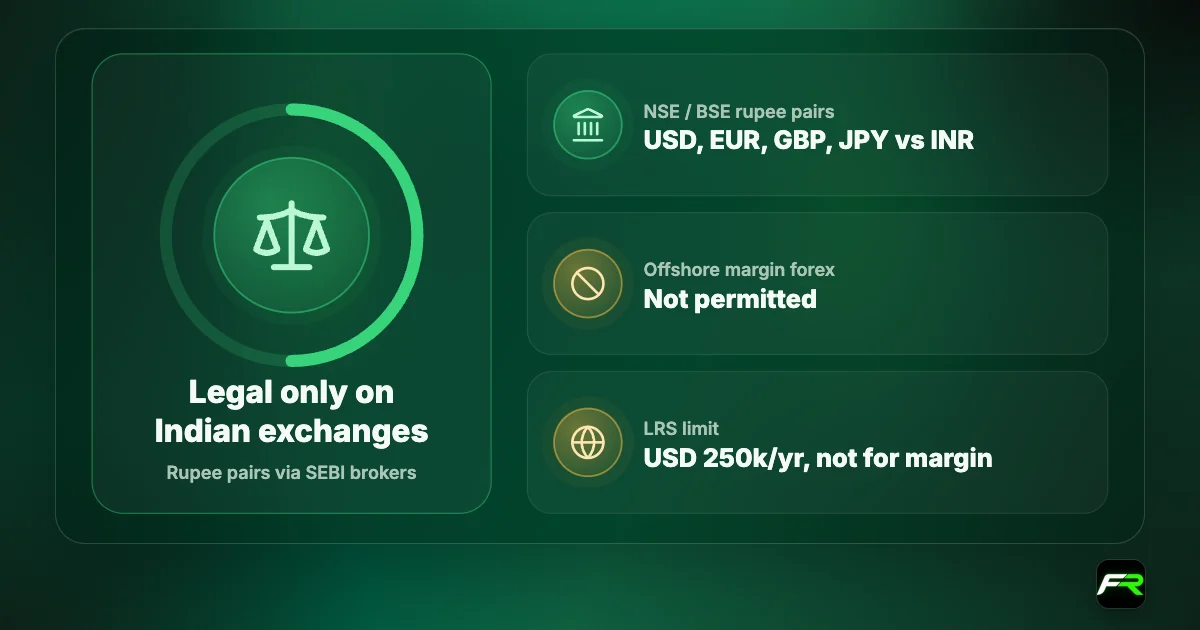
Yes, within limits. The Foreign Exchange Management Act, 1999 (FEMA) and RBI rules allow residents to trade currency futures and options on recognised Indian exchanges, NSE and BSE, through SEBI-registered brokers. Permitted contracts cover the four rupee pairs, USD/INR, EUR/INR, GBP/INR and JPY/INR, plus three cross pairs, EUR/USD, GBP/USD and USD/JPY.
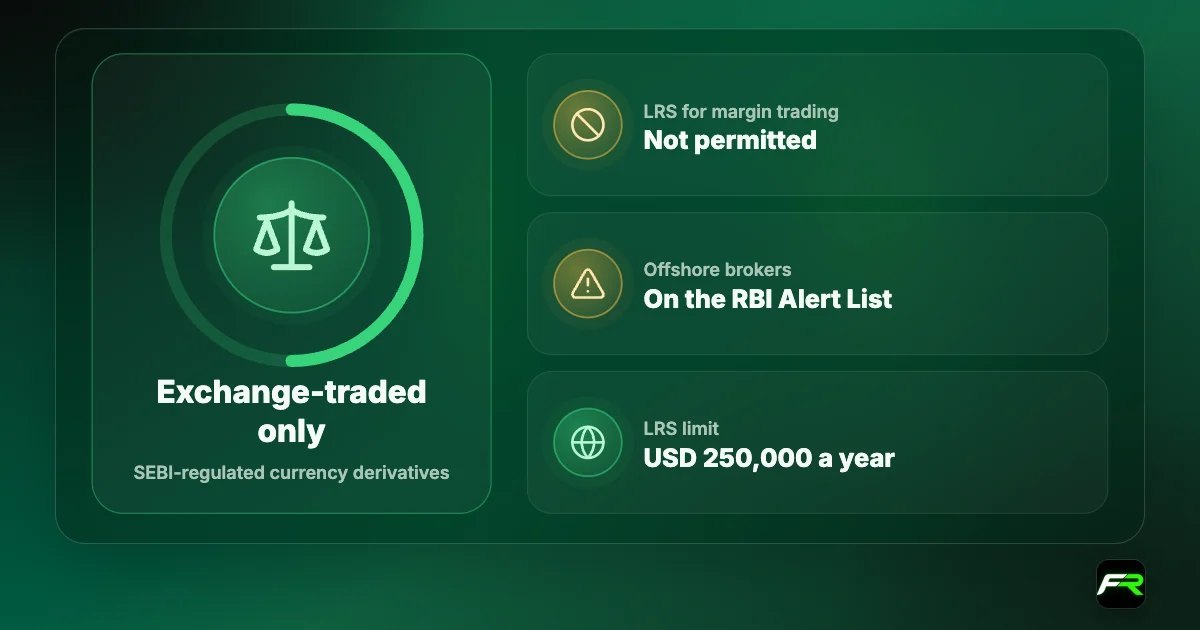
What is not permitted is sending money abroad to trade margin forex or CFDs with an overseas broker. The LRS lets a resident remit up to USD 250,000 a financial year for approved purposes, and margin trading is not one of them. Its Alert List names platforms that are neither authorised to deal in forex under FEMA nor to run an electronic trading platform for Indian residents; in November 2025 it added seven more, including Fusion Markets, Trive and NordFX. Penalties under FEMA can reach three times the sum involved.
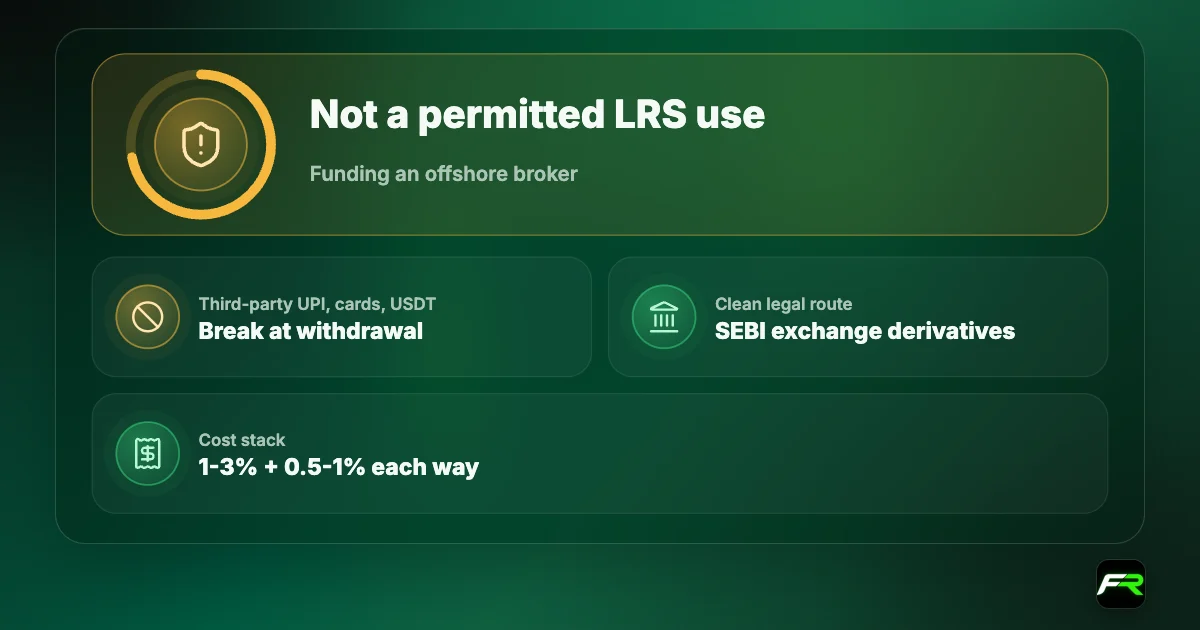
Enforcement against individual traders has been light, but it is not zero, and the Alert List keeps growing. A deposit sent through a third-party UPI handle or a USDT seller has no protection if the platform stops paying out.
The legal route: SEBI-registered brokers
Most large Indian brokers offer currency derivatives alongside equities. Zerodha, Upstox, Angel One, ICICI Direct and HDFC Securities all give access to NSE currency futures and options through the same account you would use for shares. Check the SEBI registration number on the SEBI website and make sure the currency segment is activated on your account, since it is often switched off by default.
| What you trade | How it works | Worth knowing |
|---|---|---|
| USD/INR futures | One lot is USD 1,000; exchange-set margin | The most liquid contract and the usual starting point |
| EUR/INR, GBP/INR, JPY/INR | Rupee pairs, cash-settled in INR | Thinner than USD/INR, so check the spread before trading size |
| EUR/USD, GBP/USD, USD/JPY | Cross-currency futures and options | The only way to trade these majors legally from India |
| Currency options | Premium paid upfront, cash-settled | Your maximum loss as a buyer is the premium |
Costs are low by global standards. Discount brokers charge a flat fee per order, and the exchange, SEBI and stamp-duty charges add a few rupees per lot. There is no overnight swap, because a futures price already builds in the interest-rate gap between the two currencies.
How to pick a broker for currency trading
- SEBI registration you can verify on sebi.gov.in, with the currency derivatives segment enabled.
- Margin you can see before you trade. A good platform shows the exact SPAN plus exposure margin on the order screen.
- A usable options chain and charts for USD/INR, since that is where most of the volume sits.
- Clear brokerage and a fair call-and-trade fee, which matters if you ever need to exit by phone.
- Support that answers in your hours. Currency markets open at 9:00 am, before many support desks.
Deposits and withdrawals
Funding an Indian broker is simple: UPI, net banking or NEFT from a bank account in your own name, usually credited within minutes, and withdrawals back to the same account the next working day. No currency conversion happens, because everything is settled in rupees. That alone removes the biggest hidden cost of offshore trading, where every deposit and withdrawal loses 1 to 3 per cent to conversion and middlemen.
If anyone asks you to send money to a personal UPI ID or buy USDT so you can "fund your trading account", you are dealing with an offshore platform or a scam, not a SEBI broker.
Leverage and margin
Exchange margins for USD/INR futures typically work out to a low single-digit percentage of contract value, far below the 1:500 or 1:1000 offered by offshore platforms. That is by design. The rupee moves less than most pairs, so even modest leverage produces real swings in a small account. Size each position so that a normal day's move against you costs no more than 1 to 2 per cent of your capital.
Tax on currency trading in India
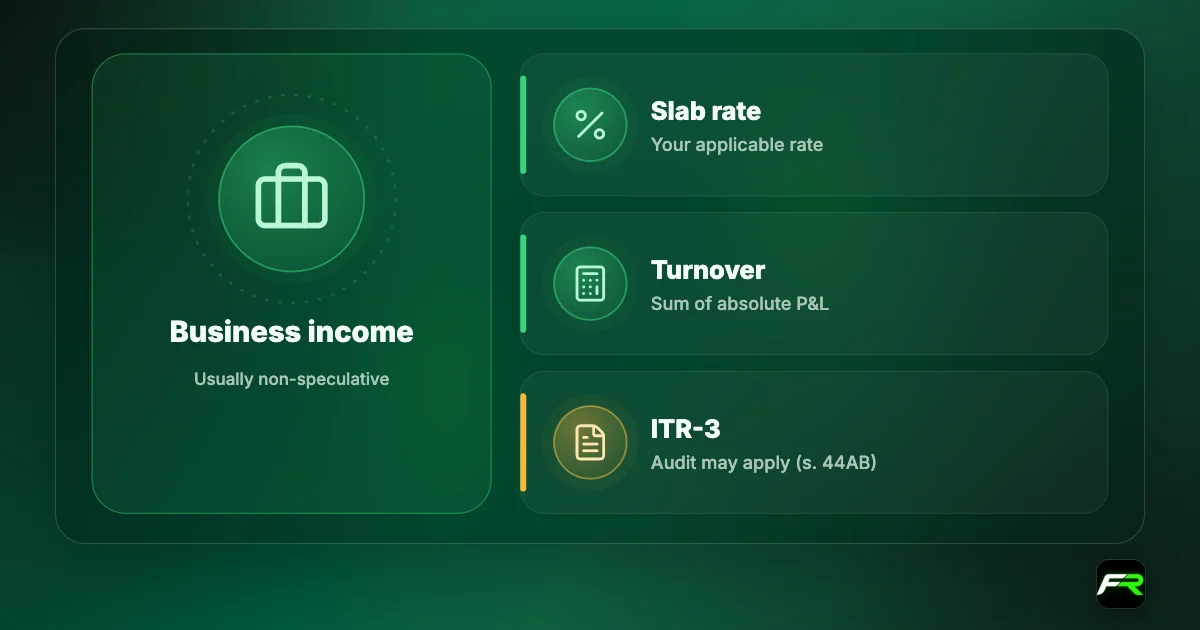
Profit from currency derivatives is normally treated as non-speculative business income and taxed at your slab rate, reported on ITR-3. Turnover for audit purposes is the sum of absolute profits and losses, not the contract value, so a tax audit under section 44AB is only triggered at higher activity levels. Losses can be set off against other non-speculative business income and carried forward for eight years if you file on time.
Gains made on an offshore platform are still taxable in India, and nothing is withheld or reported for you, so the burden of proof sits entirely with your own records. That is one more reason the exchange route is cleaner.
This is general information, not tax advice. A chartered accountant can confirm how your trading should be classified.
Best times to trade currencies from India
NSE currency derivatives trade from 9:00 am to 5:00 pm IST, with cross-currency contracts running into the evening. USD/INR is most active in the first hour and around RBI announcements and US data releases, which land in the Indian evening. Most Indian traders with a day job focus on the late-afternoon overlap with the London open, around 1:30 pm to 3:30 pm IST.
Scams aimed at Indian traders
- "Forex signal" groups on Telegram that push you to an offshore platform through an affiliate link.
- Apps promising fixed daily returns, many of which appear later on the RBI Alert List.
- Requests to fund through someone else's UPI handle or bank account.
- "Recovery agents" who contact you after a loss and ask for a fee upfront.
Before sending money anywhere, search the platform's name on the RBI Alert List and look for a SEBI registration number. If it has the first and lacks the second, stop.
Is Exness, XM or IC Markets legal in India?
This is the question Indian traders search most, and the RBI answers it directly. Its Alert List of entities not authorised to deal in forex or run a forex trading platform for Indians includes many of the best-known international names, among them Exness, XM, IC Markets, FXTM, HotForex (HFM) and OctaFX, alongside binary-option apps such as Binomo, IQ Option, Olymp Trade, Pocket Option and Quotex. The list is not exhaustive, so a platform missing from it is not thereby authorised.
Exness went further on its own: on 11 July 2025 it stopped accepting new sign-ups from India and removed its app from the Indian Play Store and App Store. Existing clients were reported to keep access, but the direction is clear. A brand being famous, or having a licence abroad, does not make it legal for an Indian resident to fund.
Binary options and "prediction" apps
Apps that ask you to guess whether a price will be higher or lower in 60 seconds are binary options, not forex, and several sit on the RBI Alert List. They are heavily advertised to Indian beginners through influencers. The payout structure means the platform wins over time even if you guess right a little more than half the time, and withdrawals are the most common complaint.
Currency trading apps you can use legally
| Broker | App | Currency segment |
|---|---|---|
| Zerodha | Kite | NSE and BSE currency futures and options |
| Upstox | Upstox Pro | NSE currency derivatives |
| Angel One | Angel One app | NSE currency derivatives |
| ICICI Direct | ICICI Direct Markets | NSE and BSE currency derivatives |
| HDFC Securities | HDFC Sky / InvestRight | NSE currency derivatives |
In every case the currency segment must be activated separately, usually with an income proof or a declaration, before you can place an order.
Indian traders often assume the exchange route is the boring option. In practice it is the one where your money comes back to your bank account the next day, your profits are easy to explain to the tax office, and nobody can freeze your balance from another jurisdiction. That is worth more than an extra zero on the leverage.
Arjun started on an offshore app a friend recommended, funding it through a third-party UPI ID. His first withdrawal of ₹18,000 took three weeks and arrived from an unknown account, which his bank flagged. He moved to a SEBI broker, activated the currency segment and traded one USD/INR lot at a time. His gains are smaller, but each withdrawal lands the next morning and his accountant files them as business income without questions.
| Legal route | Exchange-traded currency derivatives on NSE or BSE |
|---|---|
| Regulators | SEBI (brokers), RBI (foreign exchange) |
| Permitted pairs | USD/INR, EUR/INR, GBP/INR, JPY/INR, EUR/USD, GBP/USD, USD/JPY |
| Offshore margin forex | Not a permitted LRS use; RBI Alert List |
| Tax | Usually non-speculative business income at slab rates |
| Market hours | 9:00 am to 5:00 pm IST |
Comparing rules across South Asia? See how Pakistan, Bangladesh and Sri Lanka treat retail forex.
Frequently asked
Is forex trading legal in India in 2026?
Yes, through SEBI-registered brokers on NSE or BSE in the seven permitted currency pairs. Trading margin forex or CFDs with an overseas platform is not a permitted use of LRS, and the RBI names such platforms on its Alert List.
Which broker is best for forex trading in India?
Any SEBI-registered broker with the currency derivatives segment enabled, a clear margin display and low brokerage. Zerodha, Upstox, Angel One, ICICI Direct and HDFC Securities all offer NSE currency futures and options.
Can I trade EUR/USD from India?
Yes, as an exchange-traded cross-currency future or option on NSE or BSE. Trading EUR/USD as a CFD with an offshore broker is not permitted for residents.
What is the RBI Alert List?
A public list of entities that are neither authorised to deal in forex under FEMA nor to run an electronic forex trading platform in India. The RBI updates it regularly; seven names were added in November 2025.
How is currency trading taxed in India?
Usually as non-speculative business income at your slab rate, filed on ITR-3. Losses can be set off against other business income and carried forward for up to eight years if you file on time.
What happens if I already have money with an offshore broker?
Withdraw it to the same method you used to deposit, keep every statement for your tax return, and do not add more. If withdrawals are blocked or you are asked to pay a fee first, treat the platform as a scam and report it to the cyber crime portal.
Is Exness legal in India?
No. Exness is on the RBI Alert List of entities not authorised to deal in forex for Indian residents, and on 11 July 2025 it stopped accepting new sign-ups from India and removed its app from Indian app stores.
Are Olymp Trade, Binomo and IQ Option legal in India?
No. All three are on the RBI Alert List. They are binary options platforms, where you bet on price direction over short periods, and are not permitted for Indian residents.
Which app is legal for forex trading in India?
The trading apps of SEBI-registered brokers with the currency segment enabled, such as Zerodha's Kite, Upstox, Angel One and ICICI Direct, used to trade exchange-listed currency futures and options.
The team behind this guide
Researched, checked and approved by five forex specialists
Every guide is written, fact-checked and edited before it goes live, and updated when the facts change. Spotted an error? Tell us.