 IC Markets




































What Is a Prop Firm? A Plain Explanation
A retail prop firm sells you a trading test, then pays you a share of the profit you make on an account it controls. Here is how the model works, in plain terms.
 WriterAbir KhanWriterWrites the guides · checks every figure against primary sources View profileAbout Abir →
 Market analysisTanbir Habib RiyadForex & Crypto AnalystForex and crypto analyst · technical and fundamental analysis View profileAbout Tanbir →
 Fact-checking & riskJannatul FerdaushFact-Checker & Risk AnalystFact-checks every figure · risk analysis · Applied Statistics, University of Dhaka View profileAbout Jannatul →
 Trading reviewJowel RanaCo-Founder & Forex TraderCo-founder · forex trader · reviews guides from a trader's view View profileAbout Jowel →
 Final approvalRanjan NiskrityFounder, Owner & Forex TraderFounder and owner · forex trader · signs off every guide View profileAbout Ranjan →
“Prop firm” is short for proprietary trading firm. The original meaning is a company that trades its own money for its own profit, with staff traders on a salary and bonus. That still exists, but when most retail traders say “prop firm” today they mean something different: an online business that sells you a trading challenge and, if you pass, lets you trade an account it controls and pays you a share of the profit.
The two models share a name and very little else, so it helps to keep them apart.
The retail prop model in four steps
- You buy a challenge. You pay a fee for an evaluation account of a stated size, such as $10,000 or $100,000.
- You trade to a set of rules. Hit a profit target without breaking a daily loss limit or a maximum loss limit, often over a minimum number of trading days.
- You get a funded account. Pass, and the firm gives you an account to trade under similar rules, with no further target to reach.
- You are paid a share of the profit. Usually 80 to 90 per cent of what you make, paid on a schedule, after which the account carries on.
FTMO, which has operated since 2015 and is the firm most others are measured against, is a good reference point. Its 2-Step Challenge asks for a 10 per cent profit target, then a 5 per cent target in a second phase, with a 5 per cent daily loss limit, a 10 per cent maximum loss and at least four trading days. Its rules are covered in detail in our FTMO review.
Whose money are you trading?
This is the question that matters most, and the honest answer is: usually nobody’s. Most retail prop firms run evaluation and funded accounts on demo, or simulated, accounts. FTMO says so plainly: the accounts it provides are demo accounts with fictitious funds, and the reward it pays is a share of simulated profit.
That does not make the payouts fake. Established firms do pay real money to traders who meet their rules. It does mean the firm decides what it will pay, under its own terms, and you have no claim on a pool of capital the way an employed trader at a bank does. Our guide to whether a funded account is real money goes into the detail.
How the firm makes money
Fees from challenges are the main income for most retail firms, because most people who buy a challenge do not pass it. Topstep, one of the few firms to publish figures, reports that only 16.8 per cent of its evaluations were passed in 2025, and that 33.3 per cent of traders who reached a funded account received a payout. Fee income from the many pays the profit share of the few.
Some firms also copy the trades of their strongest funded traders onto real accounts and earn from that. Either way, the firm’s business only works if it collects more in fees and trading income than it pays out. How prop firms make money explains why that matters to you.
Prop firm vs a regular broker account
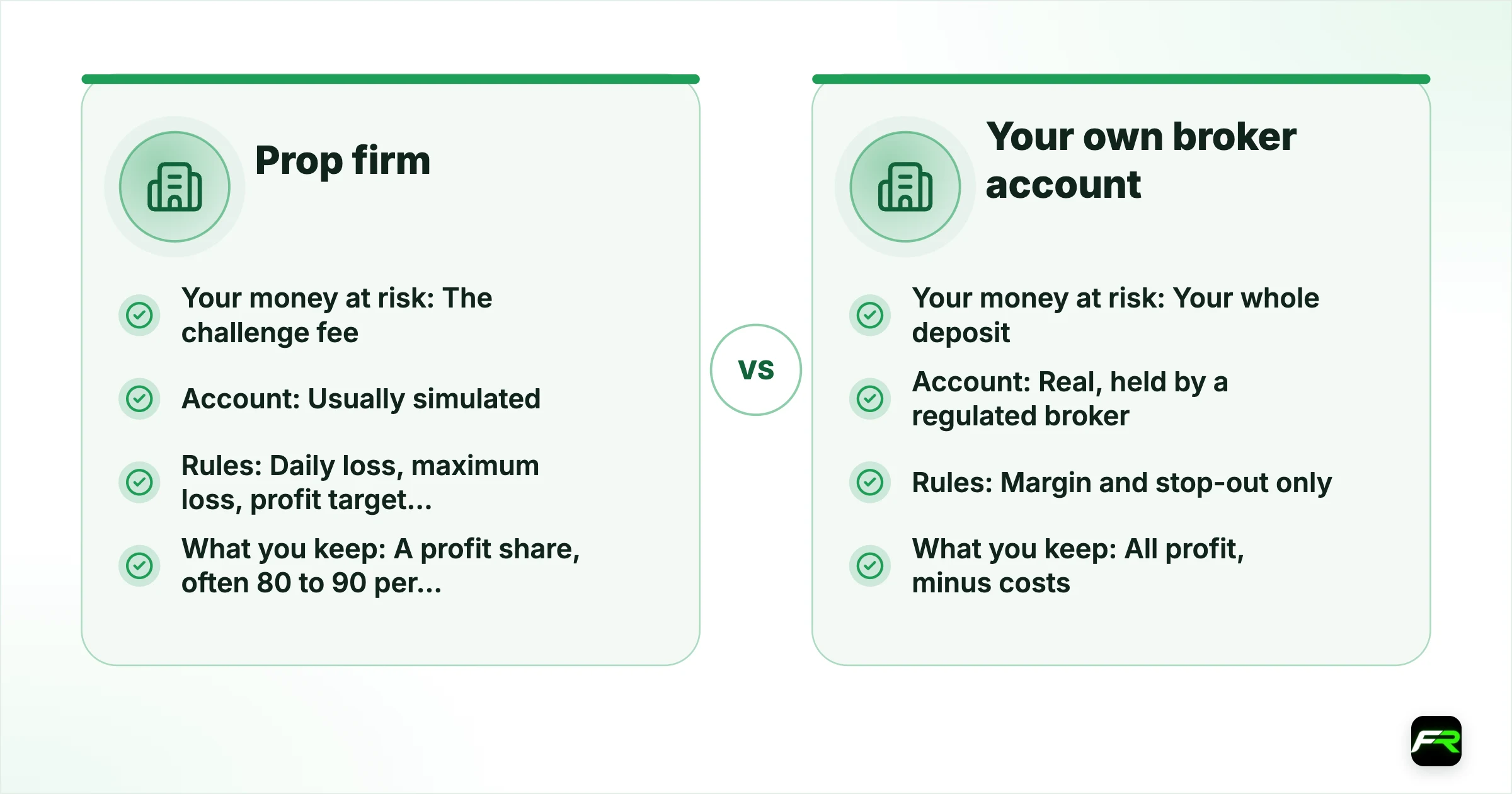
| Prop firm (retail) | Your own broker account | |
|---|---|---|
| Your money at risk | The challenge fee | Your whole deposit |
| Account | Usually simulated | Real, held by a regulated broker |
| Rules | Daily loss, maximum loss, profit target, sometimes consistency and news rules | Margin and stop-out only |
| What you keep | A profit share, often 80 to 90 per cent | All profit, minus costs |
| Regulation | Rarely regulated as a trading firm | Licensed by a financial regulator |
| If the firm closes | Unpaid profit can be lost | Client money is segregated; some countries have compensation schemes |
The appeal is leverage on your skill without risking a large deposit. The cost is a set of rules that are stricter than any broker’s, and a counterparty with much less oversight. We compare the two routes in is prop trading worth it.
Who prop trading suits
- Traders with a tested method and a record of keeping losses small, who lack the capital to make that method pay.
- Traders who are comfortable with hard limits, because one bad day can end an account.
- Not beginners. A challenge is a test of discipline under rules, not a way to learn trading. A demo account is free and teaches the same market.
Prop firms are mostly unregulated. Before you pay any fee, check how long the firm has operated, whether it publishes its rules in full, and whether traders report being paid. Our red flags guide lists the warning signs.
Think of a challenge fee as the price of a test, not an investment. If you would not be comfortable losing it, you are not ready to buy it.
Frequently asked
What is a prop firm in simple terms?
A retail prop firm sells you a trading challenge. If you hit its profit target without breaking its loss limits, it gives you a funded account and pays you a share, often 80 to 90 per cent, of the profit you make on it. The account is usually simulated, and the firm pays the share from its own revenue.
Do prop firms give you real money to trade?
Most retail prop firms do not. Evaluation and funded accounts are usually demo accounts; FTMO, for example, says its accounts use fictitious funds. Established firms do pay real money as a share of the simulated profit, under their own terms.
How much does a prop firm challenge cost?
It depends on the firm and the account size. FTMO lists €540 for a $100,000 2-Step Challenge, refunded with your first reward. Smaller accounts cost less. Fees are the firm's main income, because most challenges are not passed.
Is a prop firm a good way to start trading?
No. A challenge tests discipline under strict rules, and most traders fail it. Learn on a free demo account first, then consider a challenge once you have a method with a record of small, controlled losses.
Related reading
The team behind this guide
Researched, checked and approved by five forex specialists
Every guide is written, fact-checked and edited before it goes live, and updated when the facts change. Spotted an error? Tell us.