 IC Markets





























Types of Forex Accounts
A forex account is a trading account offered by a broker, with different types designed for various trading styles, experience levels, capital sizes, and risk preferences. Account types can affect spreads, leverage, trading costs, and position sizes. Common options include Standard, Cent/Micro, Raw Spread, Demo, and Islamic (Swap-Free) accounts. Choosing the right account depends on your capital, experience, strategy, and risk tolerance.
 WriterAbir KhanWriterWrites the guides · checks every figure against primary sources View profileAbout Abir →
 Market analysisTanbir Habib RiyadForex & Crypto AnalystForex and crypto analyst · technical and fundamental analysis View profileAbout Tanbir →
 Fact-checking & riskJannatul FerdaushFact-Checker & Risk AnalystFact-checks every figure · risk analysis · Applied Statistics, University of Dhaka View profileAbout Jannatul →
 Trading reviewJowel RanaCo-Founder & Forex TraderCo-founder · forex trader · reviews guides from a trader's view View profileAbout Jowel →
 Final approvalRanjan NiskrityFounder, Owner & Forex TraderFounder and owner · forex trader · signs off every guide View profileAbout Ranjan →
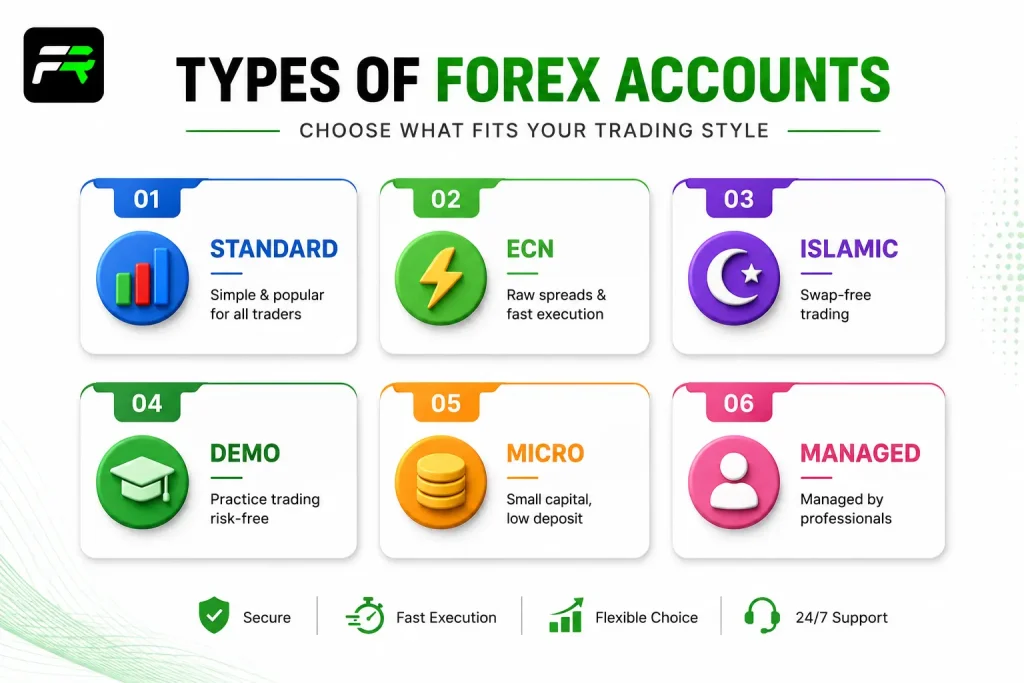
A forex account determines how you access the market, how much each trade costs, and the level of risk you take. Everyone operates in the same global currency market, but the vehicle you choose shapes how you respond to that market, how much risk you carry, how much each trade costs, and how clearly you can make trading decisions.
Many beginners choose cent or micro accounts because they allow trading with smaller position sizes and lower capital requirements. Micro, mini, or cent accounts let traders enter the market with limited capital, experience real price movement, and test how strategies hold up outside of a demo environment. A cent account lets traders gain live market experience while keeping financial risk relatively low.
As traders gain experience, traders typically move toward a Standard account. Standard accounts typically support standard lot trading and may provide access to the broker’s full range of available instruments, and a more demanding environment that suits traders with good risk management. Beyond that, traders looking for lower trading costs and cost efficiency look at Raw Spread or ECN accounts, where pricing is tighter but a commission applies per trade.
Some traders select their account based on platform preference, running MT4 or MT5 accounts specifically for the tools, indicators, and automated trading features those platforms provide. Others require accounts structured around their personal or religious principles, which is where swap-free Islamic accounts come in.
Virtually everyone goes through a demo account before trading with real funds. It is a simulated environment of virtual funds where traders build strategies, test platforms, and practice discipline without any financial risk.
There is no single account that suits every trader. The right choice depends on your goals, experience, and trading approach. It is about which one fits where you are right now and your trading goals.
How Forex Accounts Actually Work
A forex account defines how your trades are executed, how trading costs are calculated, and the conditions under which you trade. It sets your cost structure, your position size limits, how your orders are executed, and what kind of risk exposure you are working with.
Different account types exist because traders have different trading requirements. A beginner needs protection through small position sizes. A professional day trader needs tight pricing and fast execution. An institution needs deep liquidity access. No single structure serves all of them well.
The key variables that separate account types are spread structure, commission model, execution method, margin requirements, and position size limits. These differences directly affect trading costs, execution quality, and overall risk. They directly affect performance across hundreds of trades.
Your account is the environment your strategy runs in. The same approach can produce different trading results depending on where it is deployed. That is why picking an account type is a really important decision, not an administrative step to get through before the real work begins.
Types of Forex Accounts Explained
Standard Account
A standard account trades in full lots, each representing 100,000 units of the base currency. One pip movement in EUR/USD on a standard lot equals approximately $10. Even small price movements create larger profit and loss fluctuations, which is exactly why this account type suits traders who have built genuine experience managing risk and carry sufficient capital.
Trading conditions vary by broker. Some brokers reserve their tightest spreads for Raw Spread, ECN, or Zero accounts rather than Standard accounts. The trade-off is that the margin requirement is higher. Trading larger position sizes also increases financial risk, making disciplined risk management more important. For newer traders, the standard account environment can create pressure that may affect decision-making.
Mini and Micro Accounts
Mini accounts trade in lots of 10,000 currency units, and micro accounts trade in lots of 1,000 units. The practical effect is that each pip is worth significantly less, which makes losses more manageable while the live market conditions remain the same.
One advantage of trading with a micro account is gaining experience with real market conditions while limiting financial exposure. Demo trading helps traders learn a platform, while live micro trading introduces the psychological aspects of trading with real money. A micro account keeps the stakes low enough to stay calm while high enough that trades involve real financial consequences.
You should also read how lot sizes work and how they translate to pip value is foundational before sizing any position. Traders who skip this step are guessing at their actual risk on every trade.
Cent Account
Cent accounts denominate balances in cents rather than dollars. A $10 deposit appears as 1,000 cents in the trading terminal. This allows traders to execute real trades with minimal financial exposure, building execution habits and testing strategies in live conditions without meaningful financial consequences.
Cent accounts can help traders transition from demo to live trading while using relatively small amounts of capital. Cent accounts help traders transition gradually from demo trading to live trading with minimal financial exposure.
Raw Spread and ECN Accounts
Raw Spread and ECN accounts are different account models. Some brokers offer Raw Spread accounts without operating a true ECN execution model. Spreads can be as low as 0.0 pips on major pairs, with a fixed commission charged per lot instead. For active traders, raw spread accounts may reduce overall trading costs depending on commissions and trading volume.
ECN stands for Electronic Communication Network. In an ECN account, your orders are routed directly to a network of liquidity providers including banks, hedge funds, and other market participants. In a true ECN environment, orders are matched through external liquidity providers. Execution models vary by broker, and traders should review each broker’s execution policy.
For scalpers, high-frequency traders, and anyone running automated systems, the combination of tight spreads and fast execution in ECN accounts makes a real difference in trading costs. At high trading volumes, even a fraction of a pip per trade adds up significantly across a month.
STP Accounts
STP stands for Straight Through Processing. An STP broker routes your orders directly to liquidity providers without a dealing desk or manual intervention. Unlike true ECN accounts where orders interact with a full network of participants, STP accounts route through a selected pool of liquidity providers the broker partners with.
Although both models aim to provide market access, execution methods and pricing vary between brokers. Many STP brokers route orders to external liquidity providers, but execution models differ by broker and cannot be generalised. STP accounts tend to have slightly wider spreads than raw ECN accounts but often carry no separate commission, making the cost structure simpler to track. STP is a practical alternative for traders who want genuine market access without the features of a true ECN account.
Islamic (Swap-Free) Accounts
When a forex position is held overnight, brokers apply a swap charge or credit based on the interest rate differential between the two currencies in the pair. For traders observing Islamic finance principles, paying or receiving interest conflicts with Sharia law, which prohibits riba (interest-based transactions).
Swap-free or Islamic accounts eliminate overnight swap charges entirely. Some brokers replace overnight swaps with a routine account-opening process fee, while others apply different conditions depending on the instrument and holding period. Trading conditions may differ between swap-free and regular accounts depending on the broker’s policy.
These accounts are available across most major brokers and can be applied across MT4, MT5, and other platforms. Traders considering an Islamic account should verify which instruments are covered under the swap-free terms, as not all currency pairs and assets may qualify, and the specific conditions vary between brokers.
MT4 and MT5 Accounts
Some brokers offer accounts designated specifically for MetaTrader 4 or MetaTrader 5. The platform itself does not change the fundamental account structure, but it does determine which tools, indicators, automated trading capabilities, and order types are available.
MT4 remains widely used for its simplicity, large library of expert advisors, and proven reliability. MT5 offers additional order types, more built-in indicators, and access to additional asset classes beyond forex. The MT4 vs MT5 comparison matters most for traders who rely heavily on automation or who want access to commodities and equities alongside currency pairs.
Demo Account
A demo account is a simulated trading environment funded with virtual money. It replicates live market conditions and allows traders to learn the platform, test strategies, and build execution habits without any financial risk.
Demo accounts replicate market prices but may not fully reflect the emotional and execution aspects of live trading. Decisions made with no consequences feel fundamentally different from decisions made when real money is at stake. Traders who only practice on demo accounts often find the transition to live trading more difficult than expected, because the psychological pressure is a new challenge.
Demo accounts are most valuable for learning platform mechanics, testing a new strategy before live deployment, and seeing how different account conditions feel in practice. Once that foundation is in place, moving to a micro or cent account with real money provides more accurate preparation for actual trading.
The Real Cost of Trading: Spreads and Commissions
Every trade has a cost. The difference between account types is whether that cost is visible or embedded.
Spread-only accounts fold the broker’s margin into the price difference between the buy and sell side. The spread might be 1.5 pips on EUR/USD. That cost is taken before the trade becomes profitable in your favour.
Raw spread accounts charge near-zero spreads but add an explicit commission per lot traded. The commission might be $7 per standard lot round trip. The total cost is often lower for active traders, but the separate charge requires traders to factor it into their break-even calculation on every trade.
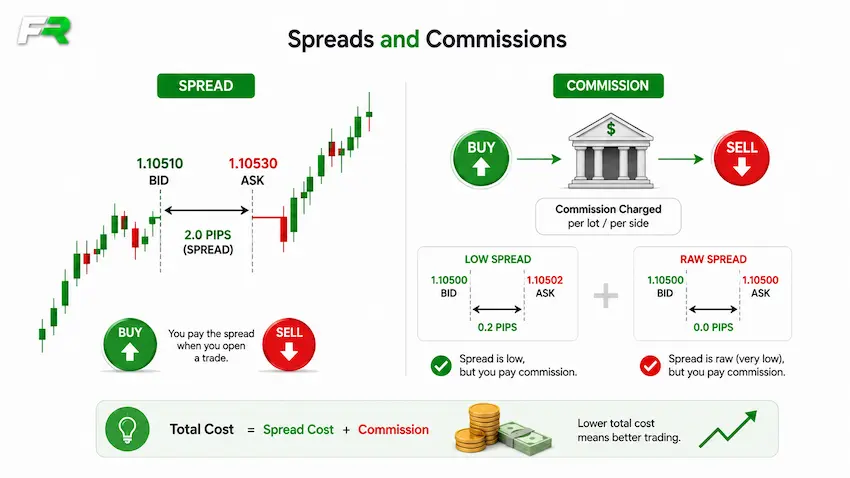
A simple illustration: if your spread-only account charges 2 pips and your target is 10 pips, 20 percent of your potential profit is already spent before the trade develops. With a 0.3-pip spread and a per-lot commission equivalent to 0.7 pips, the same trade carries a total cost of 1 pip, half as much.
This arithmetic matters across hundreds of trades. Cost predictability also matters for performance analysis. Many active traders prefer raw spread or commission-based accounts because they can offer lower trading costs, depending on the broker and trading volume. When you know exactly what each trade costs before you place it, you can model estimated trading performance more effectively.
New traders often underestimate how much the cumulative effect of spreads shapes long-term outcomes. The account type sets the starting trading cost. Strategy determines what you do from there.
Execution Models: Why They Matter More Than Most Traders Understand
Not all accounts execute trades the same way, and the difference matters most exactly when highly volatile market conditions.
Market execution fills your order at the current market price at the moment of submission. If the price has moved slightly between when you clicked and when the order reached the market, your fill reflects the current price, not the quoted price. This is called slippage, and in normal conditions it is minimal.
Instant execution seeks to fill at the exact price you requested. If the price has moved, the broker can reject the order and issue a requote. In slow markets this is manageable. Around major economic announcements, interest rate decisions, or geopolitical events, requotes during instant execution can mean missed entries or exits at the wrong moment.
ECN and STP accounts typically use market execution, which means orders fill at real market prices without dealer intervention. This gives traders faster fills and fewer requotes in exchange for accepting that the final price may differ fractionally from what was displayed.
Execution methods vary by broker. Market maker brokers may offer either instant execution or market execution depending on the account type. Understanding your broker’s execution model is important, particularly during periods of high market volatility.
Trading Size and Risk Exposure Across Account Types
Different account types offer different levels of exposure relative to deposited capital. Higher exposure means a larger position size relative to your capital, which amplifies both gains and losses equally.
The leverage mechanics tied to each account type are worth reading carefully before committing to any broker. Higher leverage increases both potential profits and losses. Actual account losses depend on position size, margin used, account equity, and stop-loss management.
Retail leverage limits differ by regulator. For example, ESMA and the FCA restrict retail leverage on major forex pairs to 30:1, while CFTC/NFA rules in the United States allow up to 50:1 on major currency pairs. These caps are not restrictions on opportunity. They are regulatory safeguards against the most common form of significant losses in retail trading.
Forex margin is equally important to track. Margin is the amount of capital your broker holds as collateral for an open position. If the market moves against you and your margin falls below the broker’s threshold, your positions are closed automatically regardless of your intentions. Knowing your margin level at any point is not optional for anyone trading with borrowed capital.
A properly structured position sizes risk to a fixed percentage of account equity per trade, typically 1 to 2 percent. With that discipline in place, leverage can be used more effectively rather than a liability. Without it, losses accumulate faster than most new traders expect.
Same Strategy, Different Account: What Actually Changes
Two traders run the same breakout entry on GBP/USD. One uses a standard account with maximum exposure. The other uses a micro account with a controlled risk per trade.
A false breakout occurs and both take a loss. The standard account trader sees a larger account loss, feels the pressure of the loss, and may encourage emotional trading to recover quickly. The micro account trader takes a small, manageable loss, reviews the trade calmly, and continues executing the same process.
Several weeks later, the micro account continues trading steadily incrementally. The standard account has blown through its capital.
This example illustrates how account size and risk exposure can influence trading behaviour and decision-making. The account type influenced how much pressure each trader felt after the loss, and that pressure determined what they did next.
Account design either rewards patience or punishes it. Matching your account to your actual risk tolerance and capital level is not a beginner’s consideration to move past quickly. It is a permanent factor in how well any strategy performs in practice.
How to Pick the Right Forex Trading Account
There is no universally right account. There is only the account that fits your current trading needs.
Beginners benefit most from small exposure and low financial consequences. A cent account or micro account keeps real money involved, which matters for developing discipline, without the kind of losses that cause traders to quit prematurely. The priority at this stage is gaining experience over time. A small account that teaches you how to manage risk outlasts a larger account that increases unnecessary risk but how fast money disappears.
Intermediate traders who have developed consistent habits and a tested approach can move toward standard account conditions with tighter spreads and full lot access. The focus shifts from survival to execution quality and cost management.
Experienced traders and active day traders generally often choose raw spread or ECN accounts, where the cost advantage compounds meaningfully across high-volume trading. Automated traders and scalpers in particular need the tightest possible spreads, and ECN accounts are designed for exactly that environment.
Practical questions useful to consider before deciding: How much capital are you genuinely prepared to lose at this stage? How many hours per day or week can you realistically monitor trades? Do you hold positions overnight, and if so, does the swap structure of the account match your strategy? Is the broker regulated and does it offer the platform you need?
The broker selection process is part of the account decision. The best account type with the wrong broker still produces poor trading conditions. Regulation, execution quality, and platform stability all sit alongside account type in the decision.
What Beginners Often Miss About Account Structure
New traders tend to focus on strategy before structure. They research indicators, read about candlestick patterns, and study entry rules before asking the more foundational question of whether their account conditions are set up to give any strategy a suitable conditions.
A forex risk management framework is impossible to run without knowing the exact cost per trade, the exposure ratio, and the execution model of your account. These variables determine what position size is safe, how much drawdown your account can absorb, and where stop-loss and take-profit levels should sit.
Choosing an unsuitable account type can make risk management and trading discipline more difficult. An undercapitalised trader in a standard account with high exposure feels every small loss disproportionately. That emotional pressure leads to exactly the behaviours that destroy accounts: cutting winners short, holding losers too long, skipping valid setups out of fear, and chasing losses after a bad day.
A well-matched account is one where you can take a loss, review it calmly, and continue executing your process without the financial or psychological damage becoming the major challenge. That condition is influenced by choosing the right account, not by willpower alone.
The Trend Toward Customised and Adaptive Accounts
Brokers are increasingly offering rigid account categories toward more flexible structures. Some brokers have introduced adaptive margin tools, tiered pricing, or risk-management features, but adoption varies across the industry.
The current trend benefits traders who want control over their conditions. Dynamic spreads that narrow during high-liquidity sessions may benefit traders who track forex market hours and time their activity accordingly. Tiered exposure ratios that adjust based on account equity and trade history reduce the worst outcomes for traders who are still learning.
The underlying principle is that account structure should support discipline, not just enable position-taking. Traders who engage with those protections rather than trying to work around them tend to stay active in the market longer and improve faster.
Key Takeaways
The type of forex account you open affects your trading costs, risk, execution, and emotional experience before strategy ever comes into play. A cent or micro account is not an alternative option for beginners. It is the right tool for anyone who has not yet built the track record to justify higher exposure.
Spreads and commissions are not trivial. Their cumulative effect over hundreds of trades is significant, and the account type sets that baseline. Many ECN and STP accounts route orders to external liquidity providers, although execution models differ between brokers and account types.
Islamic accounts make forex trading accessible to traders who follow Sharia principles, with swap charges replaced by alternative fee structures. Position size relative to capital influences trading behaviour as much as it multiplies returns. The right level of exposure is the level that lets you make objective decisions after a losing trade. Matching account type to actual capital, schedule, and risk tolerance is the structural decision that makes every other decision work better.
Structure Before Strategy
Selecting the right account type is an important part of building a sustainable trading plan because it affects costs, execution, leverage, and risk management.
A well-chosen account type is quiet. It does not demand your attention. It helps manage difficult trading periods without threatening your position in the market. It does not reduce the impact of trading mistakes. That kind of stability is what makes long-term trading development possible.
Before your next trade, look at your account structure. Ask whether it genuinely matches where you are right now, not where you intend to be. The account that fits your actual situation is the one that helps you continue trading long enough for everything else to work.
For more on the mechanics behind these decisions, visit the FXrecap guides on getting started in forex, forex risk management, forex trading strategies, and reading forex charts.
The team behind this guide
Researched, checked and approved by five forex specialists
Every guide is written, fact-checked and edited before it goes live, and updated when the facts change. Spotted an error? Tell us.
Related Articles
 Education
8 min read
Education
8 min read

 Education
11 min read
Education
11 min read
 Education
9 min read
Education
9 min read
 Education
5 min read
Education
5 min read
 Education
9 min read
Education
9 min read
 Education
7 min read
Education
7 min read