IC Markets





































Canada's September Inflation Is Due Today: What the Bank of Canada Will Look For
Gasoline drove August's 3.0% rate. Today's figure shows whether high oil prices are spreading into rent, food and services before 28 October.
 WriterAbir KhanWriterWrites the guides · checks every figure against primary sources View profileAbout Abir →

 Market analysisTanbir Habib RiyadForex & Crypto AnalystForex and crypto analyst · technical and fundamental analysis View profileAbout Tanbir →

 Fact-checking & riskJannatul FerdaushFact-Checker & Risk AnalystFact-checks every figure · risk analysis · Applied Statistics, University of Dhaka View profileAbout Jannatul →

 Trading reviewJowel RanaCo-Founder & Forex TraderCo-founder · forex trader · reviews guides from a trader's view View profileAbout Jowel →

 Final approvalRanjan NiskrityFounder, Owner & Forex TraderFounder and owner · forex trader · signs off every guide View profileAbout Ranjan →

Statistics Canada publishes consumer prices for September at 08:30 Ottawa time on Monday 19 October, which is 12:30 UTC. It is the last inflation report the Bank of Canada will see before its rate decision on 28 October, and it arrives with crude oil close to $100 a barrel and the Canadian dollar coming off a firm week.
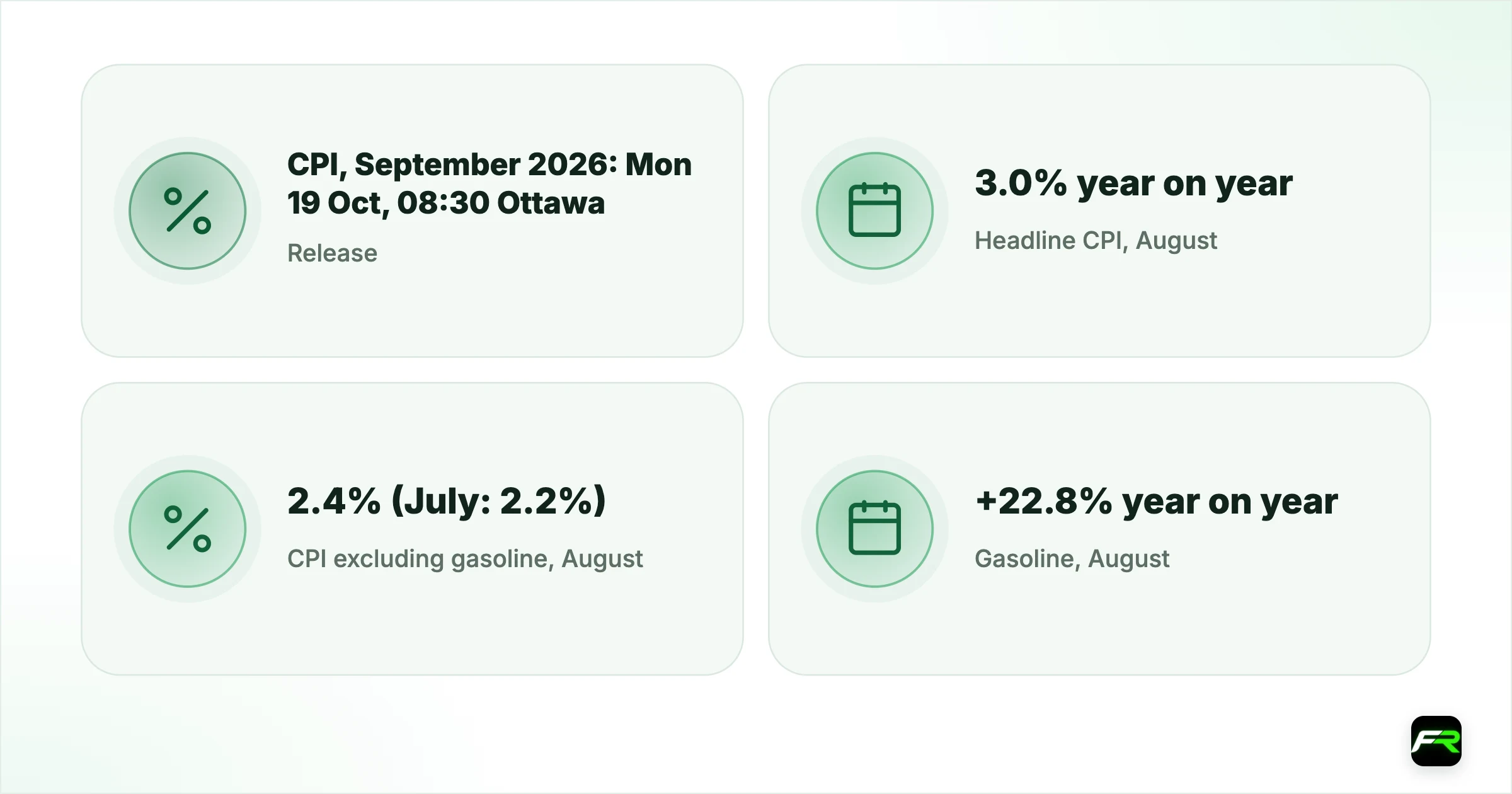
In August, consumer prices rose 3.0% from a year earlier, the same rate as in July. Gasoline did most of the work: pump prices were 22.8% higher than a year before. Strip gasoline out and inflation was 2.4%, up from 2.2% in July, and it is that second number the central bank has been watching most closely. The question for today is simple. Are high fuel costs starting to push up the price of everything else?
This preview was written before the release, at about 03:30 UTC, so it gives no new figure. It sets out the readings to compare against, what the Bank of Canada has said it is watching, and how USD/CAD tends to behave around the data. USD/CAD traded near 1.4119 at 03:04 UTC, after falling 0.82% last week.
| Release | CPI, September 2026: Mon 19 Oct, 08:30 Ottawa (12:30 UTC) |
|---|---|
| Headline CPI, August | 3.0% year on year (July: 3.0%) |
| CPI excluding gasoline, August | 2.4% (July: 2.2%) |
| Gasoline, August | +22.8% year on year (July: +25.7%) |
| CPI-trim / CPI-median, August | 1.9% / 2.0% |
| Bank of Canada policy rate | 2.25% (held 2 September) |
| Next decision | Wed 28 October, with the Monetary Policy Report |
| USD/CAD | about 1.4119 at 03:04 UTC |
What August's report showed
August's numbers were a story of energy and base effects. Gasoline prices rose at a slower annual pace than in July, which pulled the headline down, but that easing was offset by higher prices for travel tours and rent. Travel tours were up 26.1% from a year earlier, partly because Canadian trips to the United States fell sharply in 2025, which lowered prices then, and partly because airlines added fuel surcharges as jet fuel became more expensive.
Other parts of the basket cooled. Grocery prices rose 2.8%, slower than July's 3.1% and, for the first time since July 2024, below the headline rate. Dairy led the slowdown. Clothing prices fell 1.1%. Rent, a stubborn item, climbed 2.8% after 2.5% in July, driven by Manitoba and Ontario. On a monthly basis the index fell 0.1%, though after seasonal adjustment it rose 0.2%.
Fuel costs also showed up in unexpected places. Prices for fuel oil and other fuels rose 43.7% from a year earlier, which pushed inflation higher in the Atlantic provinces, where homes rely more on heating oil. That detail matters heading into winter, when heating demand climbs and those costs weigh more heavily on household budgets.
| Measure | July 2026 | August 2026 |
|---|---|---|
| CPI, all items | 3.0% | 3.0% |
| CPI excluding gasoline | 2.2% | 2.4% |
| Gasoline | 25.7% | 22.8% |
| CPI-trim | 1.9% | 1.9% |
| CPI-median | 2.0% | 2.0% |
| CPI-common | 2.7% | 2.6% |
Source: Statistics Canada, Consumer Price Index, August 2026, and table 18-10-0256 (measures of core inflation, Bank of Canada definitions). Year-on-year changes.
What the Bank of Canada is watching
The Bank of Canada held its policy rate at 2.25% on 2 September. Its statement explained why the September figure matters so much. CPI inflation had been hovering around 3%, mainly because of gasoline, and the bank said there had so far been “little evidence” of higher energy prices spreading to other components. In the same paragraph it warned that, with the Middle East conflict ongoing and little progress reopening the Strait of Hormuz, upside risks to its inflation forecast had increased.
The bank was specific about the danger: “The longer that high oil prices and elevated refinery margins persist, the greater the risk of spillover to the prices of other goods and services.” It also said new US tariffs and Canadian counter-tariffs could raise costs for businesses and feed into consumer prices over time. Governing Council said it was “prepared to adjust monetary policy as needed”, which leaves the door open in both directions.
Growth gives the bank more room than it had earlier in the year. GDP rose 3.3% in the second quarter, the statement said, after very weak growth in the first quarter, and unemployment edged down to 6.4% in July. Even so, the bank judged that labour demand remains subdued and that the economy still has spare capacity. That combination usually argues for patience, unless inflation outside energy starts to climb.
Three readings that matter more than the headline
A headline rate of 3% tells you little on its own, because gasoline swings so much from month to month. These three measures say more about where the Bank of Canada might go next.
- CPI excluding gasoline. It rose from 2.2% to 2.4% between July and August. A further rise would show energy costs leaking into other prices, the exact risk the bank flagged.
- CPI-trim and CPI-median. The bank's preferred core measures stood at 1.9% and 2.0% in August, close to the 2% target. A jump in either would carry more weight than a move in the headline.
- Rent and services. Rental prices climbed 2.8% in August. Services prices respond slowly and are hard to bring down once they rise, so a broad pick-up there would concern policymakers.
Gasoline itself is the wild card for the headline. Pump prices had been rising more slowly on an annual basis in August, but crude oil climbed through September and into October. US crude futures closed Friday near $99 and Brent touched $110 during the session, before both eased early on Monday to about $97.5 and $107.9 at 02:54 UTC. Higher crude feeds through to pump prices with a short lag, so energy may again lift the headline.
How USD/CAD may react
The loonie arrives at the release in good shape. USD/CAD fell from about 1.4254 at the close on 9 October to 1.4137 on Friday, and traded near 1.4119 early on Monday. Higher oil prices helped, since Canada is a large crude exporter, and so did the softer US dollar after Treasury yields fell last week. A move lower in USD/CAD means a stronger Canadian dollar.
The rate gap still favours the US dollar. At 3.75% to 4.00%, the Federal Reserve's target range sits well above the Bank of Canada's 2.25%. A hot Canadian reading, especially in the core measures, would narrow expectations for that gap and could push USD/CAD lower. A soft reading would support the case for another hold on 28 October and could let the pair rebound. Both central banks announce on the same day, the Bank of Canada first at 09:45 Ottawa time and the Fed at 14:00 New York time.
Speculators are heavily positioned against the loonie. CFTC figures for 13 October showed leveraged funds holding a net short of 88,112 Canadian dollar futures contracts, the largest of any currency we tracked, as our CFTC positioning story reported. A crowded short can unwind quickly if the data surprise on the high side.
What it means for traders
Inflation releases produce some of the fastest moves in USD/CAD. A little preparation goes a long way.
- Note the time in your own zone. 12:30 UTC is 08:30 in Ottawa and New York, 13:30 in London and 18:30 in Dhaka. Our economic calendar converts it for you.
- Compare against the previous readings in the table above, not only against forecasts quoted elsewhere. A core measure moving from 2.0% to 2.3% would matter even if the headline stayed at 3.0%.
- Watch oil at the same time. A move in crude around the release can blur the reaction to the data.
- Avoid entering in the first seconds. Spreads widen sharply at 12:30 UTC and the first move often reverses.
- Think about 28 October. Positions opened today will face the Bank of Canada and the Fed on the same afternoon.
Say you plan to sell USD/CAD at 1.4119 if core inflation rises, with a stop at 1.4169, 50 pips above. One standard lot of USD/CAD moves about C$10 a pip, roughly $7 at this rate, so a 50-pip stop risks about $354 per lot. On a $10,000 account with a 1% limit of $100, the right size is about 28,000 units, or 0.28 lots. Add a few pips for the spread at release time when you size the trade.
Last week's preview of every release due this week is in our week-ahead story, and our guide to forex news trading strategies covers how to approach releases like this one. Work out trade size with the position size calculator.
Inflation releases can move currencies by dozens of pips in seconds, and spreads often widen at the moment of release. Leverage magnifies losses as well as gains, so trade only with money you can afford to lose.
Previous readings come from Statistics Canada's Consumer Price Index release for August 2026 and its table of core inflation measures (Bank of Canada definitions). The release time is from Statistics Canada's official calendar. Policy quotes are from the Bank of Canada's 2 September 2026 announcement. Fund positions are from the CFTC. The Fed's target range is from the Federal Reserve. Currency and oil levels are market data built from hourly bars to 03:04 UTC on 19 October and differ slightly between providers. We wrote this preview before the September figures were published. This is news, not investment advice.
Frequently asked
When is Canada's September 2026 CPI released?
Statistics Canada publishes it on Monday 19 October 2026 at 08:30 Ottawa time, which is 12:30 UTC and 13:30 in London.
What was Canada's inflation rate in August 2026?
Consumer prices rose 3.0% from a year earlier in August, the same as in July. Excluding gasoline, prices rose 2.4%, and gasoline itself was up 22.8%.
What is the Bank of Canada's interest rate?
The policy rate is 2.25%. Canada's central bank held it there on 2 September 2026 and announces its next decision, with a new Monetary Policy Report, on 28 October.
Which core inflation measures does the Bank of Canada use?
Its preferred measures are CPI-trim and CPI-median, published by Statistics Canada with each CPI release. In August 2026 they stood at 1.9% and 2.0%.
Sources: Statistics Canada: Consumer Price Index, August 2026 · Bank of Canada: Bank of Canada maintains the policy rate at 2¼% (2 September 2026) · Statistics Canada: upcoming releases · Statistics Canada: Measures of core inflation, table 18-10-0256-01 · CFTC: Traders in Financial Futures, futures only
The team behind this guide
Researched, checked and approved by five forex specialists
Every guide is written, fact-checked and edited before it goes live, and updated when the facts change. Spotted an error? Tell us.