IC Markets






































Japan's Core Inflation Jumps to 2.1% in September, a Week Before the Bank of Japan Decides
Prices excluding fresh food and energy rose 2.4%, the fastest since January, even as the gasoline tax cut kept holding the headline rate down.
 WriterAbir KhanWriterWrites the guides · checks every figure against primary sources View profileAbout Abir →

 Market analysisTanbir Habib RiyadForex & Crypto AnalystForex and crypto analyst · technical and fundamental analysis View profileAbout Tanbir →

 Fact-checking & riskJannatul FerdaushFact-Checker & Risk AnalystFact-checks every figure · risk analysis · Applied Statistics, University of Dhaka View profileAbout Jannatul →

 Trading reviewJowel RanaCo-Founder & Forex TraderCo-founder · forex trader · reviews guides from a trader's view View profileAbout Jowel →

 Final approvalRanjan NiskrityFounder, Owner & Forex TraderFounder and owner · forex trader · signs off every guide View profileAbout Ranjan →

Japan's consumer prices rose faster in September. The core index, which leaves out fresh food and is the measure the Bank of Japan watches most closely, was 2.1% higher than a year earlier, up from 1.7% in August, the Statistics Bureau said on Friday 23 October. Headline inflation rose to 2.1% from 1.9%. A narrower gauge that also strips out energy climbed to 2.4% from 1.9%, its highest reading since January.
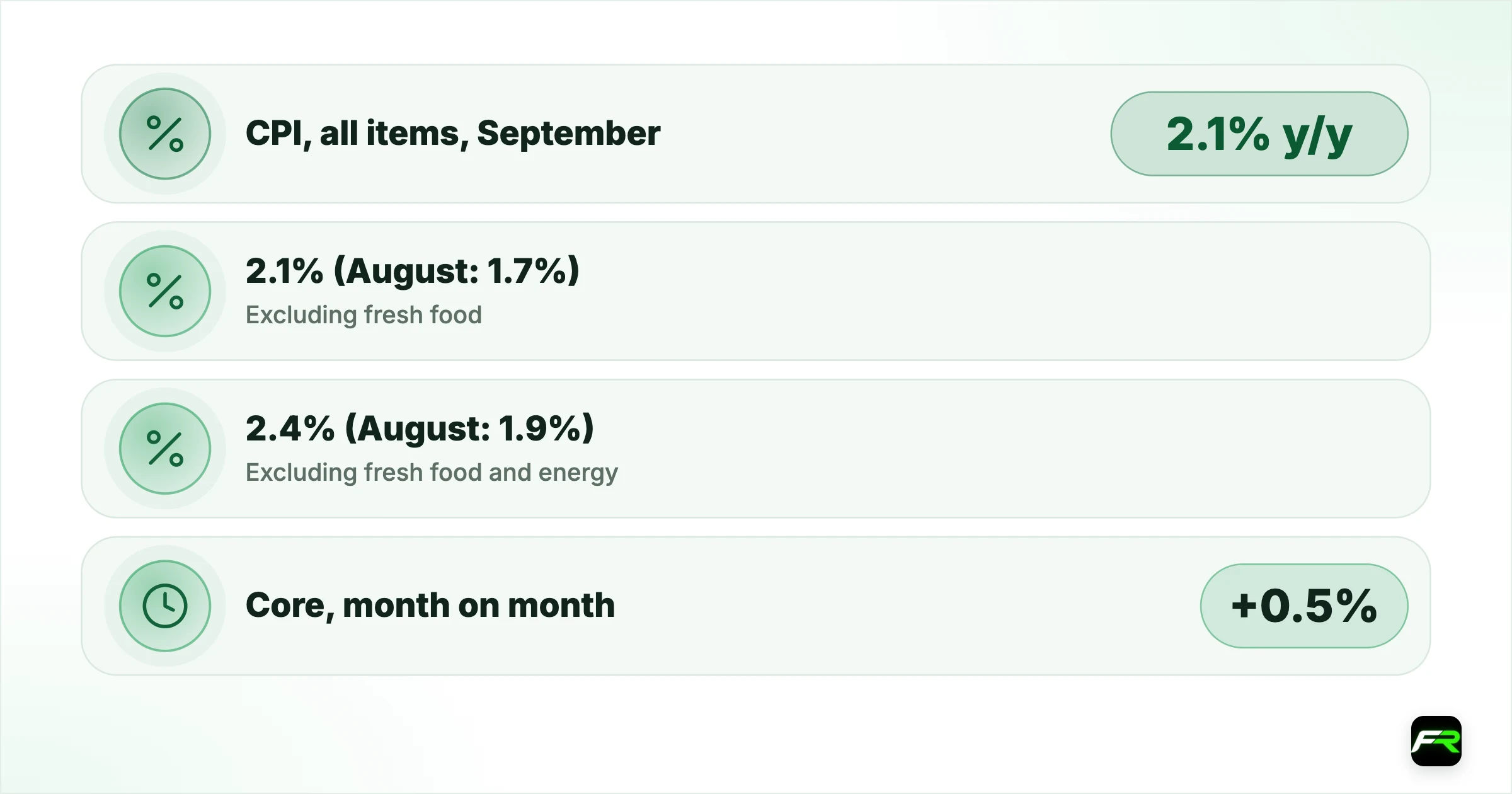
Monthly figures were firm too. On a seasonally adjusted basis, core prices rose 0.5% from August, and the measure without fresh food and energy also gained 0.5%, the biggest monthly rise in the bureau's table covering the past 13 months. Government energy measures kept the headline lower than it would otherwise be: the bureau estimates that the abolition of the provisional gasoline tax rate and related policy steps took about 0.82 percentage point off annual inflation.
The yen moved only slightly on the 08:30 Tokyo release, which was 23:30 UTC on Thursday. USD/JPY traded near 156.63 just before it and dipped to 156.39 within 15 minutes, then extended the slide to about 156.07 in the next hour as the fall in US Treasury yields carried on. By 06:20 UTC the pair had bounced to around 156.94.
| CPI, all items, September | 2.1% y/y (August: 1.9%) |
|---|---|
| Excluding fresh food (core) | 2.1% (August: 1.7%) |
| Excluding fresh food and energy | 2.4% (August: 1.9%) |
| Core, month on month (seasonally adjusted) | +0.5% |
| Energy | -0.6% y/y (August: -0.7%) |
| Food excluding fresh food | 2.9% (August: 2.7%) |
| Gasoline tax and policy effect | about -0.82 point on the headline |
| BoJ policy rate | 1.25%, next decision 30 October |
What the Statistics Bureau reported
These figures use the new 2025-base index, which the bureau introduced with the July data in August. On that base, the all-items index stood at 102.2 in September, the core index at 102.3 and the index excluding fresh food and energy at 102.8. Headline inflation rose 0.2 point from August, while the core rate jumped 0.4 point. Fresh food prices rose more slowly than a month earlier, and the bureau says that alone narrowed the headline rise by about 0.15 point.
Food remains the biggest single contributor. Food excluding fresh food rose 2.9% from a year earlier, up from 2.7%, and added about 0.69 point to the headline rate. Within it, the bureau highlighted prepared foods, up 4.2%, confectionery, up 4.3%, and drinks, up 6.0%, with green tea 33.8% dearer than a year ago. Fresh fish and seafood cost 13.9% more. Rice moved the other way: ordinary non-Koshihikari rice was 21.1% cheaper than in September 2025, and grains as a group fell 5.0%.
Several service and household items picked up. Accommodation charges rose 4.6% on the year after falling 1.4% in August, and water charges rose 4.9% after a 3.5% fall. Household consumables were 12.4% dearer, with toilet paper up 17.8%, and voluntary car insurance premiums rose 5.9%. Education was the main drag, down 3.8%, mostly because the measured cost of private high school tuition fell 73.2%.
| Measure | September 2026 | August 2026 |
|---|---|---|
| All items | 2.1% | 1.9% |
| Excluding fresh food | 2.1% | 1.7% |
| Excluding fresh food and energy | 2.4% | 1.9% |
| Food excluding fresh food | 2.9% | 2.7% |
| Energy | -0.6% | -0.7% |
| Electricity | -2.4% | -2.4% |
| Gasoline | -2.6% | -2.6% |
| Accommodation | 4.6% | -1.4% |
Source: Statistics Bureau of Japan, 2025-base Consumer Price Index, Japan, September 2026. Changes are from a year earlier.
Energy is still holding the headline down
Energy prices were 0.6% lower than a year earlier in September, after a 0.7% fall in August. Electricity bills were down 2.4% and gasoline 2.6%, while kerosene was 15.3% dearer and propane 6.3%. Those small falls hide a large policy effect. Splitting its estimate by item, the bureau puts gasoline's share at about 0.48 point off the headline rate, electricity at about 0.24 point, kerosene at about 0.07 point and city gas at about 0.03 point.
Anyone reading the yen through inflation should keep that in mind. Our own rough sum, adding the 0.82 point back to 2.1%, gives about 2.9%, although the bureau labels its figure an estimate and the true counterfactual is uncertain. Oil is also climbing again, with Brent crude futures near $114 a barrel early on Friday, so energy may stop subtracting from inflation in the coming months.
A second detail supports that view. The index excluding fresh food and energy, which is free of the tax effect, rose 0.5% in a single month. That kind of pace, if it held, would keep underlying inflation above the Bank of Japan's 2% target even after the energy measures fade from the yearly comparison.
What it means for the Bank of Japan and the yen
The Bank of Japan raised its policy rate to 1.25% on 18 September and holds its next meeting on 29 and 30 October, with the decision on Friday 30 October. Its price stability target is 2% inflation, measured by the year-on-year change in the consumer price index. September's report gives the board fresh evidence that underlying inflation is near or above that goal: core inflation is back above 2%, and prices excluding fresh food and energy rose at a 0.5% monthly pace.
Policy makers will also have Tokyo's October CPI, which the bureau publishes on the morning of 30 October, and the bank releases its quarterly Outlook for Economic Activity and Prices with the decision. That report sets out the board's own inflation forecasts, so it often moves the yen as much as the rate call itself.
For the yen, the domestic story and the US story now point the same way. Japanese inflation is picking up just as US Treasury yields have fallen, and both narrow the rate gap that kept USD/JPY near 158 for much of October. A stronger yen is not guaranteed, though. A cautious Bank of Japan, or a rebound in US yields after the Federal Reserve decides on 28 October, could push the pair back up quickly.
What traders can take from it
Japan's monthly CPI rarely moves the yen much on the day, but it shapes expectations for the Bank of Japan. These points help put it to use.
- Read the core measures, not only the headline. The gasoline tax change distorts the all-items figure, while the index without fresh food and energy shows underlying pressure.
- Mark 30 October. Tokyo CPI comes out at 08:30 Tokyo time, and the Bank of Japan's decision usually follows around midday, with no fixed time.
- Watch US yields alongside Japanese data. USD/JPY fell 1.6 yen on Thursday mostly because Treasury yields dropped, not because of news from Tokyo.
- Check oil. Brent near $114 can lift Japan's energy prices and add to the case for another rise in rates.
- Keep position sizes small around the decision. Yen moves on Bank of Japan days can run well beyond normal daily ranges.
Say you sell USD/JPY at 157.00 because you expect a firmer Bank of Japan, with a stop at 157.60, 60 pips above. At 157.00, one pip on a standard lot of 100,000 units is worth about $6.37, so the stop risks about $382 per lot. On a $10,000 account with a 1% limit of $100, the right size is about 26,000 units. If you hold into 30 October, remember that the decision has no fixed time and can arrive while you are away from the screen.
For today's levels, see our USD/JPY analysis, and for the US side read our story on the fall in Treasury yields. Every central bank date is on the economic calendar, you can convert yen amounts with the currency converter, and you can size each trade with the position size calculator.
The yen can move several big figures around Bank of Japan decisions, and official statements on currency moves can trigger sharp swings. Leverage magnifies losses as well as gains, so trade only with money you can afford to lose.
All price figures are from the Statistics Bureau of Japan's 2025-base Consumer Price Index for September 2026, released on 23 October 2026, including its estimate of the gasoline tax and policy effect. The 2.9% figure is FX Recap's own rough sum, not an official number. The policy rate, meeting dates and Outlook Report date are from the Bank of Japan. Currency and oil levels are market data from 15-minute and hourly bars to about 06:20 UTC on 23 October and differ slightly between providers. This is news, not investment advice.
Frequently asked
What is Japan's inflation rate for September 2026?
Japan's consumer price index rose 2.1% from a year earlier in September 2026, up from 1.9% in August, according to the Statistics Bureau. Core CPI, excluding fresh food, also rose 2.1%, up from 1.7%, and prices excluding fresh food and energy rose 2.4%.
Why is Japan's headline inflation lower than underlying inflation?
Energy prices were 0.6% lower than a year earlier. The Statistics Bureau estimates that the abolition of the provisional gasoline tax rate and related policy measures cut about 0.82 percentage point from the headline rate in September 2026.
When is the next Bank of Japan decision?
The Bank of Japan meets on 29 and 30 October 2026 and announces its decision on 30 October, usually around midday Tokyo time with no fixed time. Its policy rate is 1.25% after a rise on 18 September 2026. The quarterly Outlook Report comes out the same day.
How did the yen react to the September CPI data?
The reaction was small. USD/JPY dipped from about 156.63 to 156.39 in the 15 minutes after the 23:30 UTC release, and later fell to about 156.07 as US yields kept falling. It was near 156.94 at 06:20 UTC on 23 October.
Sources: Statistics Bureau of Japan: Consumer Price Index, Japan, latest monthly results (Japanese) · Statistics Bureau of Japan: CPI Japan, September 2026 (PDF, Japanese) · Bank of Japan: Monetary Policy Meetings schedule · Bank of Japan: Monetary policy decisions, 2026 · Statistics Bureau of Japan: CPI release schedule
The team behind this guide
Researched, checked and approved by five forex specialists
Every guide is written, fact-checked and edited before it goes live, and updated when the facts change. Spotted an error? Tell us.