IC Markets

 3:09
 2:39
 2:10
 2:18
 3:43
 8:42
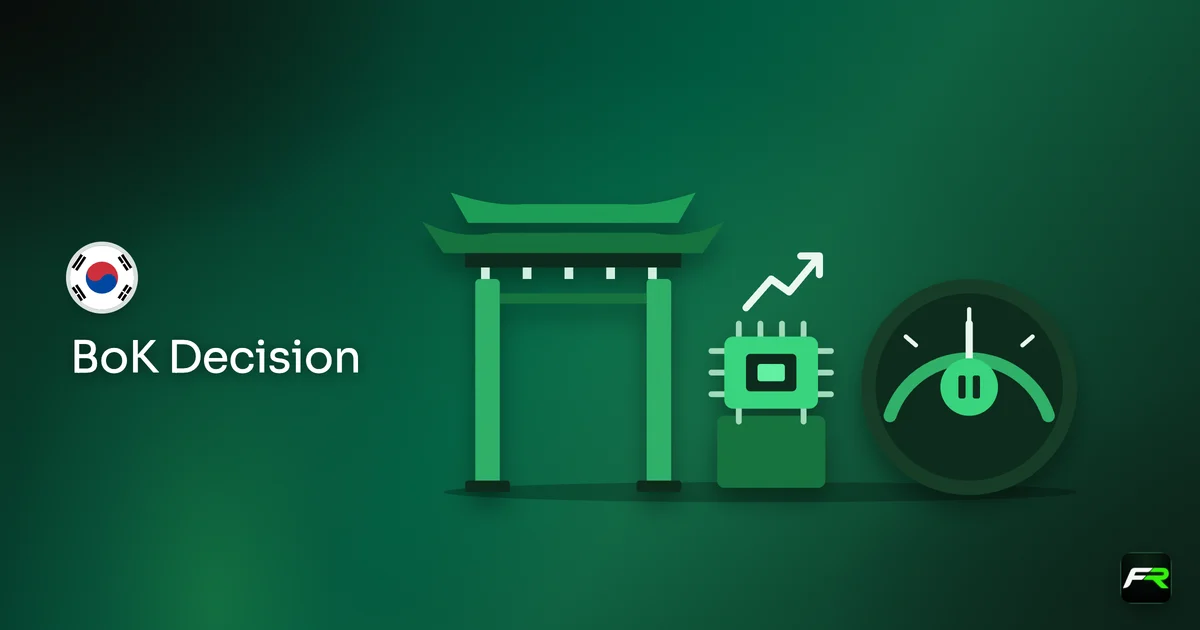
Bank of Korea Raises Its Base Rate to 3.25% in a 5-2 Vote and Lifts Its 2027 Growth Forecast to 4.1%
Seoul's third rise this year came with much higher growth forecasts and two dissents, and the board kept the door open to more increases.
 WriterNafish PialJournalist & FX WriterJournalist · forex news and market writing View profileAbout Nafish →

 ReportingJawad Bin GoniPR & ReporterPR and reporting · media enquiries and press coverage View profileAbout Jawad →

 Market analysisTanbir Habib RiyadForex & Crypto AnalystForex and crypto analyst · technical and fundamental analysis View profileAbout Tanbir →

 EditingAbir KhanWriterWrites the guides · checks every figure against primary sources View profileAbout Abir →

 Fact-checking & riskJannatul FerdaushFact-Checker & Risk AnalystFact-checks every figure · risk analysis · Applied Statistics, University of Dhaka View profileAbout Jannatul →

 Trading reviewJowel RanaForex TraderForex trader · reviews guides from a trader's view View profileAbout Jowel →

The Bank of Korea raised its Base Rate by a quarter point to 3.25% on Thursday 26 November, its third increase this year. Its Monetary Policy Board said growth had "further strengthened", that inflation was projected to stay above target "for a considerable time", and that financial stability risks persist. Five members voted for the rise; two, Hwang Kunil and Lee Soohyung, wanted to keep the rate at 3.00%.
The board paired the decision with a sharp upgrade to its forecasts. It now expects the economy to grow 3.9% this year and 4.1% next year, against 3.3% and 2.9% in August. In October the bank said it would wait for third-quarter GDP and October inflation before moving again. Both arrived strong, as our Bank of Korea preview set out on Monday, and the board acted on them.
| Base Rate (Bank of Korea) | 3.25%, raised 5-2 on 26 November (previous 3.00%) |
|---|---|
| GDP growth forecast for 2026 (Bank of Korea) | 3.9% (August forecast 3.3%) |
| Consumer inflation, annual (Ministry of Data and Statistics) | 2.8% in October (September 2.9%) |
| USD/KRW (ECB reference rates) | 1,345.40 on 25 November (22 October 1,324.63) |
Why the board raised rates
The statement gave three reasons. Exports and investment, led by semiconductors, have kept growth high, and consumption is expected to recover as incomes improve and government spending rises. Inflation, both headline and core, was in the "upper 2% range (2.8%)" in October, above the 2% target, with personal services and durable goods prices rising fastest. Household loans have also accelerated, and the board said "expectations of rising housing prices still remain high" in Seoul and its surrounding areas.
In his opening remarks to the press conference, Governor Hyun Song Shin linked the decision to oil. "Against this backdrop of sustained strong growth, given high oil prices persisting for an extended period, it was judged necessary to respond with more emphasis on price stability," he said. Inflation had not accelerated sharply, he added, "owing to the two rate hikes and the government's price stability measures". But stronger demand on top of high costs could keep it above target for longer and affect expectations.
External conditions also played a part. The statement noted that "the US dollar strengthened, driven by heightened expectations of rate hikes by the US Federal Reserve". Shin said the "likelihood of further monetary tightening by central banks in major economies has increased", with possible effects on Korean inflation and financial stability "through the exchange rate and other channels". A rise now keeps the gap with US rates from widening further.
Housing remains a worry. The bank said the pace of price rises in Seoul and its surrounding areas "slowed somewhat", and the governor noted that prices kept falling in some higher-priced districts. In lower- and mid-priced parts of Seoul and some areas of Gyeonggi Province, though, he said housing prices "continued to rise sharply". Household loans from financial firms grew faster, with both mortgage-related and other loans rising. Higher borrowing costs are the board's main tool to cool that demand, which is why financial stability sat beside inflation among the reasons for the rise.
Global markets were rougher than in October. The statement said stock prices "underwent a sizable correction" as concerns grew about the profitability of AI investment, and that long-term government bond yields fell in major economies, Korea included. Foreign investors pulled money out of Korean shares. Short-term money and credit markets stayed broadly stable, the governor said, so the board judged that the economy could absorb a further rise.
New forecasts
Growth saw the biggest change. The bank raised its 2026 forecast by 0.6 point and its 2027 forecast by 1.2 points, and it now projects 3.0% growth in 2028. According to the governor, the higher path reflects strong exports and investment "as the expansion of AI infrastructure continues" and "the significantly increasing weight of the IT sector as a growth engine for the Korean economy".
Inflation forecasts moved up only slightly. Consumer prices are expected to rise 2.7% this year, unchanged, and 2.4% next year, up from 2.3%. Core inflation is now forecast at 2.6% for both years, up from 2.5%. The bank expects inflation to stay above target through 2027 and to move back toward 2% in 2028, "partly due to the effects of monetary tightening".
| Forecast (Bank of Korea) | August | November |
|---|---|---|
| GDP growth 2026 | 3.3% | 3.9% |
| GDP growth 2027 | 2.9% | 4.1% |
| Consumer inflation 2026 | 2.7% | 2.7% |
| Consumer inflation 2027 | 2.3% | 2.4% |
| Core inflation 2026 | 2.5% | 2.6% |
| Core inflation 2027 | 2.5% | 2.6% |
The vote and the signal for 2027
October's hold was unanimous; this time two members dissented. Hwang Kunil had already voted against the August rise, so his dissent is consistent. Lee Soohyung joining him gives the minority a second voice, which suggests the board will not move at every meeting. The bank also raised the rate on its Bank Intermediated Lending Support Facility, which funds lending to smaller firms, to 1.50% from 1.25%.
Guidance points to more tightening, not a pause. According to the statement, the board "will decide on matters such as the timing of further increases in the Base Rate" while watching inflation, growth and financial stability. Shin went further: the board "sees it warranted to continue its policy response until there is confidence that inflation will converge stably to the target level". This was the last meeting of 2026, so the next decision comes in the new year on dates the bank will publish.
What it means for the won
Against a strong dollar, the won has been steadier than most currencies. The bank said the won to dollar rate "remained broadly stable" despite outflows from Korean stocks, supported by a large current account surplus. ECB-derived reference rates show USD/KRW at 1,345.40 on Wednesday, up from 1,324.63 on the day of the October decision, a 1.6% fall for the won. Over the same period EUR/USD fell more than 2%.
These levels come from the ECB's euro reference rates, from which we derive USD/KRW once a working day, so they show where the pair fixed rather than its intraday range.
| Level | Why it matters |
|---|---|
| 1,388.10 | 18 Sep reference rate, the 60-day high |
| 1,358.73 | 6 Nov reference rate, the November high |
| 1,348.85 | 23 Nov reference rate |
| 1,345.40 | 25 Nov reference rate, the latest |
| 1,324.63 | 22 Oct reference rate, the last decision day |
A higher Korean rate makes holding won slightly more attractive, but the Fed's 9 December decision is likely to matter more for the pair this year. If the Fed raises rates and signals more, the gap the Bank of Korea has just narrowed would open again.
What it means for traders
The Bank of Korea has now raised rates three times this year as oil and a strong dollar push prices up. Points to keep in mind:
- The two dissents matter. A split board makes a rise at the first meeting of 2027 less certain, even with hawkish guidance.
- Growth forecasts above 4% depend on chips and AI investment. The bank named the semiconductor cycle as the main uncertainty.
- USD/KRW follows the Fed and the dollar more than Korean rates. Watch the 9 December Fed decision and US data first.
- For other Asian currencies, the move shows central banks in the region are willing to tighten when oil keeps inflation above target.
- Daily dollar levels against the yen are on our USD/JPY analysis page, since the yen and won often react to the same Asian themes.
Emerging-market currencies can move sharply on central bank surprises, and leverage magnifies losses as well as gains. Only trade money you can afford to lose. This is news and education, not a recommendation to buy or sell.
The decision, vote, forecasts and quotations are from the Bank of Korea's Monetary Policy Decision and the Opening Remarks to the Press Conference of 26 November 2026. USD/KRW is derived by FX Recap from European Central Bank (ECB) euro reference rates (KRW per euro divided by USD per euro).
Cite this guide
FX Recap, "Bank of Korea Raises Its Base Rate to 3.25% in a 5-2 Vote and Lifts Its 2027 Growth Forecast to 4.1%", updated 26 November 2026, https://fxrecap.com/forex-news/top-stories/bank-of-korea-raises-rate-to-3-25-percent-5-2-vote
Free to quote with a link. Journalists: data and comment in our press room.
Frequently asked
What is the Bank of Korea's interest rate now?
The Base Rate is 3.25% after the Monetary Policy Board raised it by 0.25 point from 3.00% on 26 November 2026. It was the third rise of 2026, after increases in July and August.
How did the Bank of Korea board vote in November 2026?
Five members voted to raise the rate to 3.25%. Two members, Hwang Kunil and Lee Soohyung, voted to keep it at 3.00%.
What are the Bank of Korea's new forecasts?
Growth of 3.9% in 2026 and 4.1% in 2027, up from 3.3% and 2.9% in August, and 3.0% in 2028. Consumer inflation of 2.7% in 2026 and 2.4% in 2027, and core inflation of 2.6% in both years.
Will the Bank of Korea raise rates again?
The board said it will decide on the timing of further increases while assessing inflation, growth and financial stability, and the governor said it will continue until there is confidence inflation will settle at target. Two members preferred to hold in November.
Sources: Bank of Korea: Monetary Policy Decision & Opening Remarks to the Press Conference (26 November 2026) · Bank of Korea: Monetary Policy Decision, 22 October 2026 · European Central Bank: euro foreign exchange reference rates · Bank of Korea: Monetary Policy Board meeting dates
The team behind this guide
Reported, written, edited and checked by five FX Recap specialists
Every guide is written, fact-checked and edited before it goes live, and updated when the facts change. Spotted an error? Tell us.