IC Markets

 3:09
 2:39
 2:10
 2:18
 3:43
 8:42




































Bank of England Raises Bank Rate to 4% by 8 Votes to 1 as Energy Costs Push Inflation Higher
The first UK rate rise in this energy shock came with a warning that CPI could reach about 5% by mid-2027. One member wanted a half-point move.
 WriterAbir KhanWriterWrites the guides · checks every figure against primary sources View profileAbout Abir →

 Market analysisTanbir Habib RiyadForex & Crypto AnalystForex and crypto analyst · technical and fundamental analysis View profileAbout Tanbir →

 Fact-checking & riskJannatul FerdaushFact-Checker & Risk AnalystFact-checks every figure · risk analysis · Applied Statistics, University of Dhaka View profileAbout Jannatul →

 Trading reviewJowel RanaForex TraderForex trader · reviews guides from a trader's view View profileAbout Jowel →

 Final approvalRanjan N. MondolForex TraderForex trader · signs off every guide View profileAbout Ranjan →

The Bank of England raised Bank Rate by a quarter of a percentage point to 4% on Thursday 5 November. Its Monetary Policy Committee voted eight to one for the move. Catherine L Mann, the only member on the other side, wanted a bigger step: a half-point rise to 4.25%. Seven weeks earlier the same committee had held at 3.75% by six votes to three.
Energy is the reason. The Bank says the conflict in the Middle East is in its ninth month and that global energy prices “have continued to rise from an already elevated level.” UK CPI inflation reached 3.5% in September, and the committee now expects it to rise to around 5% by the middle of next year before falling back. That projection is the headline figure behind the decision, and it is far above the 2% target.
Sterling did not rally on the news. GBP/USD, worked out from ECB euro reference rates, was 1.3459 on Thursday, a fixing set about 75 minutes after the 12:00 UK announcement. That was down from 1.3500 a day earlier, when the pound had climbed for several sessions into the meeting.
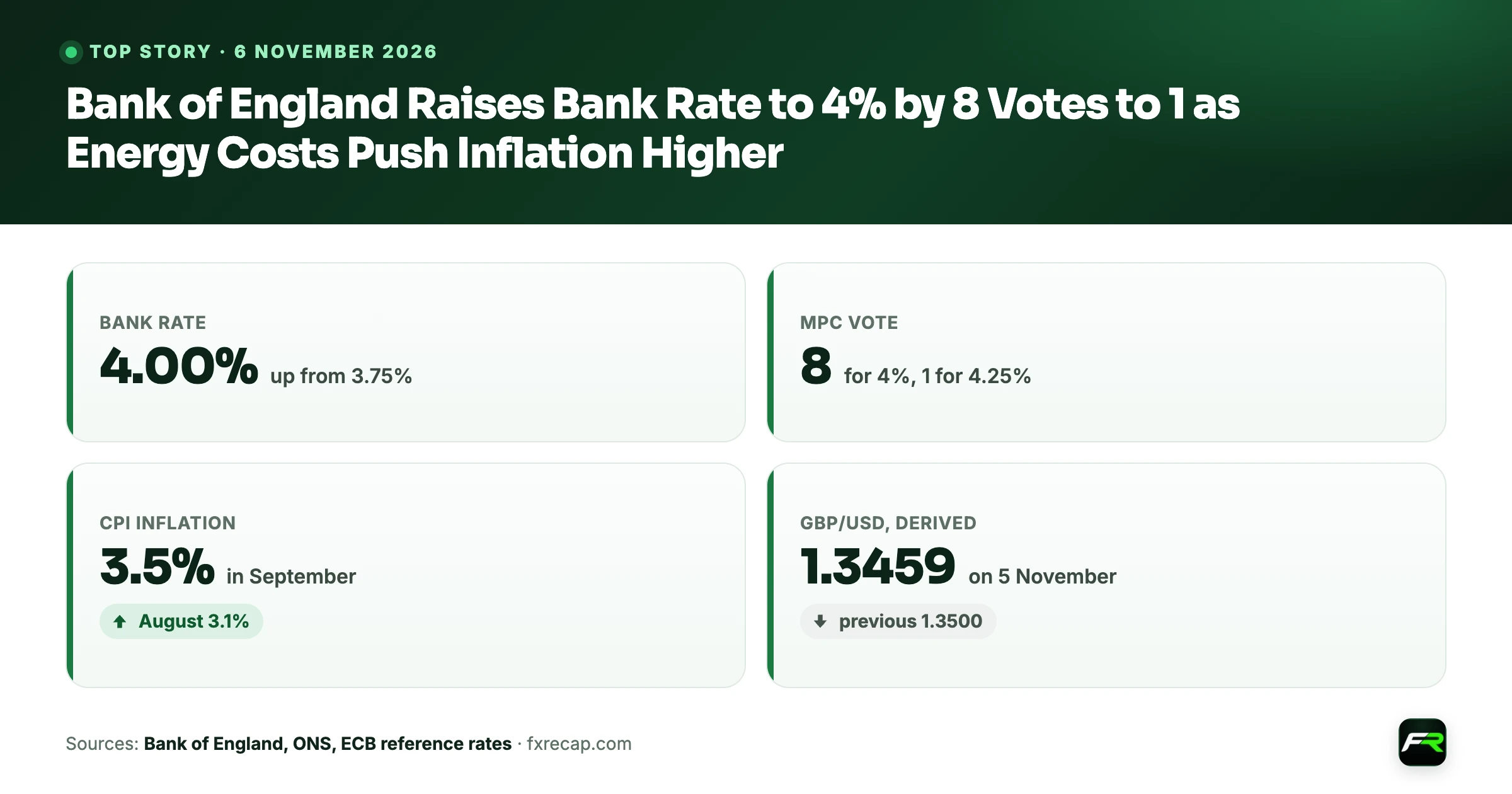
| Bank Rate (Bank of England) | 4.00%, up from 3.75% |
|---|---|
| MPC vote (Bank of England) | 8 for 4%, 1 for 4.25% |
| CPI inflation (ONS) | 3.5% in September (August 3.1%) |
| GBP/USD, derived (ECB reference rates) | 1.3459 on 5 November (previous 1.3500) |
What the Bank decided and why
Eight members backed the quarter-point rise: Andrew Bailey, Sarah Breeden, Swati Dhingra, Megan Greene, Clare Lombardelli, Huw Pill, Dave Ramsden and Alan Taylor. According to the minutes, they agreed that “the duration and scale of the energy price increase had generated sufficient inflationary pressures in the pipeline to warrant an increase in Bank Rate.” Views still differed among them on how much spare capacity the economy has and how tight policy already is.
Oil and gas drove the change of mind. Over the 15 UK working days to 27 October, front-month Brent crude futures averaged $108 a barrel and UK front-month gas futures 216 pence per therm. Those prices were 38% and 81% higher than when the July Monetary Policy Report was written. Direct energy effects added around one percentage point to September's 3.5% inflation rate, most of it through motor fuels.
Bank staff now expect headline CPI of around 4½% in the first quarter of 2027, about 1¼ points above the July forecast, and around 5% in the second quarter. Measures announced in the 28 October Budget are expected to take a quarter of a point off inflation by mid-2027, so the outlook would have been worse without them.
Growth helped the case too. Activity data “have generally been stronger than expected,” the summary said, adding to the argument for “modestly tighter monetary policy.” Benchmark two-year mortgage rates had already risen by nearly 50 basis points since the beginning of September, which shows how much tightening markets had done before the Bank moved.
What members said about the next step
The official line is that policy “is not on a pre-set path.” Inside the committee the tone varies a great deal, and the gap between members is what traders will price for 17 December, the next decision date.
- Andrew Bailey, the Governor, wrote that without news that softens the inflation risks, “I can see the argument for a further increase in rates and thereafter taking a more conditional approach.”
- Huw Pill, the chief economist, said “a single 25-basis point hike is unlikely to be sufficient” and that more tightening is likely, “including in the near term.”
- Megan Greene wrote that “additional hikes will likely be required going forward.”
- Clare Lombardelli said that unless pressures weaken, “there is likely to be a case for a further increase in rates in the near term.”
- Alan Taylor pushed the other way: “this is not the start of a hiking cycle,” he wrote, calling the move a “one-for-now” insurance hike. “The next move could be up, down, or sideways.”
Mann's case for 4.25% rested on credibility. She noted that projected CPI reaches 4.9% by mid-2027 on a path that already assumes energy prices fall, and that UK inflation has averaged 4.7% over five years of running above target. From a risk management view, she wrote, a 50-basis point move was “good policy”.
Put together, four members, including the Governor and the chief economist, openly discussed another rise soon, one argued for pausing after this step, and one wanted to move faster. That leaves December live but not certain. The Bank's own Market Participants Survey, cited in the minutes, showed a median expected path of 4% in November and 4.25% in February.
Why sterling slipped after the hike
A rate rise usually supports a currency, so a lower fixing needs explaining. The move was widely discussed beforehand. The Bank's survey showed respondents expected 4% in November, and the pound had gained about 1.6% against the dollar between 28 October and 4 November, so much of the news was already in the price. Taylor's warning against reading the move as the start of a cycle also gave sellers an argument.
The dollar was firm against everything on Thursday, which matters here. EUR/USD's reference rate fell to 1.1224 from 1.1267. EUR/GBP, by contrast, edged down to 0.8340 from 0.8346, so the pound gained slightly against the euro. Read together, those two pairs say sterling held up against Europe's currency and that most of the GBP/USD drop came from the dollar side.
GBP/USD levels after the decision
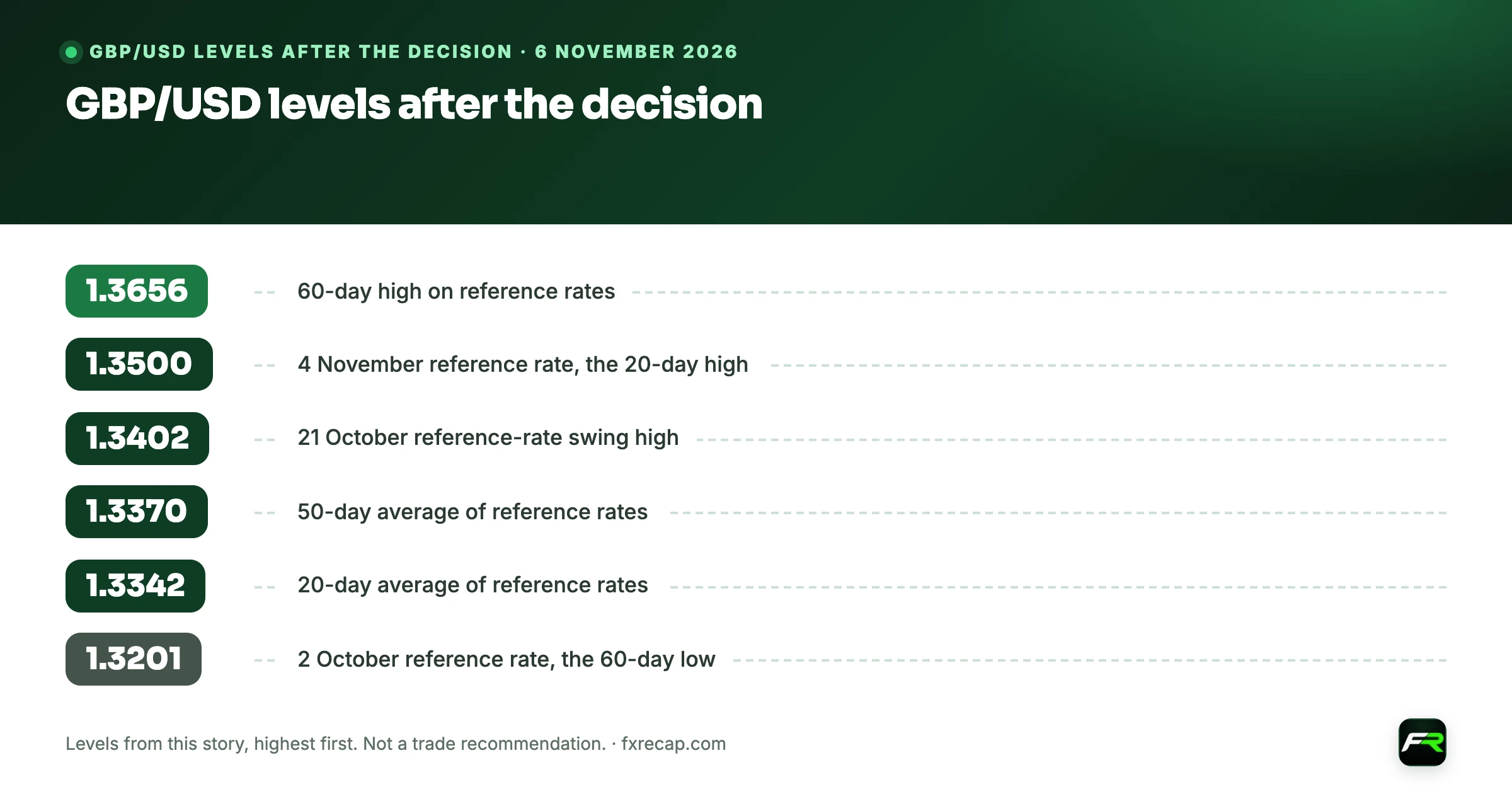
The levels below come from ECB reference rates, one fixing a day at about 13:15 UTC, converted to GBP/USD by dividing EUR/USD by EUR/GBP. They are not intraday highs or lows. Our analysis page shows the live price, which will differ during the day.
| Level | Why it matters |
|---|---|
| 1.3656 | 60-day high on reference rates |
| 1.3500 | 4 November reference rate, the 20-day high |
| 1.3402 | 21 October reference-rate swing high |
| 1.3370 | 50-day average of reference rates |
| 1.3342 | 20-day average of reference rates |
| 1.3201 | 2 October reference rate, the 60-day low |
GBP/USD still sits above its 20, 50 and 100-day averages, and its 14-day RSI on reference rates has cooled to about 61 from 66 the day before. So the trend into the meeting is intact; the hike simply did not extend it. A close back above 1.3500 would show buyers taking the hawkish guidance at face value. A fall through 1.3402 and then the averages near 1.334 to 1.337 would suggest the market is siding with Taylor's “one-for-now” reading.
What it means for traders
Sterling now trades on two questions: will energy prices keep climbing, and will December bring a second rise? The ONS releases that feed that second question come before 17 December, including October CPI and the next labour market figures, and each will be read against the Bank's 5% forecast. US data also matters for GBP/USD; Friday's October jobs report lands at 13:30 UTC.
- Read the minutes, not only the vote. Four members leaning towards another rise is a stronger signal than the 8-1 headline suggests.
- Watch oil and gas. The Bank tied its outlook directly to energy futures, so a sharp fall in Brent or UK gas would weaken the case for December.
- Compare EUR/GBP with GBP/USD. When sterling rises against both, it is a cleaner sign of a hawkish Bank than a move driven by the dollar.
- Use our GBP/USD analysis for live levels and the economic calendar for UK release times in your own zone.
Suppose you want to buy GBP/USD near 1.3460 with a stop below the 21 October swing high at 1.3395, 65 pips away. With a $5,000 account and 1% risk, the most you should lose is $50, so each pip can be worth about $0.77, roughly 7,700 units. If a data release on jobs day pushes the stop 20 pips past its level, the loss grows to about $65. Our <a href="/position-size-calculator">position size calculator</a> does this arithmetic for you.
Central bank decisions and the data that follow them can move currencies quickly, and prices can gap past stop orders. Leverage magnifies losses as well as gains, so only trade money you can afford to lose. This article is news and education, not a recommendation to buy or sell.
Decision, vote, projections, energy prices and member quotes are from the Bank of England's November 2026 Monetary Policy Summary and minutes, published on 5 November. September CPI is from the ONS. GBP/USD, EUR/USD and EUR/GBP are ECB euro reference rates or derived from them.
Cite this guide
FX Recap, "Bank of England Raises Bank Rate to 4% by 8 Votes to 1 as Energy Costs Push Inflation Higher", updated 6 November 2026, https://fxrecap.com/forex-news/top-stories/bank-of-england-raises-rate-to-4-percent
Free to quote with a link. Journalists: data and comment in our press room.
Frequently asked
What is the Bank of England interest rate now?
Bank Rate is 4%. The Monetary Policy Committee raised it from 3.75% on 5 November 2026 by eight votes to one. Catherine L Mann voted for a larger rise to 4.25%.
Why did the Bank of England raise rates in November 2026?
Higher energy prices linked to the Middle East conflict pushed UK CPI inflation to 3.5% in September, and the Bank expects it to reach around 5% by mid-2027. The committee judged that this pipeline pressure, together with stronger-than-expected activity, warranted a rise.
When is the next Bank of England decision?
The next decision is on Thursday 17 December 2026 at 12:00 UK time, when the minutes of that meeting are also published.
How did the pound react to the rate rise?
On ECB reference rates, GBP/USD was 1.3459 on 5 November, down from 1.3500 a day earlier, while EUR/GBP edged lower to 0.8340, a small gain for sterling against the euro. The dollar was firm across the board that day.
Sources: Bank of England: Monetary Policy Summary and minutes, November 2026 · Bank of England: Monetary Policy Report, November 2026 · ECB: euro foreign exchange reference rates · Office for National Statistics: Consumer price inflation, UK, September 2026 · Bank of England: upcoming MPC dates
The team behind this guide
Researched, checked and approved by five forex specialists
Every guide is written, fact-checked and edited before it goes live, and updated when the facts change. Spotted an error? Tell us.