IC Markets

 3:09
 2:39
 2:10
 2:18
 3:43
 8:42




































Forex Week in Review: Australian Dollar Drops 2.2% Despite an RBA Hike as Gold Gains 5%
Two rate rises, euro inflation at 4% and a strong US jobs report, yet the biggest moves came in the Aussie dollar and gold. The week's measured changes.
 WriterAbir KhanWriterWrites the guides · checks every figure against primary sources View profileAbout Abir →

 Market analysisTanbir Habib RiyadForex & Crypto AnalystForex and crypto analyst · technical and fundamental analysis View profileAbout Tanbir →

 Fact-checking & riskJannatul FerdaushFact-Checker & Risk AnalystFact-checks every figure · risk analysis · Applied Statistics, University of Dhaka View profileAbout Jannatul →

 Trading reviewJowel RanaForex TraderForex trader · reviews guides from a trader's view View profileAbout Jowel →

 Final approvalRanjan N. MondolForex TraderForex trader · signs off every guide View profileAbout Ranjan →

Central banks did most of the talking this week, but the price moves did not follow the script. The Reserve Bank of Australia raised its cash rate to 4.85% on Tuesday, yet the Australian dollar ended the week as the weakest major currency we track. Gold, which pays no interest and normally dislikes rising rates, gained about 5%. The US dollar finished almost flat against the euro and the pound.
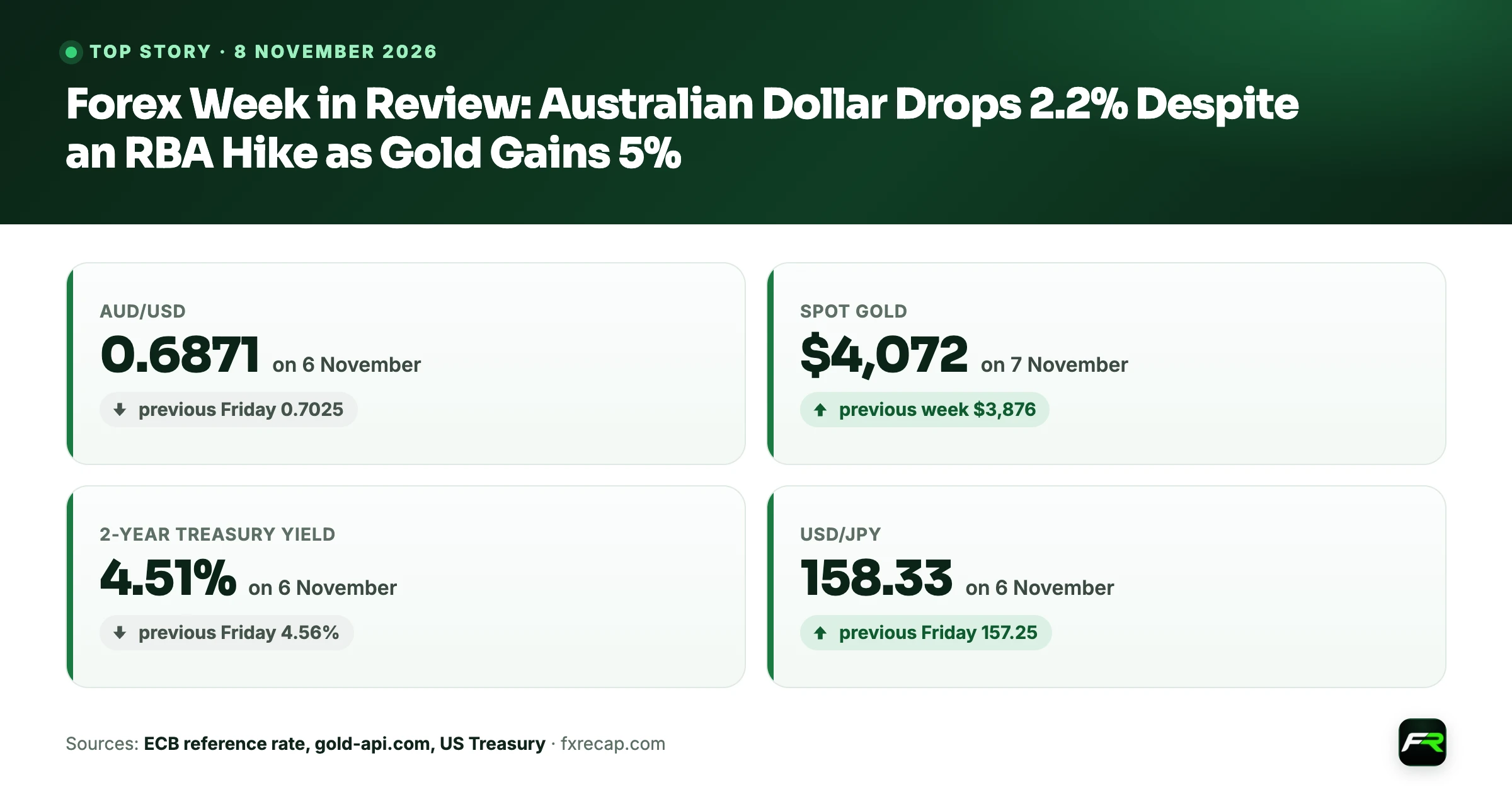
Here is what happened, measured from official daily rates rather than intraday quotes. Currency figures are European Central Bank (ECB) euro reference rates, set at about 13:15 UTC each working day, with dollar crosses derived from them. Gold is spot from gold-api.com, read once a day by our own log. Yields are the US Treasury's daily par yield curve.
| AUD/USD (ECB reference rate) | 0.6871 on 6 November (previous Friday 0.7025) |
|---|---|
| Spot gold (gold-api.com) | $4,072 on 7 November (previous week $3,876) |
| 2-year Treasury yield (US Treasury) | 4.51% on 6 November (previous Friday 4.56%) |
| USD/JPY (ECB reference rate) | 158.33 on 6 November (previous Friday 157.25) |
Five days, five big releases
The calendar was crowded from Tuesday onwards. In Sydney the RBA lifted its cash rate target by a quarter point to 4.85%, its fifth rise of 2026, with six Board members in favour and three wanting to hold. New staff forecasts showed headline inflation of 4.5% by December, well above the 2 to 3% target band.
Wednesday brought two more data points. Eurostat's flash estimate put euro area inflation at 4.0% in October, up from 3.8%, with energy prices 20.8% higher than a year earlier. Stats NZ reported that New Zealand's unemployment rate rose to 5.7% in the September quarter. Washington added its quarterly refunding plan, keeping auction sizes unchanged at $125 billion across 3-year, 10-year and 30-year sales.
Thursday belonged to London. The Bank of England raised Bank Rate to 4% by eight votes to one, with one member wanting a half-point move, and warned that inflation could reach about 5% by mid-2027. Across the Atlantic, the BLS said nonfarm productivity grew at a 3.6% annual pace in the third quarter, while unit labour costs fell.
Friday closed the week with the October jobs report. Payrolls rose 165,000, unemployment slipped to 4.1% and average hourly earnings climbed 0.4%, with earlier months revised up by 84,000. US midterm results also arrived during the week; those are not official counts, so we cover them only as reported elsewhere and leave them out of the figures here.
The scorecard: what moved and by how much
The table compares Friday 6 November with Friday 30 October for currencies, using ECB reference rates. Gold compares our reading at 03:31 UTC on 7 November, after Friday's close, with the reading at 03:14 UTC on 31 October. A minus sign means the first currency in the pair fell against the second, or that gold fell.
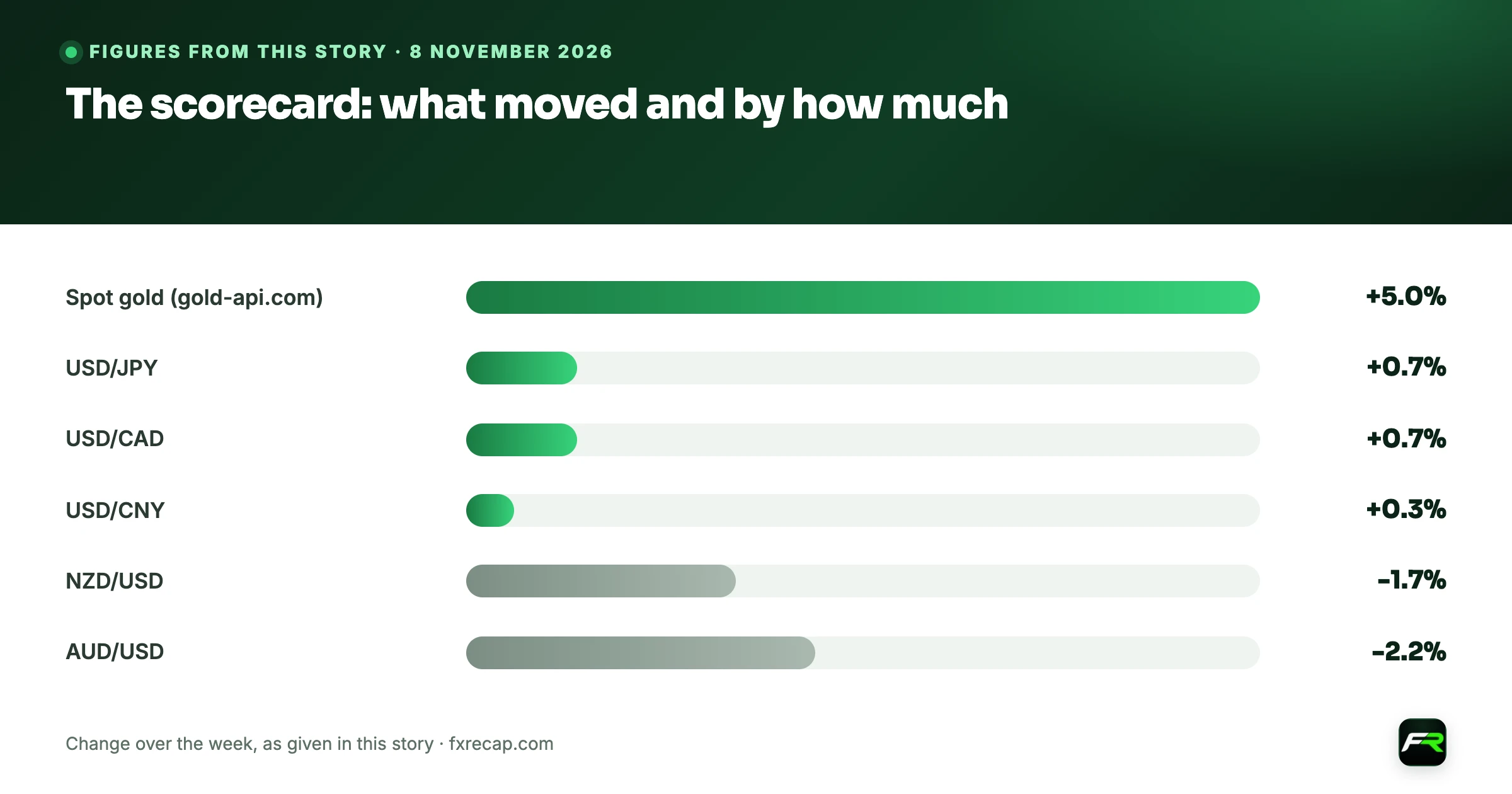
| Market | Change over the week |
|---|---|
| Spot gold (gold-api.com) | +5.0% |
| USD/JPY | +0.7% |
| USD/CAD | +0.7% |
| USD/CNY | +0.3% |
| NZD/USD | -1.7% |
| AUD/USD | -2.2% |
Two majors barely moved and so are left out of the table. EUR/USD went from 1.1172 to 1.1165, a change of less than 0.1%, although it travelled to 1.1267 on Wednesday along the way. GBP/USD slipped from 1.3399 to 1.3385 after touching 1.3500 on 4 November, the day before the Bank of England's rise. Both pairs gave back their midweek gains by Friday.
Why the Australian dollar stands out
Most of the Australian dollar's fall came on one day. AUD/USD was 0.7001 at Thursday's fixing and 0.6871 at Friday's, a drop of about 1.9% between two reference rates set 24 hours apart. The New Zealand dollar fell 1.4% over the same window, to 0.5543. Because the ECB sets its rates before US data, the move came before the jobs report, not because of it.
No official source we checked explains Friday's drop, and we will not guess at a cause. What the figures do show is that the RBA's rise on Tuesday did not lift the currency: AUD/USD was 0.6984 on Tuesday's fixing, below Monday's 0.7008. The split vote may have mattered here. With three members preferring to wait, markets may judge that the Board is close to the end of its tightening.
Friday's 0.6871 is the lowest reference rate in 60 working days, below the 15 October swing low of 0.6911. The 14-day relative strength index (RSI) on reference rates fell to about 31, close to the 30 line that many traders treat as stretched. On the euro cross, EUR/AUD climbed from 1.6033 to 1.6250 in a single day, so the weakness was in the Aussie itself rather than a dollar rally.
Gold climbed while yields fell
Gold's rise fits the bond market better than it fits the central banks. Over the week the 2-year Treasury yield eased from 4.56% to 4.51% and the 10-year from 4.94% to 4.86%, even with a strong jobs report on Friday. Lower yields reduce the cost of holding a metal that pays nothing, and that tends to support it.
The path was bumpy. Spot gold was $3,876 after the previous Friday's close, reclaimed $4,000 by Wednesday morning and reached $4,138 in our Thursday reading at 04:22 UTC. It then dropped to about $4,046 on Friday, before settling near $4,072 after the jobs data. Our log takes one reading a day, so these are snapshots, not highs or lows.
Yields did most of their falling on Thursday, when the 2-year dropped 12 basis points to 4.46% on the day of the productivity report. Friday's payrolls lifted it back to 4.51%, but not to the 4.61% of Tuesday. USD/JPY, which usually tracks that yield, still edged higher to 158.33, near the top of its 20-day range of 156.80 to 158.60.
Lessons from a week of surprises
Two points stand out for anyone who trades around central bank days. A rate rise does not guarantee a stronger currency. Markets price what they expect in advance, so the vote split, the forecasts and the tone of the statement often matter more than the decision itself, as the RBA's 6 to 3 vote showed on Tuesday.
Data surprises also fade quickly when the wider trend points the other way. Friday's jobs report was strong, yet yields still ended the week lower and gold still finished higher. Weekly figures like these help you see which moves lasted and which reversed within hours, which is useful when you set stops and targets for the next week.
What it means for traders next week
- Start with China. October consumer and producer prices are due on Monday at 09:30 Beijing time (01:30 UTC), and the Australian dollar is the major currency most exposed to Chinese demand. See our China inflation preview.
- Treat AUD/USD near 0.6871 with care. A pair at a 60-day low with RSI near 30 can bounce sharply, but it can also keep falling. Wait for a reference rate back above 0.6911 before calling a turn.
- Watch US inflation on Tuesday 10 November at 13:30 UTC. After this week's payrolls, a firm reading would test gold's gains and the fall in yields.
- Follow the Treasury auctions on 9, 10 and 12 November. Weak demand for the 10-year or 30-year could lift long yields, which matters for gold and USD/JPY.
- Check the live price and levels on our AUD/USD analysis and release times on the economic calendar.
Say you think the Australian dollar's slide has gone far enough and plan to buy AUD/USD at 0.6880 with a stop at 0.6840, 40 pips away. On a $3,000 account risking 1%, your maximum loss is $30, so each pip can be worth about $0.75, roughly 7,500 units. If Monday's China data opens the market 25 pips below your stop, the loss grows to about $49. Check the size first with our <a href="/position-size-calculator">position size calculator</a>.
Currencies can gap at the Monday open and after data releases, and stop orders may fill at worse prices than planned. Leverage magnifies losses as well as gains, so only trade money you can afford to lose. This article is news and education, not a recommendation to buy or sell.
Currency figures are ECB euro reference rates for 30 October to 6 November 2026, with USD crosses derived from them. Gold is gold-api.com spot from our daily log. Yields are US Treasury daily par yield curve rates. Central bank and data details come from the RBA, Bank of England, Eurostat, Stats NZ, US Treasury and BLS releases covered in our stories this week.
Cite this guide
FX Recap, "Forex Week in Review: Australian Dollar Drops 2.2% Despite an RBA Hike as Gold Gains 5%", updated 8 November 2026, https://fxrecap.com/forex-news/top-stories/forex-week-review-aud-falls-gold-gains
Free to quote with a link. Journalists: data and comment in our press room.
Frequently asked
Why did the Australian dollar fall this week?
AUD/USD fell from 0.7025 to 0.6871 on ECB reference rates, with most of the drop on Friday 6 November. The RBA's rise to 4.85% did not lift it, and no official source gives a single cause for Friday's fall.
How much did gold rise this week?
Spot gold rose about 5%, from $3,876 after the previous Friday's close to about $4,072 on 7 November (gold-api.com). It reached $4,138 in our Thursday reading before easing.
What did US Treasury yields do this week?
The 2-year yield eased from 4.56% to 4.51% and the 10-year from 4.94% to 4.86% between 30 October and 6 November, according to Treasury par yields, despite a strong jobs report.
What are the key events next week?
China's October CPI and PPI on Monday at 01:30 UTC, US consumer prices on Tuesday at 13:30 UTC, UK third-quarter GDP on Thursday at 07:00 UTC and US producer prices on Friday, plus Treasury auctions on 9, 10 and 12 November.
Sources: ECB: euro foreign exchange reference rates · US Treasury: daily par yield curve rates · Reserve Bank of Australia: Statement by the Monetary Policy Board, 3 November 2026 · Bank of England: Monetary Policy Summary, November 2026 · US Bureau of Labor Statistics: Employment Situation, October 2026 · Gold API: spot gold price
The team behind this guide
Researched, checked and approved by five forex specialists
Every guide is written, fact-checked and edited before it goes live, and updated when the facts change. Spotted an error? Tell us.