





























How to Check a Broker Is FCA Regulated, Step by Step
Search the FCA Firm Checker, confirm the status says Authorised, then match the website, phone and the entity in your client agreement. Clone firms copy real FRNs, so a number proves little.
 WriterAbir KhanWriterWrites the guides · checks every figure against primary sources View profileAbout Abir →
 Market analysisTanbir Habib RiyadForex & Crypto AnalystForex and crypto analyst · technical and fundamental analysis View profileAbout Tanbir →
 Fact-checking & riskJannatul FerdaushFact-Checker & Risk AnalystFact-checks every figure · risk analysis · Applied Statistics, University of Dhaka View profileAbout Jannatul →
 Trading reviewJowel RanaCo-Founder & Forex TraderCo-founder · forex trader · reviews guides from a trader's view View profileAbout Jowel →
 Final approvalRanjan NiskrityFounder, Owner & Forex TraderFounder and owner · forex trader · signs off every guide View profileAbout Ranjan →
To check whether a broker is FCA regulated, search its name or firm reference number (FRN) on the FCA’s Firm Checker or the full Financial Services Register. You want to see a status of Authorised, permissions that cover dealing in investments, and contact details that match the website you are on. Then open your client agreement and confirm the company named there is that same UK entity, not an overseas sister company with a similar name.
Most online guides stop at step one. That is the mistake that costs people money, because clone firms copy real names and FRNs, and some big brands run a UK firm for show while signing customers up offshore. The ten-minute routine below covers all of it.
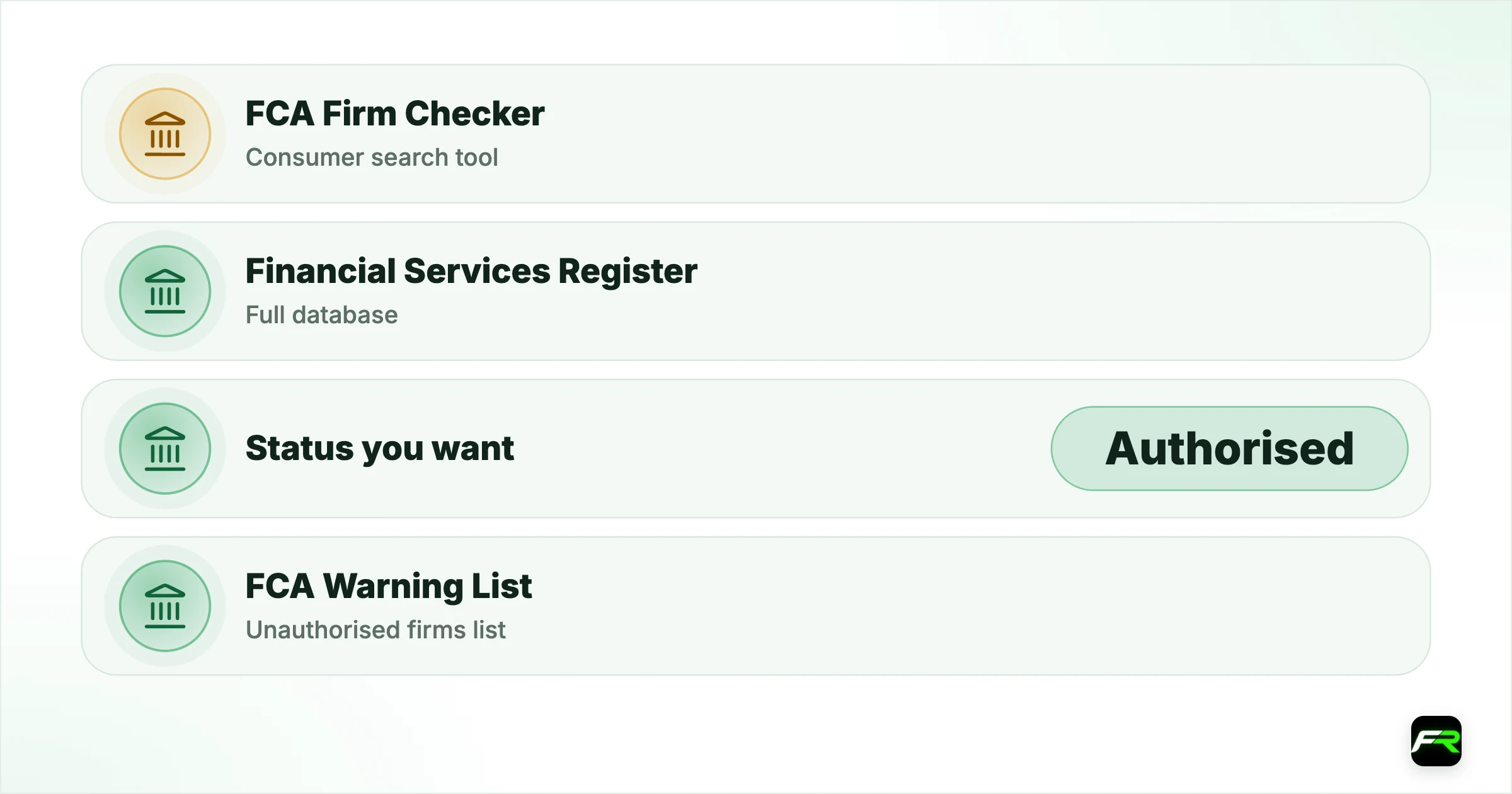
| Consumer search tool | FCA Firm Checker |
|---|---|
| Full database | Financial Services Register (register.fca.org.uk) |
| Status you want | Authorised |
| Unauthorised firms list | FCA Warning List |
| FCA consumer helpline | 0800 111 6768 |
| Time needed | About 10 minutes |
The ten-minute checklist
- Find the legal name and FRN on the broker’s site. UK firms must show them, usually in the footer or the legal documents page. A missing FRN is a warning sign on its own.
- Search the Firm Checker or Register yourself. Type the address into your browser rather than clicking a link from the broker, an email or an advert.
- Confirm the status reads Authorised and that the record is current, not Cancelled or No longer authorised.
- Open the permissions tab. A CFD or spread betting provider needs permission to deal in investments as principal (or agent) with retail clients.
- Compare contact details. Website address, phone number, email domain and head office address should match what the broker uses with you.
- Read the trading names and check the brand you know is listed against that FRN.
- Search the Warning List for the brand name and web address, including lookalike spellings.
- Check your client agreement. The contracting entity and governing law should be the UK firm and English (or Scottish) law.
- If anything does not match, stop and call the FCA on 0800 111 6768 before sending money.
Firm Checker versus the full Register
The FCA runs two routes into the same data. Firm Checker is the simpler consumer tool on fca.org.uk: you enter a name, it tells you whether the firm is authorised and what it can do, and it links to warnings. The Financial Services Register at register.fca.org.uk is the full record, with tabs for permissions, trading names, individuals, appointed representatives, passport history and more. We suggest starting with Firm Checker and then opening the Register entry for the detail.
Search by FRN where you can. A name search for a large brand can return a dozen entries, including old companies, subsidiaries and firms with no connection at all. The FRN is unique, so it pins down exactly one record, and it is the number clone firms copy, which is why the remaining steps matter.
What each Register status means
| What you see | What it means for you | Safe to trade CFDs or spread bets? |
|---|---|---|
| Authorised | The firm can carry on the regulated activities listed in its permissions. FCA conduct rules apply. | Yes, if the permissions fit and the details match |
| Registered | Registered for a narrow regime (for example certain e-money or cryptoasset businesses), not authorised to provide regulated investment products. FOS and FSCS access is unlikely. | No |
| Appointed representative | Not authorised itself. It acts under a principal firm that takes responsibility for its regulated activities. | Only if the principal is authorised for the activity and you know who you contract with |
| No longer authorised / Cancelled | The firm used to be authorised and is not now. | No |
| EEA authorised or temporary permission | EEA passporting ended on 31 December 2020 and the Temporary Permissions Regime ended on 30 December 2023. No firms remain in it. | Any such record is historical |
| Not on the Register / on the Warning List | Unauthorised. The FCA may have warned it is targeting UK residents. | No UK protection at all |
"Registered" catches people out because it sounds official. A firm that is registered but not authorised cannot sell you a regulated investment product, and you would struggle to reach the Financial Ombudsman or the FSCS if it went wrong. When a broker says "FCA registered" rather than "authorised and regulated by the FCA", treat the wording as a prompt to look harder.
Appointed representatives
An appointed representative (AR) is a business that carries on some regulated activities under the umbrella of an authorised principal. The principal is responsible for it. ARs are common among introducers and advisers, and rarer among dealing brokers. If a trading firm shows up as an AR, check the principal’s own entry, confirm that the principal holds the relevant permissions, and find out which of the two companies holds your money.
Clone firms: why matching details matters
A clone firm copies a genuine firm’s name, address and FRN, then uses its own website, phone number and email. Search the FRN and you land on a real, authorised record. The only giveaway is that the contact details on that record do not match the ones you are being given. That is why the FCA tells people to use only the contact details on the Register, not the ones in an email or advert.
Watch for small differences: an extra hyphen in the domain, a .co instead of .com, a mobile number where the Register shows a landline, a Gmail or Outlook address. If the Register entry has no website listed at all, call the FCA helpline rather than assuming it is fine. Our scams and Report Fraud guide explains what to do if you have already paid.
The Warning List only shows firms the FCA already knows about. New scam sites appear daily, so absence from the list is not proof of safety. The FCA published 2,329 warnings about unauthorised firms in 2025.
The same-brand, offshore-entity check
This is the step most readers skip. Many global broker brands own a UK authorised company and several offshore companies with near-identical names. The UK company appears on the Register and the brand’s homepage may mention the FCA, yet you can still be signed up by the offshore arm, sometimes after a pop-up offering higher leverage or a bonus. In that case the FCA badge on the website tells you nothing about your own account.
On 25 September 2026 the FCA said 24 CFD firms have closed or are closing after it challenged firms that carry out little UK business but use their authorisation "as a badge" for linked overseas companies. We cover that in our write-up of the 2026 CFD crackdown. To protect yourself:
- Open the client agreement or terms of business and find the full legal name of the company you contract with.
- Look up that exact company, not just the brand, on the Register.
- Check the governing law and complaints clause: a UK firm will refer you to the Financial Ombudsman Service.
- Confirm your leverage on major pairs is capped at 30:1. An offer of 500:1 means you are outside UK retail rules.
- Review the risk warning. UK firms publish the percentage of their retail accounts that lose money.
Ben found a broker through a YouTube advert. The homepage footer mentioned an FCA-authorised company and an FRN, which he searched: the record said Authorised, with the right permissions. His broker’s phone number, though, started +248, while the Register showed a London landline. The draft client agreement he was sent named a Seychelles company under Seychelles law and offered 1:500 leverage and a 50% deposit bonus. He called the FCA helpline, which confirmed the UK firm’s listed website was different. Ben did not deposit his £5,000, and instead opened an account directly with a firm whose agreement named the UK entity and capped his GBP/USD leverage at 30:1.
Other things worth a look while you are there
The Register also lists the senior managers and approved individuals at a firm, any disciplinary history, and, for firms that can hold client money, whether that permission exists. A dealing broker that holds your deposits should be permitted to hold client money under the FCA’s CASS rules, which require it to be kept in segregated accounts away from the firm’s own funds.
Beyond the Register, look up the firm on Companies House (a UK authorised firm will usually be a UK company with filed accounts), and read the latest retail loss percentage on its site. Our regulators page lists other bodies worth knowing, and our broker methodology shows how FX Recap scores regulation in reviews.
Check again after a rebrand or a new web address
A Register check is a snapshot. Brands change names, move domains and shift customers between companies, and each change is a moment when clone sites and phishing emails appear. Two live examples from 2026: City Index customers moved to the StoneX Trading brand in September 2026, run by StoneX Financial Ltd (FRN 446717), and IC Markets switched its website from icmarkets.com to ic.com on 11 July 2026. After a change like that, confirm the new brand name is listed as a trading name against the same FRN, and that the new web address appears on the Register entry.
Where the firm has no UK authorisation at all, a rebrand changes nothing about your protection. IC is a good illustration: our explainer on whether IC Markets is FCA regulated covers its status, and our guide to IC Markets clone sites shows the lookalike domains that copy it.
Save a screenshot of the Register entry and your signed client agreement on the day you open the account. If you ever need to complain to the Ombudsman or claim on the FSCS, those two documents show exactly who you were dealing with.
Frequently asked
What is an FRN?
The firm reference number is a unique number the FCA gives every firm and individual on its Register. It identifies one specific legal entity. Clone firms copy genuine FRNs, so you must also check that the website, phone number and email on the Register match the ones you are using.
Is "FCA registered" the same as FCA regulated?
No. Registered firms are on the Register under narrow regimes and cannot provide regulated investment products such as CFDs or spread bets. A broker should be authorised. If a firm stresses "registered", look up its status and permissions before you deposit anything.
The FRN matches but the phone number does not. What now?
Treat it as a probable clone. Do not call the number on the website or reply to emails. Contact the genuine firm using the details on the Register, and ring the FCA on 0800 111 6768. If you have already sent money, contact your bank immediately and report it to Report Fraud.
Does being on the FCA Register mean my money is protected?
It means the firm must follow FCA rules, including keeping client money segregated. FSCS cover of up to £85,000 per person per firm applies if an authorised firm fails and cannot return your money. It never covers trading losses, and it does not cover an offshore sister company.
Can a big, well-known brand still sign me up offshore?
Yes. Many groups own a UK firm and several overseas firms under similar names. What protects you is the entity named in your client agreement, so check it and look up that exact company on the Register.
What if the broker is not on the Register at all?
It is not authorised to provide investment services to UK retail customers. Search the Warning List too. Even without a warning, dealing with it means no FCA conduct rules, no Financial Ombudsman and no FSCS.
Do I need to check again after opening an account?
It is sensible to check once a year and whenever something changes, such as a new website, a request to move to a new entity or a change in payment details. Firms can lose permissions, and the FCA said in September 2026 that 24 CFD firms had closed or were closing.
Related reading
The team behind this guide
Researched, checked and approved by five forex specialists
Every guide is written, fact-checked and edited before it goes live, and updated when the facts change. Spotted an error? Tell us.