 IC Markets



































The short answer
If your account sits with a broker entity authorised by the FCA, ASIC, CFTC/NFA, FINMA, BaFin, CIRO, MAS or Japan's FSA, you get strong supervision, strict rules on client money and, in some countries, a compensation scheme if the firm fails.
Brokers licensed in Seychelles, Vanuatu, Belize or St Vincent usually offer far less. If one of them collapses, there is normally no fund to claim from and no ombudsman to hear your case.
Many global brokers run several regulated companies under one brand. The licence that matters is the one held by the company that opens your account, and that is named in your client agreement.
How we tier forex regulators
One question decides the tier: if the broker collapsed tomorrow, what would you realistically get back, and who would make them pay it?
Strict capital, reporting and conduct rules, active enforcement, and in several countries a compensation scheme behind the licence.
Segregated money, leverage caps, an ombudsman and often a payout fund
14 regulatorsLicensing and reporting are genuine. What you get back after a collapse can be smaller, slower or missing compared with Tier 1.
Real supervision, with thinner redress in some countries
48 regulatorsA licence exists and costs money, but day to day supervision is light and there is no fund behind it.
A named regulator, and little else if the firm fails
12 regulatorsCompany registries and pay-to-print badges, plus countries where retail margin forex has no legal licence category at all.
Nothing you can rely on as a trader
21 regulatorsForex regulator directory
Pick a tier, a continent or a country, or search for the name printed in your broker's small print.
Showing 95 of 95 regulators
FCA
Tier 1Financial Conduct Authority
The FCA is widely regarded as one of the world's most respected financial regulators for retail forex brokers. It fines firms, bans products, and the FSCS pays out when one fails.
register.fca.org.uk- Max leverage
- 30:1
- Payout limit
- £85,000
- Protection 4/4

FINMA
Tier 1Swiss Financial Market Supervisory Authority
FINMA requires firms to meet strict licensing requirements, resulting in a relatively small number of authorised forex providers. Deposit protection runs through the banking scheme.
finma.ch- Max leverage
- No fixed cap
- Payout limit
- CHF 100,000
- Protection 4/4
BaFin
Tier 1Federal Financial Supervisory Authority
EU rules with German follow-through. BaFin actively supervises investment firms and has the authority to impose product intervention measures where necessary.
bafin.de- Max leverage
- 30:1
- Payout limit
- €20,000
- Protection 4/4

CySEC
Tier 2Cyprus Securities and Exchange Commission
Full EU rules, a real compensation fund, and more licensed forex brokers than any other regulator. Payouts from the Investor Compensation Fund depend on its eligibility rules, so treat the €20,000 as a last resort rather than a promise.
cysec.gov.cy- Max leverage
- 30:1
- Payout limit
- €20,000
- Protection 4/4

MFSA
Tier 2Malta Financial Services Authority
The same EU rulebook as Germany or France, enforced by a much smaller supervisory team.
mfsa.mt- Max leverage
- 30:1
- Payout limit
- Up to €20,000
- Protection 4/4
AMF
Tier 2Autorité des Marchés Financiers
Full MiFID II rules and an assertive marketing watchdog that keeps a public blacklist of unauthorised forex sites.
amf-france.org- Max leverage
- 30:1
- Payout limit
- €20,000
- Protection 4/4

CONSOB
Tier 2Commissione Nazionale per le Società e la Borsa
Same EU rulebook, with one of the more active site-blocking programmes against unlicensed brokers in the bloc.
consob.it- Max leverage
- 30:1
- Payout limit
- €20,000
- Protection 4/4

CNMV
Tier 2Comisión Nacional del Mercado de Valores
Standard EU protections, enforced through a public warning list that names unauthorised firms targeting Spanish residents.
cnmv.es- Max leverage
- 30:1
- Payout limit
- €20,000
- Protection 4/4
AFM
Tier 2Autoriteit Financiële Markten
Full EU rulebook, layered with some of the strictest national marketing restrictions on leveraged products.
afm.nl- Max leverage
- 30:1
- Payout limit
- €20,000
- Protection 4/4
FSMA
Tier 2Financial Services and Markets Authority
Went further than the rest of the EU in 2016 and banned selling leveraged forex and CFDs to Belgian retail clients outright.
fsma.be- Max leverage
- Sale banned to retail
- Payout limit
- €20,000
- Protection 4/4
CBI
Tier 2Central Bank of Ireland
Full EU protections and the licence several UK-founded brokers now use for the rest of the EU post-Brexit.
centralbank.ie- Max leverage
- 30:1
- Payout limit
- €20,000
- Protection 4/4

CSSF
Tier 2Commission de Surveillance du Secteur Financier
Standard EU rules, run by the regulator best known for overseeing the country's much larger fund industry.
cssf.lu- Max leverage
- 30:1
- Payout limit
- €20,000
- Protection 4/4
FMA Austria
Tier 2Finanzmarktaufsicht
Full EU rulebook, with an active investor-warning list for firms operating without an Austrian licence.
fma.gv.at- Max leverage
- 30:1
- Payout limit
- €20,000
- Protection 4/4

CMVM
Tier 2Comissão do Mercado de Valores Mobiliários
Standard EU protections, enforced through one of the bloc's more frequently updated unauthorised-firm lists.
cmvm.pt- Max leverage
- 30:1
- Payout limit
- €20,000
- Protection 4/4

HCMC
Tier 2Hellenic Capital Market Commission
Full EU rulebook with a payout ceiling slightly above the EU floor.
hcmc.gr- Max leverage
- 30:1
- Payout limit
- €30,000
- Protection 4/4
FI Sweden
Tier 2Finansinspektionen
Standard EU protections, run by the same supervisor responsible for the country's banks and insurers.
fi.se- Max leverage
- 30:1
- Payout limit
- €20,000
- Protection 4/4

Denmark FSA
Tier 2Finanstilsynet
Full EU rulebook, enforced by the same body that supervises Danish banks and pension funds.
dfsa.dk- Max leverage
- 30:1
- Payout limit
- €20,000
- Protection 4/4

FIN-FSA
Tier 2Finanssivalvonta
Standard EU protections. Very few brokers are headquartered here, so most licences cover a branch.
finanssivalvonta.fi- Max leverage
- 30:1
- Payout limit
- €20,000
- Protection 4/4

Norway Finanstilsynet
Tier 2Finanstilsynet
Outside the EU but inside the EEA, so it mirrors the same MiFID II rulebook with a national payout ceiling.
finanstilsynet.no- Max leverage
- 30:1
- Payout limit
- NOK 200,000
- Protection 4/4

KNF
Tier 2Komisja Nadzoru Finansowego
Full EU rulebook and one of the more aggressively updated warning lists for firms without a Polish passport.
knf.gov.pl- Max leverage
- 30:1
- Payout limit
- €20,000
- Protection 4/4
CNB Czechia
Tier 2Česká národní banka
Standard EU protections, run by the country's central bank rather than a standalone conduct authority.
cnb.cz- Max leverage
- 30:1
- Payout limit
- €20,000
- Protection 4/4
NBS
Tier 2Národná banka Slovenska
Full EU rulebook, enforced through the national central bank's supervisory arm.
nbs.sk- Max leverage
- 30:1
- Payout limit
- €20,000
- Protection 4/4

MNB
Tier 2Magyar Nemzeti Bank
Standard EU protections, folded into the central bank's supervisory mandate since 2013.
mnb.hu- Max leverage
- 30:1
- Payout limit
- €20,000
- Protection 4/4
ASF Romania
Tier 2Autoritatea de Supraveghere Financiară
Full EU rulebook, run by a regulator that also oversees insurers and pension funds.
asfromania.ro- Max leverage
- 30:1
- Payout limit
- €20,000
- Protection 4/4

FSC Bulgaria
Tier 2Financial Supervision Commission
Standard EU protections, and one of the lower-cost EU jurisdictions for a broker to license in.
fsc.bg- Max leverage
- 30:1
- Payout limit
- €20,000
- Protection 4/4
HANFA
Tier 2Hrvatska agencija za nadzor financijskih usluga
Full EU rulebook since accession, run by the national non-bank financial supervisor.
hanfa.hr- Max leverage
- 30:1
- Payout limit
- €20,000
- Protection 4/4

Bank of Lithuania
Tier 2Lietuvos bankas
Standard EU protections. Its light-touch fintech licensing has made it a popular EU base for newer brokers.
lb.lt- Max leverage
- 30:1
- Payout limit
- €20,000
- Protection 4/4

Estonia FSA
Tier 2Finantsinspektsioon
Full EU rulebook, run by a joint banking and securities supervisor.
fi.ee- Max leverage
- 30:1
- Payout limit
- €20,000
- Protection 4/4

Bank of Latvia
Tier 2Latvijas Banka
Standard EU protections, absorbed into the central bank's supervisory role in 2023.
bank.lv- Max leverage
- 30:1
- Payout limit
- €20,000
- Protection 4/4

ATVP
Tier 2Agencija za trg vrednostnih papirjev
Full EU rulebook, run by the country's dedicated securities market agency.
a-tvp.si- Max leverage
- 30:1
- Payout limit
- €20,000
- Protection 4/4
Central Bank of Iceland
Tier 2Seðlabanki Íslands
EEA member mirroring the EU rulebook. The former FME merged into the central bank in 2020, which now supervises investment firms directly.
cb.is- Max leverage
- 30:1
- Payout limit
- ISK equivalent of €20,000
- Protection 4/4
FMA Liechtenstein
Tier 2Finanzmarktaufsicht Liechtenstein
EEA member mirroring MiFID II, and a common EU-passport base for firms that want a smaller regulator.
fma-li.li- Max leverage
- 30:1
- Payout limit
- €20,000
- Protection 4/4
ASIC
Tier 1Australian Securities and Investments Commission
Hard caps and real enforcement since 2021. There is no compensation fund, so a collapse puts you in the creditor queue.
asic.gov.au- Max leverage
- 30:1
- Payout limit
- None
- Protection 3/4
NZ FMA
Tier 1Financial Markets Authority
Clean licensing and honest reporting, but no hard leverage limit and nothing to claim against if the firm goes under.
fma.govt.nz- Max leverage
- No fixed cap
- Payout limit
- None
- Protection 3/4

VFSC
Tier 3Vanuatu Financial Services Commission
A real dealer licence, modest capital, obtainable in weeks. Common on the offshore arms of big brands.
vfsc.vu- Max leverage
- No cap
- Payout limit
- None
- Protection 1/4
Marshall Islands Registrar
Tier 4Registrar of Corporations
A company registry. It confirms a company exists and checks nothing else. Brokers quote it as regulation because it sounds like a jurisdiction.
No financial register- Max leverage
- Unlimited
- Payout limit
- None
- Protection 0/4
CFTC
Tier 1Commodity Futures Trading Commission
Writes the rules for US retail forex and brings the enforcement cases. Offshore firms that solicit Americans end up in its court filings.
cftc.gov- Max leverage
- 50:1
- Payout limit
- None
- Protection 3/4

NFA
Tier 1National Futures Association
Does the day to day supervision under CFTC oversight. A 20 million dollar capital floor keeps the list of US-legal brokers to a handful, and its BASIC tool is the fastest check you can run.
nfa.futures.org/basicnet- Max leverage
- 50:1
- Payout limit
- None
- Protection 3/4
CIRO
Tier 1Canadian Investment Regulatory Organization
The largest payout ceiling of any body on this page, through CIPF. Membership is small and provincial registration applies on top.
ciro.ca- Max leverage
- Margin based, near 50:1
- Payout limit
- CAD 1,000,000
- Protection 4/4
Bahamas SCB
Tier 3Securities Commission of The Bahamas
A recognised offshore regulatory framework with limited investor protection compared with Tier-1 regulators. No fund and no ombudsman behind it.
scb.gov.bs- Max leverage
- No cap
- Payout limit
- None
- Protection 2/4
CIMA
Tier 3Cayman Islands Monetary Authority
Better reputation than most offshore centres because of its fund industry. For retail forex clients the practical protection is still low.
cima.ky- Max leverage
- No cap
- Payout limit
- None
- Protection 1/4
BVI FSC
Tier 3Financial Services Commission
Used by several large brokers for their high leverage entities. A licence exists, the safety net does not.
bvifsc.vg- Max leverage
- No cap
- Payout limit
- None
- Protection 1/4
Belize FSC
Tier 3Financial Services Commission
Long-standing offshore licence, formerly the IFSC. Cheap, quick, and thin on ongoing supervision.
fsc.gov.bz- Max leverage
- No cap
- Payout limit
- None
- Protection 1/4

SVG FSA
Tier 4Financial Services Authority
Not a forex licence at all. It registers companies. Since 2023 an SVG company needs a licence from somewhere else before it may offer currency pairs, so an SVG-only broker is telling you something.
svgfsa.com- Max leverage
- Unlimited
- Payout limit
- None
- Protection 0/4
Saint Lucia IFC
Tier 4International Financial Centre registry
Registers international business companies. There is no forex supervision sitting behind the certificate.
No financial register- Max leverage
- Unlimited
- Payout limit
- None
- Protection 0/4
Costa Rica
Tier 4No financial licence covers forex brokerage
Firms quoting a Costa Rica registration are quoting a tax number. The country licenses no forex brokers, which is exactly why they incorporate there.
No financial register- Max leverage
- Unlimited
- Payout limit
- None
- Protection 0/4
CVM
Tier 2Comissão de Valores Mobiliários
Retail CFDs on currency pairs are not permitted. Legal currency exposure runs through exchange-listed contracts, so a broker claiming CVM cover for margin forex is misreading its own licence.
gov.br/cvm- Max leverage
- Not permitted
- Payout limit
- None
- Protection 2/4

CNV
Tier 2Comisión Nacional de Valores
Securities oversight is genuine, retail margin forex is not part of it. Offshore firms serving Argentinians sit outside the framework entirely.
argentina.gob.ar/cnv- Max leverage
- Restricted
- Payout limit
- None
- Protection 2/4
Colombia SFC
Tier 2Superintendencia Financiera de Colombia
Supervises banks and local brokerages. Leveraged forex through offshore platforms sits outside what it covers, and it publishes warning lists.
superfinanciera.gov.co- Max leverage
- Restricted
- Payout limit
- None
- Protection 2/4
Japan FSA
Tier 1Financial Services Agency
Japan applies one of the strictest retail forex leverage limits in the world at 25:1. Foreign brokers may not solicit residents at all, and bonuses are heavily restricted. The Japan Investor Protection Fund exists, but its rules exclude FX margin trading, so protection here rests on mandatory trust-account segregation rather than a payout fund.
fsa.go.jp- Max leverage
- 25:1
- Payout limit
- None for FX
- Protection 3/4
MAS
Tier 1Monetary Authority of Singapore
Careful licensing and low leverage. No payout fund if a firm fails, so the protection is in the rules rather than a safety net.
mas.gov.sg- Max leverage
- 20:1
- Payout limit
- None
- Protection 3/4

SFC
Tier 1Securities and Futures Commission
Serious licensing, but the local compensation fund covers exchange-traded products rather than leveraged forex. Worth reading twice.
sfc.hk- Max leverage
- Near 20:1
- Payout limit
- Not for OTC forex
- Protection 3/4
DFSA
Tier 2Dubai Financial Services Authority
Strong supervision by regional standards, though it only covers firms inside the DIFC. Retail redress is thin.
dfsa.ae- Max leverage
- No fixed cap
- Payout limit
- None
- Protection 3/4
ADGM FSRA
Tier 2Financial Services Regulatory Authority
Abu Dhabi's equivalent of the DFSA. Same shape, same limits, and a growing number of broker entities.
adgm.com- Max leverage
- No fixed cap
- Payout limit
- None
- Protection 3/4

UAE SCA
Tier 2Securities and Commodities Authority
Covers firms outside the free zones. Newer to retail forex than the DIFC and ADGM, and its rules are still settling.
sca.gov.ae- Max leverage
- Set per firm
- Payout limit
- None
- Protection 3/4

ISA
Tier 2Israel Securities Authority
Leverage is limited and marketing is policed hard. Several global brokers left the retail market rather than comply.
isa.gov.il- Max leverage
- Capped
- Payout limit
- None
- Protection 3/4

Bappebti
Tier 2Commodity Futures Trading Regulatory Agency
Licensed local futures brokers must join a compensation fund, which is more than most of Asia offers. Leverage runs well past European limits and offshore firms serving Indonesians sit outside it.
bappebti.go.id- Max leverage
- Far above EU limits
- Payout limit
- Exchange fund
- Protection 3/4
AFSA
Tier 2Astana Financial Services Authority
A young English-law financial centre regulator picking up broker entities quickly. Untested by a large failure so far.
afsa.aifc.kz- Max leverage
- Set per firm
- Payout limit
- None
- Protection 3/4

Labuan FSA
Tier 2Labuan Financial Services Authority
Malaysia's offshore zone. Lower capital and lighter oversight than the mainland regulator, and it sits close to Tier 3 in practice.
labuanfsa.gov.my- Max leverage
- No cap
- Payout limit
- None
- Protection 1/4
CMB Turkey
Tier 2Sermaye Piyasası Kurulu (Capital Markets Board)
One of the toughest leverage caps outside Japan, paired with a high minimum deposit rule. Only locally licensed firms may operate, and it blocks unlicensed broker sites regularly.
spk.gov.tr- Max leverage
- ~10:1
- Payout limit
- None
- Protection 3/4
Bangladesh Bank
Tier 4Bangladesh Bank foreign exchange control
No licence category exists for retail margin forex, and moving money abroad to fund a trading account runs into standing foreign exchange controls. Treat any broker claiming Bangladeshi approval with suspicion.
bb.org.bd- Max leverage
- Not permitted
- Payout limit
- None
- Protection 0/4

CBR
Tier 4Central Bank of the Russian Federation
A domestic forex-dealer licence exists on paper, but almost no international broker holds one and sanctions have cut off most legal payment routes since 2022.
cbr.ru- Max leverage
- 1:50 for retail
- Payout limit
- None
- Protection 2/4
Vietnam SBV
Tier 4State Bank of Vietnam foreign exchange rules
Retail margin forex through foreign platforms has no legal basis. Authorities have stepped up enforcement against local traders.
sbv.gov.vn- Max leverage
- Not permitted
- Payout limit
- None
- Protection 0/4
SECP
Tier 4Securities and Exchange Commission of Pakistan
No licence category covers retail leveraged forex, and the SECP publishes regular warnings against offshore platforms marketing to Pakistani residents.
secp.gov.pk- Max leverage
- Not permitted
- Payout limit
- None
- Protection 1/4
FSCA
Tier 2Financial Sector Conduct Authority
A genuine licence with a category built for CFD brokers, and Africa's most credible option. No leverage cap and no fund.
fsca.co.za- Max leverage
- No cap
- Payout limit
- None
- Protection 2/4

Kenya CMA
Tier 2Capital Markets Authority
One of very few African regulators with a licence category written specifically for online forex brokers.
cma.or.ke- Max leverage
- Set per firm
- Payout limit
- None
- Protection 2/4
Mauritius FSC
Tier 3Financial Services Commission
The most credible of the offshore group. Capital rules are real and banking works, which is why serious brokers pick it. Redress after a failure still does not exist.
fscmauritius.org- Max leverage
- No cap
- Payout limit
- None
- Protection 1/4
Seychelles FSA
Tier 3Financial Services Authority
A genuine securities dealer licence with modest capital rules and light day to day supervision. It is one of the most common licences behind the offshore arms of large brokers.
fsaseychelles.sc- Max leverage
- No cap
- Payout limit
- None
- Protection 1/4

Anjouan MISA
Tier 4Anjouan offshore finance authority
The cheapest badge on the market, printed in days. Several Tier 1 regulators have published warnings about firms using it.
No public register- Max leverage
- Unlimited
- Payout limit
- None
- Protection 0/4

ESMA
Tier 1European Securities and Markets Authority
Sets the bloc-wide rules that every national EU regulator on this page enforces, including the 30:1 leverage cap. It does not license brokers directly; your account still sits with a national regulator.
esma.europa.eu- Max leverage
- 30:1
- Payout limit
- Varies by state
- Protection 4/4
Gibraltar FSC
Tier 2Gibraltar Financial Services Commission
A popular post-Brexit base for brokers wanting an EU-adjacent, English-language licence. Real leverage caps, and the Gibraltar Investor Compensation Scheme pays 90% of eligible losses up to €20,000.
fsc.gi- Max leverage
- 30:1
- Payout limit
- €20,000 (90% cover)
- Protection 4/4

SEBI
Tier 4Securities and Exchange Board of India
Regulates India's exchange-listed derivatives, not margin forex on non-rupee pairs, which has no legal footing under FEMA. A broker claiming SEBI cover for leveraged forex is misreading its own licence.
sebi.gov.in- Max leverage
- Not permitted
- Payout limit
- None
- Protection 2/4
Securities Commission Malaysia
Tier 4Securities Commission Malaysia
Licenses local capital-market intermediaries and, together with Bank Negara Malaysia, publishes regular alert lists naming unlicensed forex platforms.
sc.com.my- Max leverage
- Restricted
- Payout limit
- None
- Protection 2/4
Bank Negara Malaysia
Tier 4Bank Negara Malaysia
Malaysia's central bank controls which entities may deal in foreign currency at all. Only licensed local banks and the entities it names may offer retail forex.
bnm.gov.my- Max leverage
- Restricted
- Payout limit
- None
- Protection 1/4
VARA
Tier 2Virtual Assets Regulatory Authority
Dubai's dedicated virtual-asset regulator, relevant to crypto-CFD offerings some forex brokers bundle in. It does not cover traditional leveraged forex, which sits with the DFSA, ADGM or SCA instead.
vara.ae- Max leverage
- n/a
- Payout limit
- None
- Protection 2/4
CBUAE
Tier 2Central Bank of the UAE
Licenses UAE mainland money-services and exchange businesses. Forex-dealing entities themselves are usually licensed through the DFSA, ADGM or SCA rather than here.
centralbank.ae- Max leverage
- Set per firm
- Payout limit
- None
- Protection 2/4
CBB
Tier 2Central Bank of Bahrain
A full prudential regulator that licenses investment firms including some forex brokers, with a formal complaints process behind it.
cbb.gov.bh- Max leverage
- Set per firm
- Payout limit
- None
- Protection 3/4
Thailand SEC
Tier 4Securities and Exchange Commission
Retail margin forex outside a handful of licensed banks has no legal basis in Thailand. The SEC has escalated warnings and blocks against offshore platforms marketing to Thai residents.
sec.or.th- Max leverage
- Not permitted
- Payout limit
- None
- Protection 2/4
South Korea FSC
Tier 4Financial Services Commission
Sets tight leverage and high margin requirements for the few domestically licensed FX-margin dealers. Foreign brokers may not market directly to residents.
fsc.go.kr- Max leverage
- Tightly capped
- Payout limit
- None
- Protection 3/4
Jordan JSC
Tier 3Jordan Securities Commission
Licenses local brokerage firms and maintains an investor-complaints channel, with light day to day supervision of leveraged forex specifically.
jsc.gov.jo- Max leverage
- Set per firm
- Payout limit
- None
- Protection 2/4

Lebanon CMA
Tier 3Capital Markets Authority
A real licence category for brokerage firms exists, with capital rules on paper. Supervision has been inconsistent through the country's banking crisis.
cma.gov.lb- Max leverage
- No cap
- Payout limit
- None
- Protection 1/4
OSC
Tier 1Ontario Securities Commission
Canada's largest provincial securities regulator, working alongside CIRO. A firm needs both CIRO membership and provincial registration to serve Ontario residents.
osc.ca- Max leverage
- Margin based, near 50:1
- Payout limit
- CAD 1,000,000
- Protection 4/4
FINRA
Tier 1Financial Industry Regulatory Authority
Oversees broker-dealers generally; retail forex dealing itself is supervised by the NFA under CFTC rules. Relevant when a broker also offers securities through the same US entity.
finra.org- Max leverage
- 50:1
- Payout limit
- SIPC (securities only)
- Protection 3/4
Bank of Ghana
Tier 4Bank of Ghana
Controls who may deal in foreign currency. No licence category exists for retail leveraged forex platforms, and the bank has warned against unlicensed online FX schemes.
bog.gov.gh- Max leverage
- Restricted
- Payout limit
- None
- Protection 1/4
BMA
Tier 3Bermuda Monetary Authority
A credible offshore financial centre for insurance and funds, with a smaller footprint in retail forex. A licence exists, but no dedicated payout scheme for trading clients.
bma.bm- Max leverage
- No cap
- Payout limit
- None
- Protection 1/4

NBG
Tier 3National Bank of Georgia
Licenses brokerage firms with real capital requirements. A comparatively young forex-supervision regime with no compensation fund behind it.
nbg.gov.ge- Max leverage
- No cap
- Payout limit
- None
- Protection 1/4

NBRB
Tier 4National Bank of the Republic of Belarus
No licence category covers retail leveraged forex, and sanctions have cut off most legal payment routes to international brokers since 2022.
nbrb.by- Max leverage
- Not permitted
- Payout limit
- None
- Protection 0/4
Nauru ISA
Tier 4International Services Authority
An offshore company and licence registry with minimal disclosed supervision, sitting in the same category as the Comoros and Marshall Islands badges.
No public register- Max leverage
- Unlimited
- Payout limit
- None
- Protection 0/4

BCB
Tier 2Banco Central do Brasil
Licenses the authorised institutions that may legally move currency in and out of Brazil. It governs FX intermediation, not retail leveraged CFD trading, which sits with the CVM and is not permitted.
bcb.gov.br- Max leverage
- Not applicable
- Payout limit
- None
- Protection 2/4
Philippines SEC
Tier 4Securities and Exchange Commission
No licence category covers retail leveraged forex trading. The commission publishes frequent advisories naming unregistered online FX platforms targeting Filipinos.
sec.gov.ph- Max leverage
- Not permitted
- Payout limit
- None
- Protection 2/4
Nigeria SEC
Tier 4Securities and Exchange Commission
Retail margin forex through offshore platforms sits outside its licensing framework. Its investor-alert list is one of the most active on the continent.
sec.gov.ng- Max leverage
- Not permitted
- Payout limit
- None
- Protection 2/4
Egypt FRA
Tier 4Financial Regulatory Authority
Non-bank financial supervisor with no licence category for retail leveraged forex. Currency controls also limit the practical routes for funding an offshore account.
fra.gov.eg- Max leverage
- Not permitted
- Payout limit
- None
- Protection 2/4
Saudi CMA
Tier 3Capital Market Authority
Licenses locally authorised investment firms and keeps an active warning list for unlicensed forex platforms marketing to Saudi residents.
cma.org.sa- Max leverage
- Set per firm
- Payout limit
- None
- Protection 2/4
Qatar QFCRA
Tier 2Qatar Financial Centre Regulatory Authority
Covers firms operating inside the Qatar Financial Centre with genuine prudential rules. Firms outside the QFC fall under separate, lighter-touch central bank rules.
qfcra.com- Max leverage
- Set per firm
- Payout limit
- None
- Protection 3/4
CSRC
Tier 4China Securities Regulatory Commission
Retail margin forex through foreign platforms has no legal footing in mainland China, and capital controls block most payment routes to offshore brokers in practice.
csrc.gov.cn- Max leverage
- Not permitted
- Payout limit
- None
- Protection 1/4
No regulator matches those filters. Try another country or clear the search.
Protection score: one point each for client money kept separate, payout fund covers forex, negative balance / loss cap, free complaints service.
Compensation schemes compared
A compensation scheme is the difference between getting your money back and joining a creditor queue. Outside Europe and Canada, very few countries run one that covers forex clients.
| Country | Scheme | Limit | What to know |
|---|---|---|---|
| 🇬🇧 United Kingdom | FSCS | £85,000 | Covers eligible investment claims when an FCA-authorised firm fails. |
| 🇨🇦 Canada | CIPF | CAD 1,000,000 | Per account category, for clients of CIRO member firms. |
| 🇨🇭 Switzerland | esisuisse | CHF 100,000 | Swiss forex dealers are licensed banks, so bank deposit protection applies. |
| 🇬🇷 Greece | Guarantee Fund | €30,000 | Above the EU minimum. |
| 🇳🇴 Norway | Investor compensation | NOK 200,000 | EEA scheme with a national ceiling. |
| 🇪🇺 Most of the EU | National ICF | €20,000 | The EU minimum. Some schemes, such as Germany's, pay 90% of the claim up to the limit. |
| 🇬🇮 Gibraltar | Investor Compensation Scheme | €20,000 | Pays 90% of eligible losses up to the limit. |
| 🇺🇸 United States | None for forex | No cover | SIPC covers securities accounts only and excludes forex. |
| 🇦🇺 Australia | None for forex | No cover | Client money must be segregated, but no fund pays out on a CFD broker failure. |
| 🇯🇵 Japan | None for forex | No cover | The investor protection fund excludes FX margin; mandatory trust accounts do the work instead. |
| 🇸🇬 Singapore / 🇭🇰 Hong Kong | None for forex | No cover | Hong Kong's fund covers exchange-traded products, not OTC forex. |
| 🏝️ Offshore centres | None | No cover | Seychelles, Vanuatu, Mauritius, Belize, SVG and similar have no payout scheme. |
Compensation only applies when the firm fails and client money is missing. It never covers trading losses.
Retail leverage limits by regulator
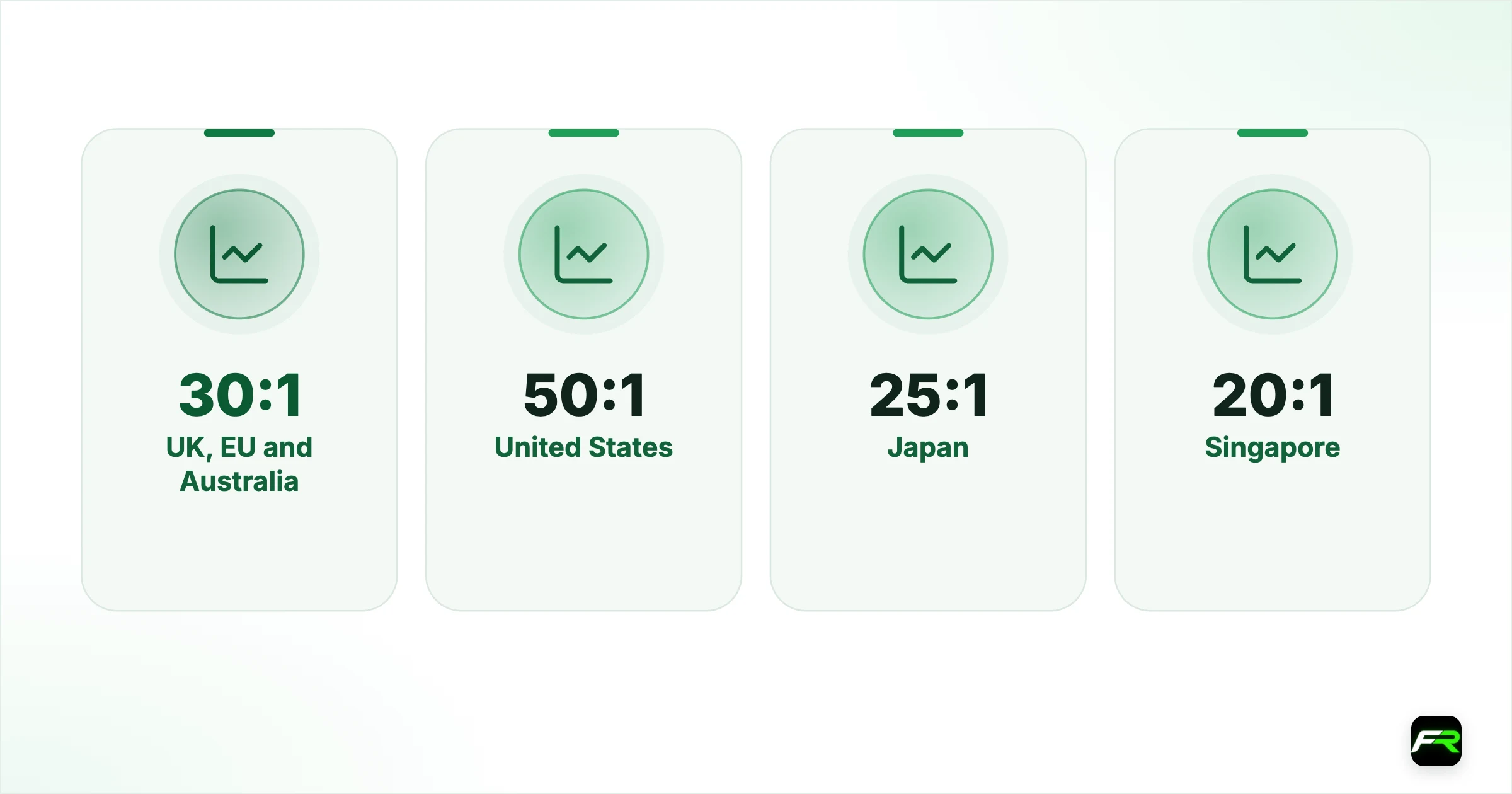
Leverage caps are the clearest sign of which rulebook your account falls under. If a broker offers you far more than your country's cap, you are being signed up to a different entity.
| Regulator region | Major pairs | Minor pairs | Notes |
|---|---|---|---|
| UK, EU and Australia | 30:1 | 20:1 | Gold and major indices 20:1, other commodities 10:1, shares 5:1, crypto 2:1. |
| United States | 50:1 | 20:1 | The US bans hedging the same pair, and positions close first in, first out. |
| Japan | 25:1 | 25:1 | A flat 4% margin on all currency pairs. |
| Singapore | 20:1 | 10:1 | Retail limits set by MAS as minimum margin requirements. |
| Hong Kong | 20:1 | 20:1 | A 5% minimum margin on leveraged forex for retail clients. |
| Turkey | 10:1 | 10:1 | Plus a high minimum deposit for retail accounts. |
| Canada | Margin based | Margin based | Set by CIRO margin rates, roughly up to 50:1 on majors. |
| South Africa | No fixed cap | No fixed cap | FSCA licenses CFD providers but sets no retail leverage limit. |
| Offshore licences | 500:1 and up | 500:1 and up | Some entities advertise 1:2000 or unlimited leverage. |
How to check a broker's licence
Verify the licence before you open or fund an account. It takes about five minutes.
- Find the entity name
Scroll to the small print at the bottom of the broker's site. You want the company name and licence number of the entity that will hold your account, not the group brand.
- Search the official register
Go to the regulator's own register, not a link from the broker. Type in the licence number and confirm the company name matches exactly.
- Read the permissions
Some firms hold a licence for something else entirely, such as payments or investment advice. It must cover dealing in CFDs or leveraged forex.
- Check which entity signs you up
Start the sign-up and read the client agreement before you deposit. If your country routes you to an offshore company, the strong licence on the homepage does not apply to you.
How to spot a fake or cloned licence
Clone firms copy the name, licence number and branding of a real regulated broker. The register always has the final say.
Contact details don't match
The register lists the firm's real website, phone number and email address. If the site you are on uses a different domain or number, treat it as a clone.
The licence number belongs to someone else
Clones copy a real firm's reference number. Search the number and read which company it belongs to, not only whether it exists.
"Registered" is not "regulated"
A company registry certificate from St Vincent, the Marshall Islands or Anjouan proves only that a company exists. It is not a financial licence.
The regulator emails you first
Real regulators do not contact traders to unlock withdrawals or collect fees. Messages like that come from scammers using a regulator's name.
See our scam broker blacklist for brokers regulators have already flagged.
What a licence does not cover
Strong regulation reduces the risk of misconduct through supervision and enforcement, but it does not stop you losing money on trades. Regulated CFD brokers in Europe, the UK and Australia must publish the share of retail accounts that lose money, and those figures usually sit somewhere between 60% and 80%.
A licence also does nothing about fast markets, slipped orders during news, or a strategy that does not work. A compensation fund only pays out when the firm collapses and your money is missing. Trading losses are not a claim.
Higher leverage magnifies losses as much as gains. An offshore broker offering 1:2000 is not being generous; it is removing the brake that keeps beginners in the game long enough to learn. Read the terms of any bonus too, since many lock your own money until you trade a volume most people never reach.
Countries where retail forex is restricted
A broker may happily accept you while your own country's rules say otherwise. Check locally before you send money abroad.
Only CFTC-registered, NFA-member firms may take retail clients, and only a handful qualify. The US also bans hedging the same pair and caps leverage at 50:1.
Brokers must be CIRO members and registered in your province. Offshore firms soliciting Canadians are regularly named in regulator warnings.
Margin forex on non-rupee pairs is off limits under FEMA. Legal currency trading runs through exchange-listed futures and options on rupee pairs.
The FSMA banned the sale of leveraged forex and CFDs to retail consumers in 2016, and the ban still stands.
Only FSA-registered domestic firms may serve residents. Foreign brokers cannot solicit at all, and leverage is capped at 25:1.
Retail margin forex through foreign platforms has no legal footing, and capital controls block most payment routes in practice.
Bappebti licenses local futures brokers only. An unlicensed offshore firm serving Indonesians sits outside the rules.
Leverage is capped at 10:1, a high minimum deposit applies, and only locally licensed firms may operate.
Leverage is tightly capped and margin requirements are high. Foreign brokers cannot market to residents.
Bank Negara and the Securities Commission both publish alert lists. Only licensed local entities may offer forex.
Sending money abroad to fund a margin account runs into foreign exchange controls. Confirm against Bangladesh Bank rules rather than a broker's blog.
Each limits retail forex to locally licensed firms or bars leveraged currency trading outright. The rules change often, so check with the local regulator.
Forex regulator FAQs
Is an offshore broker automatically a scam?
No. Plenty of large, long-running brokers hold Seychelles or Mauritius licences and pay clients every day. The point is what happens on a bad day. If that firm fails there is no fund, no ombudsman and no realistic court route from another continent, so you are trusting the company rather than the system behind it.
My broker shows an FCA licence. Am I covered?
Only if your account sits with the FCA-authorised entity. Large brokers run several companies: the UK one serves UK clients, while clients elsewhere are often signed up to a Seychelles or Vanuatu company under the same brand. Your client agreement names the entity, so read it before depositing.
Which regulator is the strictest?
On leverage, Turkey's 10:1 cap is the tightest on this page, followed by Singapore and Hong Kong at 20:1 on major pairs and Japan at 25:1. The US is toughest on capital, since a retail forex dealer needs $20 million before it can take clients. For tough rules plus a real payout if things go wrong, the UK's FCA with £85,000 of FSCS cover is hard to beat, and Canada's CIPF has the largest ceiling at CAD 1,000,000.
What is the difference between Tier 1 and Tier 2 regulators?
Both license and supervise brokers properly. Tier 1 regulators combine strict rules with strong enforcement and, often, a compensation scheme. Those in Tier 2 apply genuine rules but may have smaller supervisory teams, lower payout limits or no fund at all, so your recovery after a failure is less certain.
Why do brokers offer 1:1000 leverage if regulators cap it at 1:30?
Because the entity offering it sits outside those rules. Offshore jurisdictions set no cap, so the same brand can advertise 1:30 in London and 1:1000 through its offshore arm. Regulators introduced the caps after measuring how often retail accounts were wiped out.
Does a licence mean my deposits are insured?
Rarely. Any decent regulator makes brokers keep client money separate from their own cash, but that is not insurance. A payout fund that covers forex exists in the UK, the EU, Canada and Switzerland. Australia, Singapore, the US, South Africa and every offshore jurisdiction have none for forex clients.
Can I use a broker regulated in another country?
Often yes, but check your own country's rules first, because some (such as the US, Japan and Belgium) restrict or ban foreign brokers from serving residents. Your protection then depends on the regulator of the entity you join, not the one in your country.
What if a licensed broker treats me unfairly?
Complain to the broker in writing first, then take it to the free dispute service if the country has one: the Financial Ombudsman Service in the UK, AFCA in Australia, OBSI in Canada, or FINMAC in Japan. Offshore, the firm's own complaints desk is usually the only route.
Risk warning: trading forex and CFDs with leverage carries a high risk of losing money quickly, and most retail accounts lose money. Only trade with money you can afford to lose. This page is general information about regulators, not financial advice, and does not recommend any broker or trade.