IC Markets

 3:09
 2:39
 2:10
 2:18
 3:43
 8:42





































ECB Holds at 2.50% After Debating a Hike, and Lagarde Says She Will Step Down in February
Officials agreed unanimously to wait for December's forecasts, but Lagarde said the direction of travel is clear unless the data changes.
 WriterAbir KhanWriterWrites the guides · checks every figure against primary sources View profileAbout Abir →

 Market analysisTanbir Habib RiyadForex & Crypto AnalystForex and crypto analyst · technical and fundamental analysis View profileAbout Tanbir →

 Fact-checking & riskJannatul FerdaushFact-Checker & Risk AnalystFact-checks every figure · risk analysis · Applied Statistics, University of Dhaka View profileAbout Jannatul →

 Trading reviewJowel RanaCo-Founder & Forex TraderCo-founder · forex trader · reviews guides from a trader's view View profileAbout Jowel →

 Final approvalRanjan NiskrityFounder, Owner & Forex TraderFounder and owner · forex trader · signs off every guide View profileAbout Ranjan →

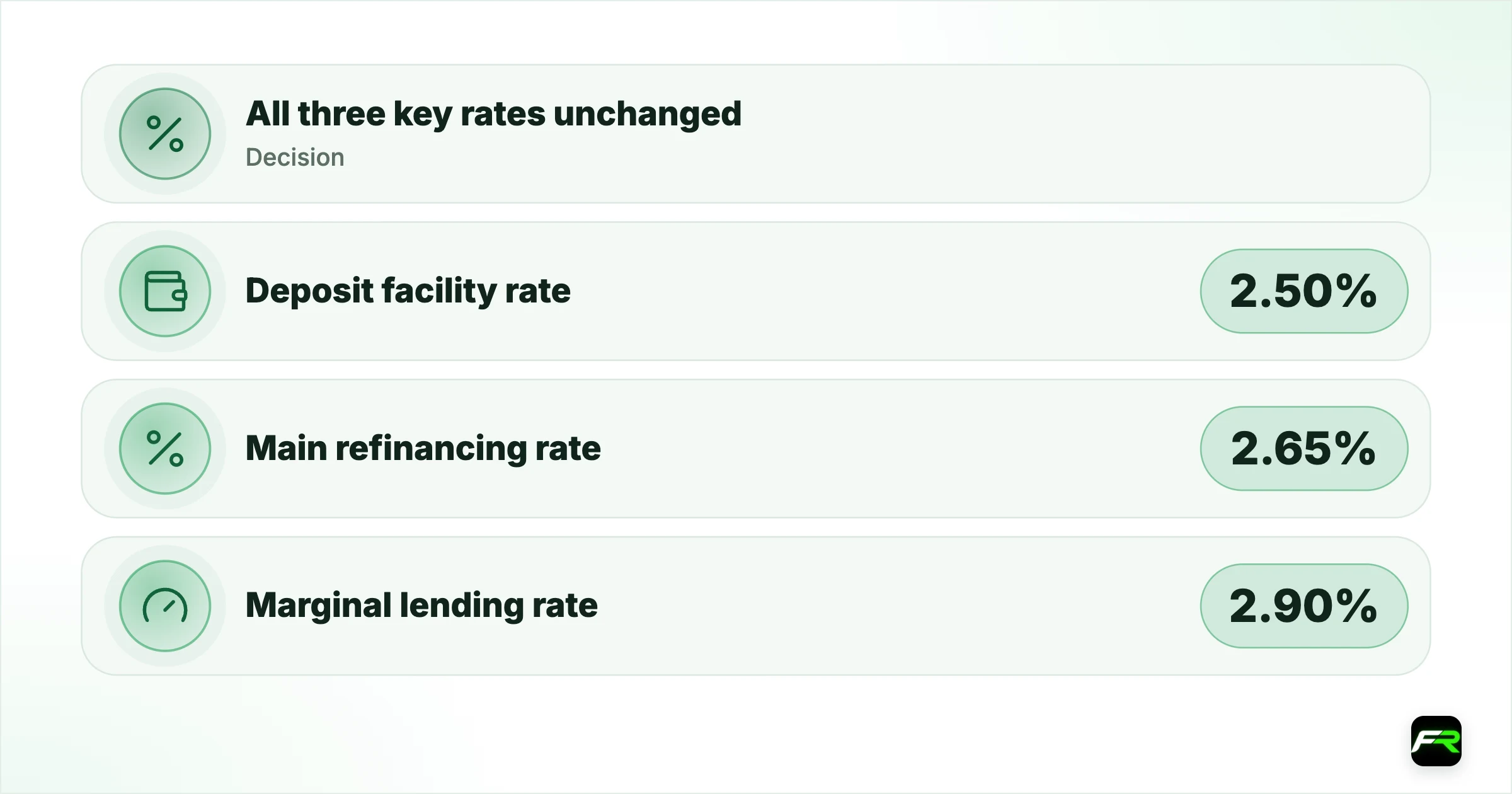
The European Central Bank left its three key interest rates unchanged on Thursday 29 October. Its deposit facility rate stays at 2.50%, the main refinancing rate at 2.65% and the marginal lending rate at 2.90%, the Governing Council said in its 14:15 Frankfurt statement, which was 13:15 UTC. A pause had been one of the main outcomes in our ECB preview, after quarter-point rises in June and September.
Two things made this meeting more than a routine hold. President Christine Lagarde told the press conference that a rate rise had been discussed, and that only a unanimous judgement to wait for more information kept rates on hold. Later in the same session she announced her own departure: she will leave “after the February monetary policy Governing Council,” about eight months before her term would have ended in October 2027.
Euro traders now face a central bank that sounds ready to tighten again in December while starting a leadership change. The ECB's euro reference rate for EUR/USD was 1.1130 on Thursday, the lowest of 2026 so far, and it was set at about the time the decision came out, so it does not yet show the full reaction.
| Decision | All three key rates unchanged |
|---|---|
| Deposit facility rate | 2.50% |
| Main refinancing rate | 2.65% |
| Marginal lending rate | 2.90% |
| Rises earlier in 2026 | June and September, 25bp each |
| Euro area inflation, September | 3.8%, up from 3.2% |
| Next decisions | 17 December 2026, then 4 February 2027 |
| Lagarde's last meeting | February 2027, by her own statement |
What the ECB decided and why it waited
Energy is at the centre of the statement. “Energy prices have continued to rise, posing upside risks to the inflation outlook and downside risks to the growth outlook,” it says. Underlying inflation “has remained broadly stable so far and wages do not show a material response at this stage.” In other words, officials see the price shock clearly but do not yet see it feeding through to pay and core prices.
A second force pulled the other way. “Financing conditions have tightened since the Governing Council's last meeting, which is likely to weigh on inflation and growth,” the statement adds. Lagarde gave the scale: average 10-year government bond yields in the euro area have risen by around 35 basis points since the cut-off date for the September staff projections. Higher market rates do part of a central bank's job, because borrowing becomes dearer even without a policy move.
Guidance stayed open. The ECB will follow “a data-dependent and meeting-by-meeting approach” and “is not pre-committing to a particular rate path.” That sentence appears at nearly every meeting, so markets paid more attention to what Lagarde said around it.
Lagarde: a hike was discussed, and December is live
Asked whether markets were right to expect a December rise, Lagarde described the debate in unusual detail. “The Governing Council debated whether a hike was appropriate,” she said, but given rising uncertainty and stable underlying inflation, it “unanimously decided that we were well positioned enough at this stage to hold, and that a measured approach, at this point in time, remained appropriate.” Some members, she added, took the line of “maybe now, why not?” before the group agreed to wait.
She then listed what the council will see before 17 December: a new set of staff projections, two inflation releases, third-quarter GDP, third-quarter employment, pay and negotiated wage data, two unemployment readings, two industrial production releases, the November PMIs and two rounds of bank interest rate statistics. Underlying inflation, she said, “will probably take a particular standing” in that assessment.
Her most quoted line came later. If the current assessment “is not infirmed by significant developments, the direction of travel is clear.” She also said the ECB is still in a phase of “measured response” and will not limit moves to the quarterly forecast meetings. For the euro, that is close to a signal that a third rise is the default for December unless energy prices fall back or the data softens.
Inflation, wages and growth in the ECB's own figures
Euro area inflation rose to 3.8% in September from 3.2% in August. Energy inflation jumped to 18.9% from 14.3%, and Lagarde said diesel and petrol prices reached new peaks in September, partly because of high refining margins. Inflation excluding energy edged up to 2.3% from 2.1%, services inflation to 3.2% from 3.0%, and food to 1.3% from 1.1%, while goods inflation slipped to 1.1% from 1.2%.
Pay growth is still moderate, which is the main reason the council did not move. Compensation per employee rose 3.3% in the second quarter, down from 3.6% in the first. According to the ECB's forward-looking wage tracker, negotiated wage growth should run between 2.5% and 2.8% for the rest of 2026 and average 2.6% in the first three quarters of 2027. Longer-term inflation expectations are “around 2 per cent” on most measures, although shorter-horizon expectations have risen.
On activity, the statement says the economy “continued to expand in the third quarter,” helped by services, AI-related business investment, and government spending on infrastructure and defence. Unemployment held at 6.4% in August. Risks to growth are to the downside and risks to inflation to the upside, mainly because of the Middle East conflict and the war in Ukraine; the ECB also warned that gas prices could climb if supply is disrupted or a cold winter meets low storage.
Credit is getting dearer. Firms' cost of market-based debt rose to 4.1% in August, growth in bank lending to companies slowed to 4.2% in August and September, and mortgage rates rose to 3.6%. Banks also tightened credit standards for business loans in the third quarter, the ECB said, citing its bank lending survey.
Lagarde's departure and what changes
At the end of the press conference, Lagarde confirmed her plan in her own words: “My decision is to step down from my position as President of the European Central Bank after the February monetary policy Governing Council.” She explained that she wants “the freedom of speech, the freedom of expression and the freedom to engage on matters that are not monetary policy matters,” which the neutrality required of an ECB president does not allow.
She stressed continuity. “A process has already started to identify my successor,” she said, and the institution is “solid, strong, like a rock.” She will chair the December and February meetings. The ECB has not named a successor or a date for the choice, so any names in news reports are speculation until European Union bodies announce one.
For currency markets, a leadership change at a central bank tends to matter less than the rate path, but it adds a layer of uncertainty to 2027. Traders will watch whether candidates are seen as more or less inclined to keep tightening, and whether the handover overlaps with the French bond-market strains that journalists raised at the press conference. Lagarde answered those questions by pointing to the ECB's existing tools, saying that if markets threaten the smooth transmission of policy, “we have instruments available to respond.”
Where the euro stands
EUR/USD has fallen steadily since the September rise. The ECB reference rate was 1.1616 on 10 September, 1.1193 on 23 October, 1.1133 on 28 October and 1.1130 on 29 October, a drop of about 4.2% in seven weeks. That 29 October figure is the lowest reference rate this year; the 2026 high was 1.1974 on 28 January.
Part of that move is about the dollar, not the euro. The Federal Reserve held rates on 28 October with two officials voting for a rise, as our Fed decision story explains, and US data released 45 minutes before the ECB showed strong growth. A hawkish ECB stops the rate gap from widening further, but it does not close it.
What it means for traders
A hold with a debated hike is a hawkish pause. It tends to support the euro against currencies whose central banks have finished tightening, while leaving EUR/USD tied to US data and energy prices. Here is what to watch next:
- The euro area flash inflation estimate for October from Eurostat, the first of the two inflation prints Lagarde listed. A rise above 3.8% would strengthen the case for December.
- Third-quarter GDP and employment figures from Eurostat in the coming weeks, which feed the December projections.
- Energy prices. Lagarde tied the outlook to oil, fuel, gas and refining margins, so a sharp fall in energy would weaken the case for a hike.
- Speeches by ECB board members and national governors, who often explain their views in the weeks after a meeting.
- The 17 December decision, which comes with new staff projections and likely new scenarios.
Suppose you buy EUR/USD at 1.1130, expecting the ECB's hawkish tone to slow the fall, with a stop at 1.1070, 60 pips below. On a $5,000 account with a 1% risk limit, you can lose $50, so the trade size is about 8,300 units, where one pip is worth about $0.83. A strong US data surprise could push the price through that stop quickly, so check the calendar first. Our <a href="/position-size-calculator">position size calculator</a> does the maths for any pair.
Daily levels for the pair are on our EUR/USD analysis page, and release times in your own time zone are on the economic calendar.
Central bank days and the data around them can move currencies sharply, and prices can gap past stop orders. Leverage magnifies losses as well as gains, so trade only with money you can afford to lose.
The decision and statement wording come from the ECB press release of 29 October 2026. Figures and quotes from Christine Lagarde come from the ECB's published monetary policy statement and the transcript of the questions and answers. Exchange rates are ECB euro reference rates. This is news, not investment advice.
Frequently asked
Did the ECB raise rates in October 2026?
No. On 29 October 2026 the ECB kept its deposit facility rate at 2.50%, the main refinancing rate at 2.65% and the marginal lending rate at 2.90%. Lagarde said a hike was debated, but the decision to hold was unanimous.
Is Christine Lagarde leaving the ECB?
Yes. At the 29 October press conference she said she will step down as ECB President after the February 2027 monetary policy meeting. Her term would have ended in October 2027, and a process to find her successor has started.
When is the next ECB decision?
The next decision is on 17 December 2026 and comes with new staff projections. The meeting after that is on 4 February 2027, which Lagarde said will be her last.
Why did EUR/USD fall to a 2026 low?
The ECB reference rate fell to 1.1130 on 29 October, its lowest this year, after a strong run for the dollar. The Fed's hawkish hold on 28 October and strong US growth data weighed on the euro even as the ECB signalled a possible December rise.
Sources: ECB: monetary policy decisions, 29 October 2026 · ECB: monetary policy statement and press conference, 29 October 2026 · ECB: euro foreign exchange reference rates · ECB: Governing Council meeting calendar
The team behind this guide
Researched, checked and approved by five forex specialists
Every guide is written, fact-checked and edited before it goes live, and updated when the facts change. Spotted an error? Tell us.