IC Markets





























What Lot Size Should You Use on a $50 Forex Account?
On a $50 account, 0.01 lots on EUR/USD risks $0.10 per pip, so a 10-pip stop costs $1, or 2% of the account. Here is the full table, why bigger sizes fail and when a cent account makes more sense.
 WriterAbir KhanWriterWrites the guides · checks every figure against primary sources View profileAbout Abir →
 Market analysisTanbir Habib RiyadForex & Crypto AnalystForex and crypto analyst · technical and fundamental analysis View profileAbout Tanbir →
 Fact-checking & riskJannatul FerdaushFact-Checker & Risk AnalystFact-checks every figure · risk analysis · Applied Statistics, University of Dhaka View profileAbout Jannatul →
 Trading reviewJowel RanaCo-Founder & Forex TraderCo-founder · forex trader · reviews guides from a trader's view View profileAbout Jowel →
 Final approvalRanjan NiskrityFounder, Owner & Forex TraderFounder and owner · forex trader · signs off every guide View profileAbout Ranjan →
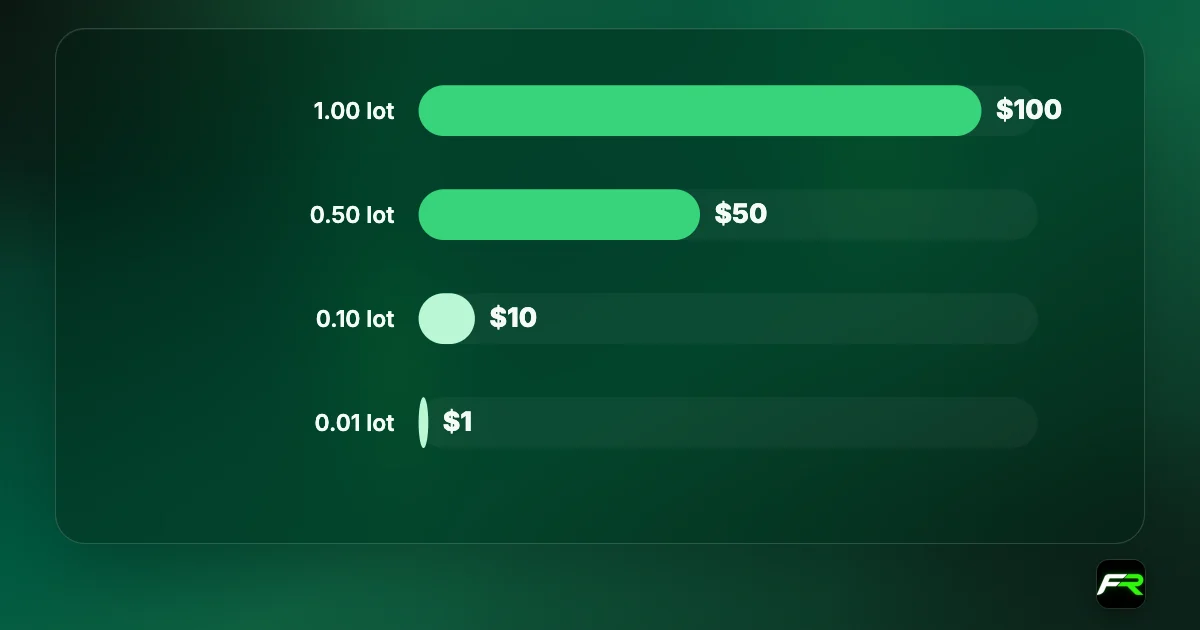
On a $50 forex account, the largest sensible size on a major pair such as EUR/USD is usually 0.01 lots, the smallest standard size. Each pip is worth about $0.10 at that size, so a 10-pip stop risks $1, which is 2% of the account. Anything bigger quickly puts a large share of the balance on a single trade.
Many traders with $50 are told to use 0.05 or 0.10 lots to make the account grow faster. The maths shows why that usually ends with an empty account, and why a cent account, which allows positions smaller than 0.01, often suits a $50 start better.
| Sensible size on EUR/USD | 0.01 lots |
|---|---|
| Pip value at 0.01 lots | About $0.10 |
| 10-pip stop at 0.01 lots | $1 risk, 2% of $50 |
| Common safe risk per trade | 1% to 2%, so $0.50 to $1 |
| Better option for tiny stops | Cent or micro account |
The risk table for $50
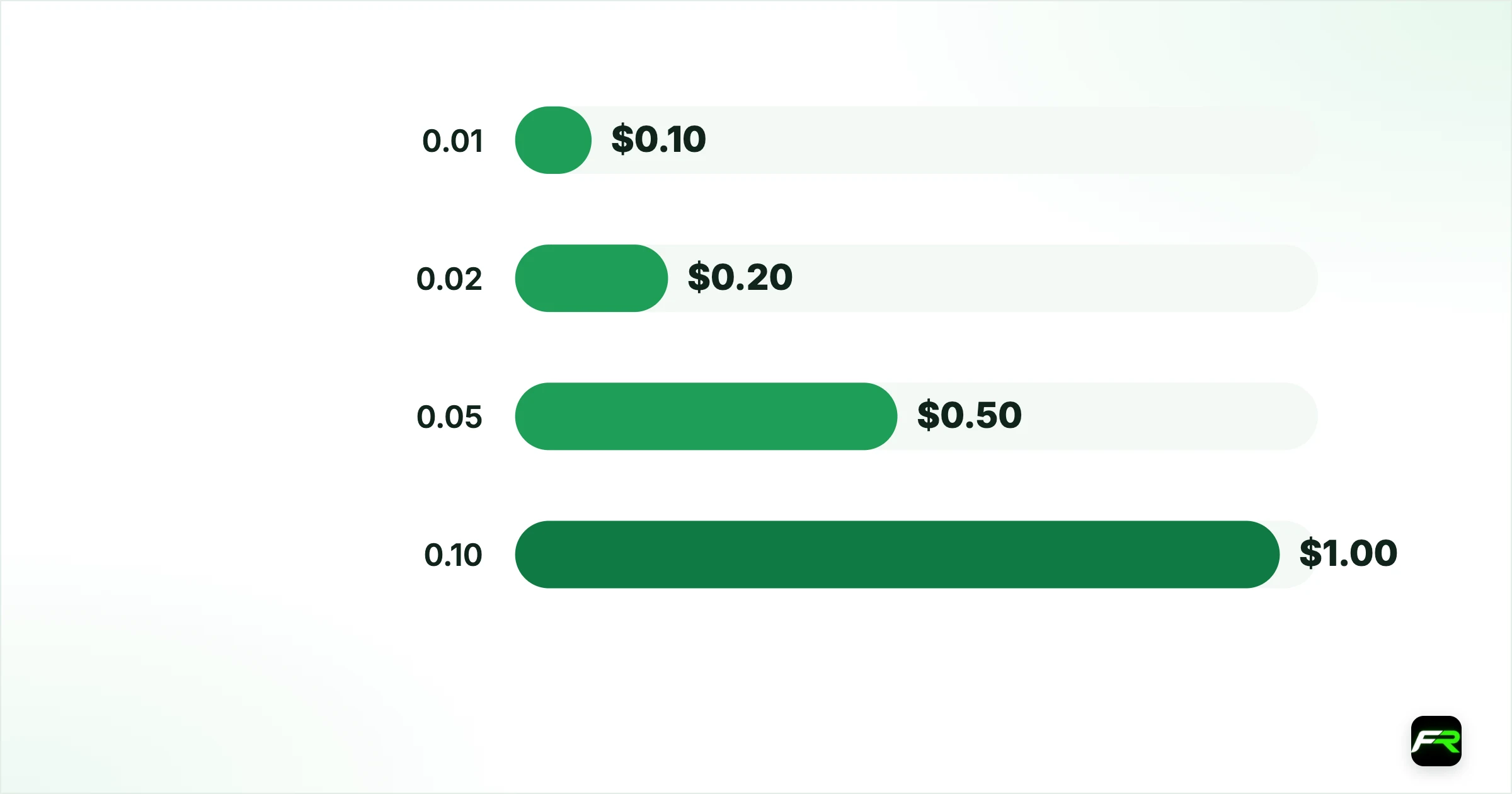
| Lot size (EUR/USD) | Pip value | Risk with a 10-pip stop | Risk with a 20-pip stop | Share of $50 at 20 pips |
|---|---|---|---|---|
| 0.01 | $0.10 | $1 | $2 | 4% |
| 0.02 | $0.20 | $2 | $4 | 8% |
| 0.05 | $0.50 | $5 | $10 | 20% |
| 0.10 | $1.00 | $10 | $20 | 40% |
Pip values are for pairs quoted in US dollars, such as EUR/USD and GBP/USD. On USD/JPY a pip at 0.01 lots is worth about $0.06 to $0.07 at current prices; on gold, 0.01 lots moves $1 for each $1 change in price, which is far more risk for a $50 account.
Why the 1% to 2% rule matters on tiny accounts
Professional and retail risk guides commonly suggest risking 1% to 2% of the account on each trade. On $50, that is $0.50 to $1. It sounds pointless, but the purpose is survival: a run of five or six losses, which happens to every trader, costs 5% to 12% of the account at that risk, and the account can recover. At 20% per trade, five losses in a row leave about a third of the money.
| Risk per trade | After 5 losses in a row | After 10 losses in a row |
|---|---|---|
| 1% | $47.55 left | $45.22 left |
| 2% | $45.20 left | $40.85 left |
| 10% | $29.52 left | $17.43 left |
| 20% | $16.38 left | $5.37 left |
The stop distance problem
At 0.01 lots and 2% risk, your stop can be no more than 10 pips on EUR/USD. That is tight: normal market noise on short timeframes often exceeds it, so many trades get stopped out before the idea plays out. You have three choices: accept higher risk per trade, trade fewer, better setups with tight stops, or use an account that allows smaller positions.
Cent and micro accounts
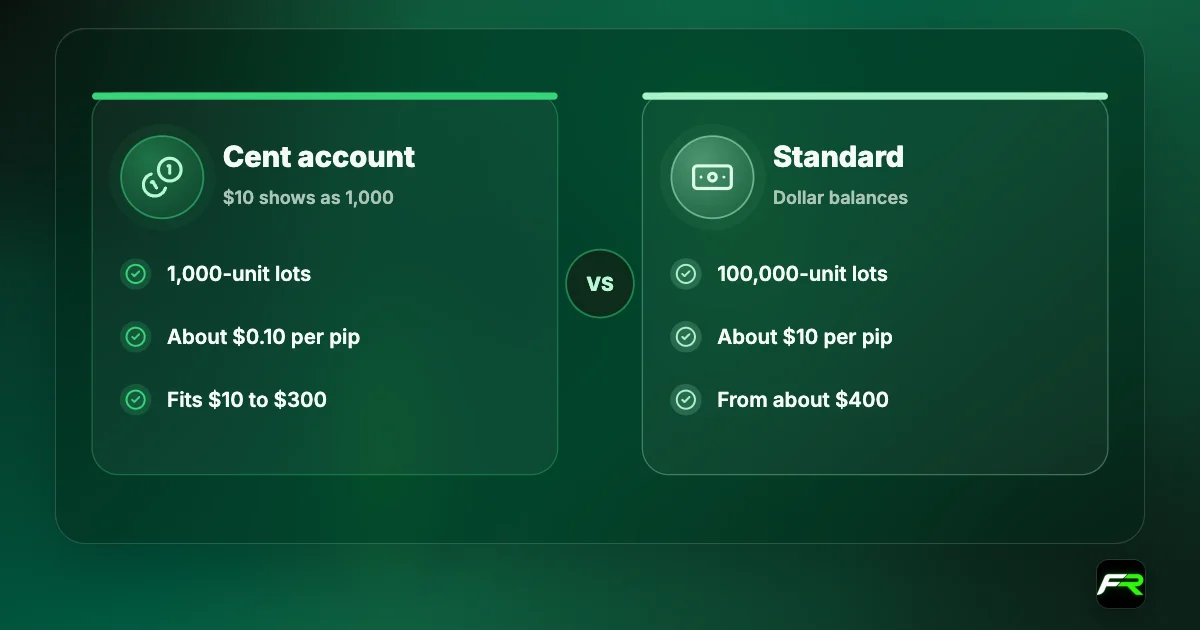
Cent accounts show your balance in cents, so $50 appears as 5,000, and they let you trade positions much smaller than 0.01 standard lots. That means you can use a normal 25- or 30-pip stop and still risk 1% to 2%. Several brokers we review offer them; see Exness Standard Cent, LiteFinance cent account and RoboForex cent account. Our cent vs standard comparison explains the trade-offs.
A trader in Kano opens a $50 standard account and trades 0.05 lots on GBP/USD with 30-pip stops, because a video suggested it. Each loss costs $15. Three losses in the first week leave $5. The trader restarts with $50 on a cent account, risks $0.75 per trade with the same 30-pip stops, and after a month of mixed results still has $47 and a trading record to learn from.
Margin is not the limit; risk is
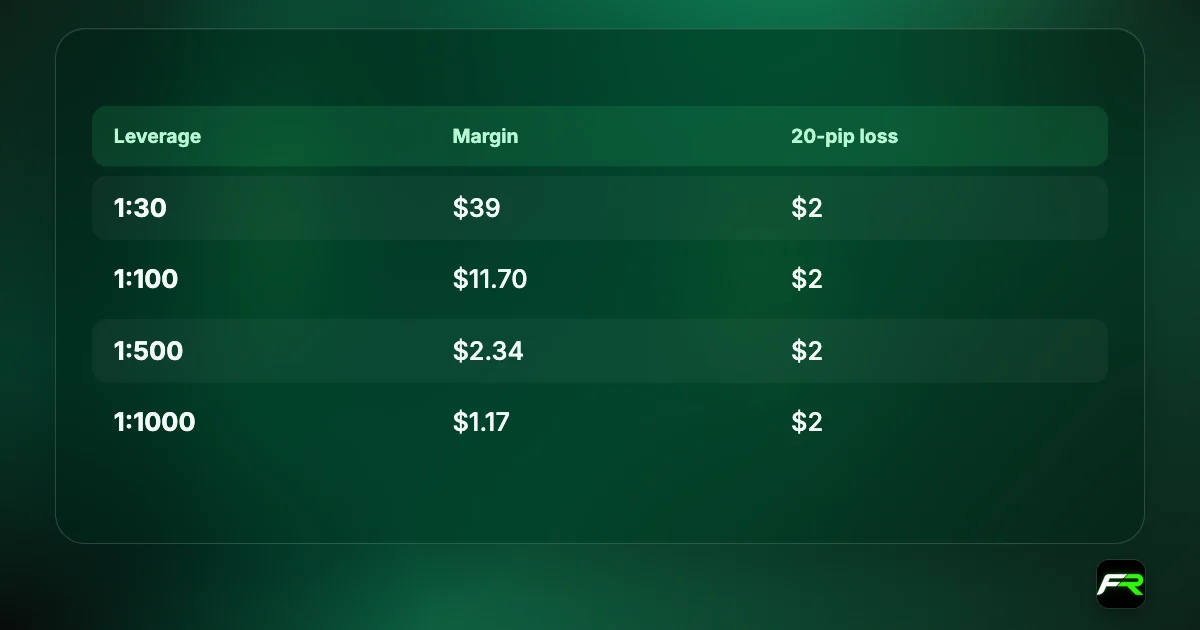
On a $50 account with 1:500 leverage, 0.10 lots of EUR/USD needs only about $23 of margin, so the platform will happily open it. The size is still far too large: a 20-pip move against you costs $20, 40% of the account. Margin tells you what the broker will allow, not what is wise. Size every trade from the stop distance with the position size calculator.
What to trade with $50
- Major pairs with low spreads, such as EUR/USD and USD/JPY, during their main sessions.
- Avoid gold at 0.01 lots unless your stop is very tight, because a $5 stop alone is 10% of the account.
- Skip exotic pairs with wide spreads, which can cost several dollars to open on even a small size.
- Trade fewer setups, on higher timeframes where possible, so each trade has room to work.
Costs matter more on small accounts
A 1-pip spread on 0.01 lots costs $0.10, which is 10% of a $1 risk. Commissions on raw accounts, often charged per round-turn lot, can be a large share of a tiny position's expected gain. On very small accounts, a standard or cent account with no commission may be cheaper in total. The trading cost calculator compares the two.
Growing from $50
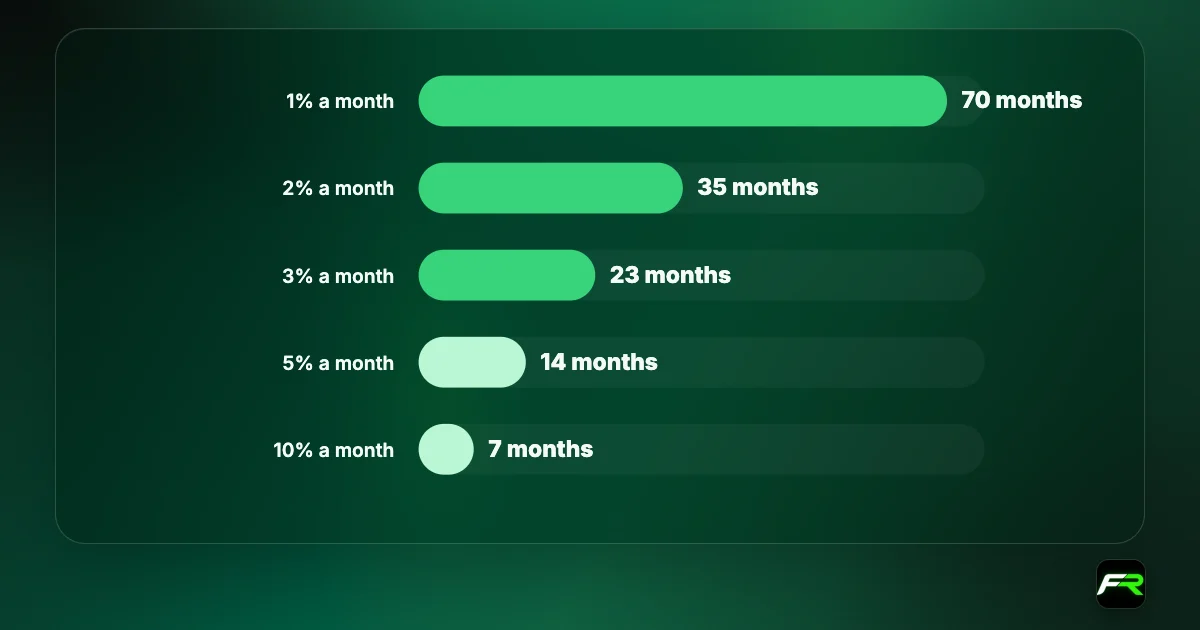
Doubling a $50 account through risky trades is unlikely and usually ends in a restart. A more realistic aim is to prove you can follow a plan for three months without losing more than 10% to 20%. Then add savings, not winnings from big bets, to grow the account. Our guide to how long it takes to double an account shows the maths of compounding at sensible risk.
Write your maximum lot size for the account on a sticky note by the screen. On $50 standard accounts, that number is 0.01 for major pairs.
Brokers' offshore entities may allow very high leverage on small accounts. High leverage makes over-sizing easy; it does not make it safe.
All figures are calculations at round example prices and assume pip values for USD-quoted pairs. Check the pip value on your account with the pip calculator.
Frequently asked
What lot size is good for a $50 forex account?
0.01 lots on major pairs is the usual maximum. Each pip is worth about $0.10, so a 10-pip stop risks $1, or 2% of $50. For wider stops, use a cent or micro account that allows positions smaller than 0.01 standard lots.
Can I trade 0.10 lots with $50?
The platform may allow it with high leverage, but each pip would be worth about $1. A 20-pip loss would cost $20, 40% of the account. That level of risk usually empties a small account within a few bad trades.
How much should I risk on a $50 account?
Common guidance is 1% to 2% per trade, so $0.50 to $1. It feels small, but it lets the account survive normal losing streaks. Risking 10% to 20% per trade usually leads to a restart.
Is a cent account better for $50?
Often, yes. Cent accounts allow positions smaller than 0.01 standard lots, so you can use normal stop distances and still risk 1% to 2%. Check spreads and the broker's entity before choosing one.
Can I trade gold with a $50 account?
On a standard account, 0.01 lots of gold moves $1 per $1 change in price. A $5 stop is 10% of the account, and gold often moves more than that. Cent accounts with smaller gold contracts suit $50 better.
How fast can a $50 account grow?
Slowly, if risk is sensible. At 2% risk and a good strategy, gains of a few percent a month are realistic. Fast growth needs high risk, which usually ends in losses. Add savings over time to grow the account.
Official sources: ESMA: CFD product intervention measures
Related reading
The team behind this guide
Researched, checked and approved by five forex specialists
Every guide is written, fact-checked and edited before it goes live, and updated when the facts change. Spotted an error? Tell us.