 IC Markets





























Best MetaTrader 5 (MT5) Forex Brokers for 2026
Exness stands out for speed and withdrawals, IC Markets for raw spreads and scalping, Pepperstone for EAs and news trading, XM for beginners, FP Markets for low-cost raw pricing and Eightcap for chart-focused traders. Check which entity holds your account and its regulator before you deposit, then compare costs on the account type you will use.
 WriterAbir KhanWriterWrites the guides · checks every figure against primary sources View profileAbout Abir →
 Market analysisTanbir Habib RiyadForex & Crypto AnalystForex and crypto analyst · technical and fundamental analysis View profileAbout Tanbir →
 Fact-checking & riskJannatul FerdaushFact-Checker & Risk AnalystFact-checks every figure · risk analysis · Applied Statistics, University of Dhaka View profileAbout Jannatul →
 Trading reviewJowel RanaCo-Founder & Forex TraderCo-founder · forex trader · reviews guides from a trader's view View profileAbout Jowel →
 Final approvalRanjan NiskrityFounder, Owner & Forex TraderFounder and owner · forex trader · signs off every guide View profileAbout Ranjan →


Exness

XM

IC Markets

LiteFinance

FP Markets

AvaTrade

Octa

RoboForex
Disclosure: "Visit Broker" links are partner (affiliate) links. FX Recap may earn a commission at no cost to you. Trading involves significant risk of loss. T&Cs apply.
MetaTrader 5 is one of the most widely used retail trading platforms in the world. But the platform itself does not determine your trading conditions. The provider behind the platform has the biggest influence on your overall trading experience. Order execution speed, pricing consistency, slippage, withdrawal processing, and licensing all depend on the broker rather than the MT5 platform itself.
This guide examines the key factors that separate stronger MT5 brokers from the rest. based on live account testing, cross-checked against official provider disclosures and regulatory information where available.
What Is MetaTrader 5 (MT5)?
MetaTrader 5 (MT5), developed by MetaQuotes Software and released in 2010, was designed as a multi-asset trading platform that expands on the capabilities of MetaTrader 4 rather than serving as a direct replacement.
MT5 is built on a different software architecture than MT4, supporting additional asset classes and more advanced trading features. MT5 uses the MQL5 programming language, which differs from MQL4 and requires Expert Advisors and custom indicators to be rewritten before they can run on MT5.
MT5 supports multiple asset classes, including forex, stocks, indices, commodities, futures, and CFDs, although the instruments available depend on the broker offering the terminal. Compared with MT4, MT5 includes 21 timeframes, six pending order types, and a multi-threaded strategy tester that generally improves backtesting performance. MT5 includes a built-in economic calendar, native Depth of Market functionality, and support for both netting and hedging account systems, although feature availability may vary by provider.
These features reflect core differences between MT4 and MT5 rather than optional additions provided by individual firms. MQL5 supports object-oriented programming and offers more advanced development features, but existing MQL4 Expert Advisors and indicators must be converted before they can run on MT5.
MT4 vs MT5: Side-by-Side
Understanding the differences between MT4 and MT5 makes it easier to compare brokers on practical features instead of marketing claims.
| Feature | MT4 | MT5 |
| Timeframes | 9 timeframes | 21 timeframes |
| Order Types | 4 pending order types | 6 pending order types |
| Asset Classes | Forex-focused | Forex, stocks, futures, commodities, crypto CFDs |
| Programming Language | MQL4 | MQL5 (faster, object-oriented) |
| Strategy Tester | Single-threaded | Multi-threaded (significantly faster backtesting) |
| Depth of Market | Not available | Available (Level II pricing) |
| Economic Calendar | Not built-in | Built-in |
| Technical Indicators | 30 built-in | 38 built-in |
| EA Compatibility | Large legacy library | New MQL5 library (not backward compatible) |
| Netting vs Hedging | Hedging only | Both netting and hedging |
One thing worth noting: if you rely on an existing library of MT4 EAs or custom indicators, the move to MT5 means rewriting or repurchasing those tools. Many active investors run both terminals through the same trading account to avoid that disruption.
Why the Broker Behind MT5 Changes Everything?
Many experienced active traders focus less on the software itself and more on the broker providing it. The distinction matters because the same MT5 terminal produces different results depending on who provides the price feed and processes the orders.
When you place an order in MT5, the platform sends it to the server, which routes it to market liquidity providers. The depth of those connections, the server’s proximity to major hubs like London and New York, and the accuracy of the price feed all shape what fills you get and at what price.
Execution quality and its impact on performance
Industry research suggests poor execution quality can reduce long-term trading performance, particularly for active traders. These costs usually build gradually over many trades rather than appearing all at once. It accumulates gradually over time a few pips at a time.
Providers with connections to multiple Tier-1 liquidity providers, banks like Citibank, Goldman Sachs, and Barclays alongside non-bank market makers, tend to offer tighter pricing and more reliable fills during high-volatility periods. Those relying on a single or narrow market liquidity desk tend to widen spreads aggressively during news events and can requote during fast markets.
Trade execution quality often becomes more noticeable during major economic events such as Non-Farm Payrolls (NFP), CPI releases, and FOMC announcements, when market volatility and pricing can increase significantly. A well-connected brokerage fills you near your order price with minor slippage. A weaker one delays, widens the spread, or rejects the order entirely.
Regulation: What It Does and Does Not Guarantee
Regulatory status is the starting point for evaluating any trading platform. The top-tier MT5 options in 2026 hold licenses from recognized authorities: the FCA in the UK, ASIC in Australia, CySEC in Cyprus, DFSA in Dubai, and the NFA or CFTC in the United States.
Many major financial regulators require licensed brokers to keep eligible client funds in segregated accounts, although specific requirements vary by jurisdiction and regulatory entity. Licensed providers are generally required to meet regulatory capital standards, comply with applicable conduct rules, and maintain ongoing regulatory oversight in accordance with the requirements of their licensing authority. Dispute resolution mechanisms exist that offshore or unregulated platforms simply do not offer.
Regulation improves accountability and investor protection, but it does not eliminate every trading or operational risk. A licensed provider can still have poor fills, hidden fees, or substandard support. But the regulatory oversight exists. Clients of regulated brokers may have access to formal complaint and dispute resolution procedures, depending on the regulator overseeing the firm. With unregulated ones, the problems often become apparent when you try to withdraw funds.
FX Recap Tip: Always verify a license directly through the regulator’s public database before depositing funds. The FCA register is at register.fca.org.uk, ASIC’s is at search.asic.gov.au, and CySEC’s is at cysec.gov.cy. Several financial regulators regularly warn investors about clone firm scams, where fraudsters imitate the names and branding of legitimate regulated firms.
Best MT5 Forex Brokers for 2026: Detailed Comparison
The table below reflects live spread data, regulatory verification, and order execution quality research as of early 2026. The average EUR/USD bid-ask spread shown below are based on each provider’s published pricing or typical market conditions and may vary depending on account type, pricing sources, and market volatility.
| Broker | Regulation | Min. Deposit | Avg Spread | Key Strength | Best For |
| Exness | FSA (Seychelles), FSCA, CMA, FSC (BVI), CBCS | $10 | From 0.0 pips | Instant withdrawals + high-volume ECN liquidity | Speed & withdrawals |
| IC Markets | ASIC, CySEC, FSA (Seychelles), SCB (Bahamas) | $200 (Raw) | From 0.0 pips | Ultra-tight raw spreads + deep liquidity pool | ECN / scalpers |
| Pepperstone | FCA, ASIC, CySEC, DFSA, CMA, SCB, BaFin | $0 | From 0.0 pips | Smart Trader Tools suite + consistent fills | EA & news trading |
| XM | ASIC, CySEC, DFSA, FSCA, FSC (Belize), SCA (UAE) | $5 | From 0.6 pips | Education + accessible onboarding | Beginners |
| FP Markets | ASIC, CySEC, FSCA, FSA (Seychelles) | $100 | From 0.0 pips | Institutional-grade ECN pricing | Raw spread / low cost |
| Eightcap | ASIC, FCA, CySEC, SCB (Bahamas), FSA (Seychelles), FSC (Mauritius) | $100 | From 0.0 pips | TradingView integration + technical tools depth | Technical chart traders |
| BlackBull | FMA (New Zealand), FSA (Seychelles) | $0 | From 0.0 pips | Fast fills on raw ECN during volatile sessions | Volatile market execution |
| AvaTrade | CBI, ASIC, CySEC, FSCA, ADGM, FSA Japan, BVI FSC, ISA | $100 | From 0.9 pips | Widest regulatory coverage in retail forex | Regulation & safety |
| OANDA | CFTC/NFA, FCA, ASIC, MAS, CIRO, FFAJ, BVI FSC, KNF | $0 | Variable | US market access + institutional trust credentials | US access / trust |
| FXTM | FCA, FSC (Mauritius), FSCA, CMA (Kenya) | $10 | From 0.0 pips | Flexible account tiers + integrated copy trading | Copy trading / flexible accs |
Minimum deposits vary by account type, so always check the brokerage’s latest trading account requirements before opening an account. Many trading platforms offer lower entry points on standard accounts type, but the trading conditions there are different.
Broker Profiles: What Sets Each Apart
IC Markets
IC Markets is widely recognized for its competitive Raw Spread accounts, with EUR/USD pricing that can start from 0.0 pips under normal market conditions, while commissions apply separately. IC Markets operates through regulated entities licensed by ASIC, CySEC, the FSA (Seychelles), and the SCB (Bahamas). The broker provides access to deep pricing sources and reports low-latency order execution, although fill quality speed varies with market conditions.
IC Markets is a popular choice among scalpers and investors who use Expert Advisors (EAs) because it supports automated trading and competitive pricing. IC Markets allows scalping, hedging, and the use of Expert Advisors (EAs) across supported account types in accordance with its trading terms. The FX Blue Advanced Trading Tools package, available through MT5, adds correlation matrices, sentiment indicators, and detailed trade analytics beyond what the standard terminal provides.
IC Markets recommends a minimum deposit of USD 200 for its Raw Spread accounts. Standard trading accounts are accessible from lower amounts but carry wider bid-ask spread.
Pepperstone
Pepperstone’s Razor account averages around 0.17 pips on EUR/USD, competitive without being the absolute tightest available. What differentiates Pepperstone is platform depth. Over 28 Smart Trader Tools are added to MT5, covering correlation tracking, sentiment maps, mini terminal order management, and more — none of which are available from the standard MT5 installation.
Licensed by FCA, ASIC, CySEC, DFSA, CMA (Kenya), SCB (Bahamas), and BaFin (Germany), Pepperstone holds one of the broadest regulatory footprints in retail forex. Latency is optimized through data center proximity to major hubs, and the platform processes over $12 billion in daily volume.
No minimum deposit is required. Commission on Razor accounts is $3.50 per side per standard lot.
FP Markets
FP Markets is an Australian firm regulated by ASIC, CySEC, FSCA (South Africa), and FSA (Seychelles), built around professional-level ECN pricing. Raw bid-ask spread on EUR/USD average near 0.0 pips with a $3 commission per side. FP Markets provides pricing through multiple market liquidity providers using its ECN execution model, with no dealing desk intervention on eligible account types.
FP Markets offers MT5 for forex and CFD trading alongside the Iress platform for eligible share CFD clients. FP Markets offers Autochartist tools to eligible clients, providing automated market analysis and trading opportunities within supported terminals.
Raw trading accounts start from a $100 deposit. Standard accounts are accessible from lower amounts.
Exness
Exness reports monthly trading volumes in the trillions of US dollars and operates through multiple regulated entities, including the FSA (Seychelles), FSCA (South Africa), CMA (Kenya), FSC (BVI), and CBCS (Curaçao). Exness also operates regulated entities in the United Kingdom and Cyprus, although the products and services available depend on the legal entity and the client’s country of residence. Maximum leverage available at Exness depends on the account type, trading instrument, regulatory entity, and the client’s trading activity.
Withdrawal processing is where Exness is particularly well known for. Exness offers automated withdrawals for many supported payment methods, although availability and processing times depend on the payment provider and the client’s region. Exness offers several account types, including Raw Spread accounts with spreads from 0.0 pips plus commission and commission-free trading accounts with variable pricing. Standard accounts suit less active traders who prefer a single predictable cost.
MT5 is available on desktop, web, and mobile. Exness offers free demo accounts, allowing investors to practise under simulated market conditions before trading with real funds.
XM
XM reports serving millions of clients worldwide and operates through regulated entities authorised by ASIC, CySEC, DFSA, FSCA, FSC (Belize), and the SCA (UAE), depending on the client’s location. XM offers Standard accounts with a low minimum deposit requirement and provides extensive educational resources covering MT5, technical analysis, trading strategies, and risk management.
XM’s Ultra Low account offers competitive variable spreads that typically start from around 0.6 pips on EUR/USD without additional trading commissions. XM offers promotions in selected jurisdictions. Availability and terms depend on the regulatory entity and the client’s country of residence.
Scalping and EA use are both permitted. Customer support is available in dozens of languages through regional teams.
Eightcap
Eightcap is regulated by ASIC, FCA, CySEC, SCB (Bahamas), FSA (Seychelles), and FSC (Mauritius), with an SCA (UAE) license added in 2025. Eightcap offers TradingView integration alongside MT5, allowing eligible investors to analyse markets and place trades using either software. Traders can use TradingView for chart analysis while continuing to use MT5 for automated trading and Expert Advisors, where supported.
Eightcap’s Raw Account offers spreads starting from 0.0 pips, with commissions charged separately according to the trading account’s pricing structure. Eligible Eightcap clients can access Capitalise.ai to create automated trading strategies without writing code. The Raw account requires a $100 opening deposit.
Eightcap offers a wide selection of cryptocurrency CFDs, subject to product availability in the client’s jurisdiction.
BlackBull Markets
BlackBull Markets operates through regulated entities in New Zealand and Seychelles, with the applicable entity depending on the client’s country of residence. The FMA is a Tier-1 authority covering NZ residents with meaningful consumer protections. International trading accounts fall under the FSA (Seychelles) entity, which carries lighter regulatory weight and should be factored into any risk assessment.
BlackBull Markets states that it provides access to deep institutional pricing sources through multiple market liquidity providers using an ECN execution model. Raw bid-ask spread start from 0.0 pips with a $3 commission per side. No minimum deposit applies to standard accounts.
Anyone prioritizing fill quality during volatile events like NFP or central bank decisions will find it worth comparing against trading platforms with heavier regulatory coverage.
AvaTrade
AvaTrade operates through multiple regulated entities across several jurisdictions, including Europe, Australia, Japan, South Africa, Abu Dhabi and Israel. This multi-jurisdictional structure means most investors globally can access AvaTrade under an authority with real jurisdiction in their region.
AvaTrade offers MT5 alongside its AvaTradeGO platform and supports selected third-party copy trading services in eligible regions. AvaTrade offers commission-free trading with variable spreads that typically start from around 0.9 pips on major currency pairs. Wider than ECN options but consistent with the market maker model. Cost calculation stays simple.
A $100 deposit opens a trading account. AvaTrade often appeals to active traders for whom stability and regulatory breadth rank above chasing the narrowest
OANDA
OANDA is among the brokers authorised to provide forex trading services to eligible retail clients in the United States through CFTC and NFA regulatory oversight. Outside the United States, OANDA operates through regulated entities authorised by the FCA, ASIC, MAS, CIRO, FFAJ, the BVI FSC and the KNF, depending on the client’s location.
OANDA uses variable spreads that change according to market liquidity and trading conditions instead of a fixed raw spread model. During liquid sessions, EUR/USD rates are typically competitive. During off-hours or major news events, bid-ask spread widened more than at ECN platforms. No minimum deposit is required.
For US-based investors specifically, the choice of regulated MT5-compatible forex platforms is narrow. OANDA fills that gap with a long-established reputation and an operating history stretching back to 1996.
FXTM (ForexTime)
FXTM operates through regulated entities authorised by the FCA (UK), FSC (Mauritius), FSCA (South Africa), and CMA (Kenya), depending on the client’s jurisdiction. FXTM no longer operates under a CySEC-regulated entity. Clients should refer to the brokerage’s current regulatory disclosures for the applicable legal entity. The FCA remains the primary Tier-1 jurisdiction.
Trading account tiers range from Cent accounts for very small position sizes up to ECN accounts with raw spreads from 0.0 pips and a $2 commission per side. FXTM offers copy trading services where available, subject to the products and services provided by the client’s regulatory entity.
Standard accounts open from $10. FXTM is widely used in African and Asian markets, where the CMA and FSC licenses carry regional authority that matters to local regulators.
Spreads, Commissions, and the True Cost of Trading on MT5
Trading costs may seem small on individual trades, but they can have a significant impact on long-term trading performance. They accumulate across every position, every month, until the total becomes visible only when comparing actual account performance against what was theoretically possible.
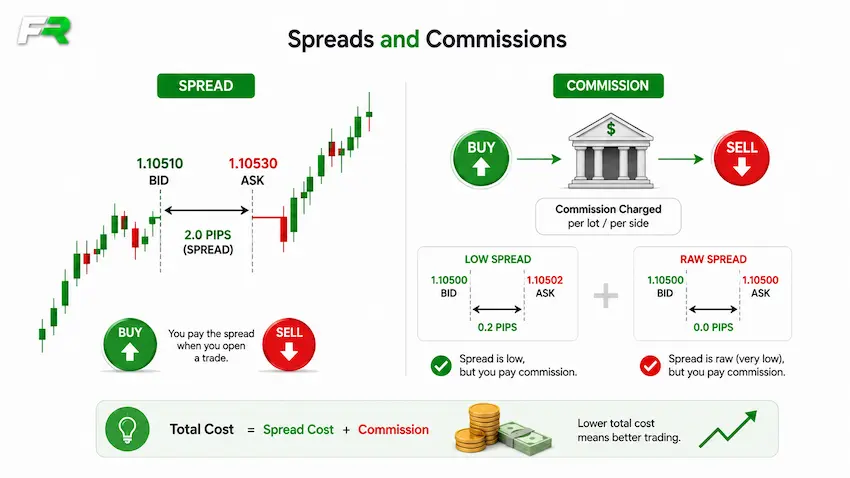
Most MT5 providers offer either spread-only accounts or raw spread accounts that combine tighter pricing with trading commissions.
| Account Type | Spread Style | Commission | Best For | Watch Out For |
| Raw / ECN | From 0.0 pips | $3-$7 per round lot | Scalpers, high-frequency traders | Commission adds up on small positions |
| Standard | 1.0-2.0 pips (built-in) | None | Swing traders, beginners | Wider spreads during news events |
| Pro / Ultra Low | 0.4-0.8 pips | None or minimal | Day traders wanting simplicity | Spreads widen more during volatility |
| Zero Spread | 0.0 pips (guaranteed) | $3-$4 per side | News traders, precise entries | Higher cost if not trading at volume |
The right account type depends on how often you trade. A swing trader opening three to five positions per week will likely pay less overall on a standard account than an ECN account where commissions accumulate on each entry and exit. A scalper running dozens of trades daily will almost always come out ahead on raw spreads, even with commissions factored in, because the tighter entry price outweighs the fixed per-lot charge.
Published minimum pricing provide a useful reference, but actual trading costs depend on market conditions, pricing sources, and fill quality. The more useful figure is the effective spread, which reflects the actual price you receive after accounting for market conditions and execution quality. Independent market data providers regularly publish brokerage spread comparisons, although their methodologies and measurement periods may differ.
Order Execution Models: ECN, STP, and Market Maker
The three execution models encountered most often with MT5 platforms each involve different mechanics for how an order gets filled.
ECN (Electronic Communication Network)
ECN providers typically aggregate pricing from multiple market liquidity providers and execute trades using market-based pricing, with commissions usually charged separately. Orders go directly to the pricing sources pool without a dealing desk. Bid-ask spread can be very tight, sometimes 0.0 pips, but commissions apply per lot. This model suits high-volume and algorithmic trading where fill transparency plays an important role.
STP (Straight-Through Processing)
STP brokers generally route client orders to market liquidity providers without operating a traditional dealing desk, although execution models vary by brokerage. This sits between ECN and market maker models. Many trading platforms describe themselves as STP when they are technically hybrid arrangements.
Market Maker
Market maker providers may act as the counterparty to certain client trades or hedge exposure externally, depending on their execution model and risk management policies. Market makers generate revenue through a combination of spreads, commissions, and risk management practices, depending on their business model. This does not automatically mean poorer execution, especially when the brokerage operates under strong regulatory oversight. Since regulated market makers must offer fair pricing, the incentive structure differs from ECN. Wider spreads and no commission are the typical markers of this model.
A practical note on execution model labels: Many brokers describe themselves using multiple labels simultaneously, such as ‘ECN/STP hybrid’ or ‘NDD with market liquidity bridge.’ These descriptions are not standardized and are not verified by regulators in the way that spread data or capital requirements are. The most reliable way to assess execution quality is through live account testing, starting with small positions during different market sessions, and recording actual fill prices versus expected prices over time.
Risk Management Tools Built Into MT5
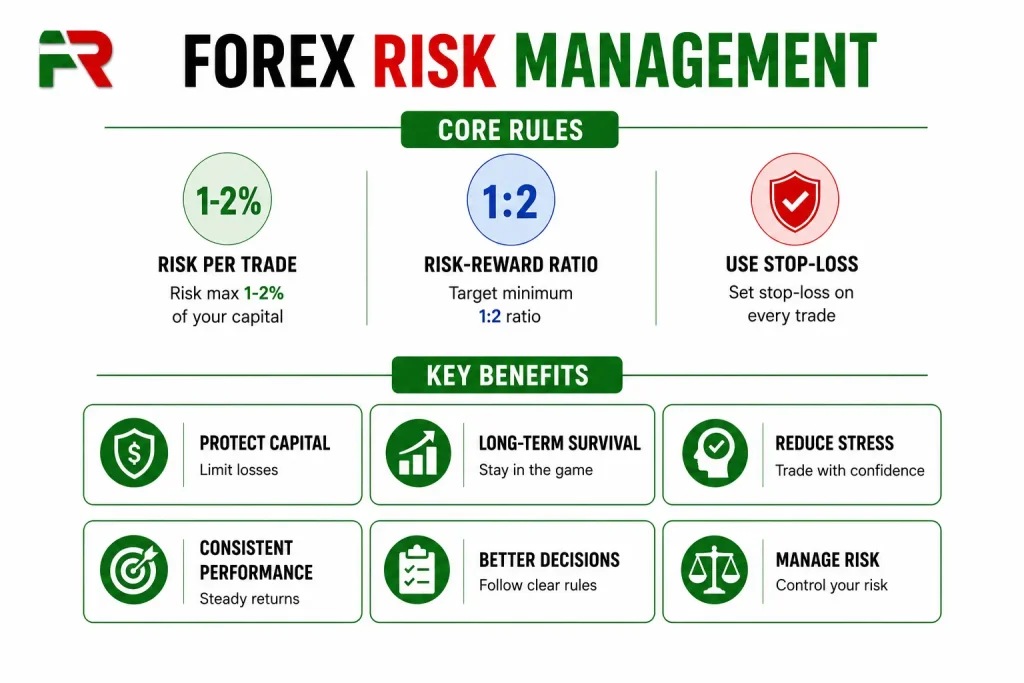
MT5 provides more risk control than most active traders initially use. Understanding these features before trading can help you avoid unnecessary mistakes.
Order Types Available on MT5
- Market Order: Immediate execution at the current price
- Buy/Sell Stop: Entry triggered when price reaches a specified level above (buy) or below (sell) current price
- Buy/Sell Limit: Entry triggered when price reaches a level below (buy) or above (sell) current price
- Buy/Sell Stop Limit: A combination order that places a limit order once a stop price is reached
- Stop Loss and Take Profit: Automatically close positions at specified price levels
- Trailing Stop: Automatically adjusts the stop loss as price moves in your favor
Depth of Market
MT5 includes a native Depth of Market feature, although the availability of Level II pricing depends on whether the broker provides this data. This helps assess market liquidity before entering large positions. Not all providers expose full DOM data through MT5, so confirming the feature is active before relying on it is worth a quick check.
Partial Position Closing
MT5 supports partial position closing where it is available under the broker’s trading conditions and supported account type. This works well for locking in partial profits while keeping remaining exposure active. The feature is available by default, but some providers restrict minimum lot sizes for partial closes.
Broker-Imposed Restrictions
Some brokers apply minimum stop-loss and pending-order distance requirements depending on the trading instrument and market conditions. Others limit specific order types on certain instruments. Checking these limitations before you begin trading is much easier than discovering them during a volatile market. Testing with a small live account before scaling up surfaces these limits early.
VPS Hosting and Algorithmic Trading on MT5
Expert Advisors require a continuously running terminal to fire trades automatically. If your computer shuts down or loses its internet connection, automated trading will stop unless MT5 is running on a VPS. VPS (Virtual Private Server) hosting keeps the terminal running on a remote server around the clock.
Several MT5 platforms offer complimentary VPS access for qualifying accounts based on minimum equity or monthly volume. IC Markets, Pepperstone, and Exness each offer broker-provided VPS or partnerships with VPS providers at reduced rates for active clients.
For algorithmic strategies specifically, server proximity to liquidity hubs matters. IC Markets and Pepperstone both host backend systems in Equinix data centers in London (LD4) and New York (NY4), the same facilities used by major pricing source providers. Hosting servers close to major financial data centres can help reduce network latency for automated strategies.
MT5’s multi-threaded strategy tester allows backtesting EAs across multiple pairs and timeframes at the same time. This is a concrete improvement over MT4, where backtesting was single-threaded and much slower on complex strategies.
Copy Trading and Social Features on MT5
MT5 includes a built-in signals service through MetaTrader’s Signals marketplace, allowing market participants to subscribe to and automatically copy trades from verified signal providers. The terminal shows provider statistics including drawdown history, profit factor, and subscriber count.
Several trading platforms extend this with proprietary copy systems running alongside MT5. Pepperstone integrates with DupliTrade and Myfxbook Autotrade. AvaTrade offers DupliTrade integration. FXTM runs its own FXTM Invest system, which lets strategy managers earn a performance fee while followers mirror positions automatically.
The key consideration with any copy setup is fill discrepancy. Signal provider entries happen at their platform, and follower entries happen at yours. The two will never be identical, especially during fast markets. The wider your spread and the slower your fill speed, the more your copied results will diverge from the provider’s stated record.
Broker Trust and Trading Psychology
One factor that receives less attention is trader confidence in their broker.
When a trader doubts whether their fills are fair or suspects the software is working against them, that suspicion bleeds into decision-making. A losing trade becomes something to investigate rather than simply accept as statistical variance. The result is overtrading, second-guessing exits, and revenge trades, each creating additional losses on top of the original.
Those operating with a trading platform they trust, having verified fills through real testing, confirmed withdrawals, and checked regulatory status, tend to process losses differently. When investors trust their provider’s execution, they are often more willing to follow their trading plan consistently. The outcome reflects the outcome of the trading strategy or the market. The next entry can be taken with a greater confidence.
This psychological dimension does not appear in any comparison table. It shows up in long-term account performance and in the quality of decisions made during difficult drawdown periods.
Behavioral finance research suggests that emotions can influence trading decisions, particularly after a series of losses. Selecting a platform you can genuinely trust is not a soft preference. It is a real component of overall trading results.
Matching an MT5 Platform to Your Trading Style
There is no universally best MT5 brokerage. There is a best match for a given strategy, capital level, and geographic location. A few direct questions narrow the field quickly.
For Scalpers and High-Frequency Traders
- Raw spread accounts with commission are almost always more cost-effective than standard accounts
- Server latency matters: look for platforms in Equinix NY4 or LD4 data centers
- Check for minimum stop distance restrictions before committing
- Verify scalping is explicitly permitted in the terms of service
- IC Markets and Pepperstone consistently rank well for this profile
For Swing and Position Traders
- Standard or Pro accounts with built-in spreads simplify cost calculation
- Overnight swap rates become relevant: check rates on the instruments you trade
- Withdrawal speed matters more here since capital cycles slower
- Strong jurisdiction regulation is particularly important for the longer time horizon
- Exness, FP Markets, and AvaTrade are frequently appropriate for this profile
For Algorithmic and EA Traders
- VPS availability and server location should be confirmed before opening an account
- Multi-threaded strategy tester access is standard on MT5, but server infrastructure affects real-world speed
- Check whether high-frequency EA execution is permitted without volume restrictions
- Verify minimum lot sizes and order frequency limits in the terms
- IC Markets and Pepperstone are the most commonly used platforms for this profile
For Beginners
- A low opening deposit reduces the cost of early learning mistakes
- Demo accounts with no time limit allow strategy development without capital pressure
- Support in your language saves significant frustration during onboarding
- Educational resources tied to the platform help contextualize what you are seeing in real time
- XM and Exness both offer accessible entry points with structured learning material
Common Mistakes When Selecting an MT5 Broker
Acting on speed without testing execution
Opening a live account before placing even a handful of real trades to observe fills is a shortcut that tends to cost more later. Demo accounts do not replicate real fill conditions. A small live account, $100 to $200, reveals actual slippage, spread behavior during news events, and order rejection frequency far better than any demo session.
Overlooking withdrawal reliability
Many firms process deposits quickly, but withdrawal times can vary depending on the payment method and region. How withdrawals are handled is where character differences appear. Consistently delayed withdrawals may be a warning sign that deserves further investigation. Test withdrawals early, before meaningful funds are at stake.
Comparing advertised spreads instead of effective spreads
Many platforms advertise figures achievable only during the quietest hours of the Asian session. EUR/USD at 0.0 or 0.1 pips may be accurate at 3am GMT but tells you nothing about what a London session trader actually pays. Track real fills across your typical hours for at least two weeks before drawing conclusions.
Ignoring swap rates for held positions
Anyone holding positions overnight, or longer, pays or receives swap rates based on the interest rate differential between currency pairs. These rates vary considerably between platforms on the same instrument and can represent a meaningful drag on returns for swing or longer-term traders. Most firms publish swap rates in their contract specifications.
Treating bonus offers as capital
Deposit bonuses almost always come with volume requirements before withdrawal is permitted. A $500 bonus with a 30x requirement means $15,000 in volume must be traded before those funds are accessible. Bonus terms are legally binding and can restrict access to your own deposited funds if the conditions are not clearly understood upfront.
How to Test a New MT5 Broker Before Committing Capital
The sequence below takes roughly two to four weeks and gives a reliable picture of how a platform actually performs before significant capital is committed.
- Open a demo account and run your typical strategy for at least one week. Note spread widening during major news events and check whether fills match expected prices.
- Open a small live account with the minimum required deposit. Execute at least 15 to 20 real trades across different sessions to observe actual slippage and fill quality.
- Process a withdrawal of a small amount within the first two weeks. The processing time and whether any friction arises tells you more about the brokerage than any review.
- Contact customer support with a specific technical question, not a general inquiry. Response time, accuracy, and tone during a real question reveals support quality better than chat widget response speed.
- Verify regulatory status independently by searching the broker’s name on the regulator’s official public database, not through the provider’s own website.
Following this process can reduce the likelihood of unexpected issues later. Those who skip it tend to find problems at exactly the moment they can least afford to.
Where MT5 Broker Infrastructure Is Heading
MetaTrader 5 continues to dominate retail forex despite several newer alternatives. Its established EA ecosystem, widespread platform adoption, and familiarity among active traders create strong inertia. MetaQuotes has consistently delivered performance improvements and mobile updates without breaking backward compatibility within the MT5 generation.
Many providers continue investing in faster trade execution technology and improved market liquidity management. Some firms report using increasingly sophisticated order-routing technology, although implementation varies. As these tools mature, the fill quality gap between platforms may gradually narrow.
Regulatory pressure continues increasing across most major jurisdictions. Leverage restrictions, negative balance protection rules, and stronger fund segregation requirements have all tightened since 2018 and are likely to tighten further. Brokers meeting current standards with headroom are better placed than those barely clearing minimums.
Those who know their terminal and have tested their execution environment under real conditions are best positioned regardless of how these technical and compliance shifts unfold.
Final Word from FX Recap
Selecting an MT5 broker is not a one-time decision made by reading a comparison table. It is a long-term choice that plays out over time, withdrawal by withdrawal, and every support interaction along the way.
Every platform on this list has been cross-referenced against official regulatory databases, publicly available spread data, and documented fill quality research. None are perfect for every trader. Each brokerage has strengths and trade-offs depending on your trading style, location, and account requirements.
What matters most is entering any broker long-term choice with clear expectations about what you are testing and what you need. Use the testing sequence above, start smaller than feels necessary, and scale only after fill performance is verified across multiple sessions and withdrawals have cleared without friction.
If you have traded with any of the platforms covered here and want to share specific fill data or withdrawal experience, the FX Recap community section is the place for it. Real trader data, recorded cleanly, helps everyone make more informed decisions.
- 1
 IC MarketsTop pick★★★★★★★★★★4.7/5
 - 2
 Exness★★★★★★★★★★4.7/5
 - 3
 XM★★★★★★★★★★4.7/5
 - 4
 RoboForex★★★★★★★★★★4.6/5
 - 5
 FP Markets★★★★★★★★★★4.6/5
Your capital is at risk. FX Recap rates brokers available in each country on regulation, trading conditions and user trust. How we rank
 Unlimited cashback on your XM tradesUnlimited XM cashbackAdT&Cs apply. Your capital is at risk.T&Cs apply · Capital at riskStart earning