IC Markets






































Canada's Inflation Rose to 3.1% in September on Gasoline, but Core Measures Eased
Pump prices pushed the headline up, yet the Bank of Canada's preferred gauges cooled, leaving its 28 October decision finely balanced.
 WriterAbir KhanWriterWrites the guides · checks every figure against primary sources View profileAbout Abir →

 Market analysisTanbir Habib RiyadForex & Crypto AnalystForex and crypto analyst · technical and fundamental analysis View profileAbout Tanbir →

 Fact-checking & riskJannatul FerdaushFact-Checker & Risk AnalystFact-checks every figure · risk analysis · Applied Statistics, University of Dhaka View profileAbout Jannatul →

 Trading reviewJowel RanaCo-Founder & Forex TraderCo-founder · forex trader · reviews guides from a trader's view View profileAbout Jowel →

 Final approvalRanjan NiskrityFounder, Owner & Forex TraderFounder and owner · forex trader · signs off every guide View profileAbout Ranjan →

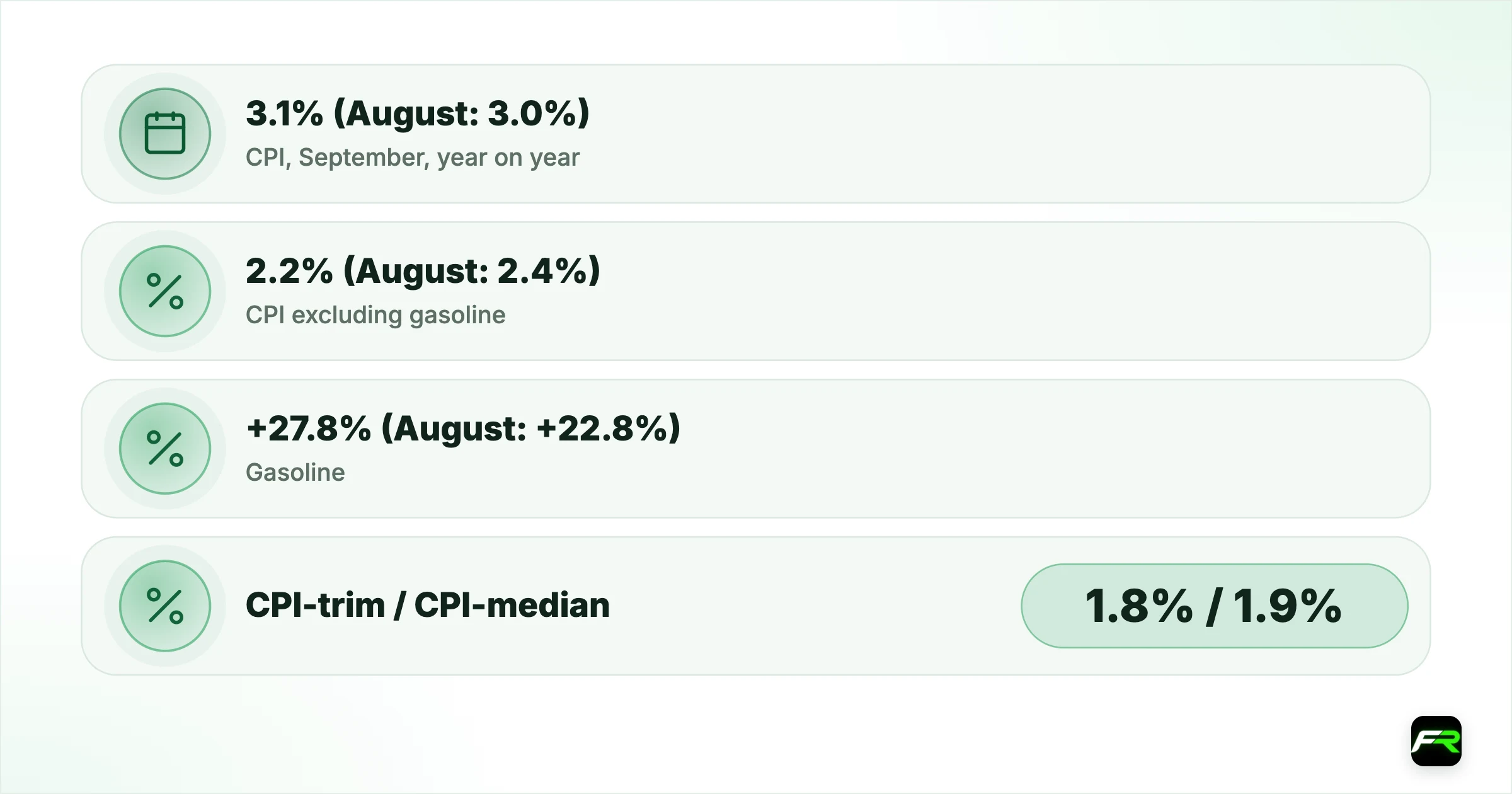
Canadian consumer prices rose 3.1% in the 12 months to September, up from 3.0% in August, Statistics Canada said on Monday 19 October. Gasoline did the lifting: pump prices were 27.8% higher than a year earlier, after a 22.8% rise the month before. Strip gasoline out and the story changes. That measure slowed to 2.2% from 2.4%, and all three of the Bank of Canada's core measures eased.
That split is the story. The headline moved the wrong way for the central bank, but the parts of the basket that show underlying pressure moved the right way. Grocery inflation dropped to its lowest rate since May 2024, and rent growth held steady. For the Bank of Canada, which decides on rates on 28 October, it is the clearest sign yet that high oil prices have not spread far into the rest of the economy.
The Canadian dollar wobbled and then firmed. In the hour of the 12:30 UTC release, USD/CAD swung between 1.4068 and 1.4113 before settling near 1.4100. It closed Monday at about 1.4106 and fell to a low of 1.4028 on Tuesday before trading near 1.4062 at 18:00 UTC. Our preview of the release set out what to look for; this story covers what came out.
| CPI, September, year on year | 3.1% (August: 3.0%) |
|---|---|
| CPI excluding gasoline | 2.2% (August: 2.4%) |
| Gasoline | +27.8% (August: +22.8%) |
| CPI-trim / CPI-median | 1.8% / 1.9% (August: 1.9% / 2.0%) |
| CPI-common | 2.4% (August: 2.6%) |
| Food from stores | +1.7% (August: +2.8%) |
| CPI, month on month | +0.1%, or +0.4% seasonally adjusted |
| Bank of Canada policy rate | 2.25%, next decision 28 October |
Energy pushed the headline higher
Energy prices rose 19.0% from a year earlier in September, up from 15.4% in August. Statistics Canada said crude oil prices climbed to their highest level since May amid continued uncertainty about the wars in the Middle East, and that fed into gasoline and heating fuel. The seasonal switch to cheaper winter-blend gasoline took a little of the edge off, but not enough to stop the annual rate rising by five points.
Heating fuel jumped the most. Prices for fuel oil and other fuels were 57.8% higher than a year before, after a 43.7% rise in August. Households in Atlantic Canada felt it most, because fuel oil is more widely used for heating there, and that region also had the highest inflation once energy is taken out: 3.3% in Nova Scotia against 2.1% nationally.
Oil remains the swing factor. US crude futures traded between $95.25 and $101.37 a barrel on Tuesday and were near $98 at 18:00 UTC, while Brent was close to $109. Those levels are higher than the averages seen through September, so October's energy figure may push the headline up again unless prices fall back soon.
Food, rent and the core measures cooled
Outside energy, price growth slowed. Food bought from stores rose 1.7% from a year earlier, down from 2.8%, the smallest increase since May 2024. Fresh vegetables fell 2.9% and sugar and confectionery 2.7%, while beef prices rose 8.7%, a slower pace than August's 11.0%. Grocery prices are still 33.0% higher than in September 2020, so the slowdown will not feel like relief at the checkout yet.
Shelter prices rose 1.8%, up a little from 1.5%, but most of that came from fuel oil and from home and mortgage insurance, which rose 4.9%. Rent grew 2.8%, the same as in August. Mortgage interest costs fell 0.2% and the homeowners' replacement cost index fell 1.9%, both unchanged from the previous month.
The Bank of Canada's own core measures all eased. CPI-trim, which cuts out the most extreme price changes each month, slowed to 1.8% from 1.9%. CPI-median, the price change in the middle of the basket, fell to 1.9% from 2.0%. CPI-common, which tracks price changes shared across categories, dropped to 2.4% from 2.6%. Two of the three now sit below the bank's 2% target.
| Measure | July | August | September |
|---|---|---|---|
| CPI-trim | 1.9% | 1.9% | 1.8% |
| CPI-median | 2.0% | 2.0% | 1.9% |
| CPI-common | 2.7% | 2.6% | 2.4% |
Source: Statistics Canada, table 18-10-0256-01, measures of core inflation (Bank of Canada definitions), year-on-year change.
What it means for the Bank of Canada on 28 October
The Bank of Canada held its policy rate at 2.25% on 2 September. Its next decision comes at 09:45 Ottawa time on 28 October, 13:45 UTC, together with its quarterly Monetary Policy Report. The September figures give it room to stay patient: headline inflation is above target because of fuel, while the measures it uses to judge underlying pressure are close to or under 2%.
That is a different position from several other central banks. The Federal Reserve, the Reserve Bank of Australia and the European Central Bank have all raised rates since early September, with energy costs pushing inflation higher. Canada's figures suggest the energy shock has so far stayed in energy, which is the condition a central bank needs before it can look through a jump in the headline rate.
There is still risk in the other direction. A one-month rise of 0.4% after seasonal adjustment is not small, and oil near $100 a barrel could keep the headline above 3% for some time. If firms start passing higher transport and heating costs into other prices, the core measures would turn up again, and October's data, due on 16 November, would show it first.
What traders can take from it
Canada's dollar depends on oil as well as on the central bank, which makes inflation days harder to trade than they look. These points can help.
- Look past the headline to CPI-trim and CPI-median. Those are the measures the Bank of Canada leans on, and they moved lower in September.
- Track oil alongside USD/CAD. Higher crude tends to support the loonie through trade, even when it also lifts inflation, so the two effects can cancel out.
- Expect the market to treat 28 October as a two-sided event. A hold is the base case suggested by the core data, but the Monetary Policy Report will update the bank's forecasts and could change the tone.
- Remember the Fed decides on the same day, about four hours later. Moves in USD/CAD that afternoon may have more to do with Washington than Ottawa.
- Respect the 1.4030 area. USD/CAD reached 1.4028 on Tuesday, and a clean break lower would extend a decline that began in early October.
Say you sell USD/CAD at 1.4060 on the view that oil and a patient Bank of Canada keep the loonie firm, with a stop at 1.4110, 50 pips above. A standard lot of 100,000 units is worth about $7.10 a pip at this rate, so the stop risks about $355 per lot. On a $10,000 account with a 1% limit of $100, the right size is about 28,000 units. If oil drops sharply, the trade loses its main support, so be ready to close it early.
See session times on our forex market hours page and every central bank date on the economic calendar. Convert any amount between the US and Canadian dollar with the currency converter, and size each trade with the position size calculator.
Inflation data and oil prices can move USD/CAD sharply, and spreads often widen at the release. Leverage magnifies losses as well as gains, so trade only with money you can afford to lose.
All price figures are from Statistics Canada's release of 19 October 2026 and its table of core inflation measures. The policy rate and decision date are from the Bank of Canada. Currency and oil levels are market data built from hourly bars to about 18:00 UTC on 20 October and differ slightly between providers. Comments on policy and the Canadian dollar are FX Recap's own reading. This is news, not investment advice.
Frequently asked
What was Canada's inflation rate in September 2026?
Canada's Consumer Price Index rose 3.1% in the 12 months to September 2026, up from 3.0% in August, according to Statistics Canada. Excluding gasoline, prices rose 2.2%.
What are the Bank of Canada's core inflation measures for September 2026?
CPI-trim was 1.8%, CPI-median 1.9% and CPI-common 2.4% in September 2026, all lower than in August, according to Statistics Canada's table of core measures.
Why did Canadian inflation rise in September?
Gasoline prices rose 27.8% from a year earlier, up from 22.8% in August, and fuel oil prices jumped 57.8%. Statistics Canada said crude oil reached its highest level since May amid uncertainty about the wars in the Middle East.
When is the next Bank of Canada rate decision?
The Bank of Canada announces its next decision on 28 October 2026 at 09:45 Ottawa time (13:45 UTC), with its Monetary Policy Report. Its policy rate is 2.25%.
Sources: Statistics Canada: Consumer Price Index, September 2026 (19 October 2026) · Statistics Canada: table 18-10-0256-01, measures of core inflation · Bank of Canada: interest rate announcement, 2 September 2026 · Statistics Canada: Consumer Price Index, August 2026
The team behind this guide
Researched, checked and approved by five forex specialists
Every guide is written, fact-checked and edited before it goes live, and updated when the facts change. Spotted an error? Tell us.