IC Markets




































Week Ahead: UK Inflation and Jobs, China GDP and Canada CPI Before Rate Week
Six official releases from Monday to Friday, led by UK inflation on Wednesday, will set the tone for five rate decisions due from 28 October.
 WriterAbir KhanWriterWrites the guides · checks every figure against primary sources View profileAbout Abir →
 Market analysisTanbir Habib RiyadForex & Crypto AnalystForex and crypto analyst · technical and fundamental analysis View profileAbout Tanbir →
 Fact-checking & riskJannatul FerdaushFact-Checker & Risk AnalystFact-checks every figure · risk analysis · Applied Statistics, University of Dhaka View profileAbout Jannatul →
 Trading reviewJowel RanaCo-Founder & Forex TraderCo-founder · forex trader · reviews guides from a trader's view View profileAbout Jowel →
 Final approvalRanjan NiskrityFounder, Owner & Forex TraderFounder and owner · forex trader · signs off every guide View profileAbout Ranjan →
Next week is the last full run of inflation and jobs data before a crowded stretch of central bank meetings. Between Monday 19 and Friday 23 October, official statisticians in China, Canada, Britain, the United States, New Zealand and Japan publish figures that feed straight into five rate decisions due from 28 to 30 October: the Reserve Bank of New Zealand, the Bank of Canada, the Federal Reserve, the European Central Bank and the Bank of Japan.
Britain has the busiest diary. The Office for National Statistics releases labour market figures on Tuesday, consumer prices on Wednesday and retail sales on Friday, each at 07:00 UK time. Sterling enters that run after a firm week: GBP/USD rose 0.73% to close Friday near 1.3330, while the dollar index slipped 0.44% to 101.78 as US Treasury yields fell.
| China Q3 GDP (NBS) | Mon 19 Oct, 10:00 Beijing (02:00 UTC) |
|---|---|
| Canada CPI, September (Statistics Canada) | Mon 19 Oct, 08:30 Ottawa (12:30 UTC) |
| UK labour market (ONS) | Tue 20 Oct, 07:00 UK (06:00 UTC) |
| US housing starts, September (Census Bureau) | Tue 20 Oct, 08:30 New York (12:30 UTC) |
| UK CPI, September (ONS) | Wed 21 Oct, 07:00 UK (06:00 UTC) |
| New Zealand CPI, September quarter (Stats NZ) | Thu 22 Oct, New Zealand time |
| Japan CPI, September (Statistics Bureau) | Fri 23 Oct, Japan time |
| UK retail sales, September (ONS) | Fri 23 Oct, 07:00 UK (06:00 UTC) |
Monday: China's third-quarter GDP and Canadian inflation
China's National Bureau of Statistics publishes its quarterly report on the economy at 10:00 Beijing time on Monday, which is 02:00 UTC, early in the Asian session. Its July release put second-quarter growth at 4.3% from a year earlier and first-half growth at 4.7%. Services grew 5.1% in the second quarter, well ahead of industry at 3.0%, so the split between the two will be worth reading as closely as the headline.
A third-quarter figure below the second quarter's pace would point to slowing demand in China. Weaker Chinese growth has often weighed on the Australian and New Zealand dollars, since both countries sell a large share of their exports there. The same NBS release normally carries monthly figures for industrial output, retail sales and fixed-asset investment, so Monday morning can bring several numbers at once. Compare the quarterly rate with the 4.7% first-half pace, the benchmark most market reports will use.
Later on Monday, at 08:30 Ottawa time (12:30 UTC), Statistics Canada releases September consumer prices. In August, its index rose 3.0% from a year earlier, the same rate as in July. Excluding gasoline, prices climbed 2.4%, up from 2.2%. Gasoline cost 22.8% more than a year before, and Statistics Canada noted that pump prices stayed high as the conflict in the Middle East continued. With US crude futures ending this week near $99 a barrel, energy will again shape the headline.
For the Canadian dollar, the measure without gasoline may matter more than the headline. The Bank of Canada held its policy rate at 2.25% on 2 September and decides again on 28 October. A further rise in underlying inflation would make another hold harder to defend, while an easing would support the case for patience. USD/CAD fell 0.82% this week to 1.4137, so the loonie arrives at the release on a strong footing.
Tuesday and Wednesday: UK jobs, then UK inflation
Tuesday's labour market report is the first of three UK releases. Last month's edition showed unemployment at 4.9% for May to July, 0.2 points higher than a year earlier, and an early estimate that payrolled employees fell by 26,000 in August. Regular pay was growing 3.5% a year. Total pay, including bonuses, slowed to 3.9%, its weakest since the September to November 2020 period. Vacancies dropped to 702,000, a level last seen outside the pandemic in 2014.
Wednesday's inflation report is the bigger event for sterling. CPI rose 3.1% in the 12 months to August, up from 2.9% in July, with motor fuels making the largest upward contribution. Core CPI, which leaves out energy, food, alcohol and tobacco, held at 2.6%, and services inflation stayed at 3.4%. Those two calmer measures show how far energy costs are spreading into the rest of the basket, and a jump in either would draw more attention than the headline.
The Bank of England held Bank Rate at 3.75% on 17 September, with six members voting to hold and three wanting a change, and its next decision is on 5 November. A rise in services inflation or a rebound in pay would strengthen the hand of members who favour tighter policy. Soft jobs figures followed by steady core inflation would point the other way. Alongside CPI on Wednesday morning, the ONS also publishes producer prices and public sector finances, so expect a busy hour for GBP pairs.
Thursday and Friday: New Zealand, Japan and UK shoppers
Stats NZ publishes consumer prices for the September quarter on Thursday 22 October, New Zealand time, which falls on Wednesday evening in Europe and the Americas. In the June quarter, prices rose 1.5% in three months and 4.1% over the year, with tradeable goods up 4.9% and non-tradeables up 3.4%. The Reserve Bank of New Zealand raised its official cash rate to 2.75% on 2 September and announces its next decision on 28 October, so this is the last inflation figure it sees before then.
Japan's Statistics Bureau releases national consumer prices for September on Friday 23 October. August prices were 1.9% higher than a year earlier, measured on the new 2025-based index the Bureau began publishing in August. The Bank of Japan raised its policy rate to 1.25% on 18 September and meets again on 30 October, the same day Tokyo's October prices come out. USD/JPY spent this week between 157.54 and 158.95 and closed Friday near 157.99, so a surprise in either direction could test the edges of that range.
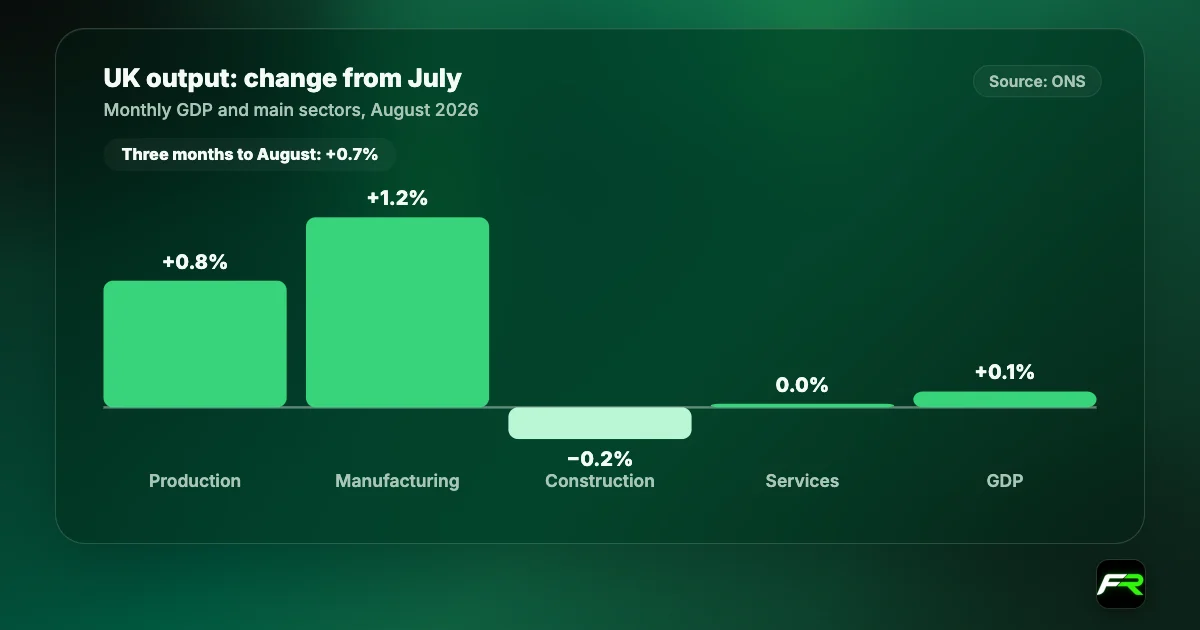
UK retail sales for September close the week at 07:00 UK time on Friday. Early signals from the ONS's own real-time indicators pointed to a softer month, with weaker consumer demand and slightly lower footfall than a year earlier, as our UK GDP story reported. A weak result after a firm CPI reading would leave the pound caught between inflation and growth worries, a mix that tends to produce choppy rather than one-way trade.
A light US calendar, with the Fed in view
Washington's schedule is thin. The Census Bureau publishes September housing starts and building permits on Tuesday at 08:30 New York time, and the Energy Information Administration's weekly petroleum report is due on Wednesday 21 October. Durable goods orders and new home sales follow on 27 October, the day before the Fed decision.
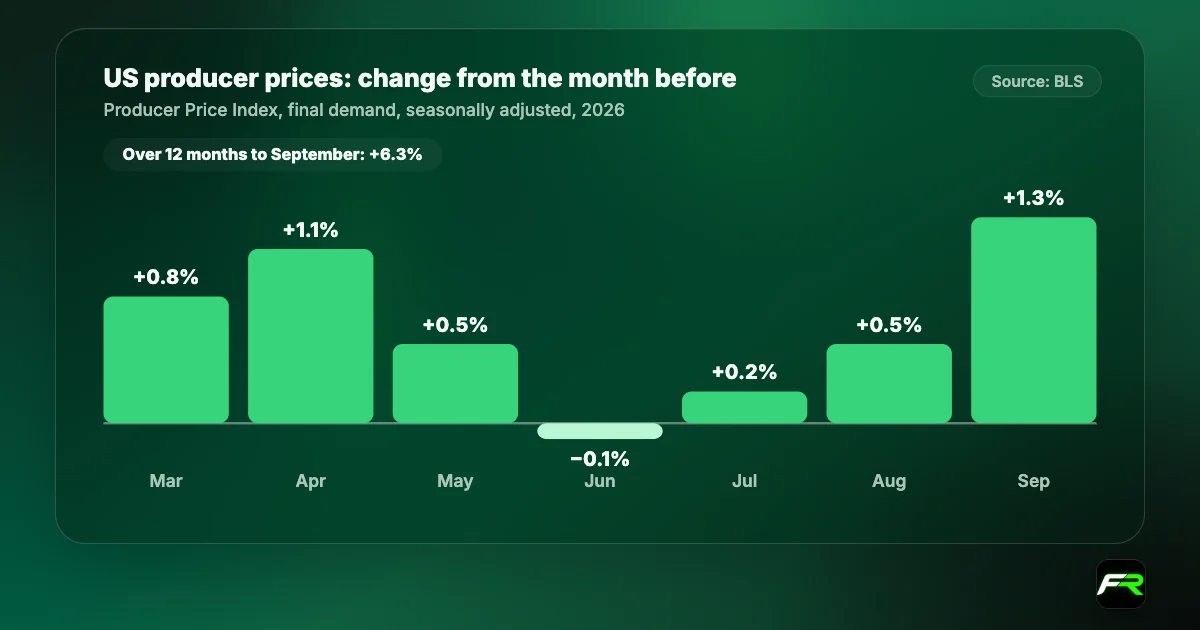
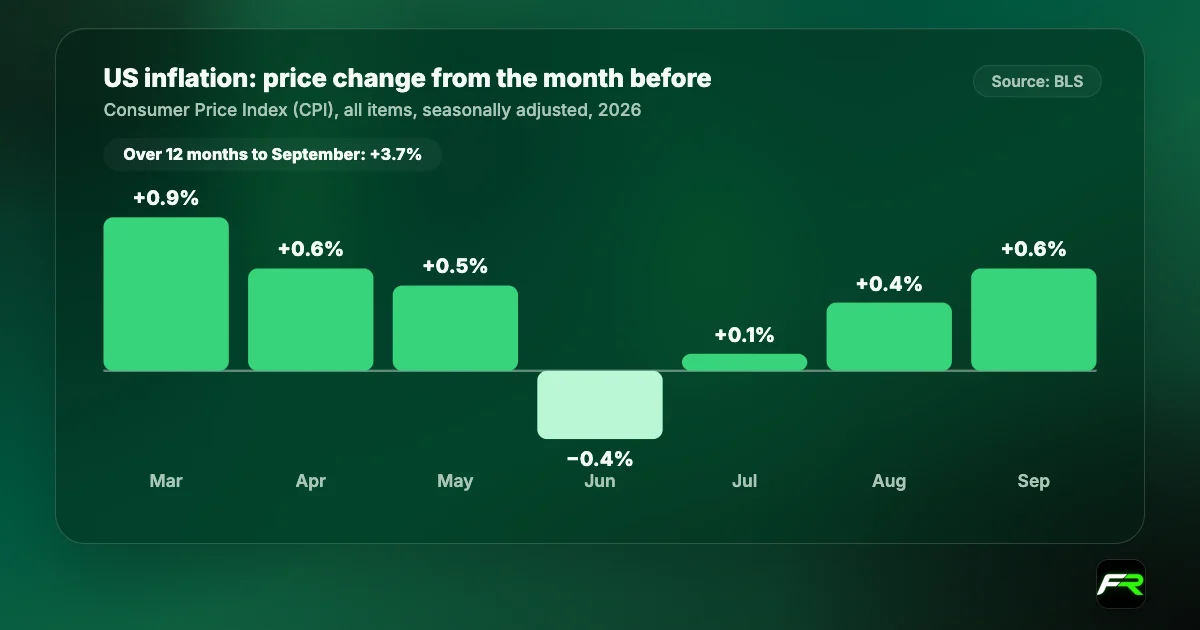
The bigger US story carries over from this week. September consumer prices rose 3.7% from a year earlier, producer prices 6.3% and, on Friday, import prices 8.1%, the largest annual rise since 2022. Yet the 10-year Treasury yield fell from 5.24% to 5.09% over the week, according to the US Treasury, and the dollar index slipped. Our dollar weekly story covers that gap in detail.
The Federal Reserve raised its target range to 3.75% to 4.00% on 16 September and announces its next decision at 14:00 New York time on 28 October. With few US numbers due, overseas data and oil prices may do more to move the dollar next week than anything domestic.
Previous readings to compare against
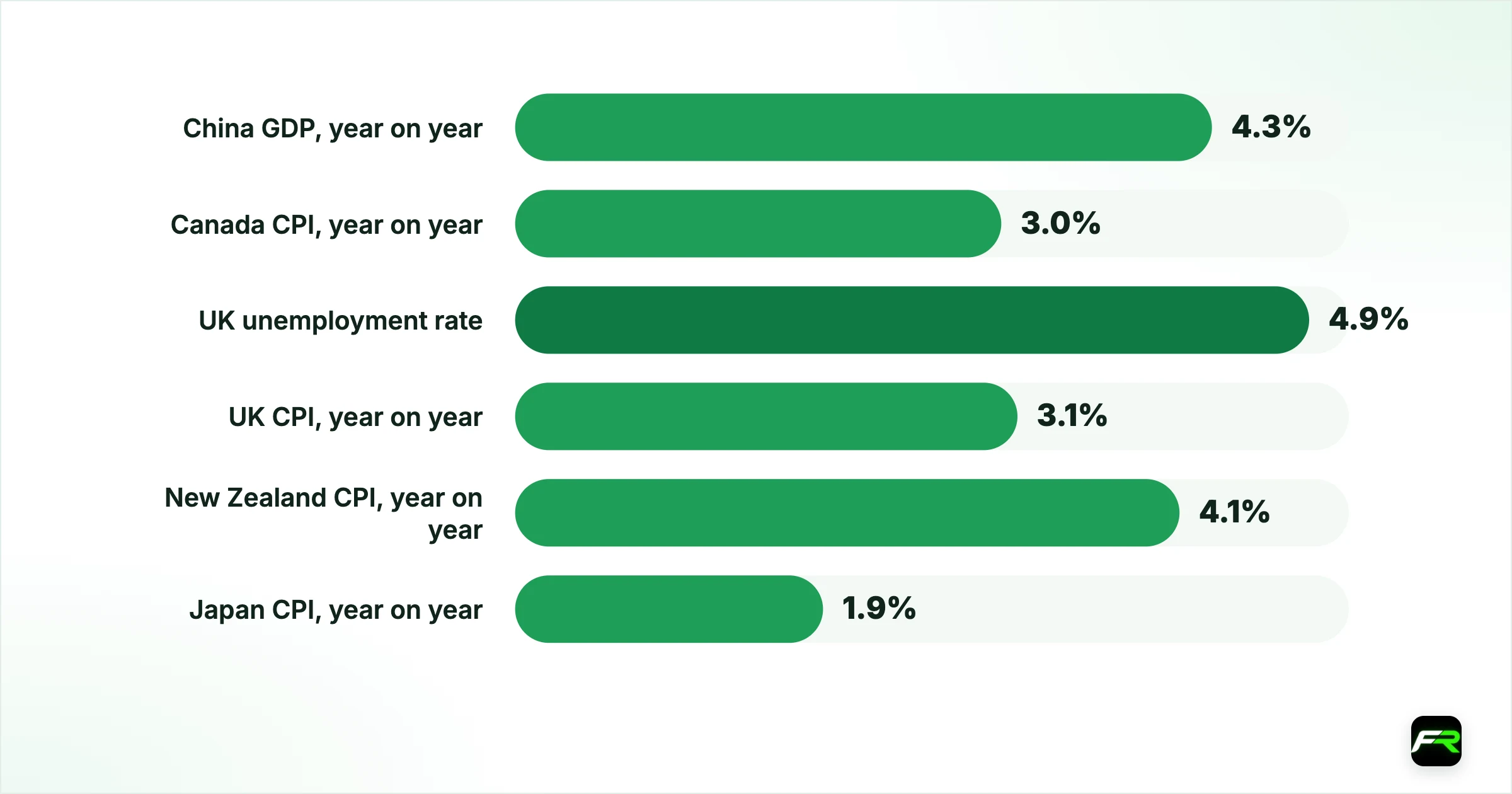
Each release is easier to judge against the figure it replaces. The table lists the latest published reading for each headline measure and the date of the next one.
| Release | Latest reading | Period | Next release |
|---|---|---|---|
| China GDP, year on year | 4.3% | Q2 2026 | 19 Oct |
| Canada CPI, year on year | 3.0% | August | 19 Oct |
| UK unemployment rate | 4.9% | May to July | 20 Oct |
| UK CPI, year on year | 3.1% | August | 21 Oct |
| New Zealand CPI, year on year | 4.1% | Q2 2026 | 22 Oct |
| Japan CPI, year on year | 1.9% | August | 23 Oct |
Sources: National Bureau of Statistics of China, Statistics Canada, Office for National Statistics, Stats NZ and Japan's Statistics Bureau, latest published releases and release calendars.
How to trade a week of scattered releases
Releases spread across six countries and every time zone make for a tiring week. A little planning helps more than fast reactions.
- Write each release time in your own time zone before Monday. Our economic calendar converts them for you, and the market hours page shows which session will be open.
- Trade the currency the data belongs to. UK figures move GBP pairs, Canadian CPI moves USD/CAD, and China's GDP is often traded through AUD and NZD.
- Compare each figure with the previous reading in the table above, not only with forecasts quoted elsewhere. A rise in UK core inflation from 2.6% would matter even if the headline matched expectations.
- Expect thin liquidity around the Asian-session releases from China and New Zealand, where spreads can widen sharply for a few minutes.
- Cut position size into 28 October, when three central banks announce decisions within about 17 hours of each other.
Say you plan to sell GBP/USD at 1.3330 if UK services inflation rises on Wednesday, with a stop at 1.3390, 60 pips away. A standard lot is worth about $10 a pip, so that stop risks about $600 per lot. On a $10,000 account with a 1% limit of $100, the right size is about 16,000 units, roughly 0.16 lots. If spreads widen to 3 or 4 pips at 07:00 UK time, count that in the risk as well.
For levels on the main pairs, see our daily GBP/USD analysis, USD/JPY analysis and EUR/USD analysis, which carry Friday's close over the weekend. Size each position with the position size calculator.
Data releases can move currencies sharply in seconds, and spreads often widen at the moment of release. Leverage magnifies losses as well as gains, so trade only with money you can afford to lose.
Release dates and times come from the official calendars of the Office for National Statistics, the National Bureau of Statistics of China, Statistics Canada, Stats NZ, Japan's Statistics Bureau, the US Census Bureau and the US Energy Information Administration. Previous readings are from each agency's latest release. Rate decisions and meeting dates are from the central banks. Currency and oil levels are market data built from hourly bars at the Friday close (about 21:00 UTC) and differ slightly between providers. Calendars can change, so check the agency's own site on the day. This is news, not investment advice.
Frequently asked
What are the main forex events for the week of 19 October 2026?
China's third-quarter GDP and Canada's September CPI on Monday 19 October, UK labour market data on Tuesday, UK CPI on Wednesday, New Zealand's quarterly CPI on Thursday, and Japan's CPI and UK retail sales on Friday 23 October.
When is UK CPI for September 2026 released?
The ONS publishes it on Wednesday 21 October 2026 at 07:00 UK time (06:00 UTC). In August, CPI inflation was 3.1% and core CPI 2.6%.
When is China's third-quarter GDP released?
The National Bureau of Statistics releases it on Monday 19 October 2026 at 10:00 Beijing time, which is 02:00 UTC. Second-quarter growth was 4.3% from a year earlier.
Which central banks decide on rates at the end of October 2026?
The Reserve Bank of New Zealand, the Bank of Canada and the Federal Reserve on 28 October, the European Central Bank on 29 October and the Bank of Japan on 30 October. The Bank of England follows on 5 November.
Sources: Office for National Statistics: release calendar · National Bureau of Statistics of China: 2026 release calendar · Statistics Canada: upcoming releases · Stats NZ: release calendar · Statistics Bureau of Japan: CPI schedule of release · Office for National Statistics: Consumer price inflation, UK: August 2026 · Statistics Canada: Consumer Price Index, August 2026 · US Census Bureau: 2026 economic indicator calendar
The team behind this guide
Researched, checked and approved by five forex specialists
Every guide is written, fact-checked and edited before it goes live, and updated when the facts change. Spotted an error? Tell us.