 IC Markets





























The Major Forex Currency Pairs
Major currency pairs are among the most actively traded forex pairs on the international market. The US dollar is included in every major currency pair. Major currency pairs offer deep liquidity, competitive spreads, and generally more stable price behaviour than less frequently traded pairs. These features make them attractive to both new and experienced traders. Their high trading volume attracts significant participation from banks, hedge funds, asset managers, and other institutional market participants. As a result, price action is often more orderly than in many minor or exotic currency pairs, although no market is fully predictable.
 WriterAbir KhanWriterWrites the guides · checks every figure against primary sources View profileAbout Abir →
 Market analysisTanbir Habib RiyadForex & Crypto AnalystForex and crypto analyst · technical and fundamental analysis View profileAbout Tanbir →
 Fact-checking & riskJannatul FerdaushFact-Checker & Risk AnalystFact-checks every figure · risk analysis · Applied Statistics, University of Dhaka View profileAbout Jannatul →
 Trading reviewJowel RanaCo-Founder & Forex TraderCo-founder · forex trader · reviews guides from a trader's view View profileAbout Jowel →
 Final approvalRanjan NiskrityFounder, Owner & Forex TraderFounder and owner · forex trader · signs off every guide View profileAbout Ranjan →
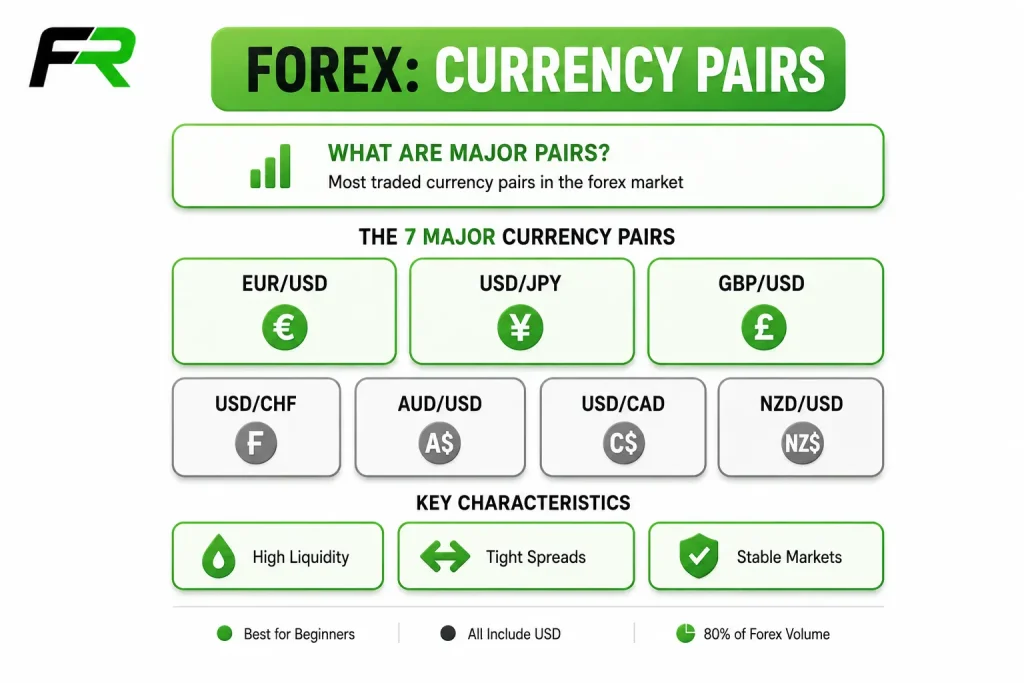
The seven major currency pairs are EUR/USD, USD/JPY, GBP/USD, AUD/USD, USD/CHF, USD/CAD, and NZD/USD. Every one of them has the US dollar on one side. They account for the largest share of daily forex volume, consistently attract the tightest spreads from brokers, and are the pairs most widely covered by analysts and economic research.
For many traders, major pairs are the preferred starting point because they combine lower trading costs with abundant market data and educational resources. But liquidity does not mean safe, and tight spreads do not make a trade easier to get right. Each major pair has its key market drivers, its typical trading characteristics, and its unique relationship with economic data and news events.
This article covers what makes major pairs different from minors and exotics, what drives prices in each one, how each pair tends to behave, when they are most active, and how to approach trading them with sound risk management.
What Makes a Currency Pair a Major
A major currency pair is classified using two main characteristics: it must include the US dollar, and both currencies in the pair must come from large, developed economies with high levels of international trade and financial market activity.
The US dollar is considered the world’s primary reserve currency because it is the world’s primary reserve currency. The dominant medium for international trade settlement, and the currency against which most commodity prices are quoted. According to the latest BIS Triennial Central Bank Survey, the US dollar remains the world’s most traded currency and is involved in around 88% of all foreign exchange transactions. This means almost every trade in the forex market involves the dollar on at least one side.
The other currencies in the major pairs come from economies with similarly deep financial markets: the eurozone, Japan, the United Kingdom, Australia, Switzerland, Canada, and New Zealand. Strong trade and investment activity between these economies creates consistent buying and selling interest, resulting in high liquidity throughout most of the trading week.
Majors vs Minors vs Exotics: The Real Differences
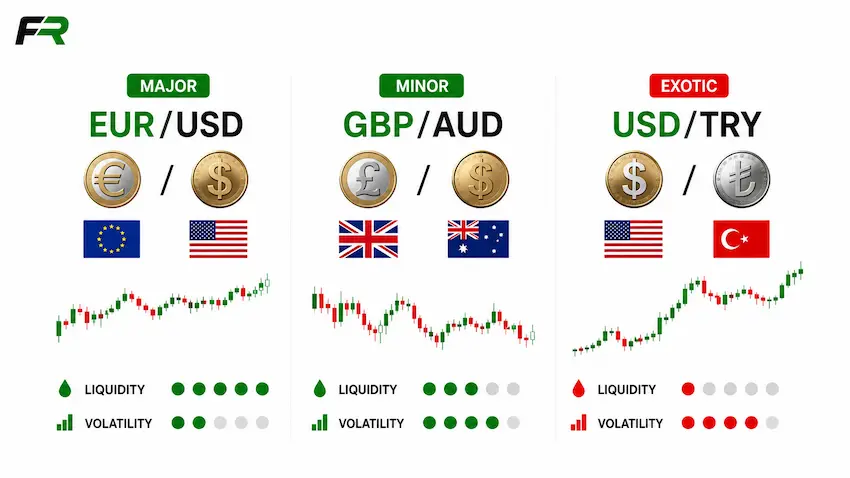
Minor currency pairs are commonly referred to as cross-currency pairs because they do not include the US dollar. EUR/GBP, EUR/JPY, GBP/JPY, AUD/JPY, and similar combinations fall into this category. They are traded actively but at lower volumes than the majors, which means spreads are typically wider and price moves can be less predictable.
Exotic pairs combine a major currency with a currency from a smaller or emerging market economy: USD/TRY, USD/ZAR, USD/MXN, EUR/PLN, and similar pairs. These tend to have wide spreads, thin liquidity outside of their home market hours, and sensitivity to local political and economic events that may not be well-covered by mainstream financial media. Exotic pairs can experience large price swings over short periods, particularly during low-liquidity conditions or domestic economic events.
For traders, the biggest main differences are execution quality, trading costs, and access to reliable market information. Major pairs are generally executed quickly at the quoted price during normal market hours, and the economic data that drives them is widely published and analyzed. Minor and exotic pairs carry greater execution risk, wider costs, and require more specialized knowledge of the economies involved.
Some traders are attracted to exotic pairs because their larger price swings appear to offer greater profit potential. Higher trading costs often reduce that advantage when spread costs are factored in. A 50-pip move in USD/ZAR with a 20-pip spread produces a net gain of 30 pips. The same 50-pip move in EUR/USD with a 0.5-pip spread produces 49.5 pips. The opportunity in exotics is real but offset by higher costs and less predictable behavior.
The Role of the US Dollar in Major Pairs
The US dollar’s position as the global reserve currency means its movements affect not just the pairs it is directly quoted in but the entire forex market. A stronger US dollar often puts downward pressure on many globally traded commodities, although supply, demand, and geopolitical factors also influence prices. When the Federal Reserve changes interest rates or signals a policy shift, virtually every major pair reacts.
This provides a useful way to analyse any major currency pair. When trading any major pair, the key question is often not about the pair in isolation but about the dollar: is the USD strengthening or weakening, and why? Strong US economic data, hawkish Federal Reserve communications, or global risk-off sentiment that drives capital into safe-haven assets all tend to strengthen the dollar against most major counterparts simultaneously.
Understanding the overall direction of the US dollar helps traders interpret movements across all major pairs. EUR/USD and GBP/USD will often move in the same direction against the dollar on a given day. USD/JPY and USD/CHF will tend to move in the opposite direction. Recognizing this correlation means a trader can avoid unintentionally increasing a dollar position by opening in the same direction across multiple pairs that all essentially express the same USD view.
What Drives Prices in Major Currency Pairs
Interest Rate Differentials
One of the most important long-term drivers of exchange rates is the interest rate differential between two economies. When one central bank raises rates while the other holds or cuts, capital tends to flow toward the higher-yielding currency as investors seek better returns. This dynamic develops over weeks and months as rate expectations shift based on economic data and central bank communications.
The Federal Reserve, European Central Bank, Bank of England, Bank of Japan, Reserve Bank of Australia, Swiss National Bank, Bank of Canada, and Reserve Bank of New Zealand all hold scheduled meetings that produce decisions and statements closely monitored by forex traders. The period leading up to these meetings, as expectations build and then either confirm or surprise, is often when the most longer-term market trends in major pairs develop.
Economic Data
Scheduled economic releases are among the most common causes of short-term volatility in the forex market. Non-farm payrolls from the US, CPI inflation data, GDP readings, retail sales figures, and manufacturing PMI surveys all have the potential to move major pairs significantly when the results deviate from expectations.
The key factor is how much the actual result differs from market expectations. A strong jobs report that meets the consensus forecast often produces little movement because the expected result was already priced in. A jobs report that comes in significantly above or below expectations often causes traders to reassess expectations to reprice its interest rate expectations immediately, producing significant price movements.
Geopolitical and Risk Sentiment
During periods of heightened market uncertainty, investors often seek safe-haven currencies such as the US dollar, Japanese yen, and Swiss franc. This happens because investors often move capital into assets they consider safer during periods of uncertainty. When equity markets sell off sharply, when geopolitical tensions escalate, or when financial system stress appears, money moves into these currencies as protection.
This means USD/JPY and USD/CHF often behave differently from EUR/USD and GBP/USD during risk events, since the dollar and yen can both be viewed as safe-haven assets simultaneously, creating opposing market forces that produce more complex price action.
Commodity Prices
AUD/USD and USD/CAD have well-established relationships with commodity prices. Australia is one of the world’s largest exporters of iron ore and a significant exporter of coal and gold. When commodity prices rise, Australian export revenues increase and the Australian dollar typically strengthens, pushing AUD/USD higher. Canada is among the world’s largest crude oil producers and exporters. Rising crude oil prices tend to support the Canadian dollar, which means USD/CAD falls when oil prices rise.
These relationships are important but not constant, as other economic and market factors can sometimes have a stronger influence on price movements. But a trader who ignores commodity price trends when analyzing AUD/USD or USD/CAD is missing an important consideration.
Each Major Pair: Characteristics and Key Drivers
EUR/USD
EUR/USD remains the world’s most traded currency pair, accounting for approximately one-fifth to one-quarter of global forex turnover according to BIS data. It represents the economic relationship between the United States and the eurozone, which together account for a substantial portion of global GDP and trade.
The pair tends to have orderly price movement during London and New York hours because of the depth of liquidity. It is one of the most closely monitored currency pairs by traders, analysts, and financial institutions worldwide. Key drivers include ECB and Federal Reserve policy divergence, European inflation data, US employment and inflation figures, and broader USD sentiment.
EUR/USD generally moves inversely to the US Dollar Index because the euro has the largest weighting in the index. For many traders, EUR/USD provides one of the clearest ways to assess broad US dollar strength or weakness.
USD/JPY
USD/JPY is the second most traded pair globally and has a unique trading behaviour shaped by the Bank of Japan’s historically highly accommodative monetary policy. For extended periods, The Bank of Japan maintained ultra-low interest rates for many years before gradually adjusting policy, making interest-rate expectations a major driver of USD/JPY.
The pair is the most active during the Tokyo session overlap with London, though it remains liquid throughout the trading day. It is sensitive to Japanese intervention risk: Foreign exchange intervention is conducted by Japan’s Ministry of Finance, with operational support from the Bank of Japan. USD/JPY also functions as an indicator of market risk sentiment. When global risk appetite falls, yen demand often increases as traders unwind carry trades, pushing USD/JPY lower even if USD is strengthening elsewhere.
GBP/USD
GBP/USD, commonly called cable, is known for larger daily ranges than EUR/USD. Sterling is sensitive to UK-specific political developments, which can produce sharp moves disconnected from broader USD trends. The Brexit period from 2016 to 2021 was an extreme example, but UK political uncertainty more generally tends to add volatility to the pair beyond what fundamentals alone would suggest.
The pair is most active during London session hours and the early New York overlap. Bank of England policy decisions, UK inflation data, GDP readings, and any developments affecting UK trade relationships all move the pair significantly. GBP/USD typically has a positive correlation with EUR/USD since both pairs respond to USD direction, but the correlation breaks down frequently enough that treating them as equivalent is a mistake.
AUD/USD
AUD/USD reflects Australian economic conditions and commodity price trends against US economic performance. The Reserve Bank of Australia’s interest rate decisions, Australian employment and inflation data, and Chinese economic data all influence the pair. China has been Australia’s largest trading partner for many years, making Chinese economic data particularly important for AUD.
The pair is most active during the Sydney and Tokyo sessions and the early London open. It tends to perform well in risk-on environments and weaken during global risk aversion. Traders who follow iron ore, gold, or coal prices will find those markets provide additional market context for AUD/USD direction.
USD/CAD
USD/CAD, called the loonie, is strongly influenced by the price of crude oil. Canada exports approximately 3 to 4 million barrels of oil per day, making energy prices an important driver of Canadian economic health and CAD valuation. When crude oil prices rise, USD/CAD typically falls as the Canadian dollar strengthens. When oil prices fall, USD/CAD typically rises.
Bank of Canada policy decisions, Canadian employment data, and trade balance figures also move the pair. The close economic relationship between the US and Canada means the pair can be less volatile than other majors during periods when both economies are moving in the same direction, but US-Canada trade policy developments, including tariff changes, can produce sharp short-term moves.
USD/CHF
USD/CHF reflects the Swiss franc’s role as a global traditional defensive currency. Switzerland’s political stability, strong external balance, and reputation as a financial centre contribute to the Swiss franc’s safe-haven status. The Swiss National Bank actively manages the franc’s strength and has intervened periodically to prevent excessive appreciation.
The pair has a historically strong negative correlation with EUR/USD because Switzerland’s economy is deeply integrated with the eurozone. When EUR/USD rises, USD/CHF often falls simultaneously. This correlation is broader market context but is not perfectly consistent and has broken down during major risk events when both the dollar and franc are sought as havens.
NZD/USD
Both Australia and New Zealand are commodity-exporting economies, although their export profiles differ significantly. The Reserve Bank of New Zealand’s policy decisions, dairy prices (New Zealand’s largest export category), and Chinese economic data are the primary drivers.
NZD/USD tends to have slightly wider spreads than AUD/USD and somewhat lower daily volume, making it less suitable for beginners. Traders already familiar with AUD/USD often find NZD/USD price action familiar and may trade both as a way to compare sentiment across the two currencies.
Liquidity, Spreads, and Trading Costs
The major pairs generally provide the tightest spreads in the forex market. EUR/USD often has the tightest spreads in the forex market, although actual spreads vary by broker, account type, liquidity, and market conditions. GBP/USD and USD/JPY are usually between 0.7 and 1.5 pips. AUD/USD, USD/CAD, and NZD/USD are slightly wider. USD/CHF falls between these ranges. FXRecap’s guide on what is a forex spread explains how spread costs affect overall trade profitability and how spreads change during news events and off-peak hours.
Spreads commonly widen during major economic announcements as liquidity providers adjust pricing to reflect increased market risk. A EUR/USD spread that sits at 0.5 pips during the London-New York overlap may jump to 3 or 4 pips in the seconds immediately following a US non-farm payrolls release. Traders who enter or hold positions through these events should account for execution at a potentially much wider spread than usual.
Liquidity also thins considerably during the Asian session for EUR/USD and GBP/USD, which are primarily European pairs. Price can move in become less consistent during low-liquidity periods, and the spread premium quoted by brokers reflects that additional risk. USD/JPY maintains better liquidity during the Tokyo session than other majors because it involves the Japanese yen.
Session Timing and Volatility Windows
Major pairs have peak activity windows tied to the trading sessions of the economies they represent. FXRecap’s guide on forex market hours covers the full session schedule, but the simple overview for major pair traders is this:
- EUR/USD and GBP/USD are most active during the London session (8am to 5pm London time) and reach peak volume during the London-New York overlap (1pm to 5pm London time). This is typically when the tightest spreads and most reliable technical behavior occur.
- USD/JPY starts moving during the Tokyo session (midnight to 9am London time) and remains active through the London-New York overlap. It is one of the more actively traded pairs across all three main sessions.
- AUD/USD and NZD/USD are most active from the Sydney open through the Tokyo session, with a second period of activity during the London-New York overlap when US data is released.
- USD/CAD is most active during the New York session given the close economic relationship between the US and Canada. Canadian data releases tend to come during New York morning hours, aligning with peak USD/CAD volatility.
- USD/CHF follows European session patterns similar to EUR/USD, with peak activity during the London session and London-New York overlap.
Trading a pair outside its primary active session means wider spreads, thinner liquidity, and price behavior that is more susceptible to being moved by individual large orders rather than broader market participation. For most strategies, trading during a pair’s primary session produces more consistent results.
How News Events Affect Major Pairs
Scheduled news events are the most common source of sharp volatility in major pairs. The economic calendar lists every significant release with an expected impact rating, the previous result, and the consensus forecast from analysts.
The pairs most sensitive to specific data categories:
- EUR/USD: ECB interest rate decisions and press conferences, eurozone CPI and GDP data, US non-farm payrolls, US CPI, and Federal Reserve decisions and FOMC minutes.
- GBP/USD: Bank of England decisions and inflation reports, UK CPI, UK employment data, and any significant UK political developments.
- USD/JPY: Bank of Japan decisions and forward guidance, Japanese CPI, US employment and inflation data, and global risk sentiment shifts.
- AUD/USD: RBA decisions, Australian employment data, Chinese manufacturing PMI, and commodity price trends particularly iron ore and gold.
- USD/CAD: Bank of Canada decisions, Canadian employment data, US employment data, and crude oil price movements.
The common approach for managing news risk is to either close positions before high-impact releases or ensure stop-losses are wide enough to accommodate the expected volatility spike, including the spread widening that accompanies it. Holding through major releases with tight stops and normal position sizes is one of the most common ways to experience unnecessary losses that have nothing to do with trade direction.
Which Major Pair Should You Start With
EUR/USD is the most suitable starting pair for most beginners. It has the tightest spreads of any pair in the market, the deepest liquidity, the most widely available analysis and educational content, and behavior during major sessions that is as easier to analyse technically as any pair in forex. When a support level holds or a resistance breaks in EUR/USD during London hours, it tends to be for reasons that are explainable and recognizable.
USD/JPY is a useful second pair because its session timing is different from EUR/USD and because it provides exposure to the yen’s distinct behavioral characteristics around risk events. A trader who understands both EUR/USD and USD/JPY has a reasonable cross-section of major pair dynamics.
AUD/USD is worth adding once commodity price relationships become easier to understand, since that context adds a layer of fundamental reasoning to the technical analysis rather than just adding another chart to watch.
GBP/USD is a logical next step from EUR/USD given the similarities in trading hours and USD sensitivity, but the higher volatility means wider stop requirements and the occasional sharp political surprise. Traders who find EUR/USD too quiet often find GBP/USD satisfies the preference for higher volatility while keeping them in familiar European session territory.
Most experienced traders recommend mastering one major pair before expanding to others. Every pair requires time to develop familiarity with its typical daily range, its behavior around support and resistance levels, and its response to the specific economic data that drives it. Spreading attention across several pairs simultaneously before any of them are well-understood produces inconsistent results.
FXRecap’s guide on forex demo trading explains how to use demo practice specifically to develop pair familiarity before committing real capital.
Risk Management Specific to Major Pairs
High liquidity reduces execution risk but does not reduce the importance of disciplined risk management. Because major pairs are heavily traded, institutional trading activity is significant and price can move quickly and decisively when large participants act. A technical level that has held for days can break decisively and without hesitation when a major economic surprise overrides the structure.
Stop-losses should be placed at structural levels rather than at fixed pip distances. The typical daily range of a major pair is a relevant context for stop placement. EUR/USD’s average daily trading range changes over time depending on market volatility and should be checked using current ATR values. A 5-pip stop on EUR/USD will be triggered repeatedly by spread movement alone. A stop placed below a meaningful support level at 30 to 50 pips reflects the normal day-to-day price fluctuations the pair produces.
Correlation between pairs is important for position sizing. Holding long positions in both EUR/USD and GBP/USD increases exposure to US dollar weakness because the two pairs are often positively correlated, although the relationship is not perfect. If the dollar strengthens sharply on news, both trades lose at the same time. A trader who treats each as an independent position with full 1% risk per trade is actually risking 2% on one market view. Accounting for correlation means treating correlated positions as part of the same exposure when calculating total risk.
FXRecap’s guide on forex risk management covers position sizing and the correlation issue in detail, with practical examples across multiple pairs.
When Minor or Cross Pairs Make Sense
Major pairs are not the only option, and experienced traders frequently find worthwhile opportunities in minor and cross pairs that do not appear in the majors at the same time.
EUR/JPY, GBP/JPY, and AUD/JPY are popular crosses because they express yen sentiment without the opposing USD influence. When a trader has a clear view on yen weakness but no strong view on the dollar, a yen cross allows that position to be reflected more directly than USD/JPY.
EUR/GBP is useful when UK-specific or eurozone-specific factors diverge. During periods of UK political uncertainty, GBP may weaken against both USD and EUR, making EUR/GBP a more direct expression of sterling weakness than GBP/USD, which mixes sterling and dollar dynamics.
The sensible time for adding cross pairs is having a genuine reason to prefer them over the equivalent major pair position. Adding crosses simply for variety or because the chart looks interesting produces more complexity without proportional benefit. Once major pair mechanics are well understood, crosses offer meaningful additional opportunities that experienced traders use regularly.
Summary
The seven major currency pairs are the foundation of retail forex trading. Their liquidity, tight spreads, and the depth of economic information available on the countries they represent make them the most suitable markets for developing trading skills and developing consistent trading skills.
Each major currency pair responds to its own economic drivers, trading sessions, and market conditions. EUR/USD is the benchmark: clean, liquid, and technically consistent during European and US hours. GBP/USD carries more volatility and political sensitivity. USD/JPY reflects yen dynamics and global risk sentiment. AUD/USD and NZD/USD track commodity prices and China-linked sentiment. USD/CAD moves with oil. USD/CHF behaves as a safe-haven pair with strong correlation to EUR/USD.
Liquidity does not mean predictable, and major pairs experience sharp moves around economic data, central bank decisions, and geopolitical events. Risk management is as essential on EUR/USD as on any exotic pair. The difference is that the drivers are easier to analyse, the costs are lower, and the behavior is generally more stable with technical analysis during normal market conditions.
FXRecap’s education library covers the related topics that support major pair trading: forex market basics for the broader market structure, what is a pip in forex for calculating profit and loss accurately across different pairs, and forex trading strategies for building approaches that match the characteristics of the pairs you trade.
The team behind this guide
Researched, checked and approved by five forex specialists
Every guide is written, fact-checked and edited before it goes live, and updated when the facts change. Spotted an error? Tell us.
Related Articles
 Education
10 min read
Education
10 min read

 Education
8 min read
Education
8 min read
 Education
7 min read
Education
7 min read
 Education
17 min read
Education
17 min read
 Education
9 min read
Education
9 min read
 Education
7 min read
Education
7 min read