IC Markets



























Best Forex Brokers in China
Mainland China licenses no retail margin forex brokers, caps personal currency conversion at USD 50,000 a year and tightened monitoring in 2026. Here is what that means and what is legal.
 WriterAbir KhanWriterWrites the guides · checks every figure against primary sources View profileAbout Abir →
 Market analysisTanbir Habib RiyadForex & Crypto AnalystForex and crypto analyst · technical and fundamental analysis View profileAbout Tanbir →
 Fact-checking & riskJannatul FerdaushFact-Checker & Risk AnalystFact-checks every figure · risk analysis · Applied Statistics, University of Dhaka View profileAbout Jannatul →
 Trading reviewJowel RanaCo-Founder & Forex TraderCo-founder · forex trader · reviews guides from a trader's view View profileAbout Jowel →
 Final approvalRanjan NiskrityFounder, Owner & Forex TraderFounder and owner · forex trader · signs off every guide View profileAbout Ranjan →
China's approach to retail forex is shaped by capital controls. The State Administration of Foreign Exchange (SAFE) limits each person to converting the equivalent of USD 50,000 a year, for stated purposes such as travel, study and medical costs. Investment abroad is not one of them, and no mainland regulator licenses retail margin forex or CFD brokers.
That is why this page does not rank offshore brokers for mainland residents. It covers the legal routes, the 2026 changes and the risks of the workarounds many people use.
Is forex trading legal in China?
Spot currency exchange through licensed banks is legal, within the annual quota. Leveraged forex is not: margin trading has been prohibited in China since 2008, and in 2018 the PBOC, the Ministry of Public Security and SAFE jointly stated that no institution has been permitted to run forex margin trading in China. Doing it with an offshore broker also has no legal channel: funding it means using the quota for a purpose it does not allow, or routing money through third parties. From 1 January 2026 new rules from the central bank and financial regulators lowered transaction-reporting thresholds, extended record keeping to ten years and added detection of structuring, where transfers are split to avoid scrutiny.
Funding an offshore trading account through someone else's quota, an underground exchange or a crypto intermediary can lead to frozen bank accounts and penalties, and you have no recourse if the platform does not pay out.
What mainland residents can do legally
| Route | What it is | Worth knowing |
|---|---|---|
| Bank personal FX trading | Spot trading of currency pairs through a mainland bank | No leverage; the bank quotes the price |
| Foreign currency deposits | Holding USD, EUR or other currencies at a bank | Within your USD 50,000 annual quota |
| Qualified schemes | Funds and products approved for overseas investment | Through licensed institutions only |
These routes lack the leverage of a CFD platform, and that is part of the point: they sit inside the rules and inside the banking system.
Why the offshore route is risky
- No mainland regulator supervises the broker, and cross-border recovery is impractical.
- Funding usually breaks the purpose rules of the annual quota.
- Bank accounts linked to P2P crypto or third-party transfers can be frozen.
- Platforms marketed on WeChat are frequently fraudulent, and victims are pressured to deposit more.
Leverage
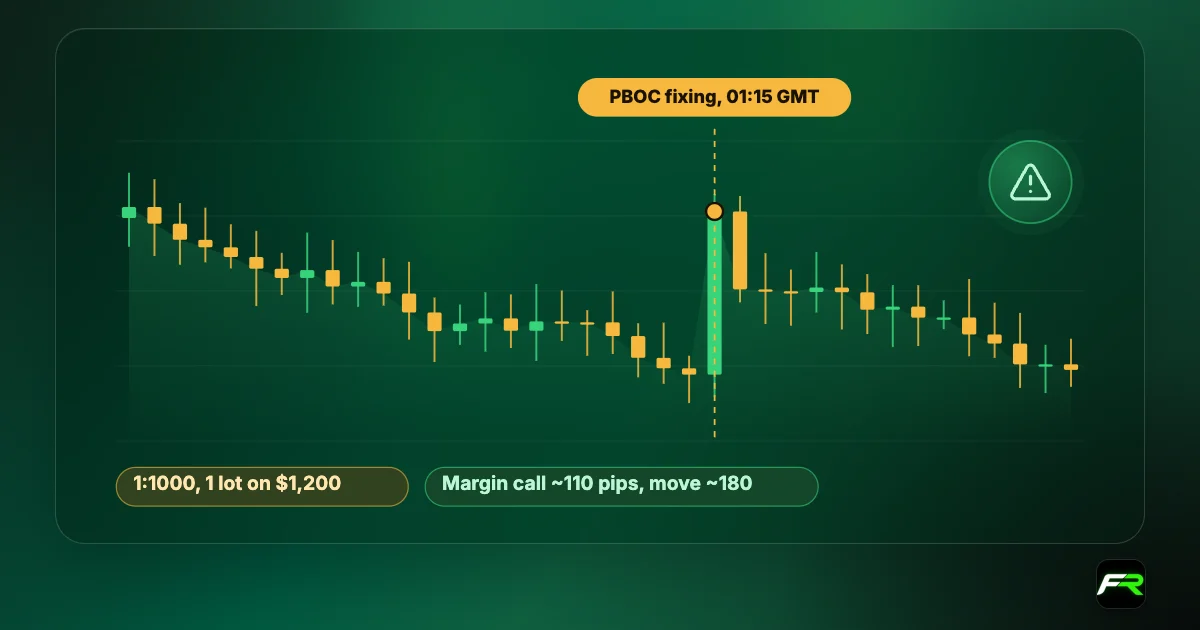
Offshore platforms targeting Chinese speakers advertise 1:500 or more on USD/CNH and gold. On an offshore yuan pair that can move 1 per cent on a single fixing surprise, that is enough to erase an account several times over. Our case study on a 1:1000 USD/CNH position shows how fast it happens.
Best times to watch the markets from China
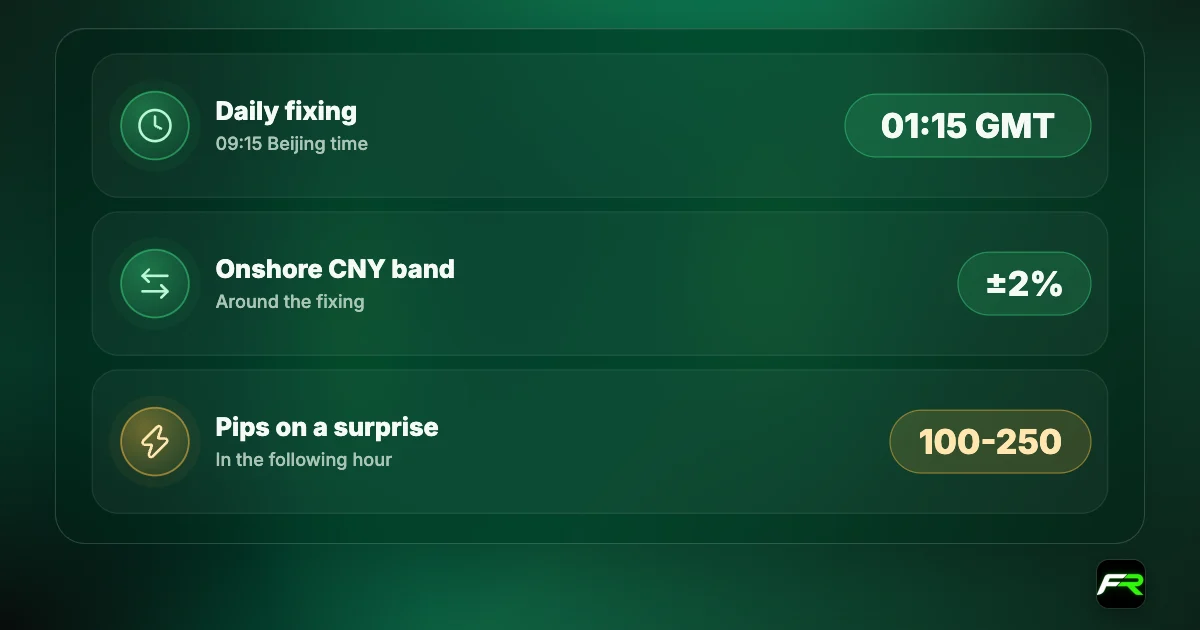
China is GMT+8. The PBOC sets the daily yuan fixing at 9:15 am Beijing time, the most watched moment for USD/CNY and USD/CNH. Tokyo trading runs through the Chinese working day, London opens around 3:00 to 4:00 pm, and the London and New York overlap is roughly 8:00 pm to midnight.
Scams aimed at Chinese-speaking traders
- "Pig-butchering" schemes that build a relationship before introducing a trading app.
- WeChat groups with "teachers" who share winning trades and then ask for bigger deposits.
- Apps that show profits but demand a "tax" or "margin" before any withdrawal.
Onshore CNY and offshore CNH
The yuan trades in two places. Onshore, USD/CNY trades within 2 per cent either side of the daily fixing set by the People's Bank of China. Offshore, mainly in Hong Kong, USD/CNH trades freely and usually stays close to the onshore rate, but can diverge sharply when markets are stressed. International brokers quote CNH, not CNY.
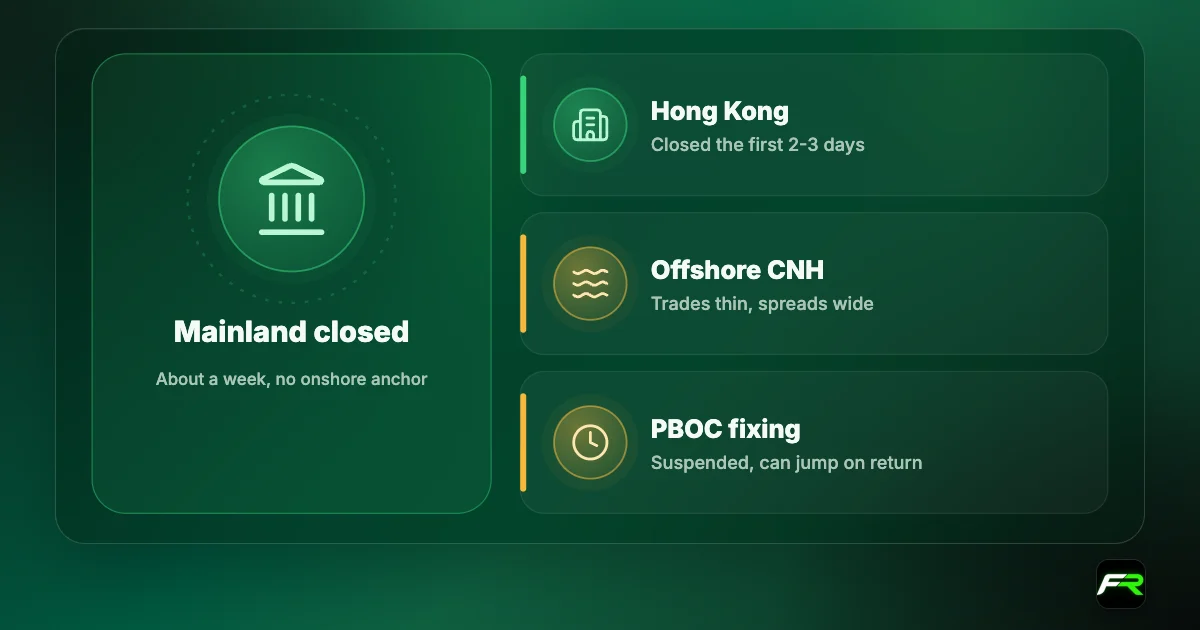
That gap matters. A position in USD/CNH reacts to Hong Kong liquidity, which can dry up during mainland holidays such as Lunar New Year, and to any change in how the fixing is set. Traders who see CNH as a quiet pair often learn otherwise during those weeks.
How to read the daily fixing
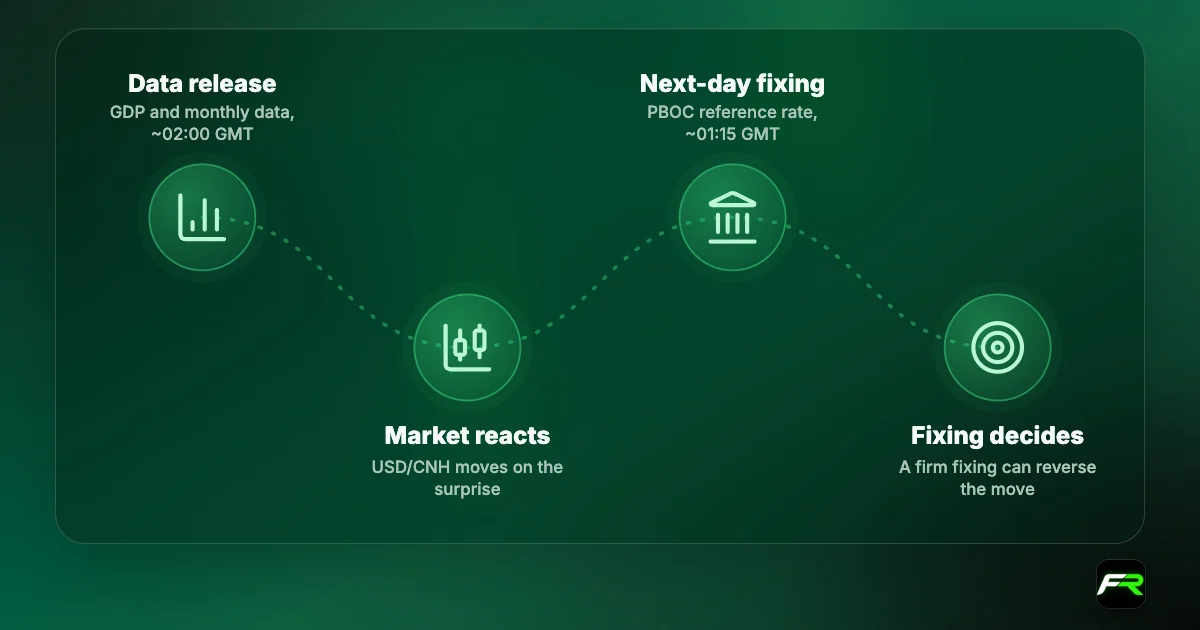
The fixing is published every trading day, and many traders keep a simple log of it next to the previous day's close. Patterns in that gap, rather than any single number, are what analysts track. A run of fixings weaker than the market expected has historically come before periods of yuan depreciation.
Each morning at 9:15 am the PBOC publishes the USD/CNY central parity. Traders compare it with market forecasts: a fixing stronger than expected is read as a signal that authorities want a firmer yuan, and a weaker one as tolerance for depreciation. Over time the fixing tells you more about policy intent than any single data release, which is why it is the most watched number in Chinese currency markets.
If you live in Hong Kong or abroad
Mainland residents who move abroad for work or study should also close or document any domestic arrangements before opening an overseas trading account, so that money moving between the two is easy to explain to both banks.
Residence, not nationality, decides which rules apply to you, so check the position in the place you live and pay tax.
The rules on this page apply to mainland residents. Hong Kong has its own regulator, the Securities and Futures Commission, which licenses leveraged foreign exchange traders under a separate regime. Chinese citizens living abroad are generally governed by the rules of their country of residence, and can use a broker licensed there with a local bank account in their own name.
Hong Kong-licensed firms are not a route around mainland rules for mainland residents: moving money to them still has to fit the annual quota and its permitted purposes.
If you have been targeted by a trading scam
- Stop sending money, including any "fee" or "tax" demanded to unlock a withdrawal.
- Keep chat records, app screenshots and transfer receipts.
- Report it to the police through the 110 hotline or the national anti-fraud app.
- Ignore anyone who contacts you offering to recover the money for a fee; that is a second scam.
Is Exness or XM legal in China?
No. Because retail forex margin trading is prohibited on the mainland and no institution is permitted to offer it, no foreign brand can legally serve mainland residents for that purpose, whatever its licence abroad. Platforms that accept mainland clients anyway do so outside Chinese law, and funding them runs into the quota's purpose rules.
Recent enforcement
Enforcement has focused on underground banks and cross-border fund channels, many now using crypto. In 2026 police and regulators have continued to break up underground exchange networks, and the new transaction-monitoring rules make split transfers far easier for banks to spot. Traders who route money through these channels risk frozen accounts even when the trading platform itself pays out.
For mainland residents the hard part is not choosing a broker, it is moving money at all. Every workaround adds a party you cannot hold to account. When the route itself is outside the rules, the safest trade is the one you do not fund.
Li met a "trading teacher" through WeChat who showed daily gold profits and a trading app. After two small withdrawals worked, Li deposited ¥150,000 through a third party. The app then demanded a 20 per cent "tax" before releasing any money. Li reported it to the police and now keeps savings in bank deposits and a qualified fund.
| Retail margin forex | Prohibited since 2008 |
|---|---|
| Regulators | PBOC, SAFE, NFRA, CSRC |
| Annual conversion quota | USD 50,000 per person, stated purposes only |
| 2026 changes | Lower reporting thresholds, anti-structuring checks |
| Legal route | Spot FX and deposits through licensed banks |
| Key daily event | PBOC fixing at 9:15 am Beijing time |
Elsewhere in Asia, Japan and Singapore run licensed retail forex markets with strict leverage caps.
Frequently asked
Is forex trading legal in China?
Spot currency exchange through licensed banks is legal within the USD 50,000 annual quota. Leveraged forex margin trading has been prohibited since 2008, and funding offshore platforms falls outside the quota's permitted purposes.
Can I use the USD 50,000 quota to fund a forex account?
No. The quota covers personal purposes such as travel, study and medical costs. Overseas investment is not a permitted use.
What changed in 2026?
From 1 January 2026, reporting thresholds fell, record keeping was extended to ten years and banks added checks for structuring, making split transfers easier to detect.
Is there a legal way to trade currencies in China?
Yes, through personal FX trading and foreign currency deposits at mainland banks, without leverage and within your quota.
How do I spot a forex scam in China?
Be wary of anyone met online who introduces a trading app, shows easy profits and asks for larger deposits. Any demand for a fee or tax before withdrawal is a scam.
What is the difference between CNY and CNH?
CNY trades onshore within 2 per cent of the PBOC's daily fixing. CNH trades offshore, mainly in Hong Kong, more freely, and is the yuan that international brokers quote.
Can Hong Kong residents trade forex?
Yes, through firms licensed by the Securities and Futures Commission for leveraged foreign exchange trading. Hong Kong's rules differ from the mainland's.
Is XM or Exness legal in China?
No. Retail forex margin trading is prohibited on the mainland and no institution is permitted to offer it, so no foreign brand can legally serve mainland residents for it.
Since when has forex margin trading been banned in China?
It has been prohibited from 2008. A 2018 joint statement by the PBOC, the Ministry of Public Security and SAFE confirmed that no institution has been permitted to conduct forex margin trading business in China.
The team behind this guide
Researched, checked and approved by five forex specialists
Every guide is written, fact-checked and edited before it goes live, and updated when the facts change. Spotted an error? Tell us.