IC Markets






































UK Retail Sales Slip 0.4% in September as Warm Weather Hits Clothing, but the Quarter Grows
Online clothing and supermarket sales fell in a warm month, yet volumes rose 0.7% over the quarter and sterling barely moved before the 5 November decision.
 WriterAbir KhanWriterWrites the guides · checks every figure against primary sources View profileAbout Abir →

 Market analysisTanbir Habib RiyadForex & Crypto AnalystForex and crypto analyst · technical and fundamental analysis View profileAbout Tanbir →

 Fact-checking & riskJannatul FerdaushFact-Checker & Risk AnalystFact-checks every figure · risk analysis · Applied Statistics, University of Dhaka View profileAbout Jannatul →

 Trading reviewJowel RanaCo-Founder & Forex TraderCo-founder · forex trader · reviews guides from a trader's view View profileAbout Jowel →

 Final approvalRanjan NiskrityFounder, Owner & Forex TraderFounder and owner · forex trader · signs off every guide View profileAbout Ranjan →

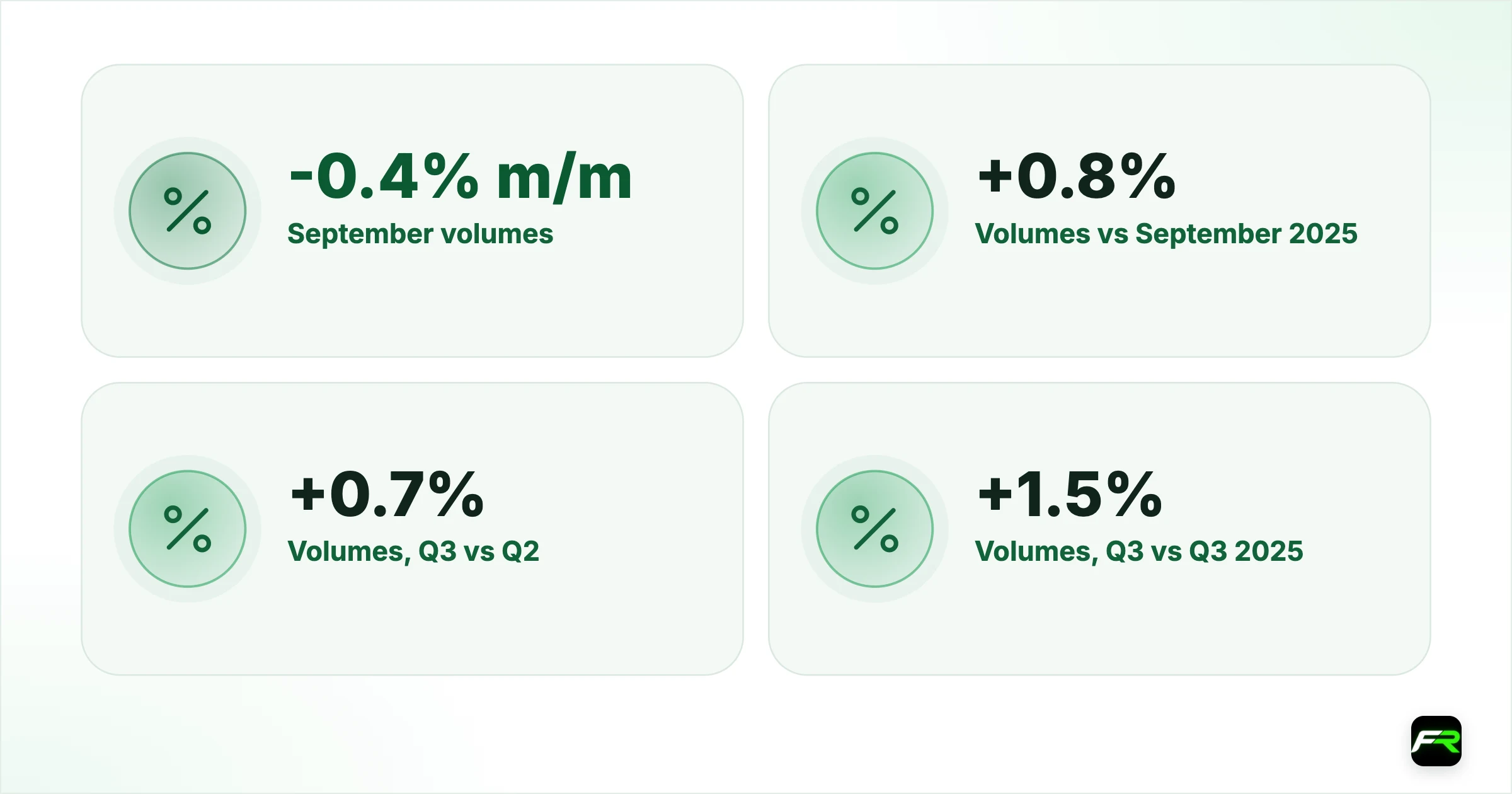
Retail sales volumes in Great Britain fell 0.4% in September, the Office for National Statistics said on Friday 23 October. That followed a rise of 0.7% in August, revised up from 0.5%. Over the third quarter as a whole the result was better: volumes rose 0.7% compared with April to June, helped by fuel and food.
Weather did much of the damage. Online clothing retailers told the ONS that their autumn and winter ranges sold poorly because of unusually warm weather, and the statistics office cited the Met Office's finding that September 2026 was the joint-fourth warmest on record. Supermarket volumes also slipped after growth in July and August, falling to just below their June level.
Sterling hardly moved. GBP/USD was near 1.3389 just before the 06:00 UTC release and around 1.3390 a few minutes later, and it was trading near 1.3394 at 06:21 UTC. EUR/GBP held at about 0.8373. A muted reaction like that suggests traders saw the monthly dip as weather noise inside a decent quarter, not as a sign that UK consumers are giving up.
| September volumes | -0.4% m/m (August: +0.7%, revised) |
|---|---|
| Volumes vs September 2025 | +0.8% |
| Volumes, Q3 vs Q2 | +0.7% |
| Volumes, Q3 vs Q3 2025 | +1.5% |
| Online spending values, September | -0.4% m/m, +6.8% y/y |
| Share of sales made online | 28.8% (August: 28.9%) |
| Total spending values | +0.3% m/m |
| Bank Rate | 3.75%, next decision 5 November |
What the ONS reported
Retail sales are measured in two ways. Volumes strip out price changes and show how much people bought, while values show how much they spent in pounds. In September the two diverged: volumes fell 0.4%, but total spending in value terms, the sum of in-store and online sales, rose 0.3%. That gap suggests higher prices were doing some of the work.
Revisions softened the blow. July's fall was revised to 0.4% from 0.5%, and August's rise to 0.7% from 0.5%, so the level of sales going into September was higher than first thought. Over the year to September, volumes were 0.8% higher, and the three months to September were 1.5% above the same period of 2025.
Survey coverage was solid. ONS said 59.1% of forms were returned for September, covering 92.4% of turnover in the sample, although monthly figures are always open to revision. It also noted that it is consulting on the release times of market-sensitive statistics such as retail sales, with the consultation closing on Friday 30 October. Any change would matter to traders who plan around the 07:00 UK slot.
Clothing, supermarkets and fuel
Non-food stores, which cover department, clothing, household and other non-food shops, saw volumes fall 0.4% on the month. Clothing and footwear stores and sports equipment shops reported lower footfall and customers cutting back, and household goods stores fell mainly because hardware retailers sold less. Non-store retailers, mostly online sellers, also fell after a strong August.
Fuel was the exception. Automotive fuel volumes rose in September even though prices kept climbing, after a fall in August when retailers said motorists were only partly filling their tanks. Across the quarter, each of July, August and September recorded higher fuel volumes than every month of the second quarter, when drivers cut journeys as prices rose.
Food stores and drink sellers had a good summer. ONS said retailers selling alcohol and beverages reported high volumes from June to September, and put that down to promotions, the warm weather and the World Cup. Online spending values fell 0.4% in September after a 3.0% jump in August but were 6.8% higher than a year earlier, and the share of sales made online eased to 28.8% from 28.9%.
| Measure | Change |
|---|---|
| September volumes, month | -0.4% |
| August volumes (revised), month | +0.7% |
| July volumes (revised), month | -0.4% |
| September volumes vs a year earlier | +0.8% |
| Q3 volumes vs Q2 | +0.7% |
| Q3 volumes vs Q3 2025 | +1.5% |
| Online values, September, month | -0.4% |
| Online values vs a year earlier | +6.8% |
Source: Office for National Statistics, Retail sales, Great Britain: September 2026. Volumes and values are seasonally adjusted.
What it means for the Bank of England and sterling
The Bank of England held Bank Rate at 3.75% on 17 September and announces its next decision at 12:00 UK time on Thursday 5 November. Two days ago the ONS reported that consumer price inflation rose to 3.5% in September from 3.1%, with fuel leading the rise. Spending data like today's matter to the Bank because they show whether higher prices are starting to squeeze demand.
September's report gives mixed signals. A monthly fall in volumes alongside higher spending in pounds fits a picture of households paying more and buying a little less. Yet the quarter grew 0.7%, and the ONS tied much of the September weakness to weather, which tends to reverse. For a central bank worried about inflation, that is not strong evidence of weak demand.
Fuel deserves a closer look as well. ONS said fuel volumes fell in April as motorists made fewer journeys and delayed filling up while prices rose, then recovered gradually through the summer. In August, retailers again reported drivers only partly filling their tanks after renewed price increases. With September inflation driven by petrol and diesel, a further rise in pump prices could hit both the inflation figure and spending volumes at once, the uncomfortable mix a central bank least wants to see.
Sterling is unlikely to take its lead from this release alone. GBP/USD has followed the US dollar this week, including Thursday's sharp fall in US Treasury yields, while EUR/GBP has slipped from about 0.842 at Monday's open to 0.837, so the pound has firmed against the euro. The bigger UK tests are the Bank's 5 November decision and October inflation on 18 November.
What traders can take from it
Retail sales are a second-tier release for sterling, but they feed the Bank of England's view of demand. These points help read them.
- Look at the three-month change. ONS warns that monthly growth is volatile, and the quarterly rise of 0.7% is a steadier guide.
- Separate volumes from values. Volumes fell while spending in pounds rose, so check both before calling a release strong or weak.
- Use EUR/GBP for UK-only news. GBP/USD carries the dollar's swings, while the cross isolates how traders weigh UK data against the euro area.
- Note the release time. Retail sales come out at 07:00 UK time, which is 06:00 UTC until the clocks change on 25 October and 07:00 UTC after that.
- Plan around 5 November. A Bank of England decision can move sterling far more than a monthly spending figure.
A simple routine helps on release mornings. Note where GBP/USD and EUR/GBP trade five minutes before 06:00 UTC, then compare the price ten minutes after. Today both pairs ended within a few pips of their pre-release levels, which tells you the market had already priced a soft month. When the move is that small, the data rarely sets the trend for the rest of the session, and US news later in the day usually matters more.
Say you buy GBP/USD at 1.3390, reading the quarter as healthy, with a stop at 1.3350, 40 pips below. A standard lot of 100,000 pounds is worth $10 a pip, so the stop risks about $400 per lot. On a $10,000 account with a 1% limit of $100, the right size is about 25,000 units. Close or cut the trade before 5 November if you do not want to hold it through the rate decision.
For today's levels, see our GBP/USD analysis and our story on September's UK inflation. Every central bank date is on the economic calendar, and you can size each trade with the position size calculator.
Sterling can move quickly around UK data and Bank of England decisions, especially in thin early-morning trade. Leverage magnifies losses as well as gains, so trade only with money you can afford to lose.
All retail figures are from the Office for National Statistics bulletin Retail sales, Great Britain: September 2026, released on 23 October 2026; the Met Office finding is as cited by the ONS. UK inflation is from the ONS consumer price inflation bulletin for September 2026, and Bank Rate and the decision date are from the Bank of England. Currency levels are market data from 5-minute and hourly bars to about 06:24 UTC on 23 October and differ slightly between providers. This is news, not investment advice.
Frequently asked
How much did UK retail sales fall in September 2026?
Retail sales volumes in Great Britain fell 0.4% in September 2026, according to the Office for National Statistics, after a revised rise of 0.7% in August. Volumes were 0.8% higher than in September 2025.
Why did UK retail sales fall in September 2026?
Online clothing retailers told the ONS that autumn and winter ranges sold poorly because of warm weather, and supermarket sales fell after growth in July and August. The ONS cited the Met Office finding that September 2026 was the joint-fourth warmest on record.
Did UK retail sales grow in the third quarter of 2026?
Yes. Volumes rose 0.7% in July to September compared with April to June 2026, helped by fuel and food stores, and were 1.5% higher than in the same quarter of 2025.
When is the next Bank of England decision?
The Bank of England announces its next decision on 5 November 2026 at 12:00 UK time. Bank Rate is 3.75% after the 17 September hold. The ONS publishes October retail sales on 20 November.
Sources: Office for National Statistics: Retail sales, Great Britain: September 2026 · Office for National Statistics: Consumer price inflation, UK: September 2026 · Bank of England: Bank Rate
The team behind this guide
Researched, checked and approved by five forex specialists
Every guide is written, fact-checked and edited before it goes live, and updated when the facts change. Spotted an error? Tell us.