IC Markets






































Bank of Canada Preview: Core Inflation Is Near 2%, but Tariffs and Oil Cloud Wednesday's Call
The policy rate has sat at 2.25% since 2 September. New forecasts arrive on Wednesday after US tariffs, an oil spike and a rise in inflation expectations.
 WriterAbir KhanWriterWrites the guides · checks every figure against primary sources View profileAbout Abir →

 Market analysisTanbir Habib RiyadForex & Crypto AnalystForex and crypto analyst · technical and fundamental analysis View profileAbout Tanbir →

 Fact-checking & riskJannatul FerdaushFact-Checker & Risk AnalystFact-checks every figure · risk analysis · Applied Statistics, University of Dhaka View profileAbout Jannatul →

 Trading reviewJowel RanaCo-Founder & Forex TraderCo-founder · forex trader · reviews guides from a trader's view View profileAbout Jowel →

 Final approvalRanjan NiskrityFounder, Owner & Forex TraderFounder and owner · forex trader · signs off every guide View profileAbout Ranjan →

The Bank of Canada announces its next policy decision on Wednesday 28 October at 09:45 Ottawa time, which is 13:45 UTC. Its target for the overnight rate is 2.25%, where the bank left it on 2 September. This time the decision comes with a new Monetary Policy Report, so traders will get fresh forecasts for growth and inflation along with the rate.
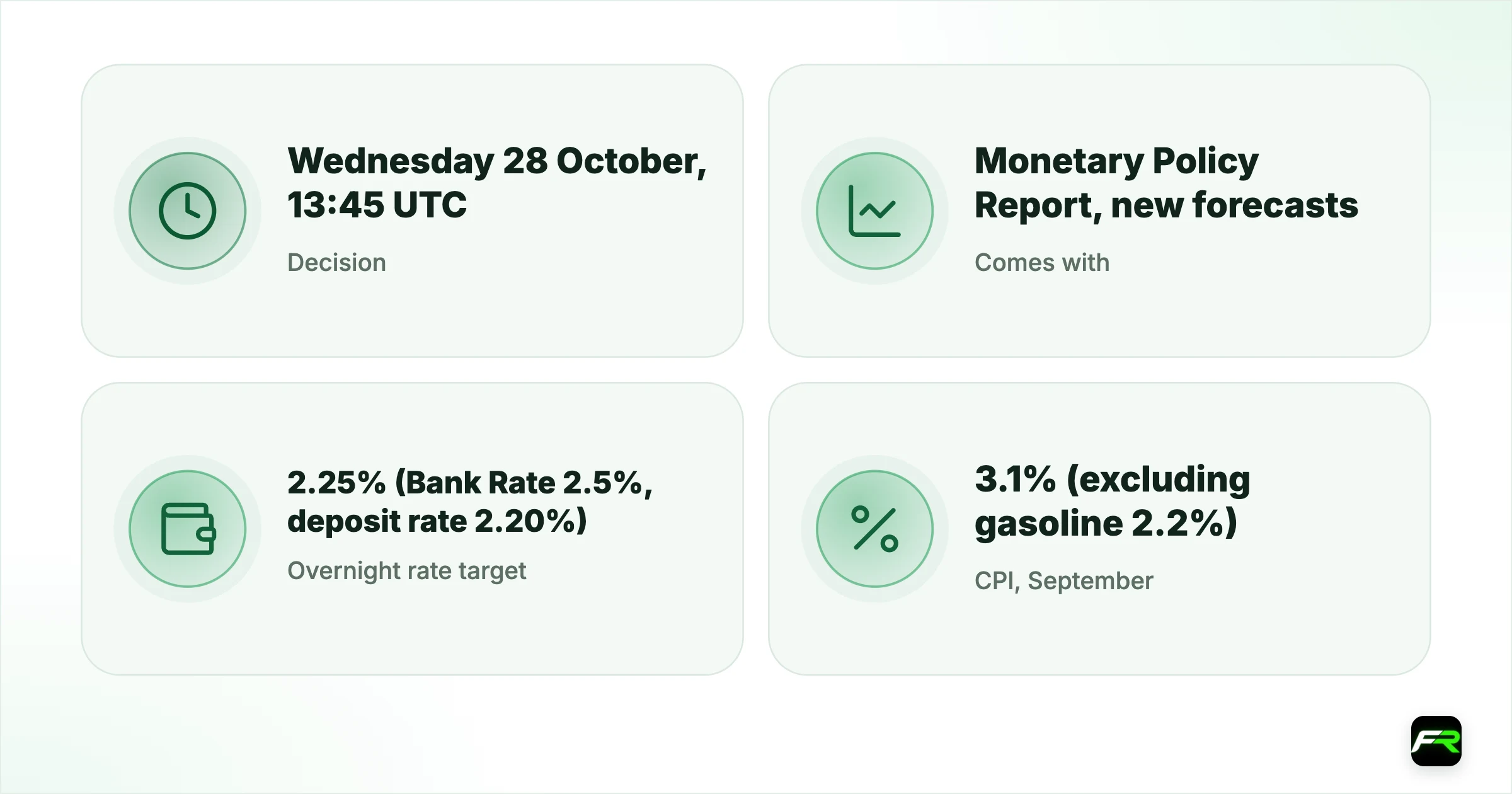
Canada's central bank faces a split picture. Headline inflation rose to 3.1% in September because of gasoline, yet the bank's two preferred core measures, CPI-trim and CPI-median, eased to 1.8% and 1.9%, right on the 2% target. At the same time, trade talks with the United States have broken down, new US tariffs and Canadian counter-tariffs are in place, and the bank's own surveys show inflation expectations rising.
Wednesday is also the busiest day of the month for rate decisions. The Reserve Bank of New Zealand announces at 01:00 UTC, the Bank of Canada at 13:45 UTC and the Federal Reserve at 18:00 UTC, so USD/CAD can be pushed around by both sides of the pair within a few hours.
| Decision | Wednesday 28 October, 13:45 UTC (09:45 Ottawa) |
|---|---|
| Comes with | Monetary Policy Report, new forecasts |
| Overnight rate target | 2.25% (Bank Rate 2.5%, deposit rate 2.20%) |
| CPI, September | 3.1% (excluding gasoline 2.2%) |
| CPI-trim / CPI-median | 1.8% / 1.9% |
| Firms planning for a recession | 6% (from 17%), Business Outlook Survey Q3 |
| USD/CAD reference rate | 1.3995 on 23 October (derived from ECB rates) |
What the Bank of Canada said in September
When it held the rate on 2 September, the bank said “the continuing conflict in the Middle East is keeping energy prices high.” It also noted that new US tariffs and Canadian counter-measures had been announced after the breakdown of trade talks, and that “both situations remain fluid.”
The domestic news was better than expected. GDP grew 3.3% in the second quarter at an annual rate after a very weak first quarter, with gains in consumption, housing, exports and business investment. Unemployment edged down to 6.4% in July, though the bank said demand for labour remained subdued and indicators pointed to excess supply in the economy.
On inflation, the bank flagged a risk rather than a problem. It said there was “little evidence of higher energy prices spreading to other components of inflation,” but warned that “the longer that high oil prices and elevated refinery margins persist, the greater the risk of spillover.” Its closing line was that the council “is prepared to adjust monetary policy as needed,” which keeps the door open in both directions.
September inflation: a gasoline story so far
Statistics Canada's September figures fit that description. The consumer price index rose 3.1% from a year earlier, up from 3.0% in August, as gasoline prices jumped 27.8%. Excluding gasoline, inflation eased to 2.2% from 2.4%. Food bought from stores rose only 1.7%.
Core measures pointed lower. CPI-trim slipped to 1.8% and CPI-median to 1.9%, both a tenth below August, while CPI-common eased to 2.4%. For a central bank that targets 2%, those numbers argue against a rate rise today. Our Canada CPI story has the full breakdown.
| Measure | July | August | September |
|---|---|---|---|
| CPI-trim | 1.9% | 1.9% | 1.8% |
| CPI-median | 2.0% | 2.0% | 1.9% |
| CPI-common | 2.7% | 2.6% | 2.4% |
What the bank's own surveys show
The Business Outlook Survey for the third quarter, published on 19 October, gives a more mixed message. Interviews ran from 6 August to 2 September, and about three-quarters took place before the trade talks broke down. In those earlier interviews, sentiment improved: sales outlooks were better than in the second quarter, and the share of firms planning or budgeting for a recession over the next year fell from 17% to 6%, the lowest since the question began in 2023.
The later results were weaker. The survey says responses collected after the breakdown suggest the new tariffs are “weighing on firms' outlooks,” and that “inflation expectations have risen alongside the new tariffs and the recent rebound in energy prices.” Hiring intentions stayed soft, with most firms planning to keep headcounts unchanged. Expected growth in input and selling prices moderated but remained elevated, and almost a quarter of firms said it was too hard to say when inflation would return to 2%.
Households are worried too. The bank's Canadian Survey of Consumer Expectations for the third quarter found that long-term inflation expectations rose to match already elevated short-term expectations, and that expectations at all horizons moved higher after the trade talks collapsed. For a central bank, rising expectations are a warning sign even when core inflation looks calm.
Three ways Wednesday could go
The Bank of Canada has given no guidance beyond being ready to act, so the paths below are our own reading of the evidence, not a forecast.
- Hold with a balanced tone. Core inflation near 2% and soft hiring support staying at 2.25%. If the new forecasts look similar to July's, the loonie's reaction may be modest.
- Hold with a warning. The bank could stress the rise in inflation expectations and the risk of oil feeding into other prices. That would support the Canadian dollar by keeping a future rise in view.
- A rate change. A rise would be a surprise given the core data, while a cut looks unlikely with headline inflation above 3% and expectations climbing. Either move would cause a sharp reaction.
The forecasts in the Monetary Policy Report may matter as much as the rate. A lower growth path because of tariffs, or a higher inflation path because of oil, would show which risk the governing council now sees as bigger.
What it means for USD/CAD
The Canadian dollar has recovered this month. Worked out from the ECB's euro reference rates, USD/CAD stood at 1.3925 on 2 September, climbed to 1.4262 on 12 October, the highest reference rate of 2026, and eased back to 1.3995 on Friday 23 October. That is a fall of almost 2% from the peak, so the loonie arrives at the decision in better shape than a fortnight ago.
Oil is one reason the currency is linked to energy news. Canada is a large oil exporter, so higher crude prices tend to help the Canadian dollar, but the same prices raise inflation risks the bank must manage. The US side matters just as much: the Fed decides about four hours after Ottawa, and a firm Fed could undo any loonie strength from the Bank of Canada.
- Note both times: 13:45 UTC for Ottawa and 18:00 UTC for the Fed. Our economic calendar shows them in your own time zone.
- Read the statement's wording on spillover from energy prices and on inflation expectations. Any new concern there is the hawkish signal.
- Avoid holding large USD/CAD positions through both announcements unless your stop allows for two big moves in one day.
- Check sessions and liquidity on our market hours page; the Ottawa decision lands in the London and New York overlap.
Imagine you want to sell USD/CAD at 1.3995 if the bank sounds firm, with a stop at 1.4065, 70 pips away. One pip on 10,000 units is worth 1 Canadian dollar, or about 71 US cents at that price. With $5,000 and a 1% risk limit of $50, you can risk about 71 cents a pip over 70 pips, so the trade size is about 10,000 units. If the Fed moves the pair against you four hours later, the stop still caps the loss, but a gap can push it a little further, so leave a margin. The <a href="/position-size-calculator">position size calculator</a> handles the conversion.
See our Fed preview for the US side of the pair, and convert amounts with the currency converter.
Rate decisions can move the Canadian dollar sharply within seconds, and prices can gap past stop orders. Leverage magnifies losses as well as gains, so trade only with money you can afford to lose.
Policy details and quotations come from the Bank of Canada's 2 September 2026 announcement, its Business Outlook Survey and Canadian Survey of Consumer Expectations for the third quarter of 2026, and its events calendar. Inflation data are from Statistics Canada's release of 19 October 2026. USD/CAD levels are derived from ECB euro reference rates (EUR/CAD ÷ EUR/USD). The scenarios are FX Recap's own reading. This is news, not investment advice.
Frequently asked
When is the Bank of Canada's October 2026 rate decision?
The Bank of Canada announces on Wednesday 28 October 2026 at 09:45 Ottawa time, which is 13:45 UTC. It publishes a new Monetary Policy Report with fresh forecasts at the same time.
What is the Bank of Canada policy rate now?
The target for the overnight rate is 2.25%, with the Bank Rate at 2.5% and the deposit rate at 2.20%. The bank left it unchanged on 2 September 2026.
Is Canadian inflation above target?
Headline CPI inflation was 3.1% in September 2026, mainly because gasoline prices rose 27.8%. The bank's preferred core measures, CPI-trim and CPI-median, were 1.8% and 1.9%, close to the 2% target.
How could the decision affect USD/CAD?
A hold with a warning about rising inflation expectations could support the Canadian dollar, while a softer tone could weaken it. The Fed decides at 18:00 UTC the same day, so the pair can move again a few hours later.
Sources: Bank of Canada: interest rate announcement, 2 September 2026 · Bank of Canada: Business Outlook Survey, third quarter of 2026 · Statistics Canada: Consumer Price Index, September 2026 · Bank of Canada: Canadian Survey of Consumer Expectations, third quarter of 2026 · Bank of Canada: upcoming events · European Central Bank: euro foreign exchange reference rates
The team behind this guide
Researched, checked and approved by five forex specialists
Every guide is written, fact-checked and edited before it goes live, and updated when the facts change. Spotted an error? Tell us.