 IC Markets































Best Forex Brokers for Asian Traders
The broker is the easy part. What matters in Asia is legality where you live, local deposits and withdrawals, tax rules and the right session.
 WriterAbir KhanWriterWrites the guides · checks every figure against primary sources View profileAbout Abir →
 Market analysisTanbir Habib RiyadForex & Crypto AnalystForex and crypto analyst · technical and fundamental analysis View profileAbout Tanbir →
 Fact-checking & riskJannatul FerdaushFact-Checker & Risk AnalystFact-checks every figure · risk analysis · Applied Statistics, University of Dhaka View profileAbout Jannatul →
 Trading reviewJowel RanaCo-Founder & Forex TraderCo-founder · forex trader · reviews guides from a trader's view View profileAbout Jowel →
 Final approvalRanjan NiskrityFounder, Owner & Forex TraderFounder and owner · forex trader · signs off every guide View profileAbout Ranjan →
The broker itself is the easy part. Any decent comparison table will point you at the same handful of names. The harder questions are the ones those tables skip: is trading even allowed where you live, can you get your own currency in and out without losing a chunk to fees, what does your tax office expect to see, and which part of the day can you sit at the screen. This page works through each of those, with real figures, and links to a full guide on every point.
Here is the pattern most traders across the region land on: an account with a firm licensed in Australia, Cyprus or the UK, funded by a local bank transfer or an e-wallet, a small starting balance, and screen time during the Tokyo hours. The sections below explain why that shape is so common, and where your country is the exception. Once the account is open, our Asia trading section covers the part that decides whether it survives: position sizing, risk, and the central-bank news that moves Asian pairs.
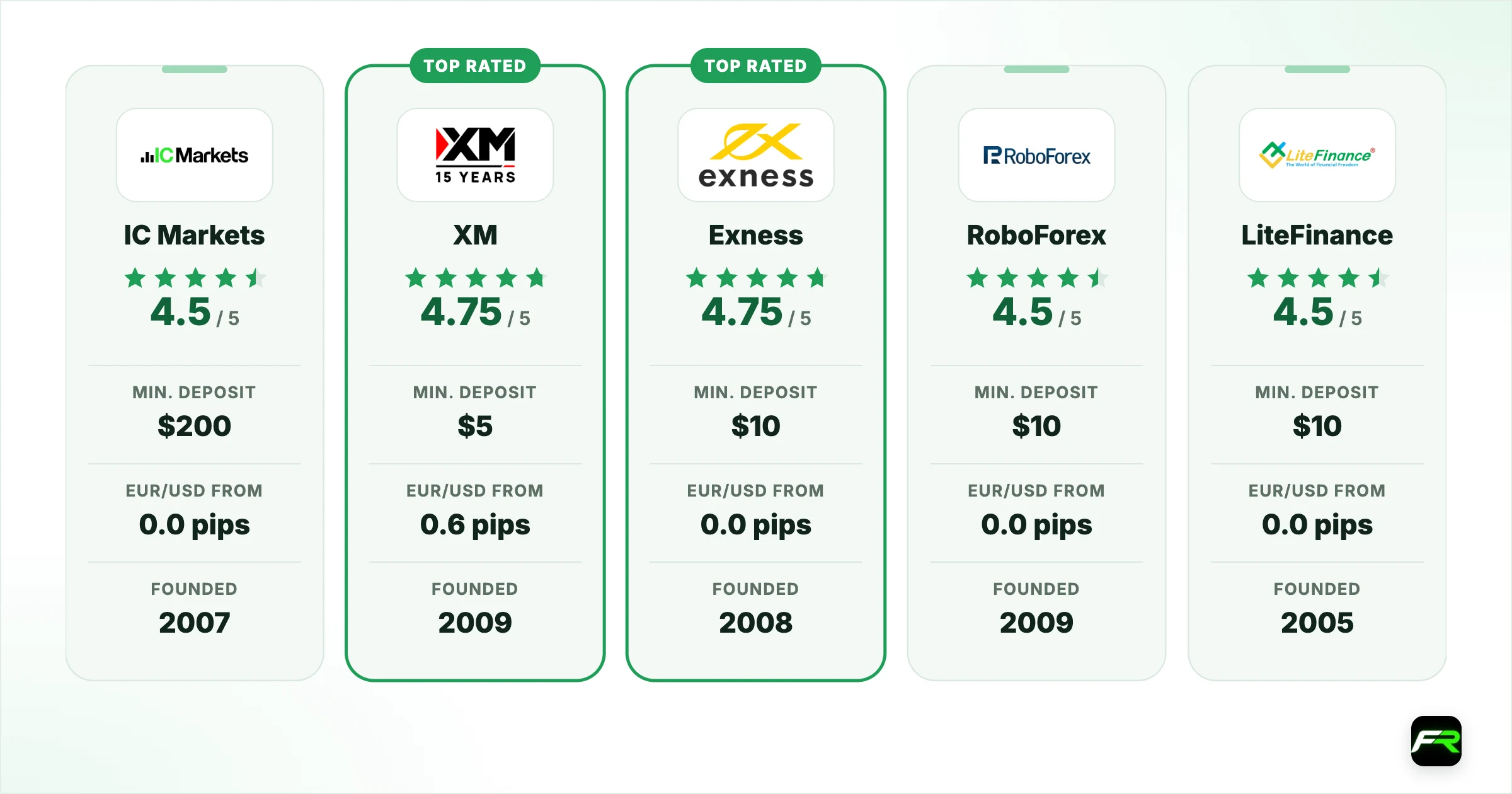
These five are where we would start a shortlist for the region. Each one holds a licence you can verify, accepts traders across most of Asia, and supports local funding. Compare them on the points that matter to you, then open a demo on two or three before you commit.
 IC Markets IC Markets |  XM XM |  Exness Exness |  RoboForex RoboForex |  LiteFinance LiteFinance | |
|---|---|---|---|---|---|
| Our rating | 4.9 | 4.75 | 4.75 | 4.5 | 4.5 |
| Regulators | ASIC, CySEC, FSA (Seychelles), SCB, CMA | FSC (Belize) on xm.com; group: CySEC, DFSA, FSCA, FSC (Mauritius), FSA (Seychelles) | FSA (Seychelles) on exness.com; also CBCS, FSC (BVI), FSC (Belize), FSCA, CMA | FSC (Belize); Financial Commission, Category A | CySEC (Cyprus), FSC (Mauritius), FSA (SVG) |
| Year established | 2007 | 2009 | 2008 | 2009 | 2005 |
| Minimum deposit | $200 | $5 (Standard, Ultra Low); $10,000 (Shares) | Set by payment method (Standard); $200+ by region (Pro, Raw, Zero) | $10 (most accounts) | $10 (Cent); $50 (Classic / ECN) |
| Spread from (EUR/USD) | From 0.0 pips (Raw Spread) | From 1.6 pips (Standard); 0.8 on Ultra Low | From 0.2 pips (Standard); 0.0 on Raw Spread / Zero | From 0.0 pips (ECN / Prime) | From 0.0 pips (ECN); 1.8 on Classic |
| Commission | $7 per lot round-turn ($6 on cTrader) | None on Standard or Ultra Low | None on Standard; up to $3.50 per side (Raw Spread) | From $10 per lot (ECN) | $5 per lot on FX majors (ECN) |
| Platforms | MT4, MT5, cTrader, TradingView | MT4, MT5, WebTrader, XM App | MT4, MT5, Exness Terminal, Exness Trade app | MT4, MT5, R WebTrader, app | MT4, MT5, WebTrader, app |
| Swap-free (Islamic) account | varies by entity | Islamic option on every account | automatic in Islamic countries; listed instruments elsewhere | on all accounts by default | Islamic account available |
| Negative balance protection | varies by entity | on every account | plus stop-out protection | Offshore primary entity, so confirm before funding | |
| Get started | Get started | Get started | Get started | Get started |
Ratings and links are ours and kept current; the figures beside them come from each broker's full FX Recap review and can change, so check the review before you open an account. Trading forex on margin carries a high risk of loss.
Getting support in your own language and time zone
Local-language support is easy to advertise and hard to verify from the outside. Many brokers put up a Bahasa, Thai, Vietnamese or Hindi page and call it done, when the real test is what happens the moment something goes wrong: a stuck withdrawal, a disputed fill, a verification hold. Fluent, specific replies from a live agent in your language are a genuine local team; a machine-translated FAQ backed by English-only chat is marketing, and it is exactly the gap that shows up when you can least afford it.
Test it before you fund an account, not after. Open live chat and write your first message in your own language, then ask something a bot cannot fake, such as the exact swap-free admin fee schedule or the withdrawal time to your local bank. Ask what hours that language support actually runs, since around-the-clock coverage in anything but English is rare — business hours in your own time zone, with English-only cover outside them, is the norm. Treat broker Telegram or WhatsApp groups with care too: many of the most active ones are run by affiliates paid per funded account rather than the broker itself, and are not where you send money or verification documents — deal with the broker's own official channels for anything involving money.
Top Asian Forex Brokers
A handful of firms show up on nearly every Asia list. Here is what each is generally known for and where it is licensed. This is background, not a ranking, and the entity that takes your account depends on your country.
| Broker | Usually licensed by | Known for | FX Recap review |
|---|---|---|---|
| Exness | FSA (Seychelles), FSCA; FCA and CySEC companies take no retail clients | Low minimums, fast withdrawals, big in South and Southeast Asia | Exness review |
| IC Markets | ASIC, CySEC; FSA (Seychelles) for most Asian clients | Raw spreads, popular with scalpers and EAs | IC Markets review |
| XM | CySEC, DFSA; FSC (Belize) for most Asian clients | USD 5 minimum, heavy local-language support and webinars | XM review |
| FP Markets | ASIC, CySEC; Saint Lucia company for many Asian clients | Raw pricing, trading since 2005 | FP Markets review |
| AvaTrade | Central Bank of Ireland, ASIC, Japan FSA; BVI FSC for most Asian clients | Broad regulation, options and copy trading | AvaTrade review |
| FXTM | FSC (Mauritius), FSCA | Local payments, cent account; does not serve India | FXTM review |
| RoboForex, LiteFinance | FSC Belize (RoboForex); SVG registration (LiteFinance) | Very low minimums, cent accounts, offshore | RoboForex, LiteFinance |
| Pepperstone, Interactive Brokers | FCA, ASIC (Pepperstone); SEC, FCA (IBKR) | Well regarded, but limited or no onboarding in much of Asia | Not reviewed here |
Notice that most of these run an Australian or Cypriot licence for the headline and onboard Asian clients through an offshore entity. That is legal and normal; it just means checking which entity is on your own account agreement. There is no single "number one broker for Asia", because the best choice in Jakarta, with rupiah funding and a swap-free need, is not the best choice in Singapore.
Is forex trading legal where you live?
The answer changes more from country to country here than in any other region. Indonesia runs a full licensing system through Bappebti, with a register and a complaints process. Nepal takes the opposite line and bars residents from trading foreign exchange at all. Most places sit in the middle: nobody hands out local licences, but an individual using a well-run foreign firm is not breaking any law.
| Country | Status for residents | Oversight | What it means day to day |
|---|---|---|---|
| Indonesia | Legal and licensed | Bappebti | Local licences exist, but the pricing pushes most people abroad |
| India | Restricted | SEBI, RBI | INR pairs on Indian exchanges are fine; anything else is a grey area under FEMA |
| Philippines | No local option | BSP, SEC | No Philippine company may offer it, so residents use foreign firms |
| Vietnam | Grey area | State Bank of Vietnam | Not licensed at home, very widely done anyway |
| Malaysia | Legal through licensed channels | SC, Bank Negara | Check the Bank Negara alert list before you sign up |
| Thailand | Legal to trade abroad | SEC, Bank of Thailand | No retail licences issued locally |
| Pakistan | No rulebook | SECP, SBP | Nothing governs retail forex, so foreign firms fill the gap |
| Bangladesh | Restricted | Bangladesh Bank | Currency-control law limits it; enforcement is light but real |
| Sri Lanka | Restricted | Central Bank of Sri Lanka | Exchange-control rules, plus public warnings from the regulator |
| Nepal | Not allowed | Nepal Rastra Bank | Prohibited for residents outright |
Where a country name links, it goes to our full broker guide for that market, with the shortlist, the deposit methods, and the local rules in more detail.
"Legal to trade" almost always means it is not an offence for you to hold an account with a legitimate firm abroad. It does not mean your own regulator will help if that firm treats you badly. Your safety net then is its regulator overseas, so the quality of that licence is the thing to check.
Before you send money anywhere, look the firm's name up on your own regulator's warning or blocked-sites list. If it is on there, walk away. If it is simply absent because the licence is held in another country, that is normal and fine.
Funding an account in your local currency
This is the practical thing that decides which firm is usable for you. A card works, but once you add the currency conversion and the card fee it costs 2 to 4 per cent, and the same again coming out. The routes below are what people in the region use.
Local bank transfer
The default. A local payment partner takes your money, so you are really sending rupiah, ringgit or dong to a domestic account rather than wiring cash overseas. Usually free, and it lands in 10 to 60 minutes. In practice that is BCA, Mandiri, BNI or BRI in Indonesia; UPI and IMPS in India; FPX online banking in Malaysia; a normal VND transfer in Vietnam.
E-wallets
Handy for smaller top-ups, sometimes with a small charge. GCash and Maya in the Philippines; DANA and OVO in Indonesia; Easypaisa and JazzCash in Pakistan; bKash and Nagad in Bangladesh. Support varies from one firm to the next, so confirm your wallet is on the list before you open the account.
USDT and other crypto
Quick, and it steps around tight banking limits, which is why it is common where currency controls bite. The catch is that you are holding a volatile asset in transit, and one wrong network or address and the money is gone. Worth it only when the local options genuinely will not work.
Nurul started with a debit card. On a RM 500 deposit her account was credited about USD 104 against a mid-market value near USD 108, and her bank tacked on a RM 5 foreign-transaction fee. She moved to FPX: same RM 500, no card fee, money in the account inside 20 minutes, and a clean withdrawal to the same bank three weeks later. Her conclusion was simply to stop using the card.
Whichever route you pick, run a small test first: deposit the minimum, place one trade, withdraw it. You want to see the money move both ways, and confirm the name on your bank account matches your trading account, before anything real goes in.
Leverage, minimum deposits and account types
Firms licensed offshore typically offer 1:500 to 1:1000. Where a local regime exists, such as India's exchange-traded currency market or South Korea's rules, the cap is far tighter. High leverage is not extra money. It lets you open a larger position on the same deposit, which enlarges the loss exactly as much as the gain, and it is the single most common reason a new account goes to zero.
- Minimum deposit. Plenty of solid firms start at USD 10 to 50. Begin there, and test a withdrawal before you add more.
- Cent accounts. Real money, shown in cents, so the position sizes are tiny. A sensible way to trade live while the stakes stay small.
- ECN vs standard. An ECN account charges commission and shows rawer spreads; a standard account folds the cost into a wider spread. For most beginners the gap is minor.
If the headline pitch is the leverage figure, be wary. Leverage is a margin setting, not a feature to shop for.
Getting your money out
Depositing is always easy. The withdrawal is the test, and a common pattern with weaker offshore firms is "trade freely, verify later": you open an account and fund it with no checks, then the first time you ask to withdraw a profit you are told to send identity documents, a proof of address, and sometimes a photo of your card. Many firms run this as a tiered system, where a balance under 1,000 or 2,000 US dollars needs nothing but a profit withdrawal triggers a full review.
- Verify the account on day one, before you deposit real size, so a document problem shows up early rather than when your money is inside.
- The name on your bank or wallet must match the trading account exactly. A mismatch is the single most common reason a withdrawal is frozen, and with family accounts it catches people out.
- Withdraw to the same method you deposited with. Anti-money-laundering rules usually require it, so a card deposit comes back to that card first.
- A first withdrawal often takes longer than the site promises while the review runs. One to three business days is normal; a week of silence and shifting reasons is not.
Being asked to pay a fee, a tax, or a "deposit to unlock" before a withdrawal is released is not how any regulated firm works. A real withdrawal is never gated behind another payment.
Fees and speed vary broker to broker, and by payment method more than most people expect. This is what our own reviews of the five shortlist brokers found, as of 2026:
| Broker | Withdrawal fee | Typical speed | Worth knowing |
|---|---|---|---|
| XM | None (your payment provider may still charge) | Fast on e-wallets; standard on cards and bank transfer | EU clients' funds are covered by the ICF scheme up to €20,000 |
| Exness | None | Very fast: Exness reports over 98% of withdrawals processed automatically, weekends included | One of the quickest payout records among brokers active in the region |
| IC Markets | None (international bank wire: $20) | Most methods instant | Cards, PayPal, Neteller, Skrill and UnionPay all process instantly |
| FP Markets | None on most methods | Fast | Paysafe carries a 1% fee capped at $30; Skrill 1% plus country fees; bank wire AUD 12.50 |
| AvaTrade | None | Standard | A $50 quarterly dormancy fee applies after 3 months idle, rising to $100 a year after 12 |
Two more that come up often: FXTM charges $3 on card withdrawals and $30 on bank wires, while e-wallet and crypto withdrawals are free, and it charges a $10 monthly inactivity fee after 3 months without trading. RoboForex waives withdrawal fees only on the second, third and fourth Tuesday of each month, not every Tuesday, so timing a withdrawal around that saves money.
These figures come from our own reviews of each broker and can change. Confirm the current fee and processing time for your payment method on the broker's own site before you rely on it.
How much the licence actually protects you
"Regulated" is not one thing. A licence from Australia, the UK or Cyprus brings capital rules, audited client-money segregation, and a compensation scheme or ombudsman you can escalate to. Compare that with a registration in St Vincent and the Grenadines, Seychelles or a similar centre, which is cheap to obtain, carries little oversight, and gives you almost no recourse if the firm fails.
| Licence | Strength | If the firm fails or cheats you |
|---|---|---|
| ASIC (Australia), FCA (UK), CySEC (Cyprus) | Strong | Segregated funds, a formal complaints route, sometimes a compensation scheme |
| FSCA (South Africa), FSC (Mauritius) | Moderate | A real regulator and complaints process, weaker compensation |
| SVG, Seychelles, Comoros, offshore-only | Weak | Little practical recourse; a warning letter at best |
Most large brokers run several entities and onboard you to whichever one your country falls under, which is often the offshore one. The entity on your account agreement is the one that matters, not the flag in the advert. Read that document before you fund the account.
Industry "broker of the year" awards are mostly paid placements or reader polls the firm campaigns for. They are marketing, not a safety signal. A licence number you can type into a regulator's own register is the check that counts.
Islamic (swap-free) accounts
Swap-free accounts are widely offered and matter to a lot of traders in Indonesia, Malaysia, Pakistan and Bangladesh. "Swap-free" drops the overnight interest, the swap, that is normally charged or paid when a position rolls past the daily cut-off. It does not drop the spread, the commission or the market risk.
The detail to pin down: many firms keep the account swap-free for a grace period of a few days, then apply a flat admin fee per lot per night. Hold trades for weeks and that fee can add up to more than the swap would have. Get the exact terms in writing before you count on it.
Tax on your trading profits
In most of the region, trading profits count as taxable income for residents even when the account sits abroad and the money only reaches a local bank on withdrawal. Returning your own capital is not usually taxable by itself; the gain on top of it is. Every accountant says the same thing: keep a clean log of every deposit and withdrawal from day one.
- India. Usually treated as business income at your slab rate; turnover and audit thresholds can apply.
- Indonesia. Profits are income. Declare them, and keep the transaction history.
- Philippines. The BIR treats gains from trading abroad as taxable income.
- Malaysia. Turns on whether it looks like active trading, and on the foreign-source income rules, which have shifted recently.
- Pakistan. Declarable to the FBR; nothing is withheld for you.
This is a general summary, not tax advice. The rules move and depend on your circumstances. Speak to a local accountant, ideally before you have a big gain to explain.
Trading the Asian session
If you are in GMT+5:30 to GMT+9 with a day job, the Asian session is often the only one you can watch as it happens. It is the Sydney and Tokyo block, running through your evening and the next morning.
| Where you are | When the Tokyo session runs, local time |
|---|---|
| Tokyo, Seoul (GMT+9) | roughly 09:00 to 18:00 |
| Manila, Singapore, Kuala Lumpur (GMT+8) | about 08:00 to 17:00 |
| Jakarta, Bangkok, Hanoi (GMT+7) | about 07:00 to 16:00 |
| Dhaka (GMT+6) | about 06:00 to 15:00 |
| Mumbai, Colombo (GMT+5:30) | about 05:30 to 14:30 |
This is the calm part of the day: less movement, tighter ranges, and price that often tracks sideways between a clear high and low. For someone learning, that is an advantage. The pairs with real movement are USD/JPY, AUD/USD and AUD/JPY. EUR/USD tends to sit still, and the spread takes a bigger slice of what little it does. Our Asia trading section covers what to do in those hours in detail.
Spreads by session: what actually changes
Spreads are not fixed. They move with liquidity, and liquidity depends on which financial centres are open. The table below shows the general pattern for the pairs that matter in Asia. These are typical pip ranges, not live quotes, the exact number depends on your broker, your account type and the day's news, so treat this as what to expect rather than something to screenshot and hold a broker to.
| Pair | Asian session (Tokyo) | London/New York overlap | What that means for you |
|---|---|---|---|
| USD/JPY | Tightest of the majors. This is the yen's home session, so liquidity holds up even in quiet hours | Widens modestly; volatility rises but the spread stays reasonable | The one major pair genuinely worth trading in Asian hours |
| AUD/USD | Tight to moderate. The early Sydney overlap helps | Can widen on Australian or US data releases | The second-best pick for Asian-hours trading |
| AUD/JPY | Moderate. A cross carries a wider spread than either leg alone, but it stays active in Asia since both currencies are "local" to the session | Similar, or slightly wider | Real movement in Asian hours, but mind the wider baseline spread on cross pairs |
| EUR/USD | Widest relative to its own London-session spread. This pair is quiet in Asia and the spread does not compensate for it | Tightest of all: this is EUR/USD's home turf | Often not worth trading in Asian hours; the spread eats a bigger share of a smaller move |
| GBP/USD, EUR/JPY, GBP/JPY | Wide and thin: low volume until London opens | The most volatile window of the day | Better suited to traders who can watch the London open |
The pattern to remember: spread roughly tracks whose session it is. A pair is cheapest to trade when at least one of its currencies is the session's home currency, JPY and AUD pairs in Tokyo hours, EUR and GBP pairs in London hours, USD pairs across the London and New York overlap. Trading EUR/USD at 8am Jakarta time means paying a London-hours-adjacent spread for Asian-hours-quiet price action, close to the worst combination available.
How to check this on your own broker, not just in general: most MT4 and MT5 platforms show the current spread live on the watchlist. Check it once during your normal trading hours and once during the London open. The gap between the two tells you more than any published table.
Prop firms, copy trading and "managed" accounts
Three alternatives to trading your own account come up constantly in the region, and they are not equal.
- Prop firm funded accounts. You pay for an evaluation, and if you pass you trade the firm's capital and keep 70 to 90 per cent of the profit. This has grown fast across Asia. It is a legitimate model, but the drawdown limits are tight, the fee is gone whether you pass or not, and some firms have changed payout terms. Check how long the firm has actually been paying traders.
- Copy trading. Your account automatically mirrors another trader's positions. On a regulated broker's own platform this is a real feature. The risk is that past returns are cherry-picked and a strategy with hidden leverage can lose in a week what it made in a year.
- "Managed" accounts and signal groups. Someone offers to trade your money for a share of the profit, usually through a WhatsApp or Telegram group. Without a licence to manage money, this is the structure behind most regional scams. A real fund manager is licensed and never asks you to pay a personal account.
The line to hold: use a tool on a licensed broker's platform, not a stranger with access to your funds. If you cannot verify who is trading and under what licence, treat the money as gone.
How to choose a broker as an Asian trader
Go down this list in order. Fail one of the first three and the rest is beside the point.
- A licence you can verify. An ASIC, CySEC or FCA number you can type into the regulator's own site and find. A logo is not a licence.
- A deposit method that fits your life. A transfer in your currency, or a wallet you already use. Card-only funding will wear you down on fees.
- A real swap-free account, if you need one, with the post-grace fee written down.
- A test withdrawal. Deposit small, trade once, take it out. Do this before you trust the account with real size.
- The spread on the pairs you trade, in the hours you trade them. Not the number on the front page.
- Support in hours that overlap yours, live chat ideally.
The Top Brokers panel beside this article is the shortlist we would start from. Each one holds a verifiable licence, accepts traders from most of the region, and has been through the checks above. For a country-by-country pick, see our full broker guides for India, Indonesia, the Philippines, Malaysia, Vietnam, Pakistan, Bangladesh and Thailand. For Sri Lanka and Nepal, where retail forex is restricted, those guides cover the legal reality and what to do instead.
Scams aimed at Asian traders
The region gets targeted hard, and the playbook barely changes: a WhatsApp or Telegram "mentor" posting daily wins, a trading app that only exists as an APK link, an "account manager" who will trade for you, or a "recovery agent" who turns up after a loss and asks for a fee to claw it back.
- Anyone promising a return, or showing screenshots of one.
- Being told to pay a personal bank account or personal USDT wallet instead of the platform's own deposit page.
- A firm that appears on no regulator's register, on a domain that is only a few months old.
- Pressure to top up in order to "release" a withdrawal.
No legitimate firm, and no legitimate "fund manager", asks you to send money to a personal account. A real deposit only ever happens inside the platform.
Frequently asked
Which broker is best for a beginner in Asia?
Look for a verifiable ASIC, CySEC or FCA licence, a low minimum deposit, a funding method that works in your country, and a real swap-free account if you need one. The Top Brokers panel here is a fair starting shortlist. Try a demo first, then open a small live account.
Do I need a licence from my own country's regulator?
In most of the region there is no local retail forex regime, so it is not on the table. People use firms licensed abroad and accept that the protection comes from that foreign regulator. Where a home regime does exist, as in Indonesia, it usually costs more for weaker pricing.
Can I trade if it is restricted where I live?
That call, and the risk, is yours. In several countries it sits in a grey area rather than being a clear offence, and action against individual retail traders is rare. Read your country's guide, learn the currency-control rules, and keep your money moves easy to explain.
What is the cheapest way to fund an account?
A local transfer in your own currency, which is almost always free. The cost that remains is the currency conversion, applied both on the way in and on the way out. A card adds 2 to 4 per cent on top.
How much do I need to start?
Many firms open a live account from USD 10 to 50, or you can use a cent account. The better question is how much you can lose while learning, because most first deposits do not survive. Keep it small.
Why is my broker asking for documents only now that I want to withdraw?
Weaker offshore firms often run a "trade freely, verify later" model: no checks at deposit, then a full identity review the first time you withdraw a profit, sometimes only above a threshold like USD 1,000. Verify the account before you fund it, make sure your bank or wallet name matches the trading account exactly, and withdraw to the method you deposited with. Being asked to pay a fee to release a withdrawal is always a scam.
Is an offshore-regulated broker safe to use?
It depends which licence. ASIC, FCA or CySEC bring segregated client money and a real complaints route. A registration in St Vincent and the Grenadines or Seychelles carries little oversight and almost no recourse if the firm fails. Large brokers run several entities; check which one is on your account agreement, because that is the one that governs your money.
Should I use a prop firm or a copy-trading service instead?
A prop firm funded account is a legitimate way to trade larger size for an evaluation fee, but the drawdown rules are tight and some firms have changed terms, so check their payout history. Copy trading on a regulated broker's own platform is a real feature, though past returns are often cherry-picked. Avoid anyone who offers to trade your money for a profit share through a chat group; that is unlicensed money management and the basis of most regional scams.
Which is the number one forex broker in Asia?
There is no single one. More than 1,500 brokers operate, the ranked "top 10" and "top 100" lists are affiliate-funded and disagree with each other, and the best choice depends on your country, your funding method and whether you need a swap-free account. The names that come up most across the region are Exness, IC Markets, XM, FP Markets and AvaTrade. Check the licence on the entity you would actually be onboarded to before the ranking.
Are Exness, Pepperstone and Interactive Brokers good for Asian traders?
Exness is widely used across South and Southeast Asia, with low minimums and fast withdrawals, and we review it. Pepperstone and Interactive Brokers are well regarded but onboard limited or no retail clients in much of Asia, so availability depends on your country. Whichever name you look at, confirm which legal entity takes your account and check its licence on the regulator's own register.
Can I just follow the best Asian forex traders?
Be careful with any "best trader" list. A verified multi-year record is rare, most social-media results are cherry-picked screenshots, and a copied strategy with hidden leverage can lose in a week what it made in a year. If you use copy trading, do it on a regulated broker's own platform where the history is real, and treat it as one position, not your whole account.
A Complete Asian Traders Guide
Every guide in this section, grouped by what you are actually trying to work out. A few marked “Soon” are still being published.
The team behind this guide
Researched, checked and approved by five forex specialists
Every guide is written, fact-checked and edited before it goes live, and updated when the facts change. Spotted an error? Tell us.