




























Forex Trading Tax in the UK: CGT, Spread Betting and HMRC (2026/27)
Spread bet profits are normally tax free, CFD and spot FX gains fall under Capital Gains Tax at 18% or 24% above a £3,000 allowance, and trading as a business is rare. Here is the full map with worked examples.
 WriterAbir KhanWriterWrites the guides · checks every figure against primary sources View profileAbout Abir →
 Market analysisTanbir Habib RiyadForex & Crypto AnalystForex and crypto analyst · technical and fundamental analysis View profileAbout Tanbir →
 Fact-checking & riskJannatul FerdaushFact-Checker & Risk AnalystFact-checks every figure · risk analysis · Applied Statistics, University of Dhaka View profileAbout Jannatul →
 Trading reviewJowel RanaCo-Founder & Forex TraderCo-founder · forex trader · reviews guides from a trader's view View profileAbout Jowel →
 Final approvalRanjan NiskrityFounder, Owner & Forex TraderFounder and owner · forex trader · signs off every guide View profileAbout Ranjan →
How your forex profits are taxed in the UK depends on the product you use, not on the currency pair you trade. Spread bet winnings are normally free of both Capital Gains Tax and Income Tax, because HMRC treats a spread bet as a bet. Profits on CFDs and rolling spot FX with a broker fall under Capital Gains Tax (CGT) instead: for 2026/27 you get a £3,000 annual exempt amount, then pay 18% on gains that fit inside your basic rate band and 24% on the rest. A small minority of people whose dealing looks like a genuine business pay Income Tax and National Insurance instead, but HMRC starts from the presumption that an individual's dealing is not a trade.
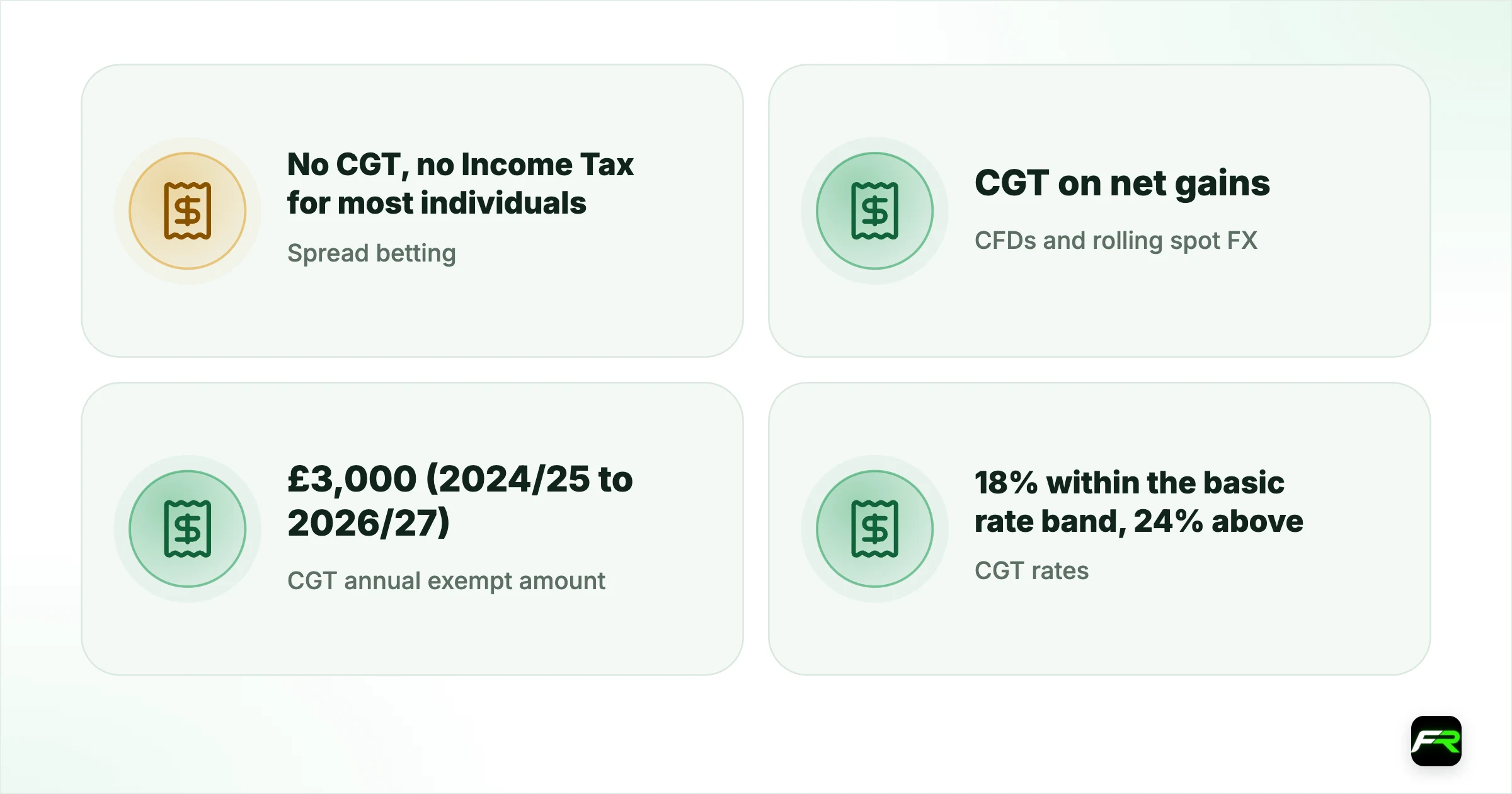
Those four boxes (spread bets, CFDs, spot currency and trading as a business) cover almost every retail forex trader in the country. Below we set out each one with the HMRC manual reference behind it, flag the out-of-date rates still quoted in places, and work through real £ examples and the self assessment dates you need.
General information, not tax advice. Your position depends on your own circumstances, and tax rules can change, including at the 28 October 2026 Budget. If your gains are large, your situation is unusual or you are unsure which regime applies, a qualified tax adviser who works with traders is worth the fee.
| Spread betting | No CGT, no Income Tax for most individuals (CG56105, BIM56900) |
|---|---|
| CFDs and rolling spot FX | CGT on net gains (CG56100) |
| CGT annual exempt amount | £3,000 (2024/25 to 2026/27) |
| CGT rates | 18% within the basic rate band, 24% above (disposals from 30 October 2024) |
| Trading as a business | Income Tax plus Class 4 NI, rare (BIM56850) |
| Key 2025/26 deadlines | Register by 5 October 2026; online return and payment by 31 January 2027 |
The four ways HMRC can see your forex profits
Start with the product, because that decides almost everything. A financial spread bet is a wager on price movement priced in pounds per point. HMRC's Capital Gains Manual at CG56105 is blunt about it: no assets are acquired or disposed of and "no chargeable gains or allowable losses arise from spread betting". The Business Income Manual at BIM56900 adds that profits and losses from gambling contracts are outside the scope of Income Tax for individuals. So for most people a spread bet win is simply not taxed.
A contract for difference is treated very differently. According to CG56100, "retail contracts for differences are financial futures, and, unless the profits are taxable as trading income, in almost every case TCGA92/S143 charges the outcomes under the capital gains regime." Rolling spot FX offered by a CFD broker works in the same way in practice, since the position is a derivative you close out rather than currency you take delivery of. Every closed CFD is a disposal, and the net result goes into your CGT calculation.
Actual foreign currency that you buy and hold is a third, smaller category. Currency other than sterling is itself a chargeable asset (CG78300), so converting pounds into dollars, holding them and converting back at a better rate can produce a gain. Cash held for personal spending abroad is exempt, which is why a holiday currency profit never troubles anyone. The fourth category is trading as a business, which we cover further down: it applies when HMRC accepts that your dealing is organised like a trade, and it switches you from CGT to Income Tax.
| How you trade | Tax regime | Rate for 2026/27 | Losses usable? |
|---|---|---|---|
| Spread bet (most individuals) | Outside CGT and Income Tax | 0% | No |
| CFD or rolling spot FX | Capital Gains Tax | 18% or 24% above £3,000 | Yes, against other gains |
| Holding physical foreign currency | Capital Gains Tax (personal-use cash exempt) | 18% or 24% above £3,000 | Yes |
| Dealing that HMRC accepts is a trade | Income Tax and Class 4 NI | 20%, 40%, 45% plus NI | Yes, subject to limits |
| Prop firm payouts | Usually self-employment income | Income Tax plus Class 4 NI | Expenses deductible |
Two rows need a word of their own. Payouts from a funded-trader programme are not trading profits of your own at all, and we explain the self-employment treatment in how prop firm payouts are taxed. And no row in the table can be moved into an ISA: CFDs, spread bets and foreign currency cash are not qualifying investments, as our forex and ISA explainer sets out.
CGT on CFDs: the numbers for 2026/27
For 2026/27 (6 April 2026 to 5 April 2027) the annual exempt amount is £3,000. It was £12,300 as recently as 2022/23 and £6,000 in 2023/24, which is why many part-time CFD traders who never paid CGT before now find they owe something. Only net gains above £3,000 are taxed.
The rate depends on how much of your basic rate band is left after your taxable income. Gains that fit inside the band pay 18%, and anything above it pays 24%. The band is £37,700 of taxable income, so for someone with the standard £12,570 personal allowance it runs out once total income reaches £50,270. Your CFD gains sit on top of your salary, so a basic rate taxpayer with a good year can end up paying partly at 18% and partly at 24%.
Several well-ranked pages still quote CGT rates of 10% and 20% for forex and CFDs. Those rates stopped applying on 30 October 2024, when the Autumn Budget raised them to 18% and 24% with immediate effect. The Budget on 26 November 2025 left the main rates alone. If a page shows 10%/20%, or an allowance of £6,000 or £12,300, it has not been updated. Check the gov.uk Capital Gains Tax rates page if in doubt.
Unlike Income Tax, CGT is not collected through payments on account. You pay it in one go by 31 January after the end of the tax year in which you closed the trades. That makes it easy to spend money that you owe HMRC, so many traders move a slice of each profitable month into a separate savings account.
Worked examples in pounds
Take three traders who all closed CFD positions in 2026/27 and had no other capital gains. We ignore Scottish income tax bands and any unusual reliefs to keep the arithmetic clear.
- Priya, salary £28,000, net CFD gains £2,600. The gain is below £3,000, so no CGT is due. If her total disposal proceeds stayed under £50,000 and she is not otherwise in self assessment, she may not need to report it at all.
- Tom, salary £35,000, net CFD gains £20,000. Taxable gain after the allowance is £17,000. His taxable income is £22,430, leaving £15,270 of basic rate band. So £15,270 is taxed at 18% (£2,748.60) and £1,730 at 24% (£415.20), a bill of £3,163.80.
- Hannah, salary £62,000, net CFD gains £10,000. Her salary already fills the basic rate band, so the taxable £7,000 is all charged at 24%: £1,680.
Had all three placed the same trades as spread bets, none would owe anything. That gap is the reason most UK retail traders who use FCA-authorised brokers pick spread betting. The trade-off comes in loss years, which we cover next, and in our spread betting vs CFD comparison.
Losses, costs and the currency of your account
CFD losses are allowable capital losses. They are set against gains in the same tax year first, and any unused balance can be carried forward indefinitely, provided you claim it within four years of the end of the tax year in which the loss arose. A trader with £6,000 of CFD losses in 2025/26 has until 5 April 2030 to put in the claim. Spread bet losses give you nothing, because the same rule that keeps winnings out of tax keeps losses out too.
CG56100 says all debits and credits to a CFD account, including commission and payments equivalent to interest and dividends, go into the computation. In plain terms, commission reduces your gain, overnight financing charges reduce it, and financing credits or dividend adjustments increase it. Deposits and withdrawals are not taxable events. Tax follows closed trades, whether or not the money ever leaves the broker.
If your account is in US dollars, each disposal has to be valued in sterling at the date it happens, following the approach in CG78310. A single average rate for the whole year is simpler but can give a different answer, especially in a year when cable moved several cents. Our self assessment walk-through explains how to build that record without spending a weekend on it.
Omar works in logistics on a £38,000 salary and trades GBP/USD and EUR/GBP CFDs in a USD-denominated account. In 2026/27 his broker statement shows 214 closed trades with net profit of $14,900 after $1,180 of commission and $640 of overnight financing. At the Bank of England rate for each closing date, those trades come to a sterling gain of £11,240. He also has a £4,100 CFD loss from 2025/26 that he claimed on last year's return, and brought-forward losses can be used down to the £3,000 allowance. So £11,240 minus £4,100 leaves £7,140, and after the £3,000 allowance £4,140 is taxable. His taxable income of £25,430 leaves £12,270 of basic rate band, so the whole £4,140 falls at 18%: £745.20, due by 31 January 2028. Omar sets aside a fifth of every profitable month in a separate easy-access account, so the bill is covered when it arrives. Had he used a spread betting account with similar pricing, the tax would have been nil in the good year, but the loss in the bad year would have given him no relief at all.
When forex trading becomes a business
HMRC's starting point for individuals is set out in BIM56850: there is a "prima facie presumption" that speculative dealing in financial instruments is not a trade. The courts have repeatedly agreed, and most people who describe themselves as full-time traders are still, for tax purposes, speculators paying CGT on CFDs. BIM56860 discusses three cases and the factors that can take a case "out of the norm", such as professional expertise, volume, a trader-like organisation and time spent, while stressing that no single factor decides it.
Trading status is not automatically good or bad. Profits would face Income Tax at 20%, 40% or 45% plus Class 4 National Insurance, which is higher than CGT for most people. Losses, though, could be set against other income, subject to limits. Our explainer on HMRC's badges of trade for forex goes through the tests. Spread betting sits in a separate category again: BIM22017 records the old case of Graham v Green, where the court held that "there is no tax on a habit", even for a systematic, skilled bettor.
Self assessment dates and what to report
CFD gains go on the SA108 Capital Gains Tax summary pages of your tax return. Fill those pages in if your gains before losses were above £3,000, if the total value of what you disposed of was over £50,000, or if you want to claim a loss. Spread bets are not reported at all for a normal individual.
| What | Tax year 2025/26 (trades closed 6 April 2025 to 5 April 2026) | Tax year 2026/27 (trades closed 6 April 2026 to 5 April 2027) |
|---|---|---|
| Register for self assessment | 5 October 2026 | 5 October 2027 |
| Paper return | 31 October 2026 | 31 October 2027 |
| Online return | 31 January 2027 | 31 January 2028 |
| Pay the CGT | 31 January 2027 | 31 January 2028 |
If you have never filed before, register for self assessment early: the Unique Taxpayer Reference arrives by post and can take a couple of weeks. A late online return starts with a £100 penalty even if no tax is owed, and interest runs on unpaid tax from 1 February. The full process is in our guide to reporting CFD gains on self assessment.
Records to keep
HMRC can ask you to back up any figure on your return, and a CFD computation with hundreds of trades is hard to rebuild from memory. The simplest habit is a monthly export of your full trade history as a spreadsheet, saved somewhere other than the broker’s own portal. Accounts get closed, brands change and old statements are not always easy to retrieve years later.
- Trade history: every closed position with open and close dates, prices, size, commission and financing.
- Exchange rates: the sterling rate used for each disposal in a non-sterling account, and the source you took it from.
- Your computation: the spreadsheet or summary behind the SA108 figures, plus any tax summary the broker issued.
- Loss claims: the return or letter on which you claimed each loss, kept for as long as the loss is being carried forward.
- Spread bet statements: not taxable, but useful to explain large deposits into your bank account if anyone asks.
For individuals who file on time and are not self-employed, gov.uk says to keep records for at least 22 months after the end of the tax year the return covers. Hold on to them for longer while you carry losses forward. Our self assessment walk-through covers retention periods and the SA108 boxes in more detail.
Budget risk and what we would do now
The next Budget is on 28 October 2026. Press reports in August 2026 speculated that the Chancellor could move CGT rates closer to Income Tax rates. That is speculation, not policy, and we would not change a trading plan around a rumour. Two points are worth keeping in mind anyway. The October 2024 rate rise took effect on Budget day itself, so any change could apply to trades closed from 28 October onwards rather than from the next April. Spread betting's tax status rests on gambling law and HMRC's long-standing manuals rather than a relief that can be switched off quickly, though no rule is permanent.
Our view at FX Recap: if you trade forex profitably and do not need to offset losses against other gains, an FCA-authorised spread betting account is the tax-efficient default. If you use an offshore broker that only offers CFDs, you are in the CGT regime and give up the Financial Ombudsman and FSCS as well. Check any firm on the FCA Register before you open an account.
Frequently asked
Do I pay tax on forex trading in the UK?
It depends on the product. Spread bet profits are normally tax free for individuals. Gains on CFDs and rolling spot FX are subject to Capital Gains Tax above the £3,000 annual exempt amount. If HMRC accepted your dealing was a genuine trade, which is rare, profits would face Income Tax and National Insurance instead.
What CGT rate applies to CFD gains in 2026/27?
18% on gains that fall within your unused basic rate band and 24% on anything above it. The rates rose from 10% and 20% on 30 October 2024 and were unchanged at the November 2025 Budget. Net gains up to £3,000 each tax year are exempt.
Is spread betting on forex tax free?
For most UK individuals, yes. HMRC's CG56105 says no chargeable gains or allowable losses arise from spread betting, and BIM56900 places gambling profits outside Income Tax. Narrow exceptions exist, such as spread bets used to hedge a business risk. The trade-off is that losses cannot be used either.
Can I offset forex CFD losses against other gains?
Yes. CFD losses are allowable capital losses. They reduce other gains in the same year, such as a share sale, and any balance carries forward to future years. You must claim a loss within four years of the end of the tax year in which you made it.
Do I pay tax when I withdraw money from my broker?
No. Tax is based on closed trades in the tax year, not on withdrawals. Profits left in the account are still taxable in the year you closed the positions, and a withdrawal from an account that made no net gain creates no tax.
My broker account is in dollars. How do I convert gains?
Value each disposal in sterling at the exchange rate on the date it happened, as HMRC's approach in CG78310 describes. Many traders use the Bank of England daily rate. Keep a spreadsheet of the rates used so you can show your working if HMRC asks.
When do I have to pay tax on 2026/27 forex gains?
Trades closed between 6 April 2026 and 5 April 2027 fall in the 2026/27 tax year. If you are not already registered, register for self assessment by 5 October 2027, then file online and pay by 31 January 2028.
Does trading forex with an offshore broker change the tax?
No. UK residents are taxed on their worldwide gains, so a CFD profit made with a broker in the Seychelles or Australia is taxed exactly like one made in London. Offshore firms rarely offer spread betting, so you are usually in the CGT regime.
Will HMRC know about my trading?
Assume so. Under the Common Reporting Standard, HMRC receives information from other countries about UK residents with overseas financial accounts, including balances and sale proceeds, and it has powers to request data from UK firms. HMRC also writes to people when that data suggests missing income or gains. If your returns are right, such a letter needs little more than a check.
Is there stamp duty on forex trades?
No. Stamp Duty and Stamp Duty Reserve Tax are charged on buying shares, usually at 0.5%. A currency trade, a forex CFD or a spread bet on a currency pair involves no transfer of shares, so none is due. Your costs are the spread, any commission and overnight financing, and on CFDs the commission and financing go into your CGT computation.
Is profit on holiday money taxable?
Not usually. Foreign currency is a chargeable asset, but HMRC's CG78315 says a gain on currency an individual acquired for personal spending outside the UK, by themselves or their family, is not a chargeable gain. That covers holiday cash and upkeep of a home abroad. Currency bought to speculate on, or held in a trading account, does not qualify.
Related reading
The team behind this guide
Researched, checked and approved by five forex specialists
Every guide is written, fact-checked and edited before it goes live, and updated when the facts change. Spotted an error? Tell us.