IC Markets























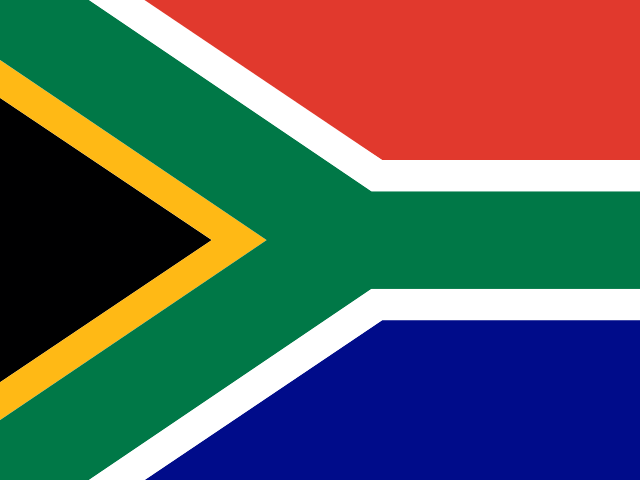













South Africa's Inflation Rose to 4.5% in September as Fuel and Fares Climbed
Diesel is 46% dearer than a year ago and taxi fares are up 13.8%, pushing prices further above the Reserve Bank's band before its November meeting.
 WriterAbir KhanWriterWrites the guides · checks every figure against primary sources View profileAbout Abir →

 Market analysisTanbir Habib RiyadForex & Crypto AnalystForex and crypto analyst · technical and fundamental analysis View profileAbout Tanbir →

 Fact-checking & riskJannatul FerdaushFact-Checker & Risk AnalystFact-checks every figure · risk analysis · Applied Statistics, University of Dhaka View profileAbout Jannatul →

 Trading reviewJowel RanaCo-Founder & Forex TraderCo-founder · forex trader · reviews guides from a trader's view View profileAbout Jowel →

 Final approvalRanjan NiskrityFounder, Owner & Forex TraderFounder and owner · forex trader · signs off every guide View profileAbout Ranjan →

South Africa's annual consumer inflation rose to 4.5% in September from 4.4% in August, Statistics South Africa said on Wednesday 21 October. It was the second rise in a row, after 4.3% in July. Prices climbed 0.4% in the month, against no change between July and August.
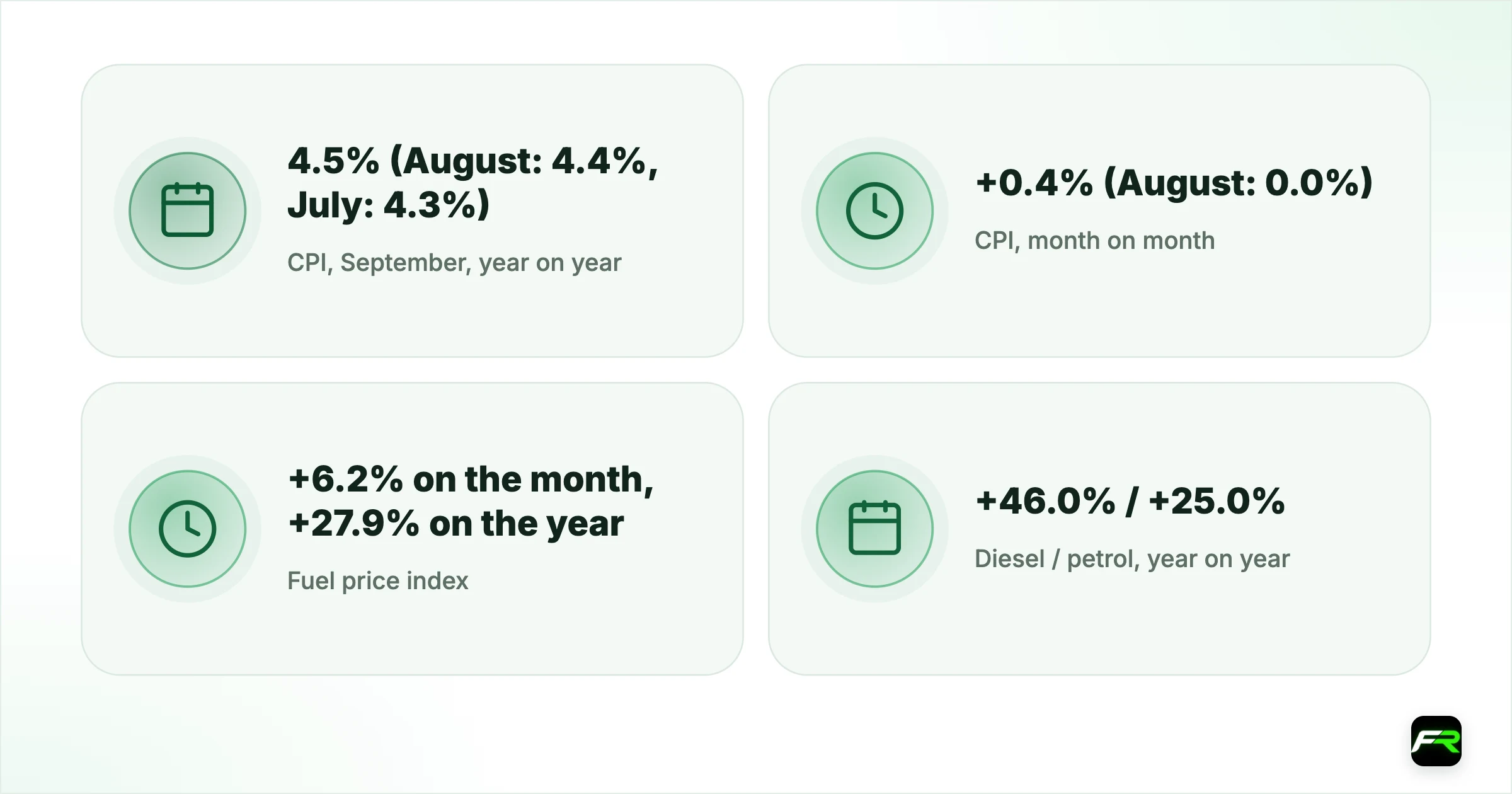
Transport did most of the work. Stats SA said the category accounted for a third of overall inflation in September, as the fuel price index jumped 6.2% in the month and 27.9% over the year. Diesel was 46.0% more expensive than a year earlier and petrol 25.0%. Higher fuel costs are now feeding into fares, with minibus taxi prices up 13.8% and airfares 18.6%.
The rand took the news calmly. USD/ZAR traded near 16.40 before the 10:00 Johannesburg release (08:00 UTC), dipped to 16.38 in the first few minutes and was back near 16.41 at 08:20 UTC. That is close to the strongest level for the rand this month: the pair fell to 16.34 on Tuesday, its lowest of the month, from a high of 16.75 on 1 October.
| CPI, September, year on year | 4.5% (August: 4.4%, July: 4.3%) |
|---|---|
| CPI, month on month | +0.4% (August: 0.0%) |
| Fuel price index | +6.2% on the month, +27.9% on the year |
| Diesel / petrol, year on year | +46.0% / +25.0% |
| Passenger transport | +12.3% (August: +11.6%) |
| Food and non-alcoholic beverages | +1.2% (August: +1.1%) |
| Actual rentals, third quarter | +3.9% (second quarter: +4.1%) |
| SARB policy rate | 7.25%, next decision 19 November |
What Stats SA reported
Headline inflation has now risen for two months in a row. At 4.5%, the annual rate sits above the top of the South African Reserve Bank's tolerance band. The bank targets 3%, with a band of one percentage point either side, so anything above 4% is outside it.
Stats SA's own summary was short and pointed: fuel is biting. Transport's share of the headline rate began to grow in April and reached a third of the total in September. Outside transport, the pressure was milder. Food inflation edged up only slightly, meat prices cooled, and rents grew more slowly in the third quarter than in the second.
That split matters for how the numbers are read. A rise driven by one category, and one that comes from global oil prices, is different from a broad rise across the basket. The Reserve Bank has said as much itself, describing the oil shock as large and persistent while noting that food and core goods inflation have been more favourable.
Fuel and fares drove the rise
Fuel prices rose 6.2% between August and September alone. Over the year, diesel is up 46.0% and petrol 25.0%, which works out at 27.9% for the fuel index as a whole. In August, annual fuel inflation had eased for a second month to 20.0%, so September undid that brief relief and more.
The knock-on effects are clear in passenger transport. That category has shown double-digit annual inflation since June and reached 12.3% in September, up from 11.6%. Airfares rose 18.6% over the year, long-distance bus fares 14.1% and minibus taxi fares 13.8%. Courier services rose 6.8%.
| Transport item, September 2026 | Change on a year |
|---|---|
| Fuel price index | +27.9% |
| Diesel | +46.0% |
| Petrol | +25.0% |
| Airfares | +18.6% |
| Long-distance bus fares | +14.1% |
| Minibus taxi fares | +13.8% |
| Passenger transport, all | +12.3% |
| Courier services | +6.8% |
Source: Statistics South Africa, Consumer Price Index, September 2026. Annual change in the price index.
Food, meat and rents stayed calm
Food and non-alcoholic beverages rose 1.2% over the year, up a little from 1.1% in August and 0.9% in July. That is a low rate, and the Reserve Bank noted in September that food inflation was at its lowest since 2010, helped by strong harvests.
Meat, which drove food prices from mid-2025 to mid-2026, has cooled sharply. Meat inflation slowed to 0.7% from 1.5%, the lowest annual rate since March 2025. Several beef cuts are cheaper than a year ago: stewing beef fell 7.2%, mince 4.6% and steak 4.4%. Processed meats moved the other way, with corned meat up 10.7%, bacon 10.1% and ham 8.1%.
Cereal products recorded an eighth straight month of falling prices over the year, at minus 1.9%, although their index rose 0.3% in September. Maize meal shows the contrast best: up 0.8% on the month and down 8.6% on the year. Rents, which Stats SA surveys every quarter, rose 3.9% in the third quarter, down from 4.1%, with flats up 4.0%, townhouses 3.9% and houses 3.8%.
What it means for the Reserve Bank and the rand
The Reserve Bank raised its policy rate by 25 basis points to 7.25% at its September meeting, effective from 25 September, in a unanimous decision. Governor Lesetja Kganyago said in the statement that headline inflation would likely be above 5% later this year and early next year before slowing as the fuel shock recedes, and that the bank sees upside risks to inflation.
September's 4.5% fits that path rather than surprising it. The bank's model in September showed the policy rate broadly stable through the rest of this year, and the statement stressed that decisions are taken meeting by meeting. The next one is on 19 November, and October's inflation figure will show whether fuel is pushing the rate towards the 5% the bank expects.
For the rand, steady and well-flagged inflation is less of a shock than the oil price itself. The Reserve Bank described the currency as notably resilient this year, and USD/ZAR has fallen from about 16.75 to near 16.40 in October. The main risk for the rand is outside the country: the bank's own scenario of higher global interest rates showed rand weakness lifting inflation and calling for tighter policy.
What traders can take from it
South African inflation data rarely move the rand far on their own, but they shape the Reserve Bank's next step. These points can help.
- Compare the print with the Reserve Bank's path. A rate heading towards 5% is what the bank expects; a jump well beyond that would change the outlook for 19 November.
- Watch fuel prices in rand. Pump prices follow both the oil price and the exchange rate, so the two together shape next month's transport inflation.
- Track global yields. The bank itself flagged higher global rates as a risk that would weaken the rand and push inflation up.
- Expect wider spreads on USD/ZAR. It trades with larger gaps than the major pairs, especially outside the London session.
- Respect the October low near 16.34. A break below it would extend the rand's recent strength, while a move back above 16.60 would undo much of it.
Say you sell USD/ZAR at 16.40 on the view that the rand stays firm, with a stop at 16.55, 1,500 pips above (one pip on USD/ZAR is 0.0001). On a position of 10,000 US dollars, each 0.01 move is worth about R100, so the 0.15 stop risks about R1,500, or roughly $91 at this rate. On a $10,000 account with a 1% limit of $100, that size fits. Check your broker's swap charges first, because holding a short USD/ZAR position can cost or earn interest every night.
For more on trading from South Africa, see our South Africa forex hub. Convert any amount between rand and dollars with the currency converter, check central bank dates on the economic calendar and size each trade with the position size calculator.
Emerging market currencies such as the rand can move sharply on global risk swings, and spreads widen in thin hours. Leverage magnifies losses as well as gains, so trade only with money you can afford to lose.
All price figures are from Statistics South Africa's September 2026 CPI data story of 21 October 2026 and its home page, with August figures from Stats SA's economic wrap-up for September 2026. The policy rate, the inflation target and the governor's comments are from the South African Reserve Bank's September 2026 MPC statement. Currency levels are market data built from 5-minute and hourly bars to about 08:20 UTC on 21 October and differ slightly between providers. Comments on the rand are FX Recap's own reading. This is news, not investment advice.
Frequently asked
What is South Africa's inflation rate for September 2026?
South Africa's annual consumer inflation was 4.5% in September 2026, up from 4.4% in August and 4.3% in July, according to Statistics South Africa. Prices rose 0.4% between August and September.
Why did inflation rise in South Africa in September 2026?
Fuel was the main reason. The fuel price index rose 6.2% in the month and 27.9% over the year, with diesel up 46.0% and petrol 25.0%. Transport accounted for a third of overall inflation, according to Stats SA.
Is South African inflation within the Reserve Bank's target?
No. The South African Reserve Bank targets 3% inflation with a tolerance band of one percentage point either side, so 4.5% is above the top of the band. The bank expects headline inflation to rise above 5% later this year.
When is the next SARB interest rate decision?
The South African Reserve Bank's Monetary Policy Committee announces its next decision on 19 November 2026. The policy rate is 7.25% after a 25 basis point rise in September.
Sources: Statistics South Africa: Consumer inflation rises for a second straight month (21 October 2026) · South African Reserve Bank: Statement of the Monetary Policy Committee, September 2026 · Statistics South Africa: Economic wrap-up for September 2026 · Statistics South Africa: Consumer Price Index, September 2026 (P0141)
The team behind this guide
Researched, checked and approved by five forex specialists
Every guide is written, fact-checked and edited before it goes live, and updated when the facts change. Spotted an error? Tell us.