IC Markets






































New Zealand Inflation Eases to 3.7% as Petrol Falls, but Domestic Prices Stay Firm
Cheaper petrol pulled the annual rate down from 4.1%, yet airfares, council rates and core prices kept the RBNZ under pressure before 28 October.
 WriterAbir KhanWriterWrites the guides · checks every figure against primary sources View profileAbout Abir →

 Market analysisTanbir Habib RiyadForex & Crypto AnalystForex and crypto analyst · technical and fundamental analysis View profileAbout Tanbir →

 Fact-checking & riskJannatul FerdaushFact-Checker & Risk AnalystFact-checks every figure · risk analysis · Applied Statistics, University of Dhaka View profileAbout Jannatul →

 Trading reviewJowel RanaCo-Founder & Forex TraderCo-founder · forex trader · reviews guides from a trader's view View profileAbout Jowel →

 Final approvalRanjan NiskrityFounder, Owner & Forex TraderFounder and owner · forex trader · signs off every guide View profileAbout Ranjan →

New Zealand's consumers price index rose 3.7% in the 12 months to the September 2026 quarter, Stats NZ said on Thursday 22 October. That is down from 4.1% in the year to the June quarter, but it is still well above the Reserve Bank of New Zealand's target band of 1% to 3%. Prices rose 0.7% in the quarter alone.
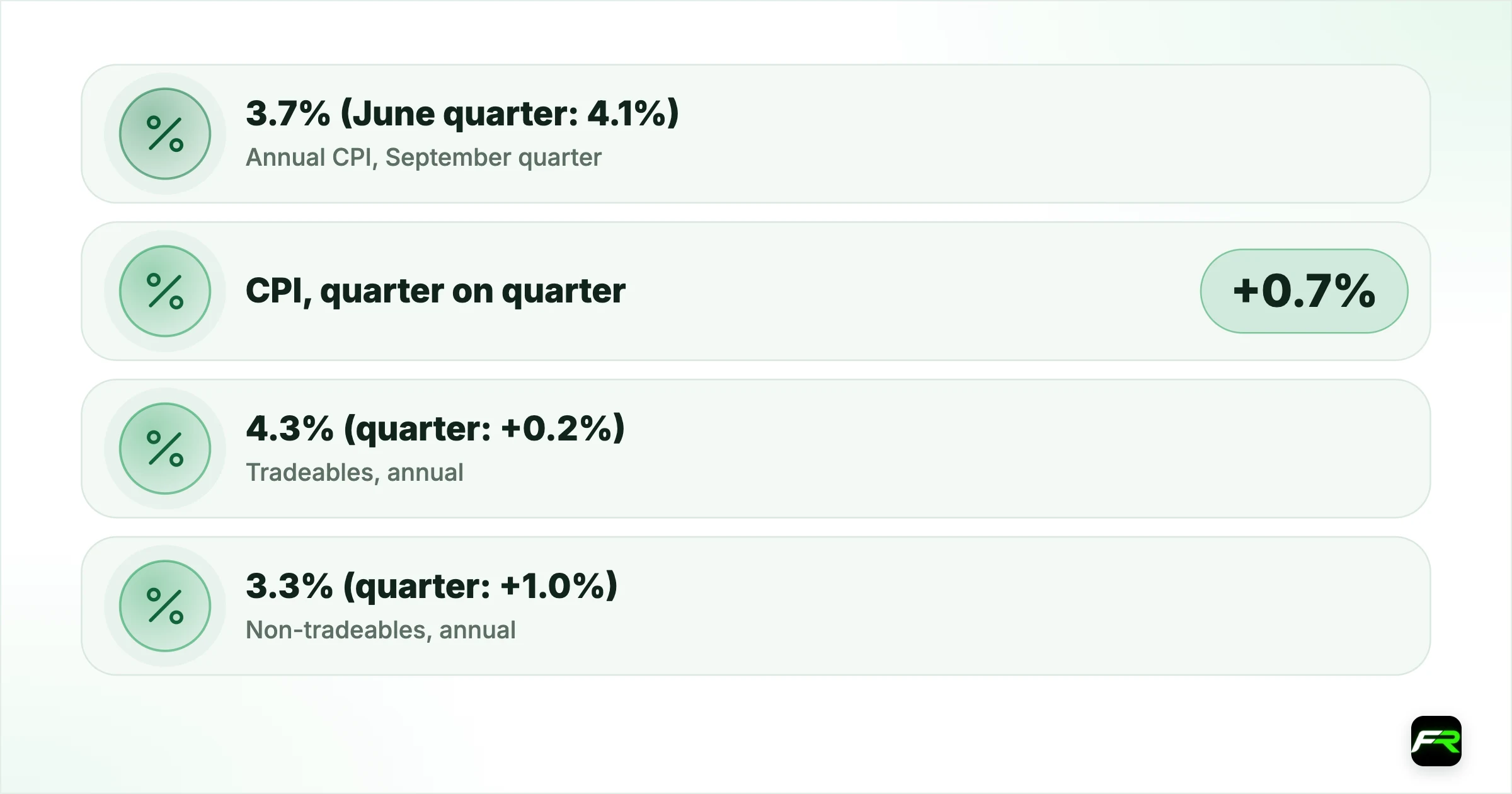
Petrol explains most of the slowdown. Pump prices fell 6.5% in the September quarter after jumping 20.1% in the June quarter, and that drop alone offset about 40% of the quarter's rise. Other parts of the basket moved the opposite way. International airfares rose 14.3% in three months, the biggest quarterly rise since late 2022, and local council rates went up 6.2%. A measure that strips out food, household energy and vehicle fuels rose 1.1% in the quarter, faster than the headline.
The kiwi slipped on the release. NZD/USD stood near 0.5704 just before the 21:45 UTC publication and fell to 0.5689 within ten minutes, then held in a narrow band around 0.5690 through the Asian morning. It was near 0.5692 at 03:20 UTC. AUD/NZD, a cleaner read on New Zealand news, rose to about 1.2347 in the hour of the release before settling near 1.2330.
| Annual CPI, September quarter | 3.7% (June quarter: 4.1%) |
|---|---|
| CPI, quarter on quarter | +0.7% |
| Tradeables, annual | 4.3% (quarter: +0.2%) |
| Non-tradeables, annual | 3.3% (quarter: +1.0%) |
| Excluding food, household energy and fuel | 2.9% annual, +1.1% in the quarter |
| Petrol | -6.5% in the quarter, +19.1% on the year |
| CPI without the petrol change | 3.2% annual |
| Official Cash Rate | 2.75%, next decision 28 October |
What Stats NZ reported
New Zealand publishes its main inflation figure once a quarter, so each release carries more weight than a monthly print elsewhere. Stats NZ splits the basket into tradeables, which compete with imports and follow world prices, and non-tradeables, which reflect conditions at home. Tradeable inflation was 4.3% over the year but only 0.2% in the quarter, as fuel prices eased. Non-tradeable inflation was 3.3% over the year and 1.0% in the quarter.
Price rises were widespread. Stats NZ said 85.5% of the basket rose in price over the 12 months, and about 13% fell, the smallest share since the December 2023 quarter. The share of the basket rising faster than 3% jumped to 54.9% from 38.5% in the year to June. A broad spread like that matters to a central bank, because it suggests inflation is no longer driven by a few items.
Stats NZ also gave a useful counterfactual. Had petrol prices not changed over the year, annual inflation would have been 3.2%. That figure is still above the top of the Reserve Bank's band, which shows the problem is not only about fuel.
Airfares and council rates pushed the other way
The quarter's biggest upward push came from international air travel. Fares rose 14.3%, mainly on routes to Europe and Asia, and accounted for 36.2% of the 0.7% quarterly rise. Local authority rates and payments, which Stats NZ measures once a year in the September quarter, rose 6.2% and made up 29.1% of the increase. Vegetables, up 10.5%, contributed another 18.0%.
On the year, petrol remains the largest single driver even after the recent fall, up 19.1% and responsible for 17.5% of annual inflation. The cost of building a new home rose 3.2%, and Stats NZ said builders reported higher costs for materials, subcontractors, labour and fuel. Electricity rose 9.3%, and international airfares were 12.5% dearer than a year earlier.
A few items fell. Milk, cheese and eggs dropped 14.7% over the year, a move Stats NZ traced to eggs, and oils and fats were 8.3% cheaper as olive oil and butter prices came down. Vegetables were 2.2% lower than a year earlier despite their rise in the quarter. The council rates increase of 6.2% was also smaller than the 8.8% rise of the September 2025 quarter.
| Item | Quarterly change | Annual change |
|---|---|---|
| CPI, all groups | +0.7% | +3.7% |
| Tradeables | +0.2% | +4.3% |
| Non-tradeables | +1.0% | +3.3% |
| Excluding food, household energy, fuel | +1.1% | +2.9% |
| Petrol | -6.5% | +19.1% |
| International airfares | +14.3% | +12.5% |
| Local authority rates | +6.2% | +6.2% |
Source: Stats NZ, Consumers price index: September 2026 quarter. Council rates are measured once a year, so the quarterly and annual changes are the same.
What it means for the Reserve Bank and the kiwi
The Reserve Bank raised the Official Cash Rate to 2.75% on 2 September and announces its next decision at 2:00pm on Wednesday 28 October, which is 01:00 UTC. On its own website the bank says it is increasing the OCR so that inflation gets back to 2%. Today's figure gives it reasons on both sides. Headline inflation is falling, but the quarterly core measure and non-tradeable prices show that domestic pressure has not eased.
Expectations going in looked close to the result. investingLive reported before the release that annual inflation was seen easing to 3.8%, so 3.7% came in only a touch lower. The kiwi's small dip suggests the market read the report as a slight relief on fuel rather than a reason to doubt another rate rise. Stats NZ's own comparison table lists Australia at 4.0% for August, so inflation on both sides of the Tasman remains above target.
For NZD/USD, the decision on 28 October lands on the same day as the Bank of Canada and the Federal Reserve, so moves in the US dollar can easily swamp a New Zealand story. AUD/NZD is a better guide to what traders think about the two central banks across the Tasman. The Reserve Bank of Australia's cash rate is 4.60%, far above New Zealand's, and that gap is one reason the cross has stayed near 1.23.
What traders can take from it
Quarterly inflation data only come four times a year, so they shape the view on the kiwi for weeks. These points help put the release in context.
- Separate fuel from the rest. Petrol fell 6.5% in the quarter, but the core measure rose 1.1%, and that is the number a central bank worries about.
- Watch non-tradeables. At 3.3% over the year and 1.0% in the quarter, they reflect domestic demand and wages more than world prices.
- Use AUD/NZD to isolate local news. NZD/USD carries the US dollar's moves, while the cross shows how traders weigh the RBNZ against the RBA.
- Mark 01:00 UTC on 28 October. The RBNZ decision comes hours before the Bank of Canada and the Fed, so liquidity and volatility can shift fast that day.
- Keep an eye on oil. Petrol is still up 19.1% on the year, and a new rise in crude would undo the relief in this report.
Say you sell NZD/USD at 0.5700 after the release, with a stop at 0.5730, 30 pips above. A standard lot of 100,000 NZD is worth $10 a pip, so the stop risks about $300 per lot. On a $10,000 account with a 1% limit of $100, the right size is about 33,000 units. If you plan to hold into the RBNZ decision on 28 October, cut the size further, because the rate call could move the pair by more than your stop in seconds.
For the Australian side of the cross, see our AUD/USD analysis. Every central bank date is on the economic calendar, and you can convert New Zealand dollar amounts with the currency converter. Size each trade with the position size calculator.
The New Zealand dollar can move sharply around quarterly data and RBNZ decisions, and liquidity is thin in the early Asian session. Leverage magnifies losses as well as gains, so trade only with money you can afford to lose.
All price figures are from Stats NZ's September 2026 quarter CPI release and news story of 22 October 2026. The Official Cash Rate, target band and decision date are from the Reserve Bank of New Zealand. investingLive reported the 3.8% forecast. Currency levels are market data built from 5-minute and hourly bars to about 03:20 UTC on 22 October and differ slightly between providers. Comments on the kiwi and policy are FX Recap's own reading. This is news, not investment advice.
Frequently asked
What is New Zealand's inflation rate for the September 2026 quarter?
New Zealand's consumers price index rose 3.7% in the 12 months to the September 2026 quarter, according to Stats NZ, down from 4.1% in the June quarter. Prices rose 0.7% in the quarter. The Reserve Bank of New Zealand's target band is 1% to 3%.
Why did New Zealand inflation fall in the September 2026 quarter?
Petrol prices fell 6.5% in the quarter after a 20.1% jump in the June quarter, which pulled the annual rate down. Without any change in petrol prices, Stats NZ said annual inflation would have been 3.2%.
What pushed New Zealand prices up in the September 2026 quarter?
International airfares rose 14.3%, local authority rates 6.2% and vegetables 10.5% in the quarter. Over the year, petrol, the cost of building new homes and electricity were the biggest contributors.
When is the next RBNZ rate decision?
The Reserve Bank of New Zealand announces its next Official Cash Rate decision at 2:00pm New Zealand time on 28 October 2026, which is 01:00 UTC. Its Official Cash Rate is 2.75% after a rise on 2 September 2026.
Sources: Stats NZ: Consumers price index: September 2026 quarter · Stats NZ: Annual inflation at 3.7 percent in September 2026 · Reserve Bank of New Zealand: Official Cash Rate
The team behind this guide
Researched, checked and approved by five forex specialists
Every guide is written, fact-checked and edited before it goes live, and updated when the facts change. Spotted an error? Tell us.