IC Markets




































UK Economy Grows 0.1% in August as Services Stall and Factories Pick Up
Factory output rose 1.2% while services were flat. Three-month growth hit 0.7%, and the pound edged up to 1.3280 ahead of the Bank of England's November call.
 WriterAbir KhanWriterWrites the guides · checks every figure against primary sources View profileAbout Abir →
 Market analysisTanbir Habib RiyadForex & Crypto AnalystForex and crypto analyst · technical and fundamental analysis View profileAbout Tanbir →
 Fact-checking & riskJannatul FerdaushFact-Checker & Risk AnalystFact-checks every figure · risk analysis · Applied Statistics, University of Dhaka View profileAbout Jannatul →
 Trading reviewJowel RanaCo-Founder & Forex TraderCo-founder · forex trader · reviews guides from a trader's view View profileAbout Jowel →
 Final approvalRanjan NiskrityFounder, Owner & Forex TraderFounder and owner · forex trader · signs off every guide View profileAbout Ranjan →
Britain's economy kept growing in August, but only just. The Office for National Statistics said on Thursday that monthly gross domestic product rose 0.1%, after an unrevised 0.4% gain in July and a 0.4% rise in June, which was revised up from 0.3%. Production grew 0.8%, services showed no growth at all, and construction fell 0.2%.
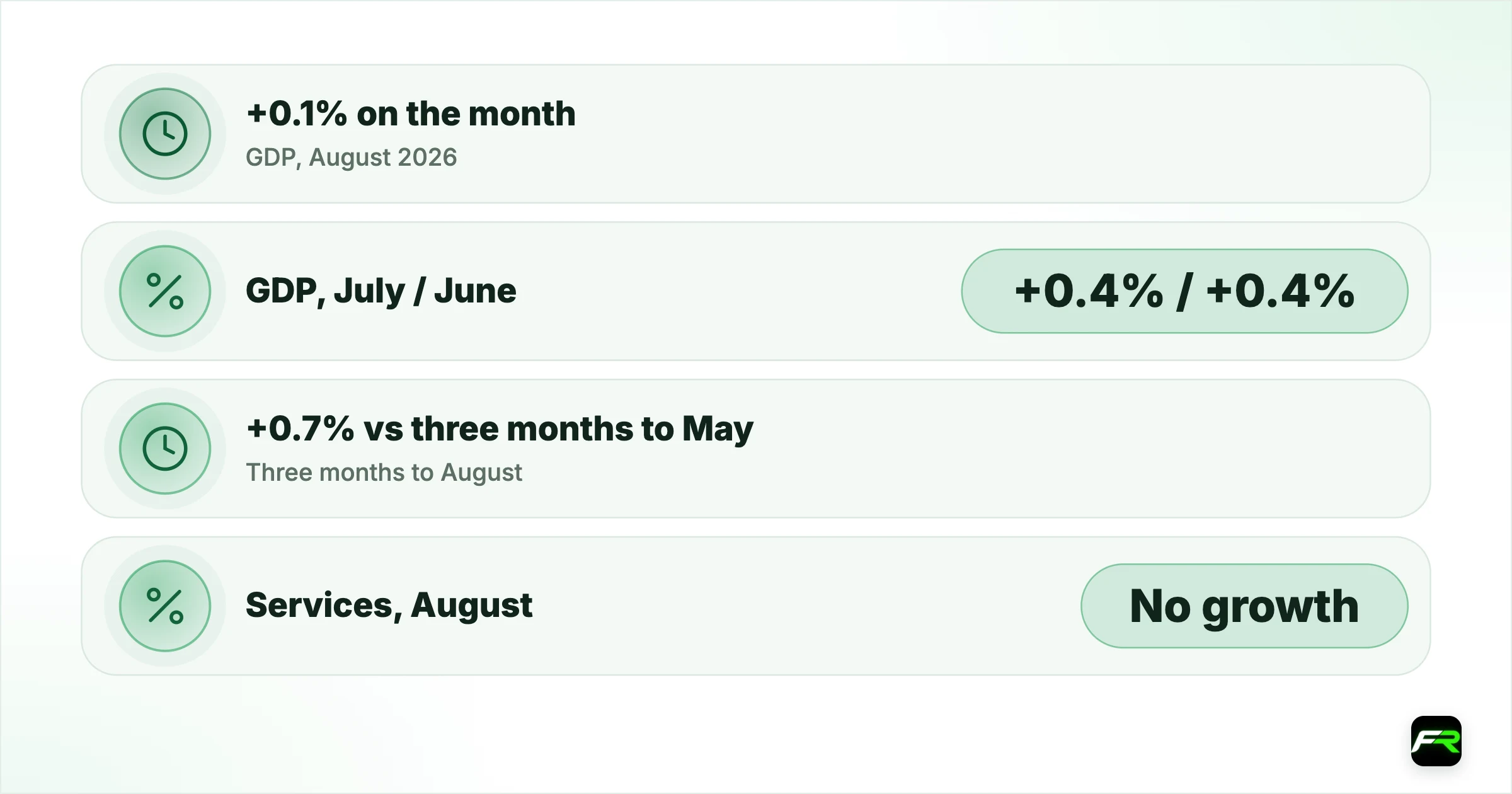
The longer view is stronger. Over the three months to August, GDP grew 0.7% compared with the three months to May, the eighth three-month gain in a row and the fastest of the recent run. Compared with a year earlier, the economy was 1.8% larger. The pound took the figures calmly: GBP/USD traded around 1.3240 when the data came out at 06:00 UTC, finished the UTC day at 1.3271 and was near 1.3281 early on Friday.
| GDP, August 2026 (ONS) | +0.1% on the month |
|---|---|
| GDP, July / June | +0.4% / +0.4% (June revised up) |
| Three months to August | +0.7% vs three months to May |
| Services, August | No growth (0.0%) |
| Production / manufacturing, August | +0.8% / +1.2% |
| Construction, August | −0.2%, fourth monthly fall |
| Next GDP release | September data on 12 November |
What drove August's small gain
Factories carried the month. Manufacturing output rose 1.2%, with 9 of its 13 subsectors growing, after a 1.0% rise in July. The biggest contribution came from pharmaceuticals, up 5.1% after 3.4% in July, followed by transport equipment, which grew 1.8%. Mining and quarrying rose 1.4%. Taken together, production expanded 0.8% on the month.
Services, which make up most of the UK economy, did not grow. Only 4 of the 14 service subsectors expanded in August, after two months of 0.5% growth. Over three months, though, services rose 0.9%, led by professional, scientific and technical work (up 2.8%), information and communication (up 2.8%) and administrative and support activities (up 3.0%). Computer programming and consultancy has been the largest single contributor to three-month growth in each of the last six months, according to the ONS.
Construction remains weak. Output fell 0.2% in August, the fourth monthly decline in a row, and July was revised to a 0.5% drop from a small gain. Over three months the sector shrank 1.0%, with private housing new work down 3.2%.
| Sector | August, monthly | Three months to August | Three months to July |
|---|---|---|---|
| GDP | +0.1% | +0.7% | +0.5% |
| Services | 0.0% | +0.9% | +0.7% |
| Production | +0.8% | −0.2% | −0.7% |
| Manufacturing | +1.2% | +0.1% | n/a |
| Construction | −0.2% | −1.0% | −0.2% |
Source: Office for National Statistics, GDP monthly estimate, UK: August 2026 (published 15 October 2026).
The longer-term trend is stronger than August suggests
Monthly figures are noisy, so the ONS puts more weight on longer comparisons. GDP in the three months to August was 1.8% higher than in the same three months of 2025, and August alone was 2.1% above August 2025. On the ONS's own comparison, annual growth has not been this high since 2022. Services grew 2.2% over that period and production 0.8%, while construction shrank 1.6%.
A handful of knowledge-based industries account for much of that growth. Computer programming and consultancy added 0.32 percentage points to annual GDP growth, legal activities 0.22 points and scientific research and development 0.18 points, with advertising and information services adding about 0.1 point each. Together these five industries supplied 0.93 points of the 1.8% gain. Wholesale trade was the weak spot inside services, falling 2.3% over three months and posting its fourth three-month decline in a row.
Revisions also lifted the recent path. June was raised to 0.4% from 0.3%, and three-month growth to June and July was revised up to 0.5% from 0.4%. For currency traders, that matters as much as the latest month: the UK economy entered the autumn with more momentum than first reported.
Energy costs and the September outlook
The ONS also published early signals for September from its real-time indicators, and they point to a softer month. Indicators of consumer demand weakened, retail footfall was slightly lower than a year earlier, and the estimated quantity of fuel bought per transaction fell further. Housing indicators were weaker, and potential redundancies rose after three monthly declines.
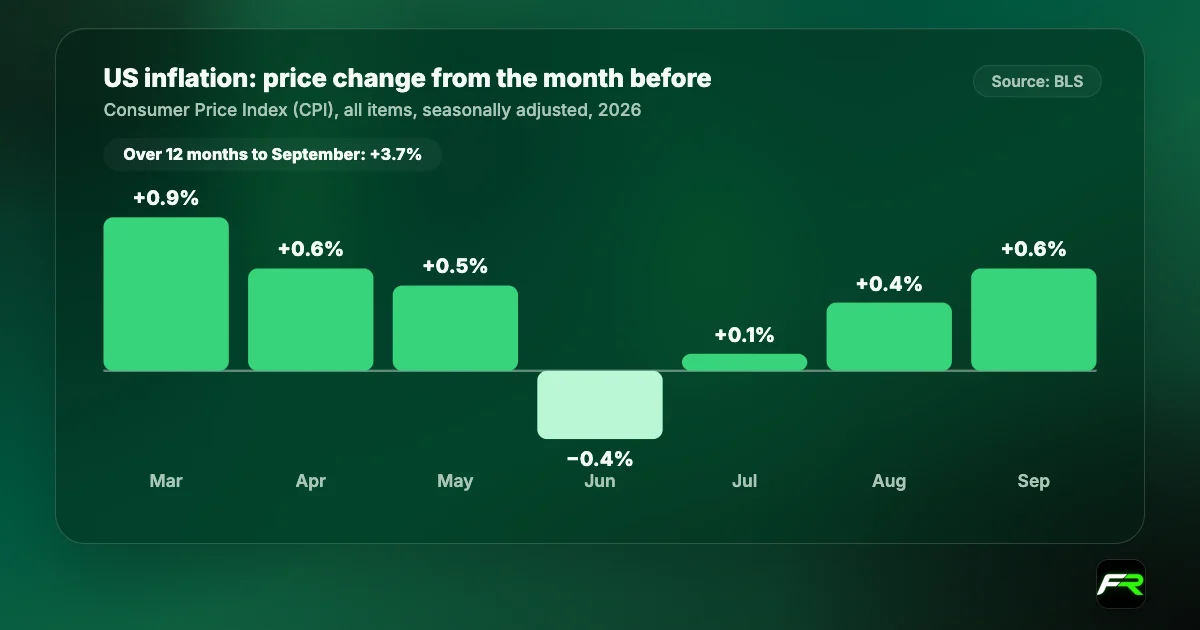
Energy is the common worry. According to the ONS, electricity and gas wholesale prices remain more than double their level of a year earlier, and motor fuel prices have kept rising. In late September, 73% of businesses reported some concern about fuel prices, and 72% about energy prices, the highest share since that question was introduced in March 2026. In accommodation and food services, the share concerned about energy reached 91%.
That backdrop matters because it squeezes households and firms at the same time as it lifts inflation. The ONS will publish September retail sales for Great Britain on 23 October, which will show whether the weaker footfall turned into weaker spending.
What it means for the pound and the Bank of England
The Bank of England held Bank Rate at 3.75% on 17 September, with six members voting to hold and three wanting a change. Its next decision is due on 5 November. August's GDP figure is unlikely to settle that debate on its own. A 0.7% three-month growth rate is solid for the UK, which reduces the case for urgent support, while a flat month for services and weak September indicators argue that momentum is fading.
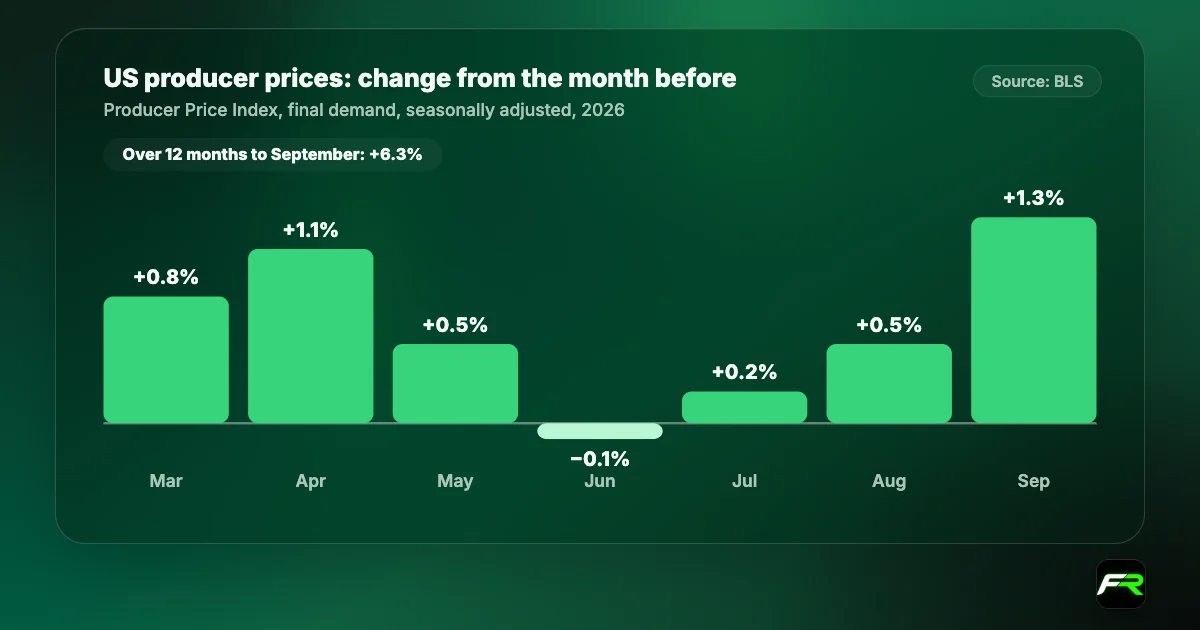
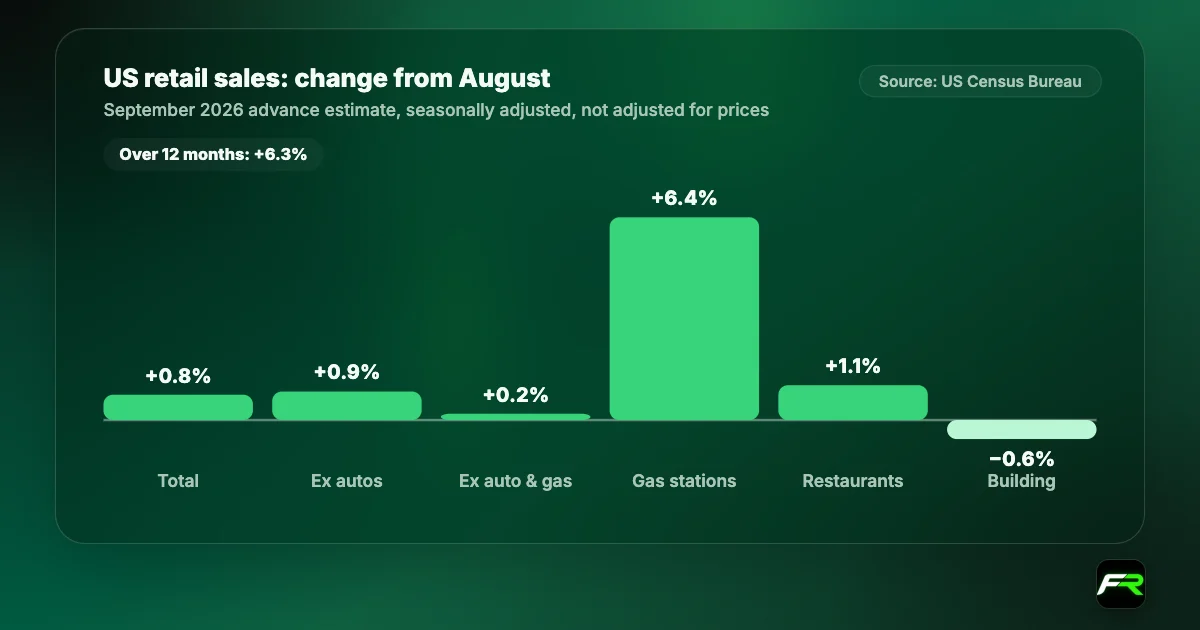
Currency traders largely shrugged. GBP/USD moved only a few pips in the hour of the release and drifted higher later in the day as the US dollar softened after US producer price and retail data. The pair's range on Thursday was 1.3224 to 1.3279. Our reading is that sterling is taking its lead from US yields more than from UK data at the moment, which can change quickly once the Bank of England meeting comes into view.
For the pound, the next UK releases are worth more attention than August GDP: September retail sales on 23 October and, after the Bank of England decision, September GDP on 12 November.
How to trade GBP/USD around UK data
- Check whether the dollar or the pound is driving the move. On Thursday, GBP/USD rose with EUR/USD, a sign that the dollar side mattered more.
- Look at the three-month figures as well as the monthly one. The ONS itself treats three-month growth as the steadier guide.
- Plan around 5 November. A Bank of England decision with a split vote can move sterling sharply, so reduce size into it.
- Use the economic calendar for UK release times; ONS figures come out at 07:00 UK time.
- Size positions with the position size calculator so a single loss stays within 1% to 2% of your account.
Say you buy GBP/USD at 1.3280 with a stop below Thursday's low at 1.3220, a 60-pip risk. A mini lot of 10,000 units is worth about $1 per pip, so the stop risks about $60. With a $5,000 account and a 1% risk limit of $50, that trade is too large: about 8,000 units keeps the loss near $48 if the stop is hit.
Our daily GBP/USD analysis carries today's levels and trade plan. US data from the same day is covered in our PPI story.
Sterling can move sharply around UK data and Bank of England decisions. Leverage magnifies losses as well as gains, so trade only with money you can afford to lose.
GDP figures, sector detail, the September indicators and the next release dates are from the Office for National Statistics. The Bank Rate decision and meeting date are from the Bank of England. GBP/USD levels are market data built from hourly bars and differ slightly between providers. The interpretation for the pound is FX Recap's own. This is news, not investment advice.
Frequently asked
How much did the UK economy grow in August 2026?
Monthly GDP grew 0.1% in August 2026, according to the ONS, after 0.4% growth in both July and June. Over the three months to August, GDP rose 0.7%.
Which sectors grew in August 2026?
Production grew 0.8%, led by a 1.2% rise in manufacturing and a 5.1% jump in pharmaceuticals. Services showed no growth and construction fell 0.2%.
How did the pound react to UK GDP?
Very little. GBP/USD was near 1.3240 at the release and ended the UTC day at 1.3271, helped later by a softer US dollar. It traded near 1.3281 early on 16 October.
When is the next UK GDP release?
The ONS will publish September GDP on 12 November 2026. Before that, the Bank of England announces its next rate decision on 5 November.
Sources: Office for National Statistics: GDP monthly estimate, UK: August 2026 · Bank of England: Bank Rate and Monetary Policy Committee dates
The team behind this guide
Researched, checked and approved by five forex specialists
Every guide is written, fact-checked and edited before it goes live, and updated when the facts change. Spotted an error? Tell us.