IC Markets

 3:09
 2:39
 2:10
 2:18
 3:43
 8:42





































Bank of Japan Holds at 1.25% in an 8-1 Vote as One Member Pushes for 1.5%
Takata Hajime said the bank should move faster toward neutral. The board also more than doubled the pace of its ETF sales from January.
 WriterAbir KhanWriterWrites the guides · checks every figure against primary sources View profileAbout Abir →

 Market analysisTanbir Habib RiyadForex & Crypto AnalystForex and crypto analyst · technical and fundamental analysis View profileAbout Tanbir →

 Fact-checking & riskJannatul FerdaushFact-Checker & Risk AnalystFact-checks every figure · risk analysis · Applied Statistics, University of Dhaka View profileAbout Jannatul →

 Trading reviewJowel RanaCo-Founder & Forex TraderCo-founder · forex trader · reviews guides from a trader's view View profileAbout Jowel →

 Final approvalRanjan NiskrityFounder, Owner & Forex TraderFounder and owner · forex trader · signs off every guide View profileAbout Ranjan →

The Bank of Japan kept its short-term policy rate unchanged on Friday 30 October. It will continue to encourage the uncollateralised overnight call rate “to remain at around 1.25 percent,” the Policy Board said in its statement on monetary policy. Six weeks ago the bank raised the rate from around 1.0%, its second rise this year, and our BoJ preview set out why a pause was the most likely result this time.
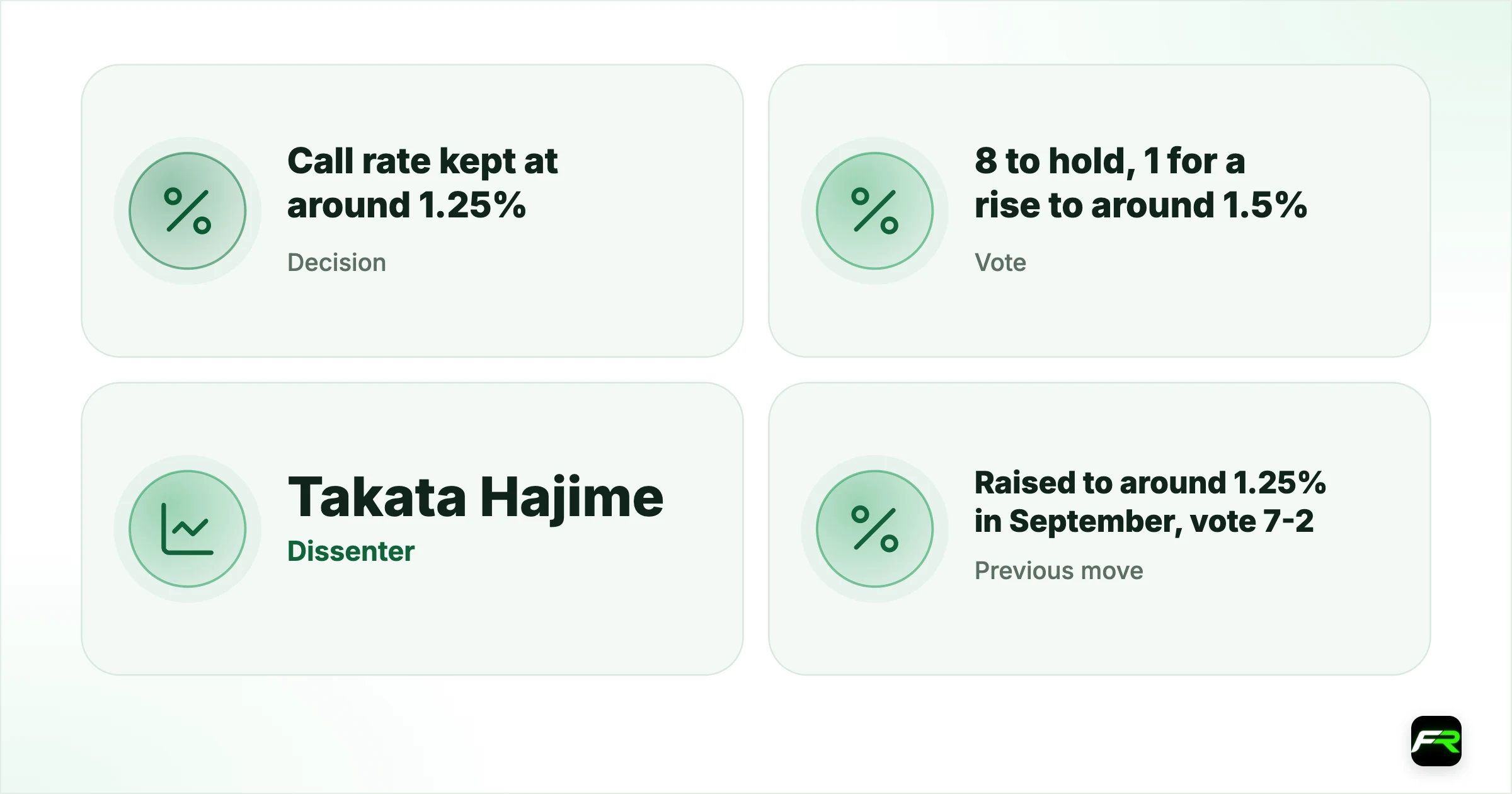
Not every member agreed. The vote was 8 to 1, and the single dissenter wanted more tightening. Board member Takata Hajime proposed lifting the target to around 1.5%, arguing that underlying inflation has reached the 2% goal and the bank must now move faster toward a neutral rate. His proposal was defeated by a majority vote.
The board also decided, unanimously, to speed up the sale of its exchange-traded fund holdings from January 2027. For yen traders the headline is a hawkish hold: no move today, a dissent for a hike, and new forecasts that keep inflation above 2% through next year.
| Decision | Call rate kept at around 1.25% |
|---|---|
| Vote | 8 to hold, 1 for a rise to around 1.5% |
| Dissenter | Takata Hajime |
| Previous move | Raised to around 1.25% in September, vote 7-2 |
| ETF sales from January 2027 | About ¥860 billion a year (book value), up from ¥330 billion |
| Core CPI forecast, FY2026 / FY2027 | 2.5% / 2.6% (board median) |
| Real GDP forecast, FY2026 / FY2027 | 0.7% / 0.7% (board median) |
| Next decision | 18 December 2026 |
What the BoJ decided
Eight members backed the hold: Governor Ueda Kazuo, Deputy Governors Himino Ryozo and Uchida Shinichi, and board members Tamura Naoki, Koeda Junko, Masu Kazuyuki, Asada Toichiro and Sato Ayano. Asada and Sato are worth noting, because both voted against the September rise. Neither proposed a cut this time, so the whole board now backs a rate of at least 1.25%.
Takata's reasoning, as summarised in the statement, is that “the situation had shifted to a new phase” with underlying inflation at target. In that phase, he argued, the bank needs “to step up the pace of bringing the policy interest rate closer to the neutral interest rate so that it could make nimble responses.” A dissent for a hike one meeting after a rise shows that at least one member wants a quicker path than the majority.
The statement itself gives no date for the next move, as is usual for the BoJ. Governor Ueda normally explains the decision at a press conference on the same afternoon, and the Summary of Opinions from this meeting will show how widely Takata's view is shared.
Faster ETF sales from January
The bank began selling the ETFs it bought during years of easing in January 2026, at about ¥330 billion a year on a book value basis, about 0.05% of stock market trading value. It says those sales have gone smoothly “while avoiding a major impact on the market,” and that trading value has grown. From January 2027 it will sell about ¥860 billion a year at book value, about 0.1% of trading value.
At market prices the new pace is about ¥2,460 billion a year, the bank estimates, using the market-to-book ratio of the ETFs sold since January. Its reference paper says the change cuts the time needed to finish the sales from about 112 years to about 43 years. Sales of real estate investment trusts stay at about ¥5 billion a year, and the bank keeps the option to adjust or suspend sales if markets become unstable.
For currency traders this is a slow-moving change. It shrinks the bank's balance sheet a little faster and confirms that the BoJ keeps unwinding its emergency tools, but at about 0.1% of trading value it is not large enough to move the yen by itself.
New forecasts: inflation above 2% into 2027
The quarterly Outlook Report came with the decision. The board's median forecast for core consumer prices, which exclude fresh food, is 2.5% for the fiscal year to March 2027, unchanged from July, and 2.6% for fiscal 2027, up 0.2 point. For fiscal 2028 it is 2.0%. On a narrower measure that also leaves out energy, the medians are 2.4%, 2.7% and 2.3%.
Growth forecasts are modest: 0.7% for fiscal 2026, 0.7% for fiscal 2027 and 0.8% for fiscal 2028. The bank says the economy should keep growing moderately, “albeit at a decelerated rate,” as energy and raw material costs weigh, with AI-related demand, wage rises and government measures as supports.
Its risk assessment leans hawkish. Risks to activity are “generally balanced,” but risks to prices are “skewed to the upside.” The report warns that medium- to long-term inflation expectations could rise and underlying inflation could move above 2%, because firms are more willing to raise wages and prices. It expects inflation to “accelerate to a level clearly above 2 percent” in the first half of the projection period, driven by crude oil, semiconductor prices and the weaker yen. The forecasts leave out the proposed cut in the consumption tax on food and beverages.
Those numbers fit recent data. Japan's core inflation rose to 2.1% in September from 1.7% in August, and the measure excluding fresh food and energy reached 2.4%, as our Japan CPI story reported from the Statistics Bureau release.
Where the yen stands
USD/JPY, derived from ECB euro reference rates, was 158.06 on Thursday 29 October, up from 156.80 on 23 October. That figure was set the day before the decision, so it does not include any reaction. Over the past 60 trading days the highest reference rate was 160.16. The live price on our analysis page updates in real time and will differ from these daily figures.
Much of the yen's weakness comes from the policy gap. With the Fed's target range at 3.75% to 4.00% after its 28 October hold, against 1.25% in Japan, holding dollars still pays far more than holding yen. A BoJ that keeps rates on hold does little to narrow that gap, even with a hawkish dissent.
What it means for traders
A hold that keeps the door open tends to cap yen strength in the short term, while the upside inflation risks give the BoJ room to move again. Key dates to mark:
- Governor Ueda's press conference comments, published by the BoJ, for any hint about December or January.
- The Summary of Opinions for this meeting, which the BoJ usually releases about two weeks later. More members echoing Takata would raise the odds of a December move.
- Japan's Ministry of Finance monthly figures on currency intervention. Its latest release showed no intervention between 27 August and 28 September.
- The next BoJ decision on 18 December, then 22 January 2027 with a fresh Outlook Report.
- US data and Fed speeches, which drive the dollar side of USD/JPY at least as much as Tokyo does.
Suppose you sell USD/JPY at 158.00 after the hold, betting that upside inflation risks will lift expectations of a December BoJ rise, with a stop at 158.80, 80 pips above. On a $4,000 account with a 1% risk limit, you can lose $40. At 158 yen per dollar, one pip on 10,000 units is worth about $0.63, so 80 pips is about $50 on that size; 8,000 units keeps the loss near $40. Our <a href="/position-size-calculator">position size calculator</a> does the sums for you.
Daily levels are on our USD/JPY analysis page, and all central bank dates are on the economic calendar.
The yen can move sharply on central bank news and on any sign of official intervention, and prices can gap past stop orders. Leverage magnifies losses as well as gains, so trade only with money you can afford to lose.
The decision, vote and Takata Hajime's proposal come from the Bank of Japan's Statement on Monetary Policy of 30 October 2026. Forecasts come from the bank's October 2026 Outlook Report summary, and ETF figures from its reference paper on ETF sales. Exchange rates are derived from ECB euro reference rates. This is news, not investment advice.
Frequently asked
Did the Bank of Japan raise rates in October 2026?
No. On 30 October 2026 the BoJ kept the overnight call rate at around 1.25%. The vote was 8 to 1, with Takata Hajime proposing a rise to around 1.5%.
Why did Takata Hajime dissent?
According to the BoJ statement, he argued that underlying inflation has reached the 2% target and that the bank needs to move its rate closer to neutral more quickly, so it can respond nimbly.
What did the BoJ change about ETF sales?
From January 2027 the bank will sell its ETF holdings at about ¥860 billion a year on a book value basis, up from about ¥330 billion. That is about 0.1% of stock market trading value.
When is the next Bank of Japan decision?
The next decision is on 18 December 2026. The meeting after that, on 22 January 2027, comes with a new Outlook Report.
Sources: Bank of Japan: Statement on Monetary Policy, 30 October 2026 · Bank of Japan: Outlook Report summary, October 2026 · Bank of Japan: change in the pace of ETF sales, October 2026 · European Central Bank: euro foreign exchange reference rates · Bank of Japan: Statement on Monetary Policy, 18 September 2026
The team behind this guide
Researched, checked and approved by five forex specialists
Every guide is written, fact-checked and edited before it goes live, and updated when the facts change. Spotted an error? Tell us.