IC Markets

 3:09
 2:39
 2:10
 2:18
 3:43
 8:42




































US Jobs Report Today: After 29,000 in September, What October Payrolls Mean for the Dollar
Payroll growth slowed to 29,000 in September while job openings rose to 7.5 million. How to read the 13:30 UTC release and the levels on EUR/USD.
 WriterAbir KhanWriterWrites the guides · checks every figure against primary sources View profileAbout Abir →

 Market analysisTanbir Habib RiyadForex & Crypto AnalystForex and crypto analyst · technical and fundamental analysis View profileAbout Tanbir →

 Fact-checking & riskJannatul FerdaushFact-Checker & Risk AnalystFact-checks every figure · risk analysis · Applied Statistics, University of Dhaka View profileAbout Jannatul →

 Trading reviewJowel RanaForex TraderForex trader · reviews guides from a trader's view View profileAbout Jowel →

 Final approvalRanjan N. MondolForex TraderForex trader · signs off every guide View profileAbout Ranjan →

The US Bureau of Labor Statistics publishes the October employment report today, Friday 6 November, at 08:30 New York time. With US clocks back on standard time since 1 November, that is 13:30 UTC. It is one of two jobs reports the Federal Reserve will see before its 9 December decision; the November figures follow on 4 December.
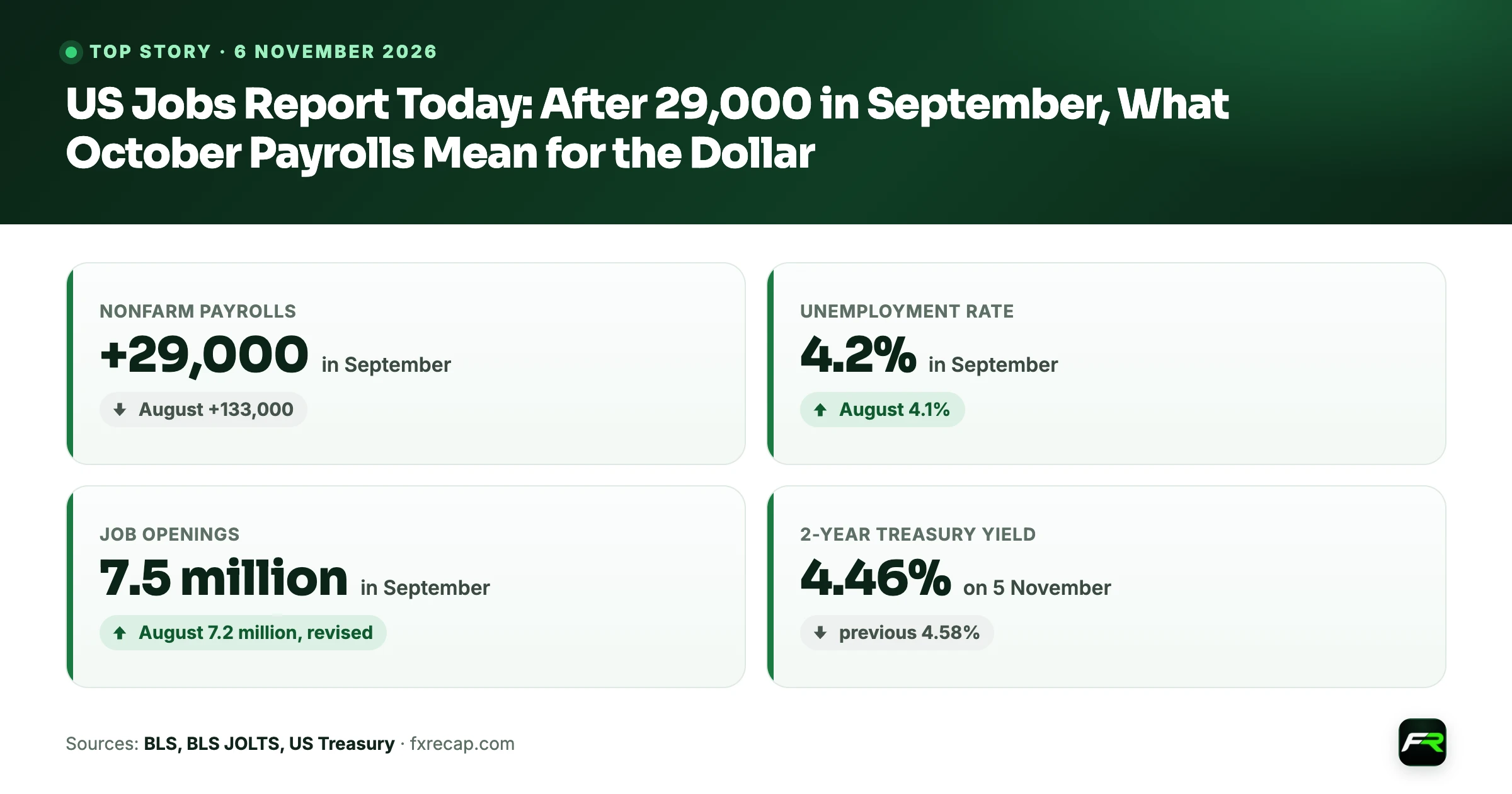
The bar to clear looks low. Nonfarm payrolls rose by just 29,000 in September, below the 45,000 average of the previous twelve months, and revisions cut July and August by a combined 60,000. Unemployment was 4.2%. Other data since then has been firmer: job openings rose to 7.5 million in September and the Fed described the economy as expanding at a strong pace.
Bond markets moved before the report. The 2-year Treasury yield fell to 4.46% on Thursday from 4.58% a day earlier, according to the Treasury's daily par yield curve, a large one-day drop for the maturity most closely tied to Fed expectations. Treasury does not give a reason, and we do not guess one, but it means rates traders arrive at the release less hawkish than they were on Wednesday.
| Nonfarm payrolls (BLS) | +29,000 in September (August +133,000) |
|---|---|
| Unemployment rate (BLS) | 4.2% in September (August 4.1%) |
| Job openings (BLS JOLTS) | 7.5 million in September (August 7.2 million, revised) |
| 2-year Treasury yield (US Treasury) | 4.46% on 5 November (previous 4.58%) |
Where the jobs market stood in September
September's report was soft but not alarming. Employment in every major industry “changed little,” the BLS said. Health care added 17,000 jobs, a slower pace than its twelve-month average of 33,000. Construction added 11,000 and manufacturing 9,000, leaving factory employment 72,000 above its recent low in December 2025. Financial activities lost 7,000 and are down 129,000 from a peak in May 2025.
The household survey was steadier. Unemployment, at 4.2%, has stayed between 4.1% and 4.3% since March. About 7.1 million people were unemployed. Labour force participation held at 61.8% and the share of the population with a job at 59.2%, both little changed since January.
Pay growth cooled. Average hourly earnings for private-sector workers rose 5 cents, or 0.1%, to $37.81, and were 3.0% higher than a year earlier. The average workweek stayed at 34.4 hours. Slower wage growth matters to the Fed because it lowers the risk that higher energy prices feed into a wage-price spiral.
What the job openings data added
The Job Openings and Labor Turnover Survey, released on Tuesday 3 November, covers September and points to a market that is not cracking. Openings were little changed at 7.5 million, a rate of 4.5%, and August was revised up by 111,000 to 7.2 million. Hires were 5.4 million.
Quits rose to 3.4 million, with the quits rate at 2.1%. Over the year they increased by 375,000. Workers tend to quit more when they are confident of finding another job, so a rising count is a mild positive. Layoffs and discharges were little changed at 1.6 million, a rate of 1.0%, which is low by historical standards.
This is the tension the October report has to resolve. Payroll growth is slow, but layoffs are low and openings are steady, so firms seem to be hiring less rather than cutting staff. A rebound in payrolls would make September look like a pause; another figure near zero would make it look like a trend.
Why the Fed cares about this report
The Fed held its target range at 3.75% to 4.00% on 28 October, with two officials voting for a rise. Its statement said job gains “have kept pace with the workforce” and that unemployment “has changed little,” while inflation “remains elevated.” Chair Kevin Warsh called the labour market “quite positive” at his press conference.
That framing makes the jobs report a test of the hawks' case. If hiring is healthy and pay picks up, the argument for a December rise gets stronger. A weak report with rising unemployment would support the ten members who chose to wait. The Fed meets on 9 December, and the November jobs report on 4 December will also be on the table, so one month of data is unlikely to settle the question.
How to read the release
- Start with payrolls and revisions together. A strong October number paired with large downward revisions to August and September can leave the three-month picture unchanged.
- Check the unemployment rate against its 4.1% to 4.3% range. A move to 4.4% or higher would break a pattern that has held since March.
- Look at average hourly earnings. Monthly pay growth back at 0.3% or more would worry an inflation-focused Fed more than the headline jobs count.
- Watch the 2-year yield. It reacts to the jobs data within seconds, and the dollar usually follows it.
A useful rule on jobs days is to wait for the first five minutes to pass. Spreads widen around 13:30 UTC and the first spike often reverses once the full report, including revisions and wages, has been read.
Gold reacts to the same mix. A soft report that pulls yields lower tends to help it, because the metal pays no interest; a strong one does the opposite. Spot gold was about $4,046 at 03:58 UTC on Friday (gold-api.com), down from about $4,138 a day earlier, so it arrives at the release after a sizeable fall.
EUR/USD levels into the report
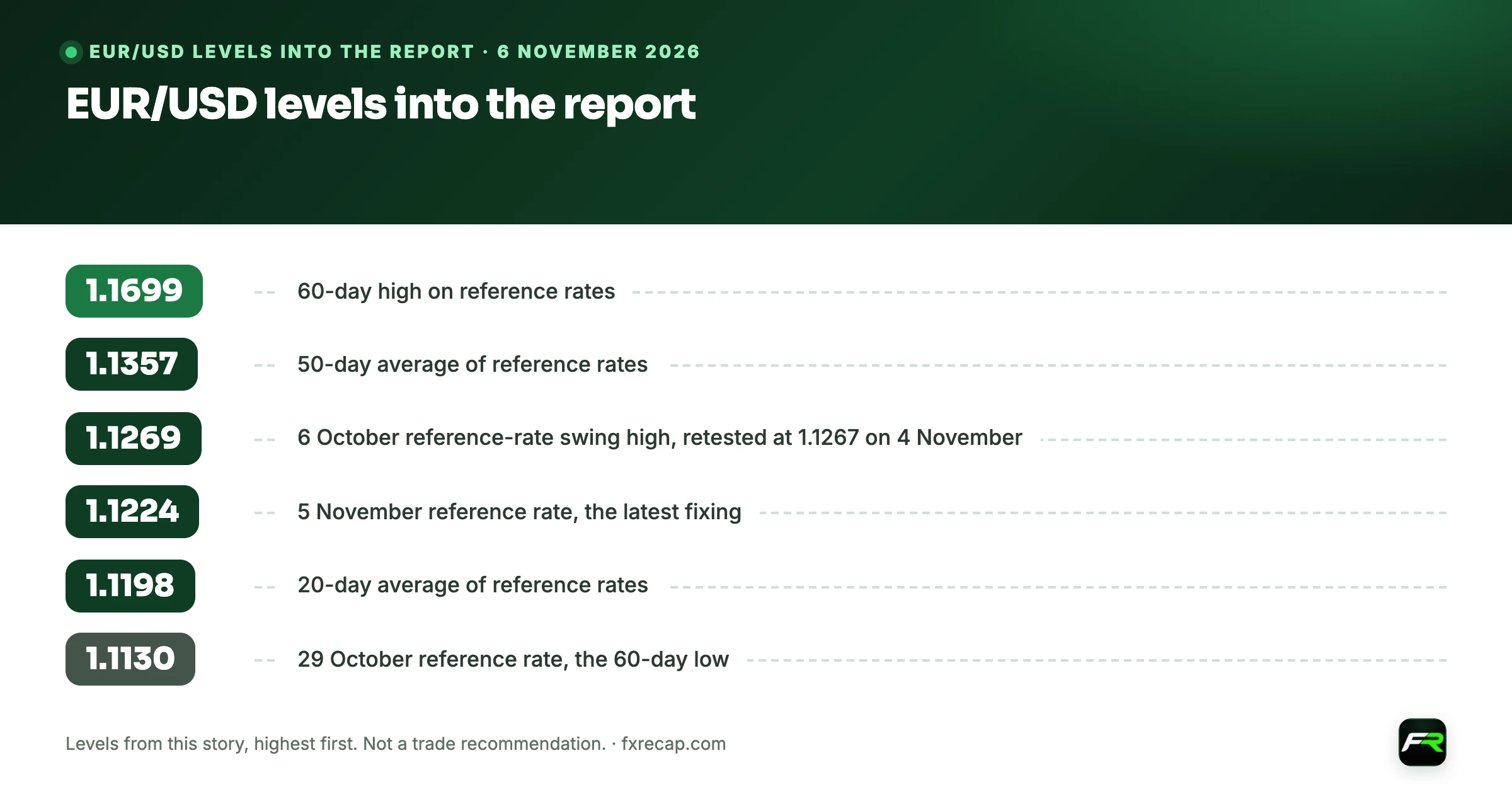
These levels use ECB euro reference rates, set once a day at about 13:15 UTC, a quarter of an hour before the jobs figures. They are not intraday highs or lows. Today's fixing will come out before the BLS release, so it will not reflect the report; our analysis page shows the live price.
| Level | Why it matters |
|---|---|
| 1.1699 | 60-day high on reference rates |
| 1.1357 | 50-day average of reference rates |
| 1.1269 | 6 October reference-rate swing high, retested at 1.1267 on 4 November |
| 1.1224 | 5 November reference rate, the latest fixing |
| 1.1198 | 20-day average of reference rates |
| 1.1130 | 29 October reference rate, the 60-day low |
EUR/USD has bounced from 1.1130 on 29 October but stalled at the 1.1267 to 1.1269 area twice. Its 14-day RSI on reference rates is about 48, neither stretched nor oversold. A weak jobs report that pulls US yields lower would give the euro another attempt at that ceiling; a strong one could send the pair back towards the 20-day average at 1.1198 and then the 60-day low. USD/JPY, at 158.46 on Thursday's reference rates, tends to follow the 2-year yield even more closely.
What it means for traders
- Size down into 13:30 UTC. The jobs report regularly moves major pairs by more than a normal day's range within minutes.
- Place stops beyond levels that matter, not at round numbers, and accept that they can fill late.
- Check gold too. A sharp move in US yields after the data usually shows up in the metal within minutes.
- Follow the live price on our EUR/USD analysis and check the time in your own zone on the economic calendar.
Say you plan to sell EUR/USD at 1.1220 if the report is strong, with a stop at 1.1270, 50 pips away just above the swing high. On a $3,000 account risking 1%, your maximum loss is $30, so each pip can be worth $0.60, about 6,000 units. If the price jumps and the stop fills 30 pips late, the loss becomes $48. Plan for that slippage before the release using our <a href="/position-size-calculator">position size calculator</a>.
Jobs reports are among the most volatile events of the month, and prices can gap past stop orders. Leverage magnifies losses as well as gains, so only trade money you can afford to lose. This article is news and education, not a recommendation to buy or sell.
Release time, September payrolls, unemployment and earnings are from the US Bureau of Labor Statistics; job openings and turnover are from its JOLTS release of 3 November. Fed wording is from the 28 October FOMC statement and press conference. Yields are Treasury par yields. EUR/USD and USD/JPY are ECB reference rates or derived from them; spot gold is from gold-api.com.
Cite this guide
FX Recap, "US Jobs Report Today: After 29,000 in September, What October Payrolls Mean for the Dollar", updated 6 November 2026, https://fxrecap.com/forex-news/top-stories/us-jobs-report-october-2026-preview
Free to quote with a link. Journalists: data and comment in our press room.
Frequently asked
What time is the US jobs report today?
The Bureau of Labor Statistics releases the October 2026 employment report at 08:30 New York time on Friday 6 November, which is 13:30 UTC.
How many jobs did the US add in September 2026?
Nonfarm payrolls rose by 29,000 in September, and the unemployment rate was 4.2%. Revisions lowered July to a fall of 10,000 and August to a gain of 133,000.
How many job openings were there in September?
According to the BLS JOLTS release of 3 November, job openings were 7.5 million in September, a rate of 4.5%, and August was revised up to 7.2 million.
When is the next Fed decision?
The Federal Reserve's next decision is on 9 December 2026. The target range is 3.75% to 4.00% after the 28 October hold.
Sources: US Bureau of Labor Statistics: Employment Situation, September 2026 · US Bureau of Labor Statistics: Job Openings and Labor Turnover, September 2026 · US Treasury: daily par yield curve rates · ECB: euro foreign exchange reference rates · US Bureau of Labor Statistics: Employment Situation release schedule · Federal Reserve: FOMC statement, 28 October 2026
The team behind this guide
Researched, checked and approved by five forex specialists
Every guide is written, fact-checked and edited before it goes live, and updated when the facts change. Spotted an error? Tell us.