IC Markets

 3:09
 2:39
 2:10
 2:18
 3:43
 8:42




































Forex Week Ahead: US Inflation on Tuesday, UK Third-Quarter GDP on Thursday and US Producer Prices Friday
After a strong jobs report, October US consumer prices could decide whether the Fed raises rates in December. Times, latest readings and what to watch.
 WriterAbir KhanWriterWrites the guides · checks every figure against primary sources View profileAbout Abir →

 Market analysisTanbir Habib RiyadForex & Crypto AnalystForex and crypto analyst · technical and fundamental analysis View profileAbout Tanbir →

 Fact-checking & riskJannatul FerdaushFact-Checker & Risk AnalystFact-checks every figure · risk analysis · Applied Statistics, University of Dhaka View profileAbout Jannatul →

 Trading reviewJowel RanaForex TraderForex trader · reviews guides from a trader's view View profileAbout Jowel →

 Final approvalRanjan N. MondolForex TraderForex trader · signs off every guide View profileAbout Ranjan →

Next week's calendar is short but heavy. The US publishes consumer prices for October on Tuesday, Britain reports its first estimate of third-quarter growth on Thursday, and US producer prices follow on Friday. All three land in the gap between last week's central bank decisions and the next round in December, so each one will shape what markets expect from the Federal Reserve and the Bank of England.
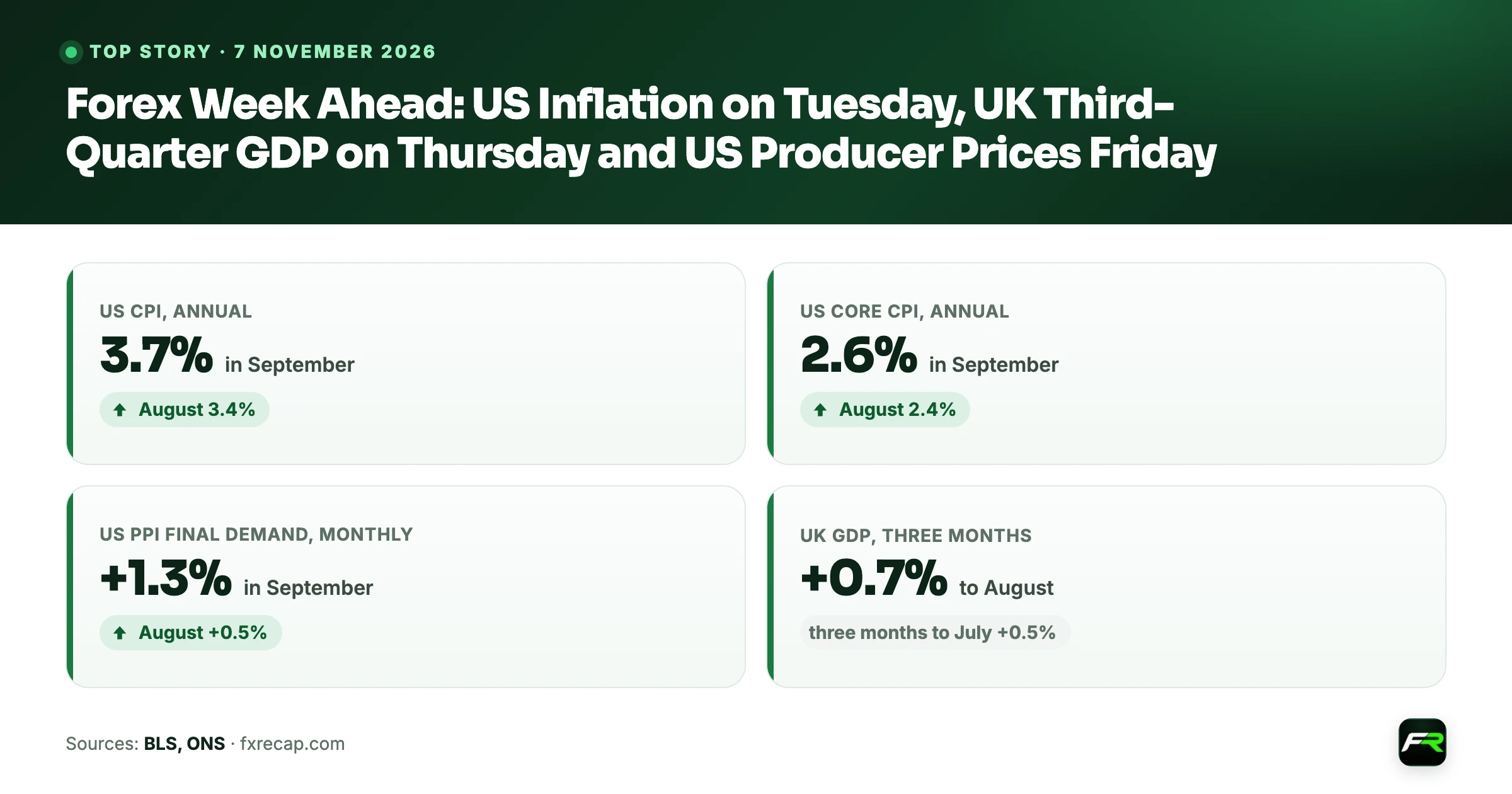
The backdrop makes the US figure the main event. Payrolls rose 165,000 in October and pay climbed 0.4%, the Bureau of Labor Statistics said on Friday, removing one argument for the Fed to keep waiting. Inflation is the other half of that debate, and September's annual rate of 3.7% was up from 3.4% a month earlier.
| US CPI, annual (BLS) | 3.7% in September (August 3.4%) |
|---|---|
| US core CPI, annual (BLS) | 2.6% in September (August 2.4%) |
| US PPI final demand, monthly (BLS) | +1.3% in September (August +0.5%) |
| UK GDP, three months (ONS) | +0.7% to August (three months to July +0.5%) |
Tuesday: US consumer prices for October
The BLS releases the October Consumer Price Index on Tuesday 10 November at 08:30 New York time, 13:30 UTC. Real earnings, which compare pay with prices, come out at the same moment. Wednesday is Veterans Day, marked as a federal holiday on the BLS calendar, and no BLS releases are scheduled that day.
September's report was driven by fuel. Prices rose 0.6% on the month, and the BLS said gasoline, up 9.1%, accounted for more than half of that rise. Energy prices as a group were 20.4% higher than a year earlier. Food prices were flat on the month and shelter rose 0.4%.
Core inflation, which leaves out food and energy, is where the Fed looks for spillover. It rose 0.3% in both August and September, and its annual rate climbed to 2.6% from 2.4%. That is not alarming on its own, but it is moving in the wrong direction for a central bank that already has two members voting for a rise.
- Read the core monthly figure first. Another 0.3% or more, after a strong jobs report, would strengthen the case for a December rise.
- Then check energy. If gasoline eased in October, headline inflation could cool even while core stays firm, which gives mixed signals.
- Look at real earnings. With pay up 3.1% over a year and prices up 3.7% in September, workers have been losing ground; a narrower gap would support spending.
- Watch the 2-year Treasury yield, which closed at 4.51% on Friday. It is the quickest read of how the market changes its Fed view.
Thursday: UK growth for the third quarter
The Office for National Statistics publishes its first quarterly estimate of GDP for July to September on Thursday 12 November at 07:00 UK time, which is 07:00 UTC now that British clocks are on GMT. The monthly figure for September comes out at the same time, so traders will see the quarter and its final month together.
Most of the quarter is already known. Monthly GDP grew 0.4% in July and 0.1% in August, and the three months to August were 0.7% larger than the three months to May, the ONS said in October. Services carried the growth, up 0.9% over that period, while production fell 0.2% and construction 1.0%. September therefore decides whether the quarter as a whole looks solid or merely steady.
The Bank of England raised Bank Rate to 4% on 5 November by an 8 to 1 vote, citing higher energy costs and an inflation outlook near 5% by mid-2027. A strong GDP figure would make it easier for the Bank to keep tightening; a weak one would sharpen the worry that higher rates and energy bills are squeezing a slowing economy. Its next decision is on 17 December, and UK consumer prices for October arrive on 18 November.
For the pound, the reaction tends to be fast and short-lived unless the number is a real surprise. GBP/USD's derived European Central Bank (ECB) reference rate was 1.3385 on Friday, between its 20-day average of 1.3350 and the 1.3500 swing high of 4 November. A break of either level after the data would give a clearer sense of direction than the first minutes of trading.
Friday: US producer prices
The BLS publishes the October Producer Price Index on Friday 13 November at 08:30 New York time, 13:30 UTC. Producer prices measure what businesses receive for goods and services, so they can hint at what consumers will pay in the months ahead.
September's figures were striking. Final demand prices rose 1.3% on the month, the largest increase since March 2022, and were 6.3% higher than a year earlier. Goods prices jumped 2.6% and services 0.8%. The core measure, which strips out food, energy and trade services, rose 0.5% after 0.3% in August, and stands 5.0% above its level a year ago.
A second large rise in October would suggest the energy shock is still working its way through supply chains. Coming after Tuesday's consumer price figures, though, the PPI usually moves markets less, unless it points in a different direction from the CPI.
The latest readings at a glance
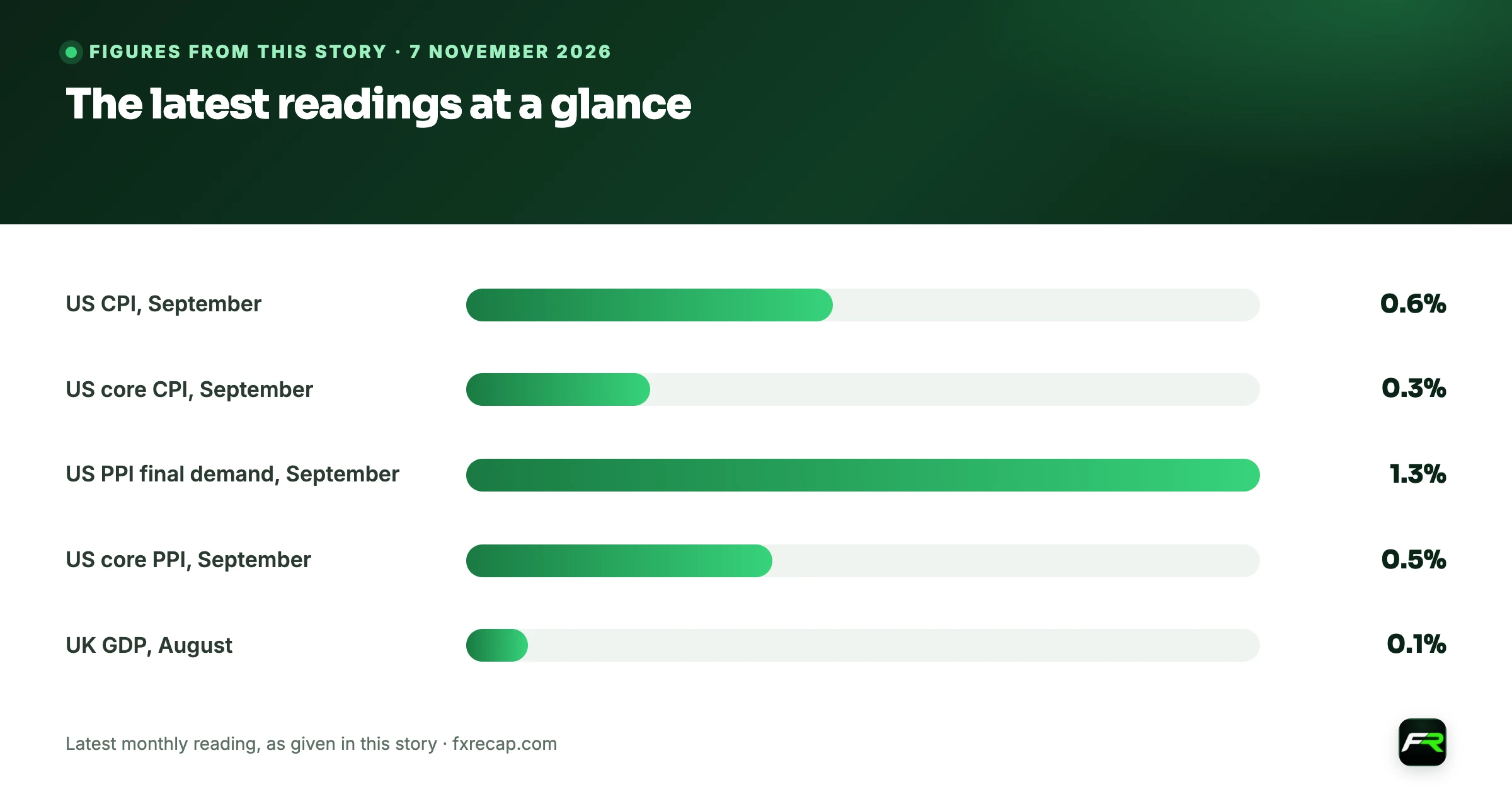
These are the most recent monthly figures for each release on next week's calendar, taken from the BLS and ONS bulletins. The new numbers will replace them.
| Release | Latest monthly reading |
|---|---|
| US CPI, September | 0.6% |
| US core CPI, September | 0.3% |
| US PPI final demand, September | 1.3% |
| US core PPI, September | 0.5% |
| UK GDP, August | 0.1% |
What it means for traders
- Mark the times in your own zone: Tuesday 13:30 UTC for US inflation, Thursday 07:00 UTC for UK GDP and Friday 13:30 UTC for US producer prices. Our economic calendar converts them for you.
- Expect the dollar to set the tone for the week. After Friday's jobs report, a firm CPI reading would add to the case for a December Fed rise; a soft one would push back against it.
- Trade the pound on Thursday with care. Spreads widen at 07:00 UTC, when liquidity is still thin, and the first move often reverses within the hour.
- Keep an eye on gold. It reacts to US yields, which are likely to move most on Tuesday. See our gold analysis for the levels we track.
- Use the GBP/USD analysis for the pound's levels and live price before and after the UK data.
Say you plan to buy GBP/USD if UK growth beats expectations, entering at 1.3400 with a stop at 1.3345, just under the 20-day average, 55 pips away. On a $2,500 account risking 1%, your maximum loss is $25, so each pip can be worth about $0.45, roughly 4,500 units. If thin early liquidity makes the stop fill 15 pips late, the loss grows to about $32. Run the numbers with our <a href="/position-size-calculator">position size calculator</a> before the release.
Risk note and sources
Inflation and growth releases can move prices sharply in seconds, and stop orders may fill at worse prices than planned. Leverage magnifies losses as well as gains, so only trade money you can afford to lose. This article is news and education, not a recommendation to buy or sell.
Release dates and times are from the BLS November 2026 release schedule and ONS release pages. September CPI and PPI figures are from the BLS; UK GDP figures are from the ONS monthly estimate for August 2026. Bank of England and Fed details are from their own statements. GBP/USD is derived from ECB reference rates; yields are Treasury par yields.
Cite this guide
FX Recap, "Forex Week Ahead: US Inflation on Tuesday, UK Third-Quarter GDP on Thursday and US Producer Prices Friday", updated 7 November 2026, https://fxrecap.com/forex-news/top-stories/forex-week-ahead-us-cpi-uk-gdp
Free to quote with a link. Journalists: data and comment in our press room.
Frequently asked
When is the US CPI report for October 2026?
The BLS publishes October's Consumer Price Index on Tuesday 10 November 2026 at 08:30 New York time, which is 13:30 UTC.
What was US inflation in September 2026?
Consumer prices rose 0.6% in September and 3.7% over the year, up from 3.4% in August. Core inflation was 2.6% annually, with a 0.3% monthly rise.
When is UK GDP for the third quarter released?
The ONS publishes its first quarterly estimate for July to September 2026, together with September's monthly GDP, on Thursday 12 November at 07:00 UK time.
When are the next Fed and Bank of England decisions?
The Federal Reserve decides on 9 December 2026 and the Bank of England on 17 December. Bank Rate is 4% after the 5 November rise; the Fed's range is 3.75% to 4.00%.
Sources: US Bureau of Labor Statistics: release schedule, November 2026 · US Bureau of Labor Statistics: Consumer Price Index, September 2026 · ONS: GDP first quarterly estimate, UK, July to September 2026 (release page) · US Bureau of Labor Statistics: Producer Price Indexes, September 2026 · ONS: GDP monthly estimate, UK, August 2026 · Bank of England: Monetary Policy Summary, November 2026 · US Bureau of Labor Statistics: Employment Situation, October 2026
The team behind this guide
Researched, checked and approved by five forex specialists
Every guide is written, fact-checked and edited before it goes live, and updated when the facts change. Spotted an error? Tell us.