IC Markets






































RBNZ Preview: Two Hikes to 2.75%. Will the Reserve Bank Raise the OCR Again on 28 October?
Inflation eased to 3.7% after the RBNZ's July and September rises, and its committee was split on the risks. What a hold or a third hike means for the kiwi.
 WriterAbir KhanWriterWrites the guides · checks every figure against primary sources View profileAbout Abir →

 Market analysisTanbir Habib RiyadForex & Crypto AnalystForex and crypto analyst · technical and fundamental analysis View profileAbout Tanbir →

 Fact-checking & riskJannatul FerdaushFact-Checker & Risk AnalystFact-checks every figure · risk analysis · Applied Statistics, University of Dhaka View profileAbout Jannatul →

 Trading reviewJowel RanaCo-Founder & Forex TraderCo-founder · forex trader · reviews guides from a trader's view View profileAbout Jowel →

 Final approvalRanjan NiskrityFounder, Owner & Forex TraderFounder and owner · forex trader · signs off every guide View profileAbout Ranjan →

The Reserve Bank of New Zealand publishes its next Official Cash Rate decision at 2pm on Wednesday 28 October, New Zealand time. That is 01:00 UTC on Wednesday, or 21:00 in New York on Tuesday evening. Its Monetary Policy Committee raised the OCR by 25 basis points in July and again in September, taking it to 2.75%, and this week's call is a Monetary Policy Review, the shorter format without a full set of new forecasts.
Timing makes this decision unusual for currency traders. Australia's statistics bureau releases its September consumer price figures 30 minutes earlier, at 00:30 UTC, so both antipodean currencies get a major test inside the same half hour. The Federal Reserve, the Bank of Canada and the European Central Bank all follow within two days.
The kiwi has been weak through the tightening. NZD/USD, derived from the ECB's daily euro reference rates, was 0.5827 on the day of the September rise and 0.5681 on Monday 26 October, a fall of about 2.5% even though New Zealand rates went up.
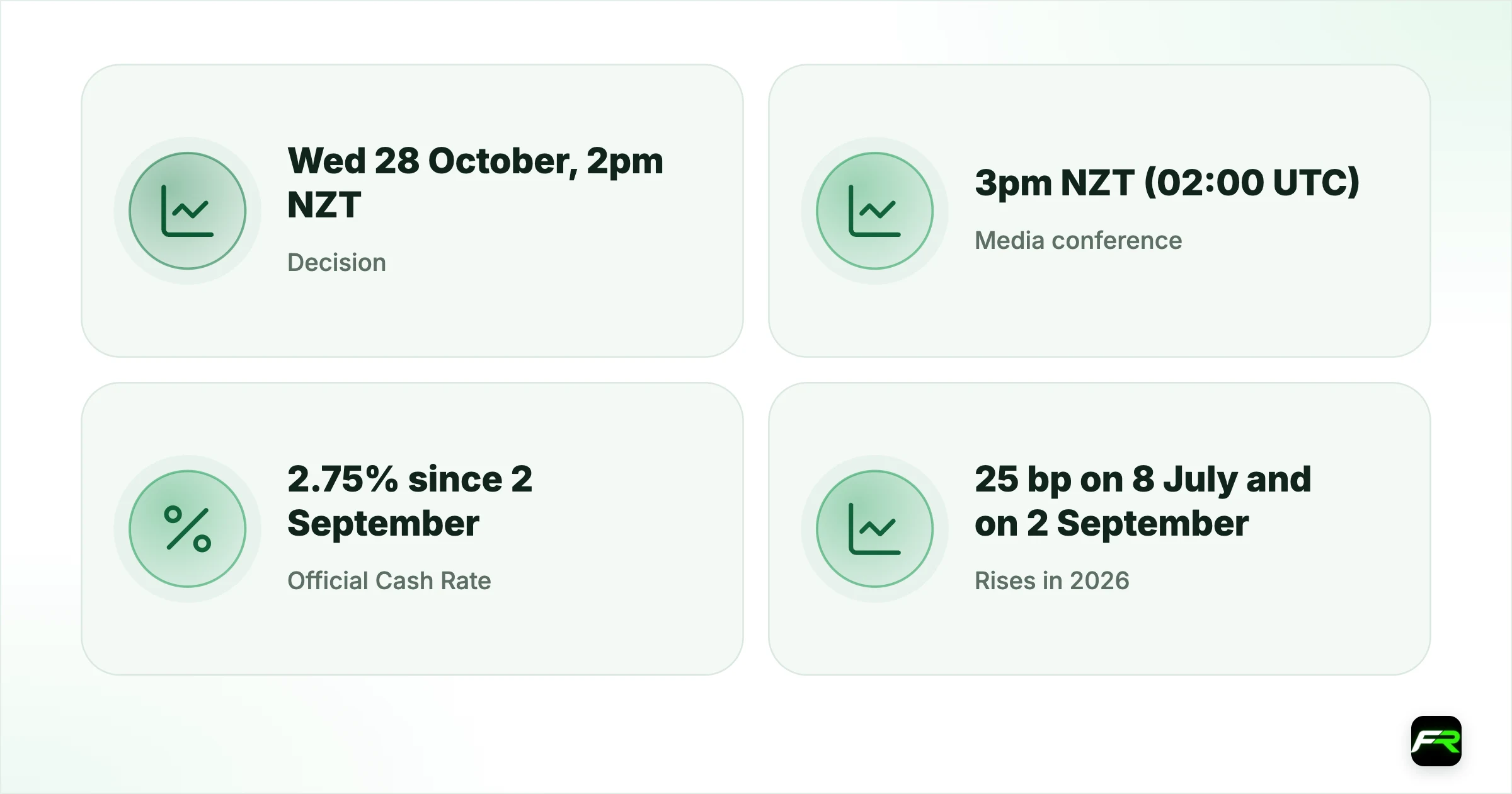
| Decision | Wed 28 October, 2pm NZT (01:00 UTC) |
|---|---|
| Media conference | 3pm NZT (02:00 UTC) |
| Official Cash Rate | 2.75% since 2 September |
| Rises in 2026 | 25 bp on 8 July and on 2 September |
| CPI, September quarter | 3.7% a year (June quarter 4.1%) |
| Target band | 1% to 3%, focus on the 2% midpoint |
| Next decision after this one | 9 December, with a full Monetary Policy Statement |
| NZD/USD reference rate | 0.5681 on 26 October (0.5827 on 2 September) |
What the RBNZ said when it raised rates in September
On 2 September the committee “reached consensus to increase the OCR by 25 basis points to 2.75 percent.” Its media release blamed the Middle East conflict for higher fuel prices and noted that inflation had climbed to 4.1% in the June quarter. Core inflation, expected wage growth and inflation expectations, it said, still pointed to inflation returning to the target band by mid-2027.
The key line for traders was the stated reason for moving. The committee judged that “gradually removing monetary stimulus is appropriate”, and added that the decision “reduces the risk that the OCR needs to increase by more later.” That is a central bank choosing to act early and in small steps rather than wait and catch up with bigger moves.
July's release set up the same path. When the OCR went from 2.25% to 2.50% on 8 July, the bank wrote that “some further reduction in monetary stimulus is likely to be required” to bring inflation back to 2%. Two rises later, the question for Wednesday is whether the committee thinks it has done enough for now.
A split committee on the inflation risks
The record of the September meeting shows a clear consensus on the decision but different views on what could go wrong. Four members, Hayley Gourley, Karen Silk, Prasanna Gai and Governor Anna Breman, “saw upside risks to inflation relative to the central projection.” They worried that more persistent energy and petrochemical prices could feed into how firms set prices, and that businesses could raise domestic prices by more than import costs justify.
Two members, Paul Conway and Carl Hansen, saw the risks to inflation as balanced. They shared the concern about price-setting but also pointed to weak house prices and cautious households, which could hold back spending and pull inflation down. All six agreed that the downside risks to activity were significant and that the recovery could stay uneven.
On the path ahead, the record says that, conditional on the central outlook, “members judged that the OCR may need to increase further.” It also stresses that “the future OCR path is not pre-determined” and that the committee's response to data “is not mechanical.” A majority leaning towards upside inflation risk, combined with explicit talk of more rises, is why a third move cannot be ruled out on Wednesday.
What has changed since September
The main new data point is inflation. Stats NZ reported on 22 October that consumer prices rose 3.7% in the year to the September quarter, down from 4.1%, as petrol prices fell 6.5% in the quarter. A measure excluding food, household energy and vehicle fuels rose 2.9% over the year, inside the target band, but 1.1% in the quarter alone, and non-tradeable inflation, the domestic part of the basket, was 3.3%. Our story on that release has the full breakdown.
That mix gives both camps something. The headline is moving the right way and fuel is falling out of the annual comparison, as the bank expected. Firm domestic prices and a fast quarterly rise in the ex-fuel measure fit the worry, voiced by the majority, that price-setting could keep inflation sticky.
The exchange rate is the other change. A weaker kiwi makes imports dearer, and in July the RBNZ itself noted that “a lower exchange rate could also add to medium-term inflation pressures.” NZD/USD has fallen from 0.5966 on 25 August to 0.5681 on 26 October on the ECB-derived rate, with a low of 0.5589 on 8 October.
Three outcomes and how the kiwi could react
The RBNZ gives no advance guidance on the decision itself, so the table below is our own framework for Wednesday, not a forecast or a statement by the bank.
| Outcome | What it would look like | Possible NZD reaction |
|---|---|---|
| Hold at 2.75%, door open | Pause to assess the effect of two rises, repeats that more may be needed | Modest; attention moves to Australian CPI and the Fed |
| Third rise to 3.00% | Another 25 bp, stress on price-setting and the weaker currency | Likely kiwi support, mostly against the Australian dollar |
| Hold, softer tone | Focus on weak households and the fall in headline inflation | Kiwi could extend its slide towards the 8 October low |
A pause would match the September wording that policy allows the committee “to observe and assess the effects of reduced monetary stimulus.” A third rise would follow the logic of acting early rather than late. A softer tone would surprise most after two hikes and could hit the currency hardest, because the kiwi has already fallen while rates rose.
Where NZD/USD and AUD/NZD stand
ECB euro reference rates give an official daily record of both pairs, derived as crosses. NZD/USD was 0.5966 on 25 August, 0.5827 on 2 September, 0.5589 on 8 October and 0.5681 on 26 October. AUD/NZD, which strips out the US dollar and isolates the gap between Australia and New Zealand, rose from 1.2265 on 2 September to 1.2366 on 26 October.
These are reference rates set around 14:15 CET each working day, not intraday highs or lows, and live prices will differ, especially at 01:00 UTC when liquidity in Asia is still thin.
What it means for traders
The 30 minutes between the Australian CPI at 00:30 UTC and the RBNZ at 01:00 UTC are the hard part. A strong Australian figure can lift AUD/NZD before the RBNZ speaks, and a hawkish RBNZ can reverse that move half an hour later.
- Read the first paragraph of the media release for whether the committee still says further rises may be needed. That sentence matters more than the decision if the OCR is unchanged.
- Look for any comment on the exchange rate. A weaker kiwi adding to inflation is a reason the bank has already given for tightening.
- Expect wide spreads in the Asian session. Market orders at 01:00 UTC can fill well away from the screen price.
- If you trade AUD/NZD, size for two events, not one. Both releases land inside the same half hour.
- Check the times in your own zone on our economic calendar.
Suppose you want to sell NZD/USD at 0.5680 if the RBNZ holds with a soft tone, with a stop 40 pips higher at 0.5720. On a $3,000 account with a 1% risk limit you can lose $30, so the position should be about 7,500 units, because each pip on that size is worth about 75 cents. If the spread widens to 4 pips at the release, your real risk is closer to 44 pips, so cut the size or wait for the media conference at 02:00 UTC. The <a href="/position-size-calculator">position size calculator</a> does the sums for you.
For the Australian side, read our Australian CPI preview and the AUD/USD analysis. Convert amounts with the currency converter.
Rate decisions can move currencies sharply in seconds, and prices can gap past stop orders, especially in thin Asian trading. Leverage magnifies losses as well as gains, so trade only with money you can afford to lose.
Rates, dates and quotations come from the RBNZ's Official Cash Rate page, its 28 October event page, its table of past decisions, and its media releases of 8 July and 2 September 2026, including the record of the September meeting. Inflation figures are from Stats NZ. Exchange rates are derived from ECB euro reference rates. The scenario table is FX Recap's own framework, not an RBNZ statement. This is news, not investment advice.
Frequently asked
When is the RBNZ's October 2026 OCR decision?
The Reserve Bank of New Zealand announces the Official Cash Rate at 2pm New Zealand time on Wednesday 28 October 2026, which is 01:00 UTC. It is a Monetary Policy Review, followed by an online media conference at 3pm.
What is New Zealand's OCR now?
The OCR is 2.75%. The RBNZ raised it by 25 basis points on 2 September 2026, after a 25 basis point rise from 2.25% to 2.50% on 8 July.
Will the RBNZ raise rates again?
The bank has not said. Its September record says members judged the OCR may need to increase further, conditional on the outlook, but also that the path is not pre-determined. Inflation eased to 3.7% in the September quarter.
How could the RBNZ decision affect the New Zealand dollar?
A third rise or a firm warning could support the kiwi, especially against the Australian dollar, while a softer tone could push NZD/USD back towards its 8 October level near 0.5589 on the ECB-derived rate. Australian CPI 30 minutes earlier can also move AUD/NZD.
Sources: Reserve Bank of New Zealand: OCR increased by 25 basis points to 2.75% (2 September 2026) · Reserve Bank of New Zealand: The official cash rate (OCR) · Stats NZ: Annual inflation at 3.7 percent in September 2026 · Reserve Bank of New Zealand: Monetary Policy Review and OCR October 2026 · Reserve Bank of New Zealand: OCR increased to 2.50% to return inflation to 2% (8 July 2026) · Reserve Bank of New Zealand: Past monetary policy decisions · European Central Bank: euro foreign exchange reference rates
The team behind this guide
Researched, checked and approved by five forex specialists
Every guide is written, fact-checked and edited before it goes live, and updated when the facts change. Spotted an error? Tell us.