IC Markets






































US 20-Year Bond Sale Clears at 5.469%, the Highest Since the Maturity Returned in 2020
Demand held up better than in September, but buyers still asked for the richest 20-year yield on record, keeping long rates high before the Fed meets.
 WriterAbir KhanWriterWrites the guides · checks every figure against primary sources View profileAbout Abir →

 Market analysisTanbir Habib RiyadForex & Crypto AnalystForex and crypto analyst · technical and fundamental analysis View profileAbout Tanbir →

 Fact-checking & riskJannatul FerdaushFact-Checker & Risk AnalystFact-checks every figure · risk analysis · Applied Statistics, University of Dhaka View profileAbout Jannatul →

 Trading reviewJowel RanaCo-Founder & Forex TraderCo-founder · forex trader · reviews guides from a trader's view View profileAbout Jowel →

 Final approvalRanjan NiskrityFounder, Owner & Forex TraderFounder and owner · forex trader · signs off every guide View profileAbout Ranjan →

The US Treasury sold $13 billion of 20-year bonds on Wednesday 21 October at a high yield of 5.469%, according to the auction results published on TreasuryDirect. That is the highest yield at any 20-year auction since the Treasury brought the maturity back in May 2020, above the 5.420% of the September sale and well above the 5.245% reached in October 2023. A year ago, in October 2025, the same auction cleared at 4.506%.
Demand was firmer than last month. Bids totalled $35.48 billion, a bid-to-cover ratio of 2.73 against 2.57 in September. Indirect bidders, a group that includes foreign central banks and other investors bidding through dealers, took 58.2% of the competitive bonds, up from 52.5%. Primary dealers, who must absorb whatever others do not buy, were left with only 10.3%, down from 16.9%.
Markets moved only a little. The 10-year Treasury yield rose to about 5.15% in the hour after the 17:00 UTC result, from about 5.11% before it, and USD/JPY ticked up to 158.30. EUR/USD dipped to 1.1226 from 1.1241 but was back near 1.1237 by the New York close. By 03:20 UTC on Thursday the dollar had softened, with EUR/USD near 1.1255 and USD/JPY near 157.73.
| Amount sold | $13 billion (reopening, matures 15 Aug 2046) |
|---|---|
| High yield | 5.469% (September: 5.420%) |
| Median yield | 5.415% |
| Bid-to-cover ratio | 2.73 (September: 2.57) |
| Indirect bidders | 58.2% of competitive awards (September: 52.5%) |
| Direct bidders | 31.6% (September: 30.7%) |
| Primary dealers | 10.3% (September: 16.9%) |
| 20-year par yield, 21 Oct | 5.47% (10-year: 5.13%) |
How the auction went
This was a reopening, meaning the Treasury sold more of an existing bond rather than a new one. The bond pays a 5.125% coupon and matures on 15 August 2046. Because buyers demanded a yield above that coupon, the bonds sold at a discount, at a price of about 95.85 per 100 of face value.
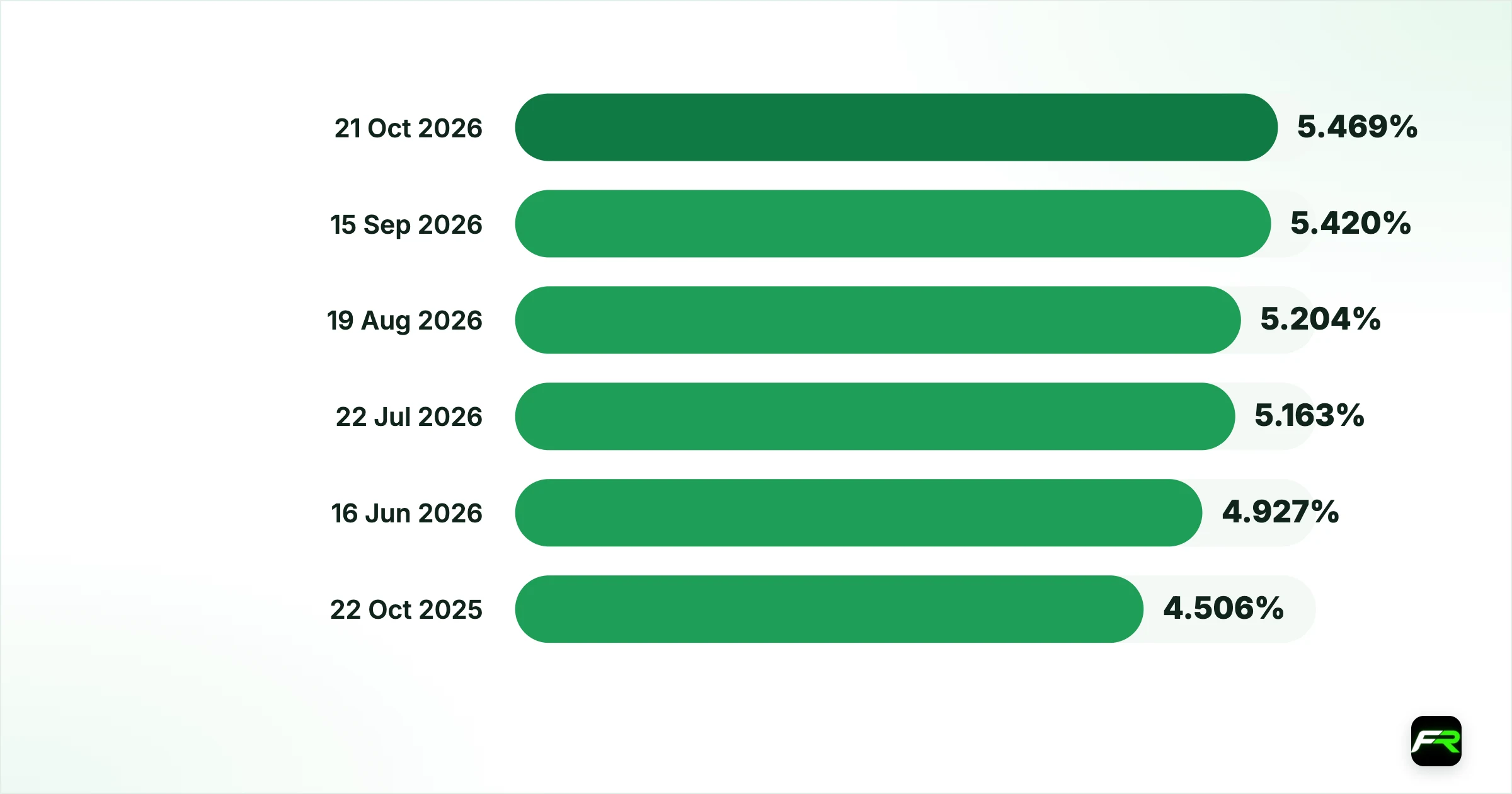
Treasury auctions use a single price. Every winning bidder pays the same price, set by the highest accepted yield, called the high yield or stop-out. Bids at exactly 5.469% received 60.05% of what they asked for, and the median accepted yield was 5.415%. A wide gap between the median and the high yield, as here, shows that some buyers were willing to accept much less, while the marginal buyer still needed a high rate.
The bidder mix is often read as a test of demand. Indirect buyers took $7.50 billion of the competitive bonds and direct buyers, who bid for their own accounts, took $4.08 billion. Primary dealers ended up with $1.32 billion, a small share by recent standards. investingLive reported that pricing needed a concession but that bidding was stronger in general, which fits the numbers.
| 20-year auction | High yield | Bid-to-cover |
|---|---|---|
| 21 Oct 2026 | 5.469% | 2.73 |
| 15 Sep 2026 | 5.420% | 2.57 |
| 19 Aug 2026 | 5.204% | 2.53 |
| 22 Jul 2026 | 5.163% | 2.64 |
| 16 Jun 2026 | 4.927% | 2.75 |
| 22 Oct 2025 | 4.506% | 2.73 |
Source: US Treasury, TreasuryDirect auction results for the 20-year bond. High yield is the stop-out yield at which all winning bids were filled.
Why long-dated yields are so high
The auction result fits a broader climb in long-term borrowing costs. On the Treasury's own par yield curve, the 20-year yield was 5.47% on 21 October and the 30-year 5.42%, while the 10-year stood at 5.13% and the 2-year at 4.81%. The 20-year sits above the 30-year, an unusual kink that has shown up in the Treasury's data on every day since at least 13 October.
Yields have come down a little from their mid-October highs. The Treasury's data put the 20-year at 5.60% and the 10-year at 5.21% on 13 October, so Wednesday's auction came after a modest rally. Even so, an earlier test of the long end was harder. The 30-year bond reopening on 8 October cleared at 5.618% with a bid-to-cover of 2.54.
Inflation is the main reason investors want more. US consumer prices rose 3.7% over the year to September, and the Federal Reserve raised its target range to 3.75% to 4.00% on 16 September. Brent crude futures near $110 a barrel keep that pressure in place. Long-term buyers also face a steady supply of new government debt, so they ask for a higher yield to hold bonds for two decades.
What it means for the dollar
High US yields usually support the dollar, because they make dollar assets more rewarding to hold. That link has been weaker this month. EUR/USD has held between about 1.119 and 1.127 since mid-October, and USD/JPY has stayed near 158, even as the 10-year yield hovered above 5%. Much of the yield rise reflects inflation and supply worries rather than a stronger US economy, and that kind of rise tends to help the currency less.
A smooth auction can still matter at the margin. Strong foreign demand, shown by the larger indirect share, eases the fear that the Treasury will struggle to fund itself, which in turn can calm the long end of the curve. If long yields settle, the dollar loses one of its supports against the yen, where the rate gap with Japan is wide. The Federal Reserve decides on 28 October and the Bank of Japan on 30 October, and both meetings will test that link.
What traders can take from it
Bond auctions are scheduled events that can move yields, and yields move currencies. These points help use them well.
- Check the auction calendar. Bidding closes at 1:00 pm New York time, 17:00 UTC in October, and the result that follows minutes later can jolt the dollar in thin afternoon trade.
- Read the tail, not just the yield. A high yield well above the market level before the sale signals weak demand and usually lifts yields further.
- Watch the dealer share. When primary dealers are left with a large slice, demand from end buyers was poor; at 10.3% this time it was light.
- Track USD/JPY against the 10-year yield. The pair has been the most sensitive major to US rates, though the link has loosened this month.
- Keep risk small into 28 October. The Fed decision can reset the whole curve, and auction signals fade quickly next to a policy move.
Say you buy USD/JPY at 157.80 because you expect long yields to stay high into the Fed, with a stop at 157.30, 50 pips below. At 157.80, one pip on a standard lot of 100,000 units is worth about $6.34, so the stop risks about $317 per lot. On a $10,000 account with a 1% limit of $100, the right size is about 31,500 units. Close before 30 October if you do not want to hold the trade through the Bank of Japan's decision.
For today's levels, see our USD/JPY analysis and EUR/USD analysis. Every central bank date is on the economic calendar, and you can size each trade with the position size calculator.
Bond yields and the dollar can move quickly after auction results and central bank decisions. Leverage magnifies losses as well as gains, so trade only with money you can afford to lose.
Auction figures are from the US Treasury's TreasuryDirect results for the 21 October 2026 auction and earlier 20-year and 30-year auctions; bidder shares are FX Recap's calculation from the awarded amounts. Par yields are from the US Treasury's daily yield curve. US inflation is from the Bureau of Labor Statistics release for September, and the Fed range from the Federal Reserve. The concession comment was reported by investingLive. Currency and 10-year yield levels are market data from hourly bars to about 03:20 UTC on 22 October and differ slightly between providers. This is news, not investment advice.
Frequently asked
What was the yield at the US 20-year bond auction in October 2026?
The US Treasury sold $13 billion of 20-year bonds on 21 October 2026 at a high yield of 5.469%, according to TreasuryDirect. That is the highest yield at a 20-year auction since the maturity returned in May 2020. The September auction cleared at 5.420%.
Was demand strong at the 20-year bond auction?
Demand was firmer than in September. The bid-to-cover ratio rose to 2.73 from 2.57, indirect bidders took 58.2% of the competitive bonds and primary dealers only 10.3%. Buyers still needed the highest 20-year yield on record to buy.
How do Treasury auctions affect forex?
Weak auctions push yields up, which can support the dollar, especially against the yen. Strong auctions can calm yields. The effect is usually small and short-lived compared with central bank decisions and major data releases.
When is the next Federal Reserve decision?
The Federal Reserve announces its next decision on 28 October 2026 at 14:00 New York time, which is 18:00 UTC. Its target range is 3.75% to 4.00% after a rise on 16 September 2026.
Sources: US Treasury, TreasuryDirect: Auction results, 20-year bond, 21 October 2026 · US Treasury: Daily Treasury par yield curve rates · TreasuryDirect: Auctioned securities data · Federal Reserve: FOMC meeting calendar
The team behind this guide
Researched, checked and approved by five forex specialists
Every guide is written, fact-checked and edited before it goes live, and updated when the facts change. Spotted an error? Tell us.