 IC Markets




































How to Choose a Prop Firm: The Checklist
Price and profit split are the least important things to compare. Start with whether the firm pays, then the rules on the exact plan you would buy.
 WriterAbir KhanWriterWrites the guides · checks every figure against primary sources View profileAbout Abir →
 Market analysisTanbir Habib RiyadForex & Crypto AnalystForex and crypto analyst · technical and fundamental analysis View profileAbout Tanbir →
 Fact-checking & riskJannatul FerdaushFact-Checker & Risk AnalystFact-checks every figure · risk analysis · Applied Statistics, University of Dhaka View profileAbout Jannatul →
 Trading reviewJowel RanaCo-Founder & Forex TraderCo-founder · forex trader · reviews guides from a trader's view View profileAbout Jowel →
 Final approvalRanjan NiskrityFounder, Owner & Forex TraderFounder and owner · forex trader · signs off every guide View profileAbout Ranjan →
Prop firms compete on headline numbers: account size, split and price. Those matter least. A cheap challenge at a firm that will not pay, or a 90 per cent split on rules you cannot trade, is worth nothing. Work through these checks in order, and drop a firm at the first one it fails.
1. Will it pay you?
- Years in business. FTMO has operated since 2015; The5ers since 2016.
- Published payout totals. FTMO reports more than $650 million in rewards; Topstep says more than $1.5 billion has been paid out to its traders.
- Recent reports from funded traders about payouts received, not just passes.
- Clear written payout terms. See how to check a prop firm actually pays.
2. Can you trade its rules?
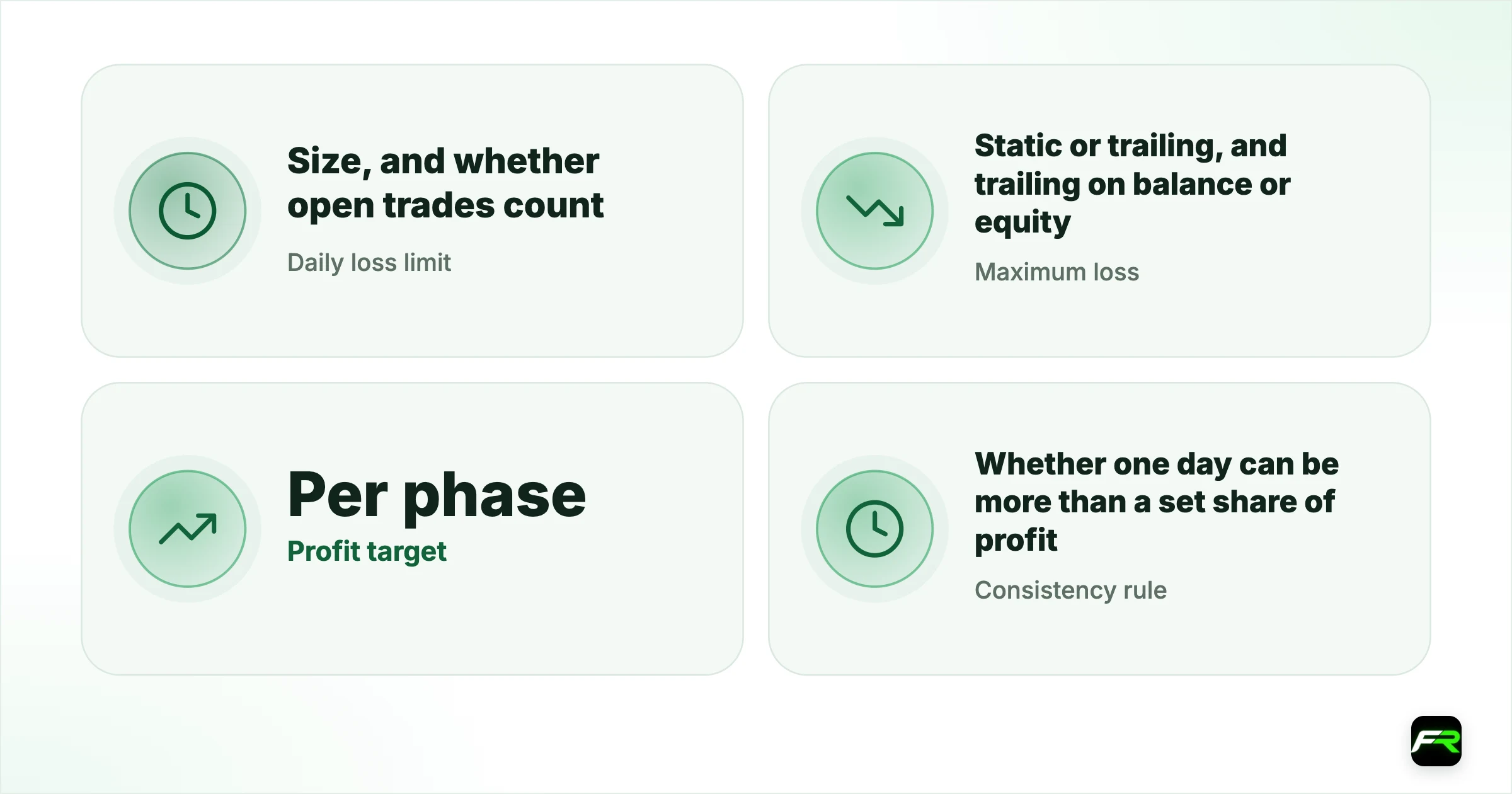
| Rule | What to look for |
|---|---|
| Daily loss limit | Size, and whether open trades count (equity) |
| Maximum loss | Static or trailing, and trailing on balance or equity |
| Profit target | Per phase; one-step or two-step |
| Consistency rule | Whether one day can be more than a set share of profit |
| News and holding | Restrictions on the funded account, not just the evaluation |
| Time limit | None is best; FTMO, for example, sets no time limit |
Match these to your trading. A swing trader who holds through news needs a firm that allows it; a scalper needs low costs and no minimum holding times. Our rules comparison lays the main firms side by side.
3. What does it really cost?
Compare the fee for the account size you need, whether it is refunded with the first payout, and the cost of resets and add-ons. FTMO’s $100,000 2-Step costs €540 and is refunded with the first reward; its $100,000 1-Step costs €499 and is not refunded. The real cost of getting funded shows how to include your chance of passing.
4. Does it suit your market?
Forex and CFD firms such as FTMO run accounts on MetaTrader or cTrader. Futures firms such as Topstep use exchange-listed contracts and their own platforms and rules. They are different products; see forex vs futures prop firms.
5. Can you use it where you live?
Firms restrict some countries, and payment and payout methods vary. Check before you pay, and read our country guides, such as prop firms for Indian traders.
The checklist
- Operating for several years, with a public payout record.
- Payout terms written down: split, waiting period, minimum, timing.
- Rules on your exact plan that fit how you trade, including on the funded account.
- A fee you can lose without it changing how you trade, ideally refundable.
- Available in your country, with a payout method you can use.
- A free trial or demo of the rules before you pay. FTMO offers free trials.
Pick the firm whose rules you could trade for a year, then pick the cheapest account size there. Not the other way round.
Frequently asked
How do I choose a prop firm?
Check first that it pays, with years in business and a public payout record. Then check that its rules on your exact plan suit how you trade, then the real cost including refunds, and finally that it serves your country and market.
What is the most important thing to check in a prop firm?
Whether it reliably pays funded traders under its published terms. A low price or a high split is worthless if payouts are delayed or refused.
Is the cheapest prop firm the best?
Rarely. Cheaper plans often have tighter rules, non-refundable fees or a shorter track record. Compare the rules and the refund policy, not only the price.
Can I try a prop firm before paying?
Some firms offer free trials. FTMO, for example, offers free trials that let you trade under its rules before buying a challenge.
Related reading
The team behind this guide
Researched, checked and approved by five forex specialists
Every guide is written, fact-checked and edited before it goes live, and updated when the facts change. Spotted an error? Tell us.