 IC Markets





































Forex Trading in Asia
Beyond the broker: position sizing, trading sessions and the central-bank meetings that move Asian pairs, worked through with real numbers.
 WriterAbir KhanWriterWrites the guides · checks every figure against primary sources View profileAbout Abir →
 Market analysisTanbir Habib RiyadForex & Crypto AnalystForex and crypto analyst · technical and fundamental analysis View profileAbout Tanbir →
 Fact-checking & riskJannatul FerdaushFact-Checker & Risk AnalystFact-checks every figure · risk analysis · Applied Statistics, University of Dhaka View profileAbout Jannatul →
 Trading reviewJowel RanaCo-Founder & Forex TraderCo-founder · forex trader · reviews guides from a trader's view View profileAbout Jowel →
 Final approvalRanjan NiskrityFounder, Owner & Forex TraderFounder and owner · forex trader · signs off every guide View profileAbout Ranjan →
Most of what goes wrong for a new trader in Asia has nothing to do with the broker. The account is with a licensed firm, the deposit cleared, the platform works. Then a single over-sized position on USD/JPY around a Bank of Japan meeting takes 40 per cent of the balance in one evening, and the trader concludes the market is rigged. It was not rigged. It was a position-sizing mistake, made worse by trading through a scheduled event, on a pair that moves hardest during Asian hours.
This section is the trading half of what we cover for the region. The broker guide handles legality, funding, tax and which firm to open with. Here we work through what happens after that: how much to risk on each trade with the exact maths, which central-bank meeting is about to move your pair, why gold catches beginners out, and what the real trading logs of people in Singapore, Kuala Lumpur and Manila actually look like month to month.

What decides whether an account survives
Three numbers do most of the work. The first is risk per trade: the share of the account you are willing to lose if a single trade hits its stop. For almost everyone that number should be one to two per cent, and on a small starter account it is the difference between a losing streak being a setback and being the end. The second is the size of the move you are trading against, measured in pips or dollars, because that plus your risk figure is what sets the position size. The third is whether a scheduled event is due before your trade would close.
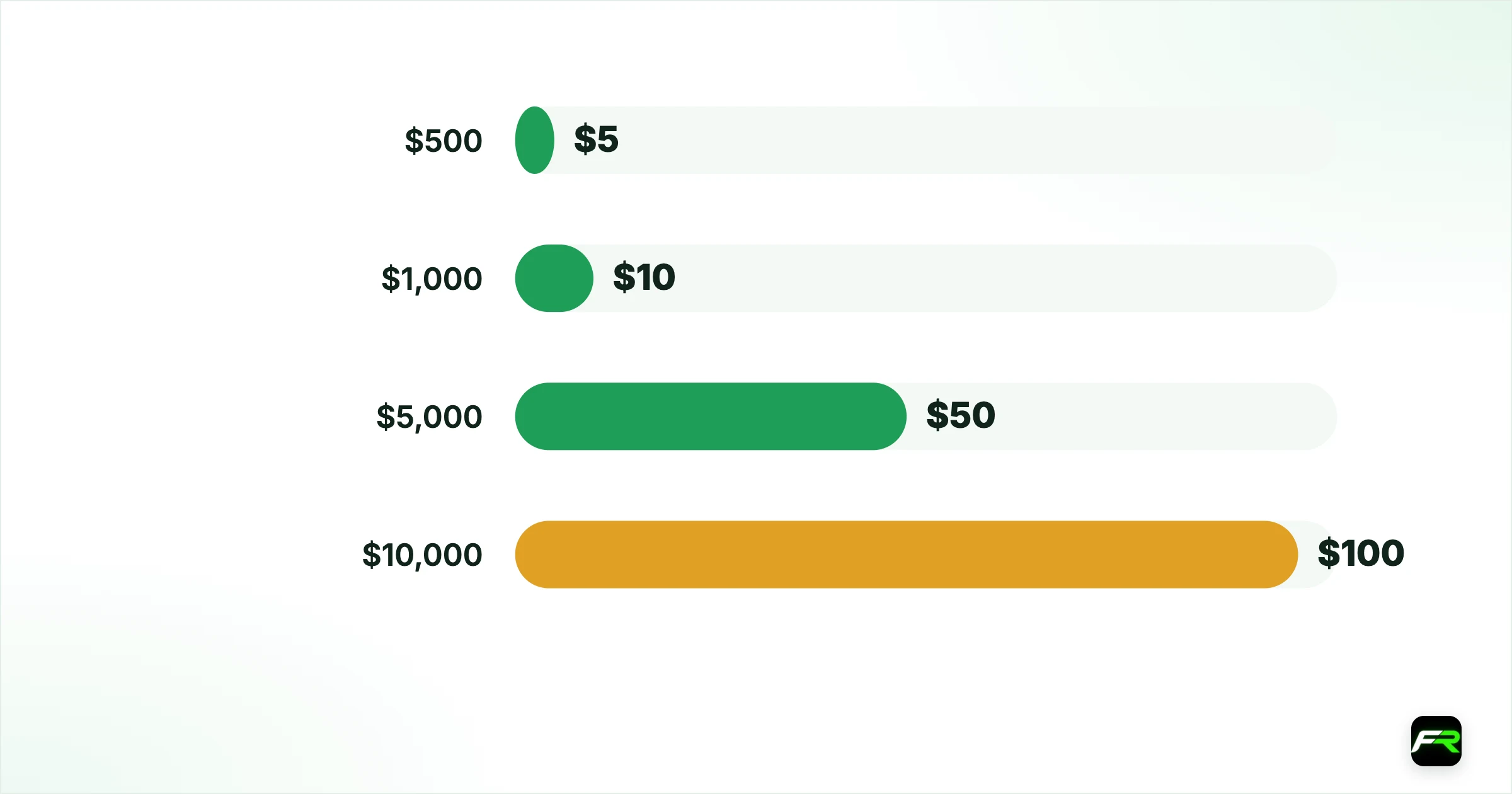
Get those three right and an ordinary strategy with a 45 to 50 per cent win rate can grind out a positive month. Get position size wrong and it does not matter how good the entries are, because one bad run clears the account before the edge has time to show.
| Account | 1% risk | Stop distance | Pip value (EUR/USD, std lot) | Formula | Position size |
|---|---|---|---|---|---|
| $500 | $5 | 25 pips | $10/pip | 5 ÷ (25 × 10) | 0.02 lots |
| $1,000 | $10 | 25 pips | $10/pip | 10 ÷ (25 × 10) | 0.04 lots |
| $5,000 | $50 | 25 pips | $10/pip | 50 ÷ (25 × 10) | 0.20 lots |
| $10,000 | $100 | 25 pips | $10/pip | 100 ÷ (25 × 10) | 0.40 lots |
The formula is risk in dollars divided by stop distance in pips times pip value: that is what turns "risk 1%" into an actual lot size, and it is the same three inputs on every account, only the risk figure changes. A standard lot of EUR/USD moves about $10 per pip, so a mini or micro lot scales that down by a factor of 10 or 100. The position sizing guide works through the maths on other pairs and lot sizes, and the 2% rule guide does the same for a small account.
What moves each Asian pair
Every pair has one or two things that actually set its direction, and for the Asian crosses those drivers are local. Knowing which one applies to your pair tells you which calendar entry to watch and which headline to ignore.
| Pair | Main driver | Also watch | Character |
|---|---|---|---|
| USD/JPY | Bank of Japan policy and US Treasury yields | Ministry of Finance intervention talk | Trends hard, then snaps back on intervention |
| USD/CNH | The PBOC daily yuan fixing | China GDP, trade data, tariff news | Managed: quiet until the fix surprises |
| AUD/USD | Reserve Bank of Australia decisions | Iron ore, Chinese demand, global risk mood | A risk-on currency, sells off fast in a scare |
| AUD/JPY | The gap between RBA and BoJ policy | Global equity direction | The classic carry pair, moves on sentiment |
| USD/INR | Reserve Bank of India action and oil | RBI dollar sales, foreign equity flows | Low volatility most days, then a step move |
| USD/SGD | The MAS exchange-rate band, not an interest rate | US dollar direction generally | One of the calmer Asian pairs |
| XAU/USD (gold) | US real yields and the dollar | Central-bank buying, festival demand, CME margin changes | Trends for months, then drops several per cent in a day |
The yuan fixing guide explains the one that confuses people most, and the Bank of Japan guide covers the yen.
The 2026 yen intervention, and why it matters to you
In the month to 26 August 2026 Japan spent about 15.4 trillion yen, close to 99 billion US dollars, supporting its currency, and part of that operation was run jointly with the United States, the largest monthly intervention on record. Japan's Ministry of Finance, which conducts intervention with the Bank of Japan acting as its agent, publishes the exact monthly figures on its own site, and the same series is also archived on the Japanese government's official statistics portal, so check the primary data rather than a headline number repeated secondhand. USD/JPY can move 200 to 400 pips in minutes when the Ministry of Finance steps in, in the opposite direction to wherever the crowd is leaning.
Two takeaways for a retail account. A short USD/JPY position held through an intervention is fine; a long one on heavy leverage is where accounts get wiped. And intervention buys time rather than fixing anything, so the yen has tended to drift back to the weak side once the effect fades, unless the Bank of Japan follows up with actual rate rises. The intervention levels guide tracks the zones where it has happened before.
There is no schedule for an intervention. It is the one Asian-hours event you cannot put in your calendar, which is the argument for keeping USD/JPY position sizes modest whenever the pair is near a level that has drawn intervention in the past.
Trading around scheduled events
The events that turn a quiet range into a fast move during Asian hours are mostly local: Bank of Japan meetings and the briefings around them, Chinese GDP and the daily yuan fix, Reserve Bank of Australia decisions, and the recurring question of whether Japan will act on the yen. Gold adds its own calendar, with seasonal demand around Diwali and Chinese New Year and the record central-bank buying that has run through 2026.
You do not have to trade any of these. You do have to know when they land, because sitting in a position through one you did not plan for is how the 40 per cent evenings happen. Flag the week's Asian releases on a calendar, and if you range-trade, be flat 15 minutes before anything marked high impact.
| Event | Pair it moves | Roughly when |
|---|---|---|
| Bank of Japan decision | USD/JPY, AUD/JPY | 8 meetings a year, Tokyo morning |
| China GDP and activity data | USD/CNH, AUD/USD | Monthly and quarterly, around 02:00 GMT |
| PBOC yuan fixing | USD/CNH | Every trading day, 01:15 GMT |
| RBA decision | AUD/USD, AUD/JPY | Monthly except January, 03:30 GMT |
| RBI decision | USD/INR | Every two months |
Why gold catches beginners out
A large share of new traders in Asia start on gold rather than a currency pair, partly because it is familiar and partly because the moves look easy to read on a chart after the fact. Gold trends for months at a time, which builds confidence, and then it drops. In one 2026 session it fell about 4.5 per cent, its worst day since the previous October, after the CME raised margin requirements on gold and silver futures with little warning.
The mistake is treating a 200 dollar range in gold like a 20 pip range in EUR/USD. A one lot gold position moves 100 dollars for every one dollar the price changes, so the same account risk buys you a far smaller position than beginners expect. Size gold off the dollar move to your stop, not off a pip count, and give the stop room, because gold's normal noise is wider than a currency pair's. The gold stop placement guide works through the numbers.
Those Telegram screenshots of a small gold account turning into a large one almost always come from position sizes that only pay off in a one-way market. On the first real reversal, the same size takes the account to zero.
The four trading sessions, and when the Asian one runs
The forex market runs 24 hours a day, five days a week, handed between four financial centres as each opens. It is always open during Asian hours; the Asian session is simply the quietest of the four. Sydney opens first, then Tokyo, which is the one most people mean by "the Asian session".
| Session | GMT / UTC | New York time (ET) | Character |
|---|---|---|---|
| Sydney | 22:00 to 07:00 | 17:00 to 02:00 | Thin, the week's first prices |
| Tokyo (Asian) | 00:00 to 09:00 | 19:00 to 04:00 | Quiet ranges, yen and AUD move most |
| London | 08:00 to 17:00 | 03:00 to 12:00 | The busiest session, tightest spreads |
| New York | 13:00 to 22:00 | 08:00 to 17:00 | High volatility, overlaps London to 17:00 GMT |
Clocks shift with daylight saving in London and New York, so the exact hours drift by one either side for part of the year. The Tokyo and London books overlap only briefly around 08:00 GMT, which is the moment a quiet Asian range often breaks. Our best trading hours guide has the local-time version for each country in the region.
Daily ranges during Tokyo hours run 30 to 50 per cent smaller than in London or New York, and a major pair like EUR/USD might cover only 20 to 30 pips across the whole session. Price tends to sit between a clear high and low. That calm suits someone learning, because smaller ranges mean smaller mistakes. The pairs with genuine movement in these hours are USD/JPY, AUD/USD and AUD/JPY.
Two things still bite. Spreads widen in the gap between the New York close and the Tokyo open, so the first hour can be expensive. And thin liquidity means a single large order, or an intervention, moves price further than the same order would in London. The thin liquidity guide covers that.
Asian currencies against the dollar
Asia has more than a dozen traded currencies, but only a handful are liquid enough for a retail account. The yen, the offshore yuan and the Singapore dollar trade with tight spreads at most brokers. Everything else is either thin, quoted only as non-deliverable forwards, or restricted by capital controls, which is why you rarely see it on a retail platform.
| Currency | Code | Rough scale per USD | Main driver | Retail-tradable? |
|---|---|---|---|---|
| Japanese yen | JPY | Around 150 | Bank of Japan, US yields, intervention | Yes, very liquid |
| Chinese yuan (offshore) | CNH | Around 7 | PBOC daily fix, trade and tariff news | Yes, as USD/CNH |
| Hong Kong dollar | HKD | Around 7.8 | Pegged to the USD in a 7.75 to 7.85 band | Yes, but barely moves |
| Singapore dollar | SGD | Around 1.30 | MAS exchange-rate band, not a rate | Yes, one of the calmer pairs |
| Indian rupee | INR | Around 88 | RBI action, oil, equity flows | Mostly offshore or NDF |
| Indonesian rupiah | IDR | Around 17,000 | Bank Indonesia, commodity prices | Thin, NDF |
| Korean won | KRW | Around 1,400 | Exports, semiconductors, BoK | NDF only |
| Thai baht | THB | Around 33 | Tourism, gold, Bank of Thailand | Limited |
| Philippine peso | PHP | Around 58 | Remittances, BSP, imports | NDF only |
| Malaysian ringgit | MYR | Around 4.2 | Oil and gas, Bank Negara | Limited |
Treat the numbers above as a sense of scale, not a quote. Rates move every day, and the rupiah in particular has drifted weaker through 2026. For a current figure use the currency converter or the live rates page. The two you can actually trade in size get their own guides: the yuan fixing guide and the Bank of Japan guide.
What realistic results look like
The adverts show 30 per cent a month. For a retail trader who becomes consistently profitable, and most do not, the honest range is roughly 1 to 5 per cent a month averaged over several years, with losing months in the mix. On a 1,000 dollar account that is 10 to 50 dollars, which is why the first year is about learning rather than income.
A losing streak is normal even for a profitable strategy. Even a 45 to 50 per cent win rate hands you five or six losers in a row several times a year, and the drawdown recovery guide shows why a 50 per cent loss needs a 100 per cent gain to undo. Risk of one to two per cent per trade is what keeps those streaks survivable.
Can you make $1,000 a day?
The honest answer for almost everyone is no, and the maths shows why. A skilled trader might average 5 per cent a month, which is roughly 0.25 per cent on a trading day. To clear 1,000 dollars a day at that rate you would need about 400,000 dollars in the account. You could instead chase it on a small account by risking 20 or 30 per cent per trade, and a few people do hit 1,000 dollars that way, once, before the same sizing takes the account to zero. Consistent four-figure days come from large capital and years of a proven record, not from a strategy you can buy.
Where to trade from, and on which platform
"Which country is best for a forex trader" comes down to three things: whether trading is legal and lightly restricted, whether the tax treatment is bearable, and whether local banks let money move in and out. Singapore scores well on all three and has the region's deepest financial infrastructure. Elsewhere it varies country by country, and the broker guide works through the legality, funding and tax for each market, plus a shortlist of firms that accept traders across most of Asia.
On platforms, MetaTrader 4 and 5 are the default across the region, and swap-free versions are widely available. India is the exception worth flagging: MT5 itself is not banned, but the RBI restricts retail traders to SEBI-approved currency derivatives on Indian exchanges and prohibits using the Liberalised Remittance Scheme to fund margin trading. Millions of Indians use offshore MT5 brokers anyway, through an offshore entity with no local protection. Our India broker guide covers where the line sits and what Indian traders actually do.
As for the lists of "best Asian forex traders" to follow or copy, treat them with the same caution as any trader marketing. A verified multi-year track record is rare, most social-media results are cherry-picked or screenshots, and a copied strategy with hidden leverage can lose in a week what it made in a year. If you do use copy trading, do it on a regulated broker's own platform where the history is real, and size it as one position, not your whole account.
Funded accounts and prop firms
Proprietary trading firms have grown fast across Asia. The pitch is that you pass a paid evaluation, then trade the firm's capital, often 10,000 to 400,000 US dollars, and keep 70 to 90 per cent of the profit. Most challenges ask for a 10 per cent gain while never breaching a 5 per cent daily or 10 per cent total drawdown.
Used well, a funded account is a way to trade meaningful size without risking a large deposit of your own. The risks are real too: the drawdown rules are tight enough that a normal losing streak fails the challenge, the evaluation fee is gone whether you pass or not, and a handful of firms have changed payout terms or closed. Treat the fee as the cost of a test you might fail, not an investment, and check how long the firm has been paying traders.
Why the case studies are here
Numbers on a page do not change behaviour. Watching a specific account go from $2,000 to $8,000 on gold with the stop placement written out, or a $5,000 USD/JPY position get closed at a $2,000 loss because there was no stop at all, tends to land harder. The case studies in this section are built from real and composite trades with the entry, the size, the stop and the outcome all shown, so you can see the difference between a win that was repeatable and a win that was luck.
People ask us for the best strategy. The honest answer is that the strategy matters far less than the position size and whether you traded through an event you should have sat out. We have seen the same setup make money on a $500 account and blow up a $5,000 one, purely because the second trader scaled the risk up with the balance instead of keeping it at one per cent.
Every piece here is built to the same standard as the broker guides: real figures, named examples, and a clear note wherever something is a general principle rather than advice for your specific situation. Trading forex and gold on margin carries a high risk of loss, and most retail accounts lose money.
Frequently asked
How is this section different from the Asian broker guide?
The broker guide covers everything up to and including opening an account: whether forex is legal where you live, how to fund it in your own currency, tax, and which firm to choose. This section covers the trading itself: position sizing, risk management, the central-bank and gold news that moves Asian pairs, market structure, and real trading case studies.
Do I need a large account to use any of this?
No. Most of the case studies and risk guides are built around accounts of $500 to $10,000, which is the normal range for retail traders across the region. The position-sizing maths scales to any balance.
Which pairs does it focus on?
The ones that move during Asian hours and matter to traders in the region: USD/JPY, AUD/JPY, AUD/USD, USD/CNH, USD/SGD, USD/INR, USD/IDR, USD/THB, plus gold (XAU/USD), which is where a large share of new traders in Asia start.
What are the four trading sessions and when do they run?
Sydney runs roughly 22:00 to 07:00 GMT, Tokyo (the Asian session) 00:00 to 09:00 GMT, London 08:00 to 17:00 GMT, and New York 13:00 to 22:00 GMT. In New York time the Tokyo session is about 19:00 to 04:00 ET. Daylight saving shifts the London and New York hours by one for part of the year.
Is the forex market open during Asian hours?
Yes. The market runs 24 hours a day, five days a week, and Asian hours are covered by the Sydney and Tokyo sessions. It is the quietest of the four sessions, with ranges 30 to 50 per cent smaller than London or New York, which suits range trading and traders who are still learning to size positions.
Is it possible to make $1,000 a day in forex?
For almost everyone, no. A skilled trader averaging 5 per cent a month makes about 0.25 per cent on a trading day, so 1,000 dollars a day needs roughly a 400,000 dollar account. Hitting it on a small account means risking 20 to 30 per cent per trade, which works until the same sizing empties the account. Consistent four-figure days come from large capital and a multi-year record.
Is MetaTrader 5 legal in India?
MT5 is not banned, but the RBI restricts Indian retail traders to SEBI-approved currency derivatives on Indian exchanges and prohibits funding margin trading through the Liberalised Remittance Scheme. Many Indians use offshore MT5 brokers regardless, through an offshore entity with no local protection. The India broker guide covers the detail.
Which Asian country is best for forex traders?
It depends on whether trading is legal and lightly restricted, whether the tax is bearable, and whether local banks let money move freely. Singapore rates well on all three and has the deepest financial infrastructure in the region. The broker guide works through the position in each country.
Are the case studies real?
They are built from real and composite trades. Where a study is a composite it is assembled from patterns we see repeatedly, with realistic figures for entry, position size, stop and outcome. The lesson in each one is the point, not the identity of the trader.
What happens to USD/JPY when Japan intervenes?
The pair can move 200 to 400 pips in minutes, against whichever way the crowd is positioned. In the month to 26 August 2026 Japan spent about 15.4 trillion yen, close to 99 billion dollars, partly jointly with the US, the largest monthly intervention on record. Intervention is not scheduled, so the safeguard is keeping USD/JPY position sizes modest when the pair is near a level that has drawn intervention before.
Why do beginners lose money trading gold?
Gold trends for months, which builds false confidence, then drops several per cent in a day, as it did in 2026 after the CME raised futures margins. New traders also size it like a currency pair, but a one lot position moves 100 dollars per one dollar price change, so the same account risk buys a much smaller position than expected. Size off the dollar distance to your stop and give the stop room.
Are prop firm funded accounts worth it?
They can be a way to trade larger size without a big deposit of your own, with profit splits of 70 to 90 per cent. The drawbacks: drawdown limits of around 5 per cent daily and 10 per cent total are tight enough that a normal losing streak fails the challenge, the evaluation fee is not refunded, and some firms have changed terms or closed. Treat the fee as the cost of a test you might fail.
What return can I realistically expect?
For a retail trader who becomes consistently profitable, roughly 1 to 5 per cent a month averaged over years, with losing months included. Most traders never reach consistent profitability. On a small account those percentages are small amounts of money, so the first year is about learning, not income.
Is any of this financial advice?
No. It is educational. It explains how position sizing, leverage and central-bank events work, using real numbers, so you can make better-informed decisions. It does not tell you what to trade, and trading on margin carries a high risk of loss.
A Complete Asia Trading Guide
Every guide in this section, grouped by what you are actually working on.
The team behind this guide
Researched, checked and approved by five forex specialists
Every guide is written, fact-checked and edited before it goes live, and updated when the facts change. Spotted an error? Tell us.