IC Markets

 3:09
 2:39
 2:10
 2:18
 3:43
 8:42





































New Zealand Unemployment Rises to 5.7% as Hours Fall and Wage Growth Stays Near 2%
Jobs held steady but hours worked dropped and pay growth stayed slow. Why the figures matter for the RBNZ's split committee and the kiwi before 9 December.
 WriterAbir KhanWriterWrites the guides · checks every figure against primary sources View profileAbout Abir →

 Market analysisTanbir Habib RiyadForex & Crypto AnalystForex and crypto analyst · technical and fundamental analysis View profileAbout Tanbir →

 Fact-checking & riskJannatul FerdaushFact-Checker & Risk AnalystFact-checks every figure · risk analysis · Applied Statistics, University of Dhaka View profileAbout Jannatul →

 Trading reviewJowel RanaForex TraderForex trader · reviews guides from a trader's view View profileAbout Jowel →

 Final approvalRanjan N. MondolForex TraderForex trader · signs off every guide View profileAbout Ranjan →

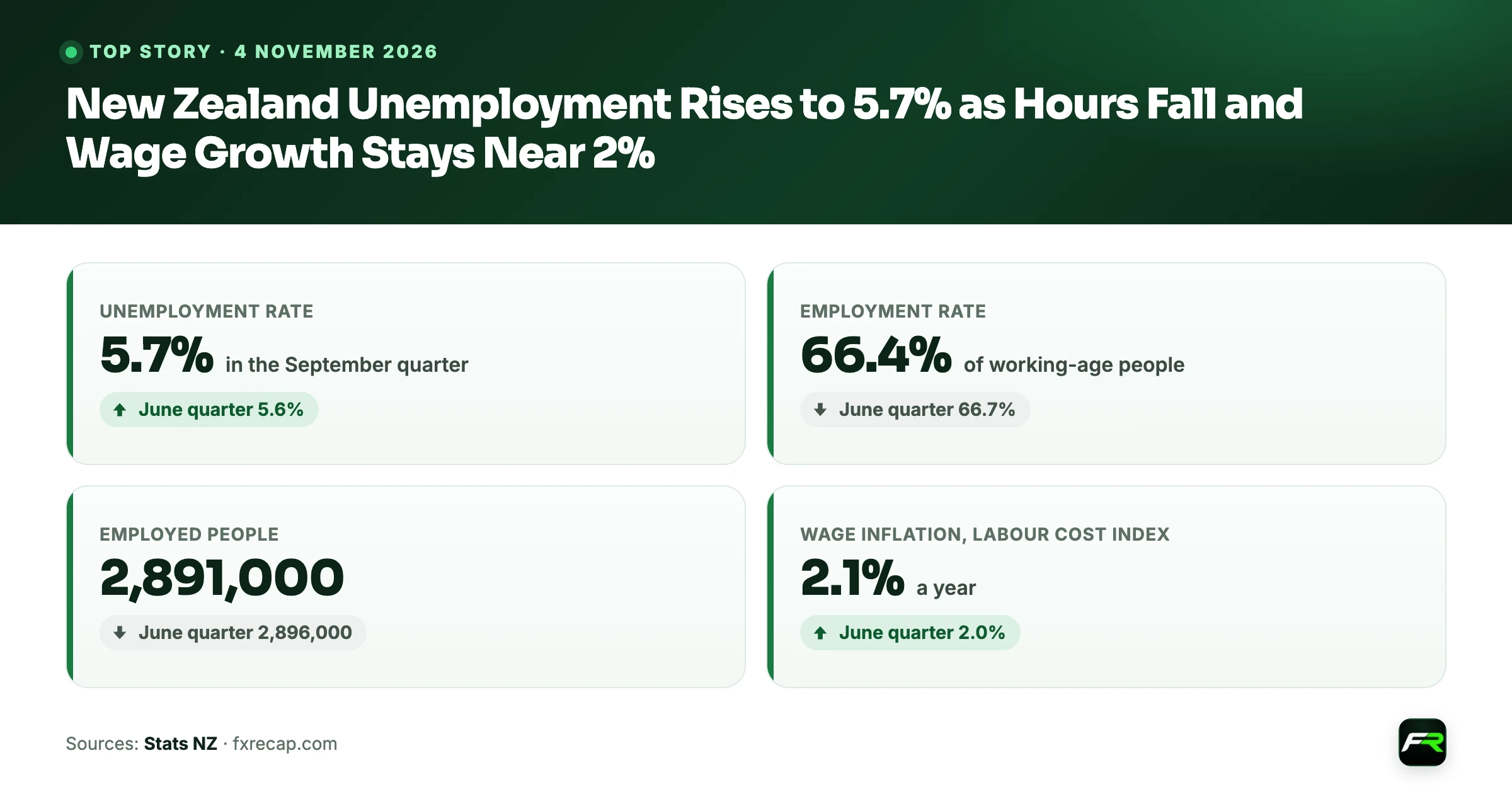
New Zealand's seasonally adjusted unemployment rate rose to 5.7% in the September 2026 quarter, from 5.6% in the June quarter, Stats NZ reported at 10:45 on Wednesday 4 November, New Zealand time. That was 21:45 UTC on Tuesday. There were 174,000 unemployed people, and the wider underutilisation rate held at 13.8%.
The headline rise was small, but the detail was softer. “In the September 2026 quarter, the level of employment remained similar to the June 2026 quarter,” Stats NZ spokesperson Abby Johnston said, while a shift to part-time work pushed down the hours people put in. Wage growth stayed close to 2%, far below the inflation rate the Reserve Bank of New Zealand expects by the end of the year.
For currency traders the release lands a week after the RBNZ's 4-3 vote to hold the Official Cash Rate at 2.75%, when three members wanted a rise. A cooler labour market gives the four who voted to wait another argument before the 9 December decision.
| Unemployment rate (Stats NZ) | 5.7% in the September quarter (June quarter 5.6%) |
|---|---|
| Employment rate (Stats NZ) | 66.4% of working-age people (June quarter 66.7%) |
| Employed people (Stats NZ) | 2,891,000 (June quarter 2,896,000) |
| Wage inflation, labour cost index (Stats NZ) | 2.1% a year (June quarter 2.0%) |
What the September quarter showed
Employment barely moved. Stats NZ counted 2,891,000 people in work, seasonally adjusted, against 2,896,000 in the June quarter and 2,872,000 a year earlier. Because the working-age population kept growing, the employment rate slipped to 66.4% from 66.7%. Underutilisation, which adds people who want more hours or could start work soon to the unemployed, stayed at 13.8%, or 438,000 people.
Hours were the weakest part of the report. Part-time employment rose by 15,000 and full-time employment fell by 17,000 over the quarter. As a result, hours usually worked dropped 0.5% to 106.5 million a week, and hours actually worked fell 1.6% to 94.7 million. “Although employment was similar to last quarter, there were changes in how people were employed,” Johnston said.
Job security also shifted over the year. Casual employees rose by 19,100, or 19.5%, to 116,900, and fixed-term employees by 8,100, or 18.9%, to 50,900. Most paid employees still hold permanent roles, 91.3% of them in the September quarter, but firms are leaning more on flexible contracts. That pattern often appears when employers are unsure about demand.
Wages: still slow
Pay growth gives the RBNZ little to worry about. The labour cost index, which tracks salary and wage rates for the same jobs over time, rose 2.1% in the year to September, from 2.0% in the year to June. Average ordinary time hourly earnings in the Quarterly Employment Survey rose 2.9% to $44.86, compared with 2.8% growth in the year to June.
Compare those numbers with prices. At its 28 October review the RBNZ said higher fuel prices and a weaker New Zealand dollar would push annual inflation up to 4.4% in the December quarter. Wages rising around 2 to 3% while prices rise faster means real incomes are shrinking, which tends to weigh on spending. It also means the inflation pressure is coming mostly from fuel and the exchange rate, not from a tight jobs market.
| Measure | June quarter | September quarter |
|---|---|---|
| Unemployment rate | 5.6% | 5.7% |
| Underutilisation rate | 13.8% | 13.8% |
| Employment rate | 66.7% | 66.4% |
| Labour cost index, annual | 2.0% | 2.1% |
| Average hourly earnings, annual | 2.8% | 2.9% |
What it means for the RBNZ
The Monetary Policy Committee holds its last decision of the year on 9 December, with a full Monetary Policy Statement and new forecasts. On 28 October it held the OCR at 2.75% in a 4-3 vote. The three dissenters, Paul Conway, Hayley Gourley and Karen Silk, preferred a rise to 3%, and the committee as a whole said tighter policy is likely to be required but remains conditional on the economic outlook.
Wednesday's figures cut both ways for that debate. Rising unemployment, falling hours and slow wage growth support the members who want to wait, because they suggest the economy is cooling without further hikes. On the other side, inflation expected at 4.4% by December is well above the 1 to 3% target, and a weak currency keeps adding to import costs.
How the kiwi stands
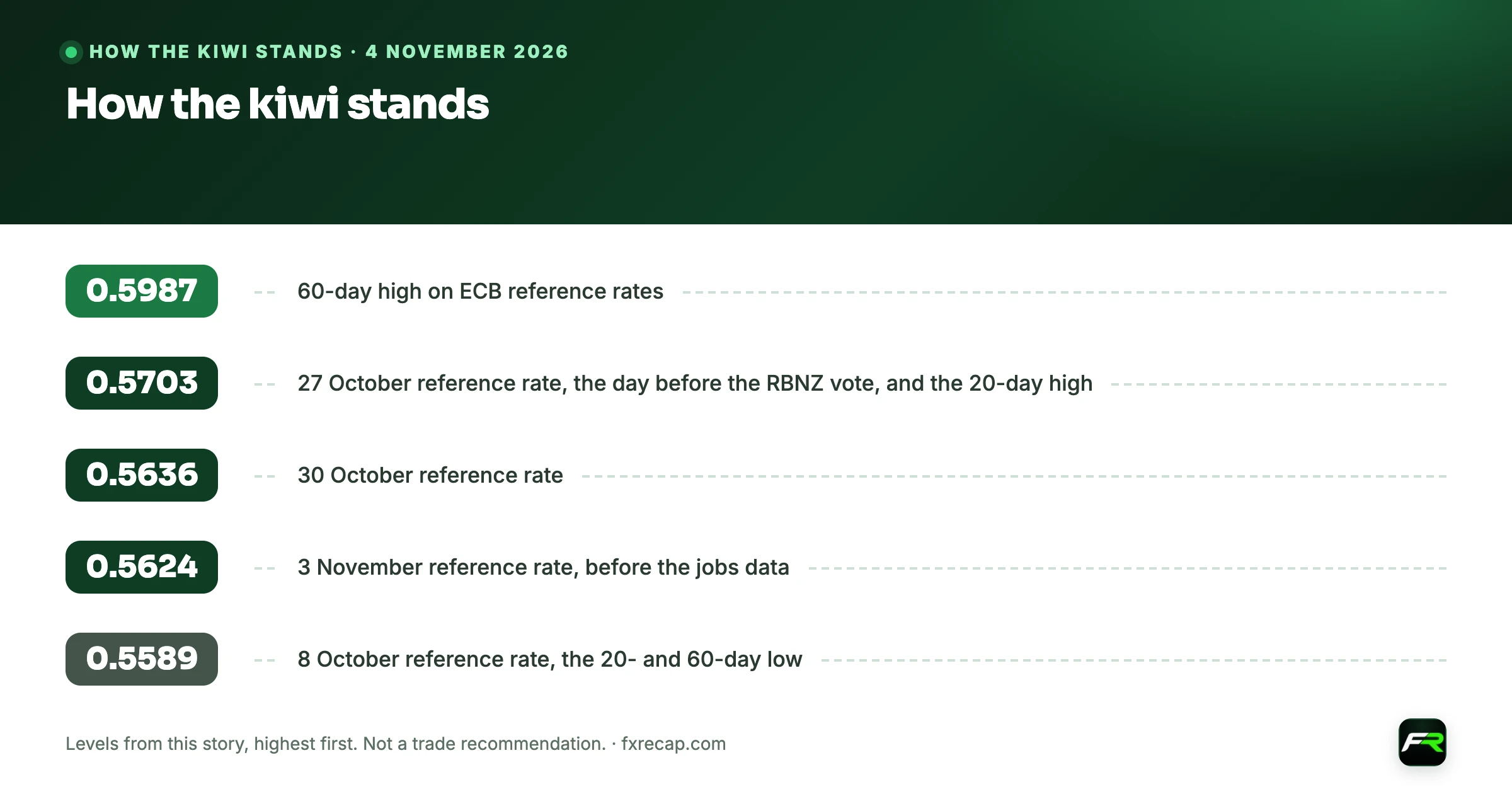
Working from the ECB's euro reference rates, NZD/USD was 0.5624 on Tuesday 3 November, set around 13:15 UTC, before the jobs data. That compares with 0.5703 on 27 October, the day before the RBNZ's split decision, and 0.5613 the day after it. The kiwi has drifted lower since, close to its lowest reference rate of the last 60 working days, 0.5589 on 8 October. The 60-day high is 0.5987.
| Level | Why it matters |
|---|---|
| 0.5987 | 60-day high on ECB reference rates |
| 0.5703 | 27 October reference rate, the day before the RBNZ vote, and the 20-day high |
| 0.5636 | 30 October reference rate |
| 0.5624 | 3 November reference rate, before the jobs data |
| 0.5589 | 8 October reference rate, the 20- and 60-day low |
Across the Tasman the picture has moved the other way. The Reserve Bank of Australia raised its cash rate to 4.85% on Tuesday, so the gap between Australian and New Zealand policy rates has widened to 2.10 percentage points. AUD/NZD, also derived from ECB rates, was 1.2417 on 3 November after 1.2529 on 28 October.
The two labour markets also look different. The RBA's November Statement on Monetary Policy says Australian unemployment averaged 4.6% in the September quarter and is forecast to rise to 4.7% by December, well below New Zealand's 5.7%. Australia's problem is inflation that refuses to fall; New Zealand's is a soft economy with a temporary price spike from fuel and a weak currency. Those different stories explain why the RBA is still raising rates while the RBNZ paused, and why AUD/NZD has been one of the clearer ways to express a view on the two central banks.
A wider rate gap usually supports the higher-yielding currency, but it is not automatic. If Australian growth slows faster than the RBA expects, or New Zealand inflation forces the RBNZ to hike in December after all, the gap could narrow again. Watch both banks' statements rather than the rate difference alone.
What it means for traders
- Watch the next ECB reference rate for the first official reading of NZD/USD after the release; a fall towards 0.5589 would show the market taking the softer jobs data seriously.
- Mark 9 December on our economic calendar. The RBNZ's forecasts and vote will matter more than any single data point before then.
- Keep the US side in mind. NZD/USD reacts strongly to US data and risk appetite, and the US October jobs report is due on Friday.
- Remember liquidity. New Zealand releases come out in the late evening for Europe and the US, when trading is thin and spreads can widen.
Say you want to sell NZD/USD at 0.5620 because you expect the softer jobs data to keep the RBNZ on hold, with a stop at 0.5660, 40 pips away. On a $3,000 account risking 1%, your loss limit is $30, so each pip can be worth $0.75, which is a position of about 7,500 units (0.075 lot). If you used a full standard lot instead, the same 40-pip stop would cost $400, more than 13% of the account.
Data releases and central bank decisions can move currencies sharply, and prices can gap past stop orders. Leverage magnifies losses as well as gains, so trade only with money you can afford to lose. This article is news and education, not a recommendation to buy or sell.
Labour market figures and quotations come from Stats NZ's release of 4 November 2026. RBNZ details are from its 28 October 2026 decision. NZD/USD and AUD/NZD are derived from ECB euro reference rates (one rate per working day, not intraday highs or lows); the RBA rate is from its 3 November 2026 decision statement.
Cite this guide
FX Recap, "New Zealand Unemployment Rises to 5.7% as Hours Fall and Wage Growth Stays Near 2%", updated 4 November 2026, https://fxrecap.com/forex-news/top-stories/nz-unemployment-5-7-percent-september-2026
Free to quote with a link. Journalists: data and comment in our press room.
Frequently asked
What is New Zealand's unemployment rate?
Stats NZ reported a seasonally adjusted unemployment rate of 5.7% in the September 2026 quarter, up from 5.6% in the June quarter. There were 174,000 unemployed people.
How fast are wages rising in New Zealand?
The labour cost index rose 2.1% in the year to the September 2026 quarter, and average ordinary time hourly earnings rose 2.9% to $44.86, according to Stats NZ.
When is the next RBNZ decision?
The Reserve Bank of New Zealand announces its next Official Cash Rate decision on 9 December 2026, with a full Monetary Policy Statement. The OCR is 2.75% after a 4-3 vote to hold on 28 October.
How did NZD/USD trade before the jobs data?
Derived from ECB reference rates, NZD/USD was 0.5624 on 3 November, down from 0.5703 on 27 October and near its 60-day low of 0.5589 from 8 October.
Sources: Stats NZ: Unemployment rate at 5.7 percent in the September 2026 quarter · Reserve Bank of New Zealand: Official Cash Rate decisions · ECB: euro foreign exchange reference rates · Reserve Bank of Australia: Monetary Policy Decision, 3 November 2026
The team behind this guide
Researched, checked and approved by five forex specialists
Every guide is written, fact-checked and edited before it goes live, and updated when the facts change. Spotted an error? Tell us.