





























How Spread Betting Works: £ per Point Explained for UK Traders
A spread bet is a stake in pounds per point of price movement. Win or lose the stake times the points moved, put up 3.33% or 5% as margin, and pay funding on bets held overnight.
 WriterAbir KhanWriterWrites the guides · checks every figure against primary sources View profileAbout Abir →
 Market analysisTanbir Habib RiyadForex & Crypto AnalystForex and crypto analyst · technical and fundamental analysis View profileAbout Tanbir →
 Fact-checking & riskJannatul FerdaushFact-Checker & Risk AnalystFact-checks every figure · risk analysis · Applied Statistics, University of Dhaka View profileAbout Jannatul →
 Trading reviewJowel RanaCo-Founder & Forex TraderCo-founder · forex trader · reviews guides from a trader's view View profileAbout Jowel →
 Final approvalRanjan NiskrityFounder, Owner & Forex TraderFounder and owner · forex trader · signs off every guide View profileAbout Ranjan →
Spread betting is a way to profit or lose from a price moving without owning the asset. You pick a direction, buy if you think the price will rise or sell if you think it will fall, and choose a stake in pounds per point. Your result is the stake multiplied by the number of points the price moves in your favour or against you. A £5 a point buy on GBP/USD that rises 48 points makes £240; if it falls 30 points you lose £150. The broker quotes two prices, you pay a small spread to enter, and you only need to deposit a fraction of the position as margin.
That is the whole idea. The details below decide what a point is worth on each market, how much margin a bet ties up, what holding it overnight costs and how you get out. For whether spread betting suits you better than CFDs, see our spread betting vs CFD comparison; this page sticks to the mechanics.
| What you choose | Direction (buy or sell) and a stake in £ per point |
|---|---|
| Profit or loss | Stake × points moved |
| Margin (retail) | 3.33% on major FX pairs, 5% on minor pairs, gold and major indices |
| Main costs | The spread, plus overnight funding on daily bets |
| Worst case | Losses capped at your account balance for FCA retail clients |
| Tax | Profits normally outside UK income tax and CGT |
Bid, offer and the spread
Every spread bet market has two prices. The lower one is the bid, where you sell; the higher is the offer, where you buy. If GBP/USD is shown as 1.3318/1.3319, a buy opens at 1.3319 and would be closed by selling at whatever the bid is later. The one-point gap is the spread, and it is the broker's main charge. You start every bet slightly behind because of it: open and close instantly and you lose the spread times your stake.
Spreads vary by market and time of day. IG lists minimum spreads of 0.9 points on GBP/USD and EUR/GBP, 1 point on the FTSE 100 and 0.3 on spot gold on its charges page, but those are best-case figures during liquid hours. Around 22:00 UK time, and during big data releases, spreads widen. A 1-point spread at £5 a point costs £5 per bet; at 3 points it costs £15, which is why the hour you trade matters as much as the stake.
What a point is on different markets
A point is the unit your stake applies to, and it differs by market. On most currency pairs it is the fourth decimal place, 0.0001, the same as a pip. Yen pairs use the second decimal place, 0.01, because the yen is priced in larger numbers. For the FTSE 100 it is one index point. Many providers, IG among them, scale prices so that a 1.0 move in the quoted price is one point, which on spot gold usually means a $1 move per ounce, although some firms use a smaller increment. Always read the contract details for the market before your first bet.
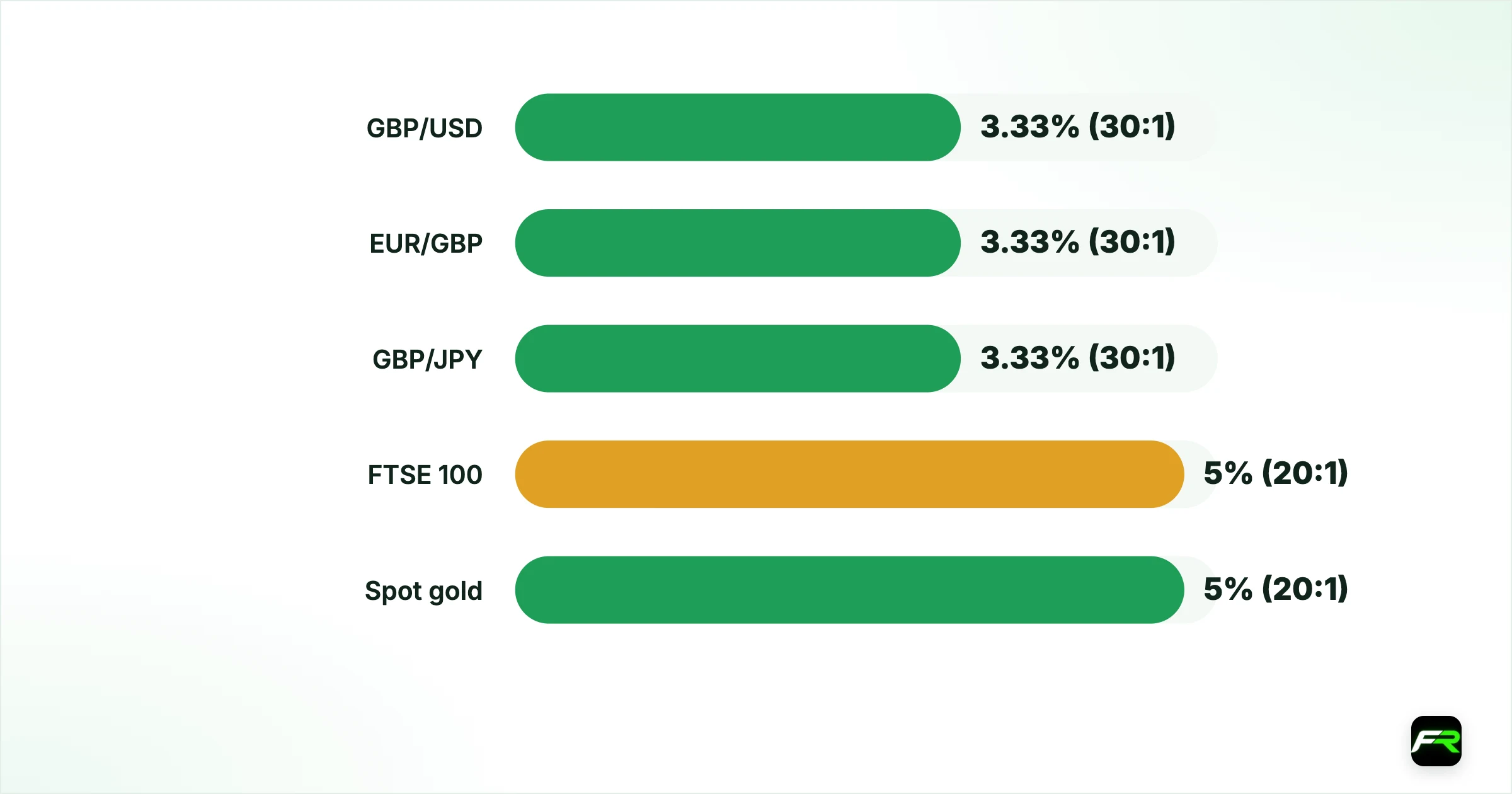
| Market | Illustrative price | One point is | £1 a point means | Retail margin |
|---|---|---|---|---|
| GBP/USD | 1.3319 | 0.0001 | £1 per 0.0001 move | 3.33% (30:1) |
| EUR/GBP | 0.8700 | 0.0001 | £1 per 0.0001 move | 3.33% (30:1) |
| GBP/JPY | 199.40 | 0.01 | £1 per 0.01 move | 3.33% (30:1) |
| FTSE 100 | 9,201 | 1 index point | £1 per index point | 5% (20:1) |
| Spot gold | 3,500.0 | Usually $1 (check your broker) | £1 per $1 move | 5% (20:1) |
Note that the stake stays in pounds whatever the market is priced in. A bet on gold, priced in dollars, still pays £1 per point at a £1 stake, with no currency conversion on the result. That is one of the main practical differences from a CFD, where a GBP/USD or gold profit arrives in dollars. EUR/GBP and GBP/JPY both count as major pairs under the FCA's convention, since each is made of two of USD, EUR, JPY, GBP, CAD and CHF, so they carry the 30:1 limit too. Prices in the table are illustrative, chosen to make the arithmetic easy to follow.
Worked profit and loss examples
Each example uses the formula stake × points moved, with the exit taken at the correct side of the quote.
- GBP/USD, buy, winning. Buy £5 a point at 1.3319. You close by selling at 1.3367. The move is 13367 minus 13319, 48 points. Profit: 48 × £5 = £240.
- Same GBP/USD buy, losing. Same entry, but you close at a bid of 1.3289. That is 30 points against you. Loss: 30 × £5 = £150.
- EUR/GBP, sell, winning. Sell £3 a point at 0.8700 and later buy back at 0.8665. The price fell 35 points in your favour. Profit: 35 × £3 = £105.
- GBP/JPY, buy, losing. Buy £2 a point at 199.40. Sterling weakens and you close at 198.65, a fall of 75 points (0.75 yen in 0.01 steps). Loss: 75 × £2 = £150.
- FTSE 100, buy, losing. Buy £2 a point at 9,201. The index slips and you sell at 9,160, 41 points lower. Loss: 41 × £2 = £82.
- Gold, sell, winning. Sell £1 a point at 3,500.0. Gold drops and you buy back at 3,462.0, a $38 move. Profit: 38 × £1 = £38.
GBP/JPY is the one that catches people out. A 75-point move is a normal day for that pair, and a £2 stake there risks far more in practice than £2 on EUR/GBP, which often moves less. Size stakes by how far your stop sits from entry, not by the stake you used on another market. Our GBP/JPY guide covers its typical ranges.
Margin at 30:1 and 20:1
Margin is the deposit your broker holds while the bet is open. The position value of a spread bet is the stake multiplied by the price expressed in points, and FCA rules set the minimum percentage of that value a retail client must put up. On major pairs that is 3.33%, or one-thirtieth; on gold, minor pairs and major indices such as the FTSE 100 it is 5%, or one-twentieth.
| Bet | Position value | Margin rate | Margin required |
|---|---|---|---|
| £5 a point GBP/USD at 1.3319 | £5 × 13,319 = £66,595 | 3.33% (1/30) | About £2,220 |
| £3 a point EUR/GBP at 0.8700 | £3 × 8,700 = £26,100 | 3.33% (1/30) | £870 |
| £2 a point GBP/JPY at 199.40 | £2 × 19,940 = £39,880 | 3.33% (1/30) | About £1,329 |
| £2 a point FTSE 100 at 9,201 | £2 × 9,201 = £18,402 | 5% (1/20) | About £920 |
| £1 a point gold at 3,500.0 | £1 × 3,500 = £3,500 | 5% (1/20) | £175 |
Margin is not the most you can lose. A £5 GBP/USD bet ties up about £2,220 but could lose far more than that on a large move if you have no stop. Two FCA rules stop the worst outcome for retail clients: your broker must start closing positions when your equity falls to 50% of the margin required, and negative balance protection means you cannot lose more than the money in your account. Our page on margin close-out and negative balance protection explains both, and the UK leverage limits page lists the other tiers.
Daily funded bets, forward bets and overnight funding
A daily funded bet, also called a rolling or cash bet, has no fixed end date. It carries a tight spread, and if you hold it past the broker's daily cut-off you pay or receive an overnight funding adjustment. A forward or dated bet runs to a set date, builds the holding cost into a wider spread and has no daily funding charge. IG's forex forwards run on quarterly dates and roll over automatically unless you ask otherwise. Daily bets suit trades held for hours or a few weeks; forwards can be cheaper for a view held for months.
Funding is usually based on an interbank interest rate plus the broker's own fee. IG, for example, charges positions held past 10pm UK time and states an admin fee of 1.5% a year for FX and 3.4% for other markets on top of the relevant interbank rate. For a £2 a point FTSE 100 buy at 9,201, with a position value of £18,402 and an interbank rate of about 3.7%, one night costs roughly £18,402 × 7.1% ÷ 365 = £3.58. On FX the calculation also reflects the interest gap between the two currencies, so a sell can sometimes earn a small credit; the 1.5% admin fee alone on a £5 GBP/USD bet worth £66,595 comes to about £2.74 a night before that interest adjustment.
Weekends still accrue funding, so check how your broker books those extra days. In November 2025 the FCA reported that some CFD firms, whose products include spread bets, could not justify their overnight charges and disclosed them poorly. Look up the exact rate before holding a position for more than a few days.
Stops, guaranteed stops and closing a bet
A normal stop-loss closes your bet at the next available price once your level is hit. In a fast market, or over a weekend gap, that price can be worse than your stop, which is called slippage. A guaranteed stop closes at exactly your level whatever happens, in exchange for a premium. IG charges its premium only if the guaranteed stop is triggered; other firms may charge on entry. The premium is shown on the deal ticket before you confirm, so compare it with how far the market could plausibly gap.
To close a bet, you place the opposite trade for the same stake: sell to close a buy, buy to close a sell. Platforms do this with a close button, and most allow a partial close, for example cutting a £5 bet to £2. A limit order, sometimes called a take-profit, closes automatically at a target. Dated bets that reach expiry settle at the closing price unless they roll. Our stop-loss and take-profit guide shows where to place them.
MetaTrader platforms were built for lots, so brokers map a volume of 1.00 to a particular £ per point stake, which can differ by market. Check the contract specification on a demo before your first live spread bet on MT4 or MT5.
Dev had £3,000 in a spread betting account and bought GBP/USD at 1.3319 for £3 a point ahead of a Bank of England decision, with a normal stop 50 points below at 1.3269. His plan capped the loss at 50 × £3 = £150, or 5% of the account. The decision surprised the market and the price jumped through his stop, filling him at 1.3251, 68 points below entry. His loss was 68 × £3 = £204. He now sizes trades at about 1% risk, so £30 on a 50-point stop means £0.60 a point, and he pays for a guaranteed stop when holding through scheduled announcements.
Where tax fits in
For most individuals HMRC treats spread betting as betting, so profits are normally free of income tax and capital gains tax, and losses cannot be offset against other gains. There are narrow exceptions, and the answer differs for companies. Our explainer is spread betting tax free? covers HMRC's manuals in detail, and the spread betting vs CFD comparison shows when a taxable CFD account can still work out better.
General information, not tax advice. Your own position depends on your circumstances, and tax rules can change, including at the 28 October 2026 Budget.
Frequently asked
What is spread betting in simple terms?
It is a bet in pounds per point on whether a price will rise or fall. If you bet £2 a point that the FTSE 100 will rise and it gains 30 points, you make £60. A 30-point fall loses you £60. You never own the underlying asset.
What is a point in spread betting?
The unit your stake applies to. On most currency pairs it is 0.0001, on yen pairs 0.01 and on the FTSE 100 one index point. Gold is often a $1 move but varies by broker, so check the contract details.
How much margin do I need for a £1 a point bet on GBP/USD?
At a price of 1.3319 the position value is £13,319. The retail rate of 3.33%, or one-thirtieth, puts the margin at about £444. Without a stop, a bad move can cost you more than that.
Can you lose more than you deposit with spread betting?
Not as a retail client of an FCA-authorised firm. Negative balance protection limits losses to your account balance, and the 50% margin close-out usually shuts positions earlier. Professional clients and offshore accounts may not have that protection.
What is the difference between a daily funded bet and a forward?
A daily funded bet has no expiry and a tight spread, and it carries an overnight funding charge. A forward bet has a set expiry date, a wider spread and no daily funding. Forwards can suit positions held for months.
How do I close a spread bet?
Place the opposite trade for the same stake, usually with a close button on the platform. You can often close part of the stake. Stop and limit orders close bets automatically at levels you set in advance.
Is a guaranteed stop worth paying for?
It can be around scheduled news or over weekends, when prices can gap past a normal stop. You pay a premium, which some firms such as IG charge only if the stop is triggered. For quiet intraday trades a normal stop is usually enough.
Do I pay tax on spread betting profits?
Normally no for individuals, because HMRC treats spread betting as betting. Losses cannot be offset either. Rules can change, including at the 28 October 2026 Budget, so check our tax pages or take advice if trading is your business.
Related reading
The team behind this guide
Researched, checked and approved by five forex specialists
Every guide is written, fact-checked and edited before it goes live, and updated when the facts change. Spotted an error? Tell us.