 IC Markets





































Trading Psychology: Why Most Forex Traders Lose Money
Most traders lose to fear and greed, not strategy. How to stay calm, stick to your plan and accept losses as part of trading.
 WriterAbir KhanWriterWrites the guides · checks every figure against primary sources View profileAbout Abir →
 Market analysisTanbir Habib RiyadForex & Crypto AnalystForex and crypto analyst · technical and fundamental analysis View profileAbout Tanbir →
 Fact-checking & riskJannatul FerdaushFact-Checker & Risk AnalystFact-checks every figure · risk analysis · Applied Statistics, University of Dhaka View profileAbout Jannatul →
 Trading reviewJowel RanaCo-Founder & Forex TraderCo-founder · forex trader · reviews guides from a trader's view View profileAbout Jowel →
 Final approvalRanjan NiskrityFounder, Owner & Forex TraderFounder and owner · forex trader · signs off every guide View profileAbout Ranjan →

Most forex traders lose money because of how they manage risk and emotion under pressure, not because they lack technical knowledge. Regulatory data backs this up directly. The UK Financial Conduct Authority and the European Securities and Markets Authority have both published figures showing that somewhere between 70 and 89 percent of retail forex and CFD accounts lose money, and most brokers are required to disclose their own version of this statistic on their websites.
The pattern behind those numbers is remarkably consistent: traders who fail usually understand support and resistance, moving averages, and basic strategy well enough. What they lack is the discipline to execute a plan consistently once real money and real losses are on the line.
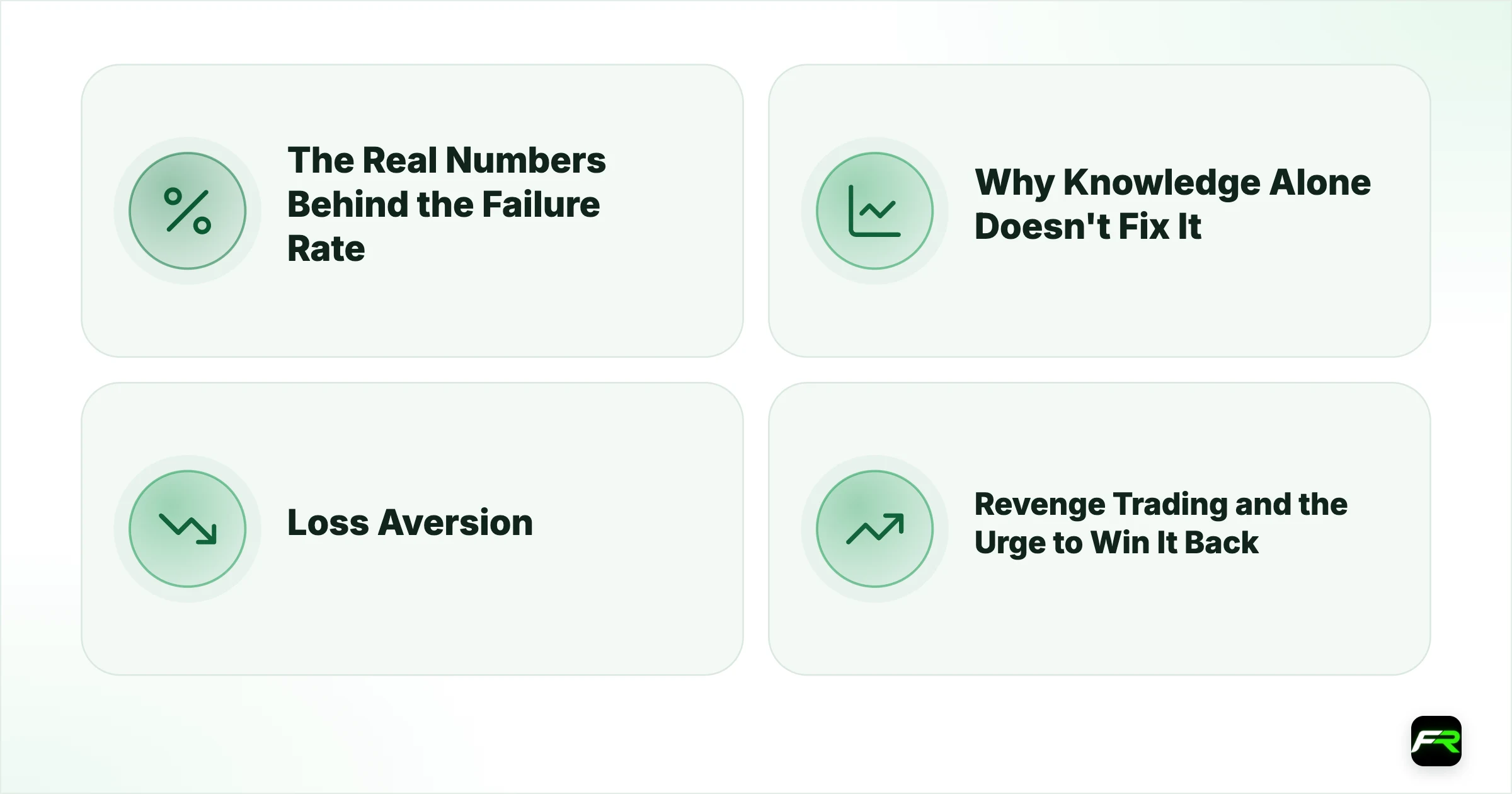
The Real Numbers Behind the Failure Rate
These aren’t vague estimates. The FCA and ESMA require brokers offering CFDs and forex to retail clients to disclose the percentage of client accounts that lose money, and that disclosed figure typically falls between 70 and 89 percent depending on the broker and the period measured. Separate data from proprietary trading firms, where traders get funded and monitored closely, shows a similarly steep dropout rate among newer traders in the first several months.
The consistency of that number across regulators, brokers, and prop firms, all measuring different populations of traders in different ways, is what makes it worth taking seriously rather than dismissing as marketing spin.
Why Knowledge Alone Doesn’t Fix It
A trader can understand every concept covered in a typical technical analysis course, structure, order blocks, risk-reward ratios, and still lose consistently. That gap between knowing the theory and executing it under real financial pressure is where trading psychology lives. Analyzing a chart calmly after the market closes is a fundamentally different mental task than watching a live position move against you while your own money is on the line.
This is why so much of what separates consistently profitable traders from the majority isn’t a better strategy. It’s the ability to follow a mediocre strategy exactly the same way every time, rather than following a great strategy inconsistently.
Loss Aversion
Behavioral research from psychologists Daniel Kahneman and Amos Tversky found that people feel the pain of a loss roughly twice as intensely as the pleasure of an equivalent gain. In trading, this bias shows up in a specific, damaging pattern: closing winning trades too early to lock in the good feeling, while holding losing trades far longer than the original plan called for, hoping to avoid confirming the loss.
Over enough trades, that asymmetry is mathematically destructive. Small wins taken early and large losses allowed to run is close to the exact opposite of what a sustainable risk-reward ratio requires.
Revenge Trading and the Urge to Win It Back
A loss triggers an urge in most traders to immediately make it back, often by entering the next trade without a real setup, at a larger size than usual, purely to erase the uncomfortable feeling of being down. This is revenge trading, and it’s one of the more direct paths from a single manageable loss to a blown account, since the position taken to fix the loss is rarely following the same rules that governed the original trade.
Overconfidence After a Winning Streak
The opposite emotional trap shows up after a string of wins. Confidence builds, position sizes creep up, and the same risk rules that worked during the winning streak start to feel unnecessarily conservative. A few outsized losing trades taken at that inflated size can erase the gains from an entire winning streak, sometimes in a single session.
The Discipline Traders Who Do Well Actually Practice
• Risking a fixed, small percentage of the account per trade, commonly 1 to 2 percent, so no single loss carries outsized emotional or financial weight.
• Defining the entry, stop, and target before opening the trade, rather than deciding in the moment while emotions are already engaged.
• Keeping a trading journal that tracks emotional state and whether the plan was actually followed, not just profit and loss.
• Treating each individual trade as one data point in a larger sample rather than a referendum on skill or worth.
• Stepping away after hitting a predefined daily or weekly loss limit instead of continuing to trade through a losing streak.
Trading Is Not a Referendum on Any Single Trade
One of the more useful mental shifts traders describe is learning to think in terms of probability across a large sample of trades rather than the outcome of any one trade specifically. A strategy with a real statistical edge can still lose on any individual trade, sometimes several in a row, without that meaning the strategy or the trader has failed. Reacting emotionally to single-trade outcomes, rather than judging performance over a meaningful sample size, is a common reason traders abandon a workable strategy right before it would have paid off.
Common Psychological Mistakes
• Moving a stop-loss further away mid-trade rather than accepting the original invalidation point.
• Increasing position size after a loss to recover it faster.
• Closing winning trades early out of fear, while letting losing trades run out of hope.
• Trading without a predefined plan, entering based on a feeling that a setup looks right.
• Checking an open position obsessively, which tends to increase impulsive decisions rather than improve them.
People’s Most Asked
What percentage of forex traders actually lose money?
Regulatory disclosures from the FCA and ESMA put the figure between roughly 70 and 89 percent of retail forex and CFD accounts, a range most brokers are required to publish for their own client base.
Is trading psychology more important than strategy?
Both matter, but a technically sound strategy applied inconsistently under emotional pressure tends to underperform a simpler strategy followed with discipline. Many traders who fail already understand the technical side reasonably well.
What is revenge trading?
Entering a new trade immediately after a loss, often at a larger size and without a real setup, purely to try to win back the loss quickly. It tends to compound the original loss rather than recover it.
How does loss aversion affect trading decisions?
Because losses feel roughly twice as painful as equivalent gains feel good, traders tend to close winning trades too early and hold losing trades too long, an asymmetry that works directly against a healthy risk-reward ratio over time.
Can trading psychology be improved, or is it fixed?
It’s generally treated as a skill that improves with structure and practice. Fixed risk per trade, a written plan, and a journal that tracks emotional patterns tend to reduce the impact of these biases over time, even if the underlying tendencies never fully disappear.
Does a trading journal actually help?
Traders who keep one report catching emotional patterns, like a tendency to move stops or oversize after a loss, that would otherwise stay invisible. The journal doesn’t fix the behavior by itself, but it makes the pattern visible enough to address deliberately.
Final Word
Most traders lose money in forex for the same handful of psychological reasons showing up again and again: reacting emotionally to individual trades, sizing risk based on how a setup feels rather than a fixed rule, and abandoning a plan under pressure instead of following it. None of that requires a better indicator to fix. It requires treating discipline as a skill worth practicing with the same seriousness as any technical concept, since the regulatory numbers make clear that knowledge alone isn’t what separates the minority who stay profitable from everyone else.
The team behind this guide
Researched, checked and approved by five forex specialists
Every guide is written, fact-checked and edited before it goes live, and updated when the facts change. Spotted an error? Tell us.
Related Articles
 Education
12 min read
Education
12 min read

 Education
25 min read
Education
25 min read
 Education
10 min read
Education
10 min read
 Education
19 min read
Education
19 min read
 Education
9 min read
Education
9 min read
 Education
7 min read
Education
7 min read