IC Markets

 3:09
 2:39
 2:10
 2:18
 3:43
 8:42




































Bank of England Decides Today With Sterling Back at $1.35: What a Rise or a Hold Means
Firms now expect 3.3% inflation a year ahead and GBP/USD sits at a 20-day high. How to read the 12:00 UK decision, the vote and the forecasts.
 WriterAbir KhanWriterWrites the guides · checks every figure against primary sources View profileAbout Abir →

 Market analysisTanbir Habib RiyadForex & Crypto AnalystForex and crypto analyst · technical and fundamental analysis View profileAbout Tanbir →

 Fact-checking & riskJannatul FerdaushFact-Checker & Risk AnalystFact-checks every figure · risk analysis · Applied Statistics, University of Dhaka View profileAbout Jannatul →

 Trading reviewJowel RanaForex TraderForex trader · reviews guides from a trader's view View profileAbout Jowel →

 Final approvalRanjan N. MondolForex TraderForex trader · signs off every guide View profileAbout Ranjan →

The Bank of England announces its November decision at 12:00 UK time today, Thursday 5 November, which is also 12:00 UTC. Bank Rate stands at 3.75%. The Monetary Policy Report and the minutes come out at the same moment, so the vote split, the new inflation forecasts and each member's own explanation all land together.
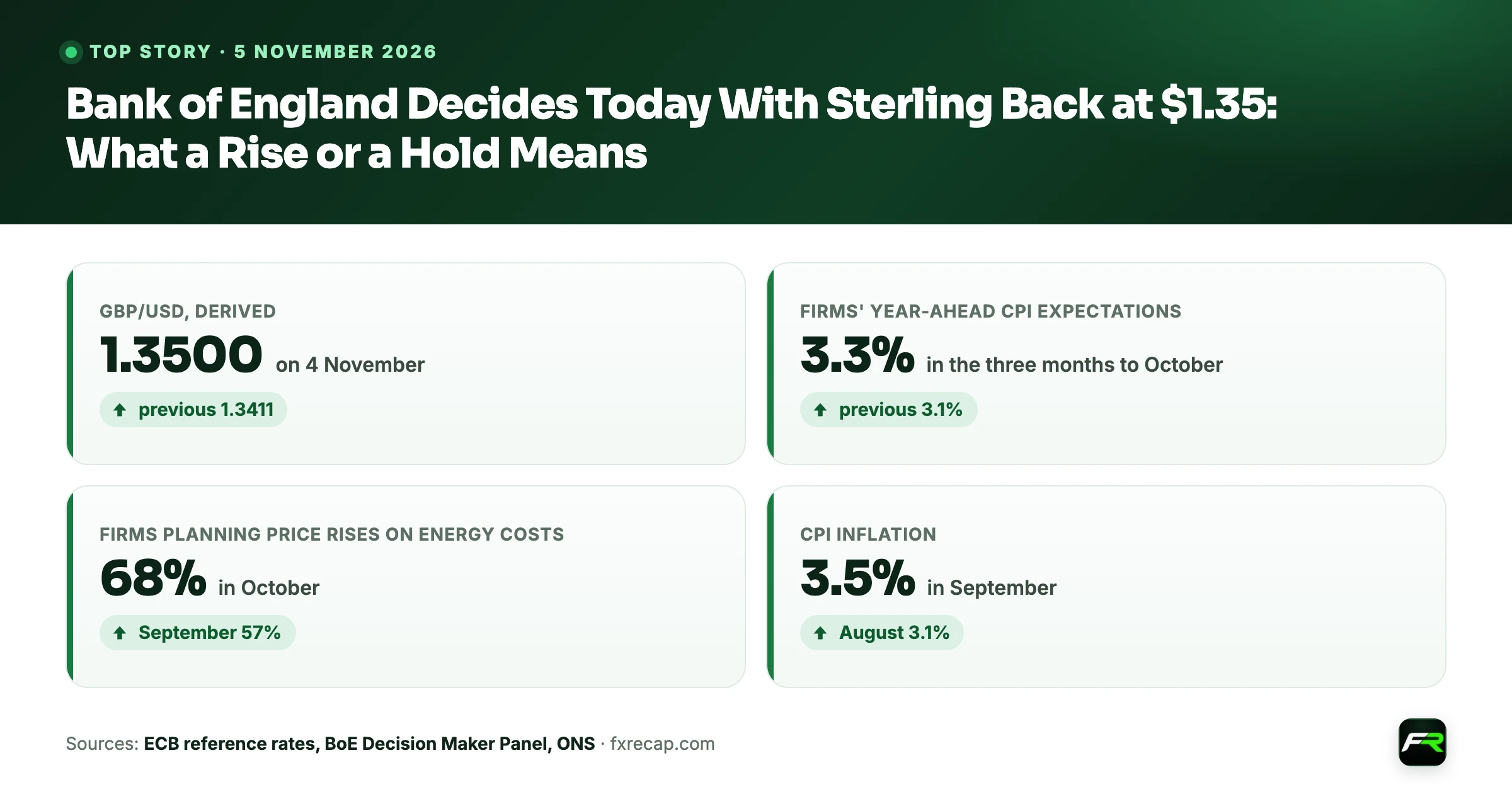
Sterling goes into the meeting firm. On ECB reference rates GBP/USD worked out at 1.3500 on Wednesday 4 November, the highest in the last 20 working days and the first time near that level since 11 September (1.3508). Investing.com reported on 4 November that the pound was on track for a sixth straight daily gain ahead of what it described as an expected rate rise. That is a market report, not something the Bank has said, and we do not forecast the result.
Our Sunday preview went through each member's September statement. This page covers what is new since then, the levels on the chart and a plan for reading the release in the first minutes after it lands.
| GBP/USD, derived (ECB reference rates) | 1.3500 on 4 November (previous 1.3411) |
|---|---|
| Firms' year-ahead CPI expectations (BoE Decision Maker Panel) | 3.3% in the three months to October (previous 3.1%) |
| Firms planning price rises on energy costs (BoE Decision Maker Panel) | 68% in October (September 57%) |
| CPI inflation (ONS) | 3.5% in September (August 3.1%) |
What the Bank learned since September
Two Bank of England surveys published on 30 October went to the committee before this meeting, and both lean towards persistent price pressure. The Decision Maker Panel, a monthly survey of finance chiefs at 1,945 UK firms carried out between 2 and 16 October, found that expectations for CPI inflation a year ahead rose to 3.3% from 3.1%. Three-year expectations held at 2.8%.
Price-setting intentions moved more sharply. Since April the survey has asked how firms expect the energy shock to affect them, and in October 68% said they expected to raise prices, eleven percentage points more than in September. At the same time 71% expected lower profit margins. Firms reported own-price growth of 3.8% over the past year and expect the same 3.8% over the next one.
Pay is the softer side. Firms said wage growth was 3.9% over the past year and expect 3.4% over the next, unchanged from the previous survey and half a point lower. Realised employment growth fell to -0.5% from -0.2%. Those figures matter to members such as Swati Dhingra and Alan Taylor, who argued in September for waiting until second-round effects show up in wages.
The Agents' summary of business conditions, built from the Bank's regional contacts in the six weeks to early October, gives the same mixed signal. Consumer demand “remains fragile and price sensitive,” it says, and the average pay settlement for 2026 “remains at 3.6%.” Contacts “expect consumer goods price inflation to start to firm up, as contracts are repriced,” while food inflation is expected to end the year at 3% to 4% and rise again in the first half of 2027.
Where the committee stood going in
In September the nine members split six to three, with Megan Greene, Catherine Mann and Huw Pill voting to raise Bank Rate to 4%. Four of the six who held wrote that a rise could follow if the energy shock lasted. Governor Andrew Bailey said that if the Middle East conflict persists for an extended period, “it is likely that policy may have to tighten.” Clare Lombardelli wrote that “the case for raising Bank Rate is building the longer the conflict continues without lasting resolution.”
Staff then expected CPI inflation of around 3¾% in the fourth quarter of 2026 and slightly above 4% early in 2027. September CPI came in at 3.5%, up from 3.1%, and services inflation rose to 3.7%. Unemployment fell to 4.7%. None of that data argues clearly for patience, which is why the vote count is the number most traders will check first.
How to read the release at 12:00
Four pieces come out at once, and each can move sterling in a different direction. A sensible order is to read them from the most mechanical to the most subtle.
- The decision and the vote. A rise to 4% with a large majority is the clearest hawkish outcome. A rise by five votes to four, or a hold with four or more votes for a rise, tells you the committee is close to evenly split and December is open.
- The inflation projections in the Monetary Policy Report. Look at the peak early in 2027 and at inflation two and three years ahead. A forecast that sits well above 2% at the three-year point supports more tightening; one that falls back near 2% does the opposite.
- Guidance in the summary. In September the committee said it “stands ready to act as necessary.” Any wording about further rises, or about the stance now being restrictive enough, will shape pricing for 17 December.
- The members' own paragraphs in the minutes. Bailey's carries most weight. If he moves from “may have to tighten” to voting for a rise, or explains why he still holds, the market will treat that as the Bank's centre of gravity.
Speed matters less than order. Spreads on GBP pairs often widen in the seconds around 12:00, and the first move can reverse once the forecasts are read. Waiting five or ten minutes for the full set of documents costs little and avoids trading a headline that the minutes later contradict.
GBP/USD levels into the decision
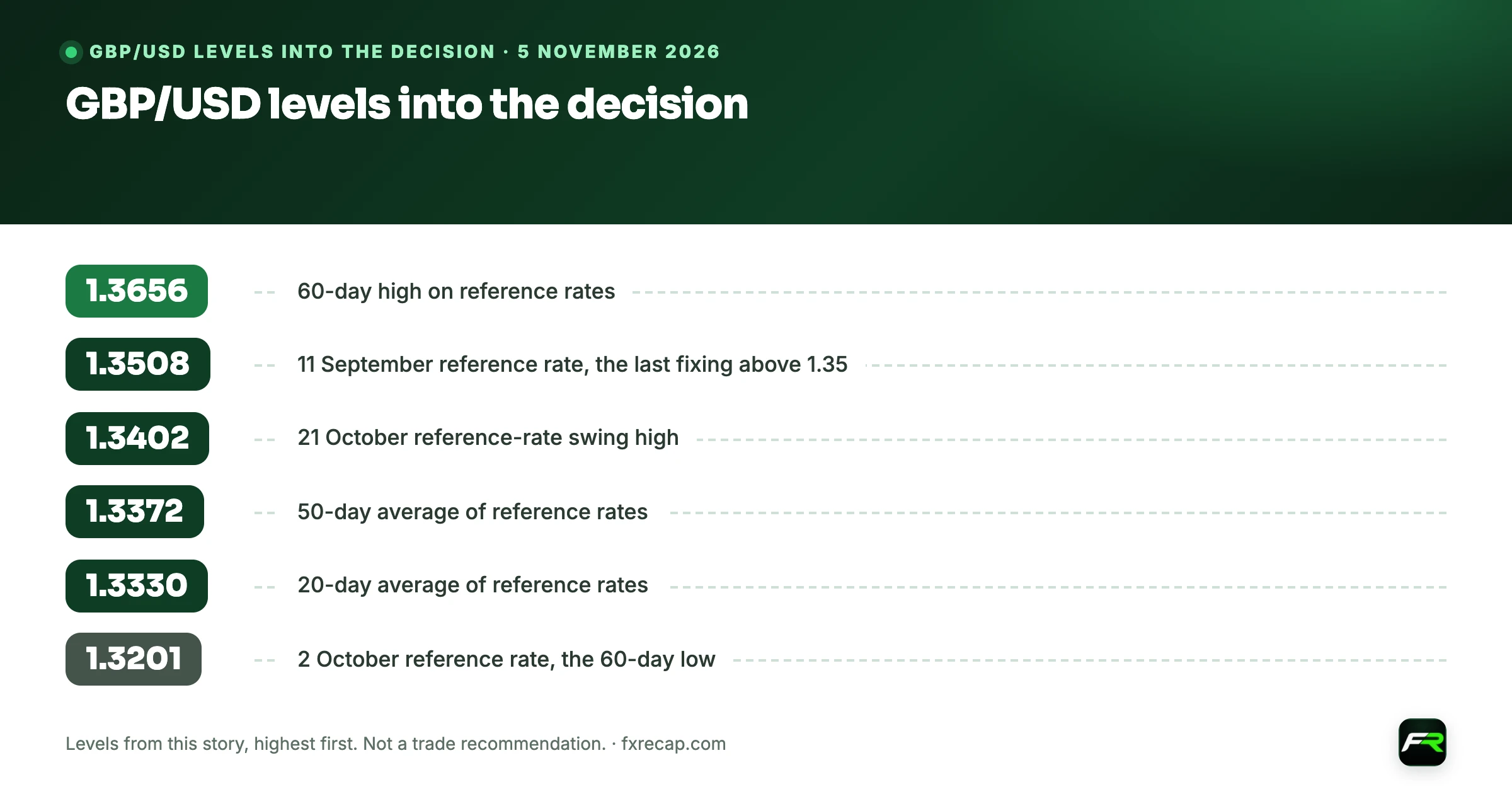
The table uses ECB euro reference rates, one fixing a day at about 13:15 UTC, converted to GBP/USD by dividing EUR/USD by EUR/GBP. They are not intraday highs or lows, and the live price on our analysis page will differ during the day.
| Level | Why it matters |
|---|---|
| 1.3656 | 60-day high on reference rates |
| 1.3508 | 11 September reference rate, the last fixing above 1.35 |
| 1.3402 | 21 October reference-rate swing high |
| 1.3372 | 50-day average of reference rates |
| 1.3330 | 20-day average of reference rates |
| 1.3201 | 2 October reference rate, the 60-day low |
The pair rose from 1.3288 on 28 October to 1.3500 on 4 November, a gain of about 1.6% in five fixings, and it now sits above both its 20-day and 50-day averages. The 14-day RSI on reference rates is 66, close to the 70 line that many traders treat as stretched. Against the euro the move is older and larger: EUR/GBP fell from 0.8546 on 30 September to 0.8346 on Wednesday, so the pound buys more euros than it did a month ago.
A rally into an event leaves less room for a positive surprise. If the Bank raises rates as reports suggest markets expect, the reaction may be modest, and a dovish vote split or softer forecasts could pull GBP/USD back towards the 1.3402 swing high or the averages near 1.33 to 1.34. A hold with an unchanged split would surprise the reported expectation and could produce a larger drop. A rise accompanied by clear signals of more to come is the case where 1.3508 and then the 60-day high come into view.
What it means for traders
Today is a day for smaller positions and wider thinking about risk, not for guessing the headline. The US side of GBP/USD adds its own event: third-quarter productivity and unit labour costs from the Bureau of Labor Statistics arrive at 13:30 UTC, ninety minutes after the Bank, and the October US jobs report follows on Friday.
- Trade the reaction, not the guess. Let the vote, forecasts and minutes come out, then decide whether the move fits what was published.
- Check EUR/GBP as well as GBP/USD. A rise in sterling against both the dollar and the euro is a cleaner signal of a hawkish Bank than a move in one pair.
- Expect gaps. Stops placed just beyond 1.3400 or 1.3500 can fill well past their level in the first minute.
- Use our GBP/USD analysis for the live price and levels and the economic calendar to see 12:00 UTC in your own time zone.
Say you plan to sell GBP/USD at 1.3480 if the vote disappoints, with a stop at 1.3540, 60 pips away. On a $4,000 account risking 1%, the most you can lose is $40, so each pip can be worth about $0.67, roughly 6,700 units. If the release causes a jump and the stop fills 25 pips late, the loss becomes about $57. Sizing for that slippage before the event, with our <a href="/position-size-calculator">position size calculator</a>, is the part you control.
Rate decisions can move currencies sharply, and prices can gap past stop orders. Leverage magnifies losses as well as gains, so trade only with money you can afford to lose. This article is news and education, not a recommendation to buy or sell.
Survey figures come from the Bank of England's Decision Maker Panel for October 2026 and its Agents' summary of business conditions, both published on 30 October. September votes and quotes are from the Bank's September 2026 Monetary Policy Summary and minutes; inflation and jobs figures are from the ONS. GBP/USD and EUR/GBP are ECB euro reference rates or derived from them. The report of market expectations is attributed to Investing.com.
Cite this guide
FX Recap, "Bank of England Decides Today With Sterling Back at $1.35: What a Rise or a Hold Means", updated 5 November 2026, https://fxrecap.com/forex-news/top-stories/bank-of-england-decision-day-sterling-1-35
Free to quote with a link. Journalists: data and comment in our press room.
Frequently asked
What time is the Bank of England decision today?
At 12:00 UK time on Thursday 5 November 2026, which is 12:00 UTC. The Monetary Policy Report, the Monetary Policy Summary and the minutes are published at the same time.
What is the Bank of England interest rate before the decision?
Bank Rate is 3.75%. It was held at that level in September by six votes to three, with three members voting for a rise to 4%.
What did UK firms say about inflation in October?
In the Bank's Decision Maker Panel, firms' expectations for CPI inflation a year ahead rose to 3.3% from 3.1%, and 68% said they expected to raise prices because of higher energy costs, up eleven points from September.
Where is GBP/USD before the Bank of England meeting?
On ECB reference rates GBP/USD was 1.3500 on 4 November, its highest in 20 working days. The last fixing above 1.35 was 1.3508 on 11 September, and the 60-day high is 1.3656.
Sources: Bank of England: Monthly Decision Maker Panel data, October 2026 · Bank of England: Agents' summary of business conditions, October 2026 · Bank of England: Monetary Policy Summary and minutes, September 2026 · ECB: euro foreign exchange reference rates · Bank of England: upcoming MPC dates · Office for National Statistics: Consumer price inflation, UK, September 2026
The team behind this guide
Researched, checked and approved by five forex specialists
Every guide is written, fact-checked and edited before it goes live, and updated when the facts change. Spotted an error? Tell us.