IC Markets

 3:09
 2:39
 2:10
 2:18
 3:43
 8:42




































US Payrolls Jump 165,000 in October as Unemployment Dips to 4.1% and Pay Rises 0.4%
Hiring beat its 12-month average more than threefold and earlier months were revised up by 84,000. What the stronger report means for the Fed and the dollar.
 WriterAbir KhanWriterWrites the guides · checks every figure against primary sources View profileAbout Abir →

 Market analysisTanbir Habib RiyadForex & Crypto AnalystForex and crypto analyst · technical and fundamental analysis View profileAbout Tanbir →

 Fact-checking & riskJannatul FerdaushFact-Checker & Risk AnalystFact-checks every figure · risk analysis · Applied Statistics, University of Dhaka View profileAbout Jannatul →

 Trading reviewJowel RanaForex TraderForex trader · reviews guides from a trader's view View profileAbout Jowel →

 Final approvalRanjan N. MondolForex TraderForex trader · signs off every guide View profileAbout Ranjan →

America's jobs market picked up speed in October. Nonfarm payrolls rose by 165,000, the US Bureau of Labor Statistics said on Friday, more than three times the average monthly gain of 48,000 over the previous year. Unemployment slipped to 4.1% from 4.2%, and average hourly earnings climbed 0.4%.
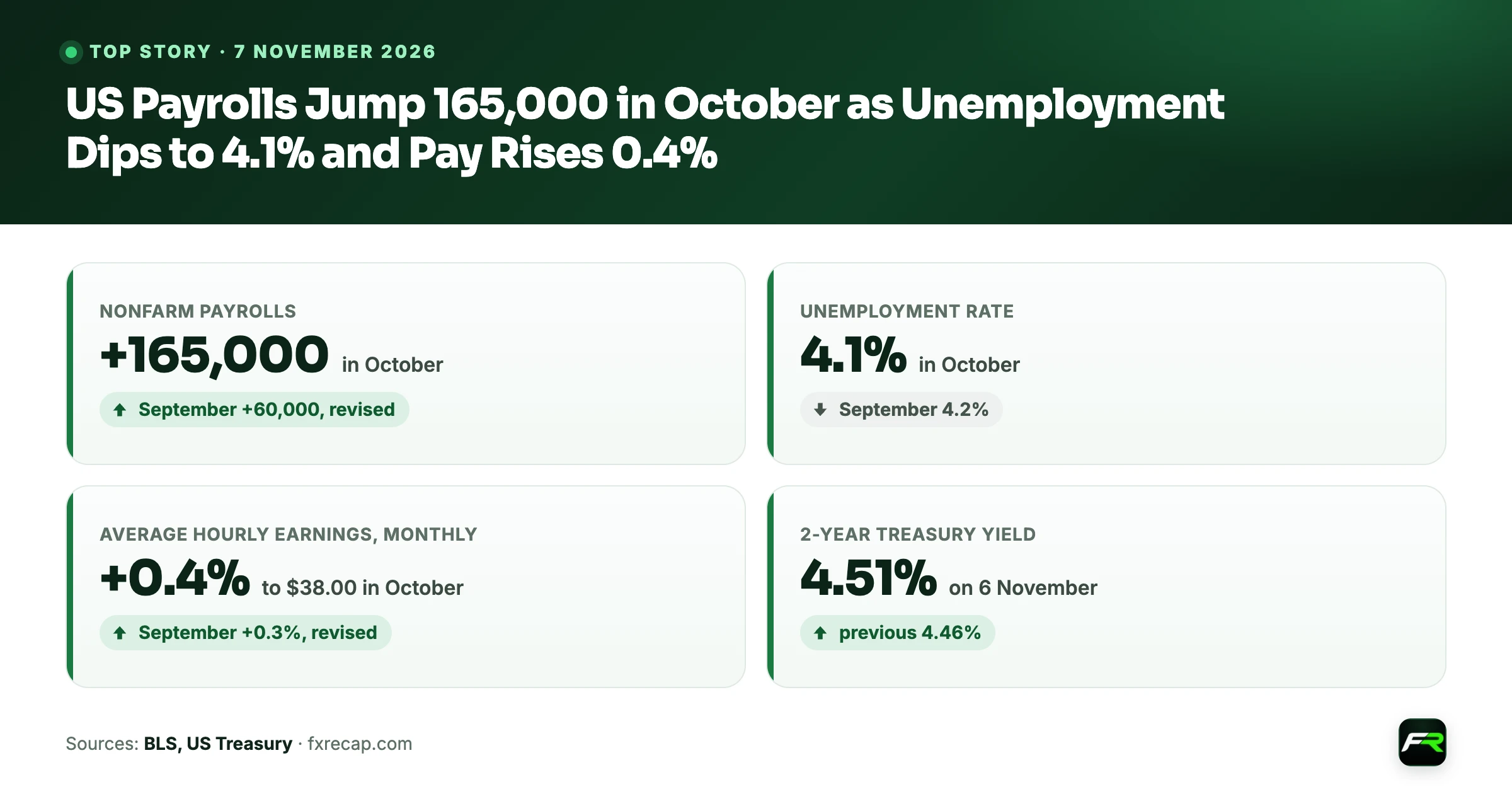
Revisions made the report stronger still. August was raised to a gain of 186,000 from 133,000 and September to 60,000 from 29,000, adding 84,000 jobs to the two months combined. September's 29,000, which looked like the start of a slowdown when we previewed the release on Friday morning, now reads as a soft patch inside a firmer trend.
Bond markets took notice. The 2-year Treasury yield closed at 4.51% on Friday, up from 4.46% a day earlier, according to the Treasury's daily par yield curve. That reversed part of Thursday's 12 basis point fall and tells you rates traders now see a little more chance of a Federal Reserve rise in December.
| Nonfarm payrolls (BLS) | +165,000 in October (September +60,000, revised) |
|---|---|
| Unemployment rate (BLS) | 4.1% in October (September 4.2%) |
| Average hourly earnings, monthly (BLS) | +0.4% to $38.00 in October (September +0.3%, revised) |
| 2-year Treasury yield (US Treasury) | 4.51% on 6 November (previous 4.46%) |
Where the new jobs came from
Hiring was broad but led by services. Professional and business services added 70,000 jobs, well above its twelve-month average of 15,000, with gains in professional and technical work (33,000), administrative and support services (28,000) and company management (9,000). That group has now added 269,000 jobs since a low in October 2025.
Health care contributed 42,000, faster than its usual pace of about 31,000, with hospitals up 16,000 and home health care up 11,000. Transportation and warehousing grew by 25,000, mostly couriers and messengers. Factories kept adding staff too: manufacturing employment rose 19,000 and is 101,000 above its recent low in December 2025.
Some areas were flat or weaker. Leisure and hospitality shed 13,000 jobs, construction lost 3,000 and government added only 6,000, according to the BLS summary table. Retail, information and financial activities changed little. Private employers created 159,000 of the 165,000 new jobs, so the gain did not lean on public hiring.
The three-month average is the number many economists prefer, because it smooths out one-off swings. After revisions it rose to 137,000 a month, from 79,000 in September. Hiring at that pace is enough to keep unemployment steady or push it lower, which is what happened in October.
Unemployment and pay
The household survey showed a steady picture. About 7.1 million people were out of work, and the unemployment rate has stayed between 4.1% and 4.3% since March. Labour force participation edged up to 61.9% and the employment-population ratio to 59.3%, both little changed since January.
One detail runs the other way. People working part time because they could not find full-time work, or because their hours were cut, rose by 339,000 to 4.8 million. Long-term unemployment held at 2.0 million, or 27.6% of everyone jobless. Neither figure changes the main message, but both are worth watching if hiring cools again.
Pay is the part the Fed will study most closely. Average hourly earnings for private workers rose 14 cents to $38.00, a 0.4% monthly gain, and September was revised up to show a 0.3% rise instead of 0.1%. Over twelve months earnings are 3.1% higher. With consumer prices up 3.7% in the year to September, real wages are still falling, but a run of 0.3% and 0.4% monthly rises points to firmer wage pressure ahead.
What it means for the Fed in December
The Federal Reserve held its target range at 3.75% to 4.00% on 28 October, with two of twelve voters asking for a rise. Its statement said job gains had kept pace with the workforce while inflation remained elevated. October's report supports the case of the two dissenters: the labour market is not weakening, and pay is picking up while energy keeps headline inflation high.
That does not make a December move certain. The Fed decides on 9 December, and it will see the November jobs report on 4 December plus October consumer prices on 10 November before then. A soft inflation figure next week could ease the pressure. What has changed is that a weak labour market is no longer a strong argument for waiting.
Short-dated yields are the quickest guide to how markets read this. The 2-year closed at 4.51%, still below the 4.58% of Wednesday and the 4.61% of Tuesday, so traders did not fully price out Thursday's drop. The 10-year rose two basis points to 4.86%. If next week's inflation data surprises higher, that gap could close.
EUR/USD levels after the report
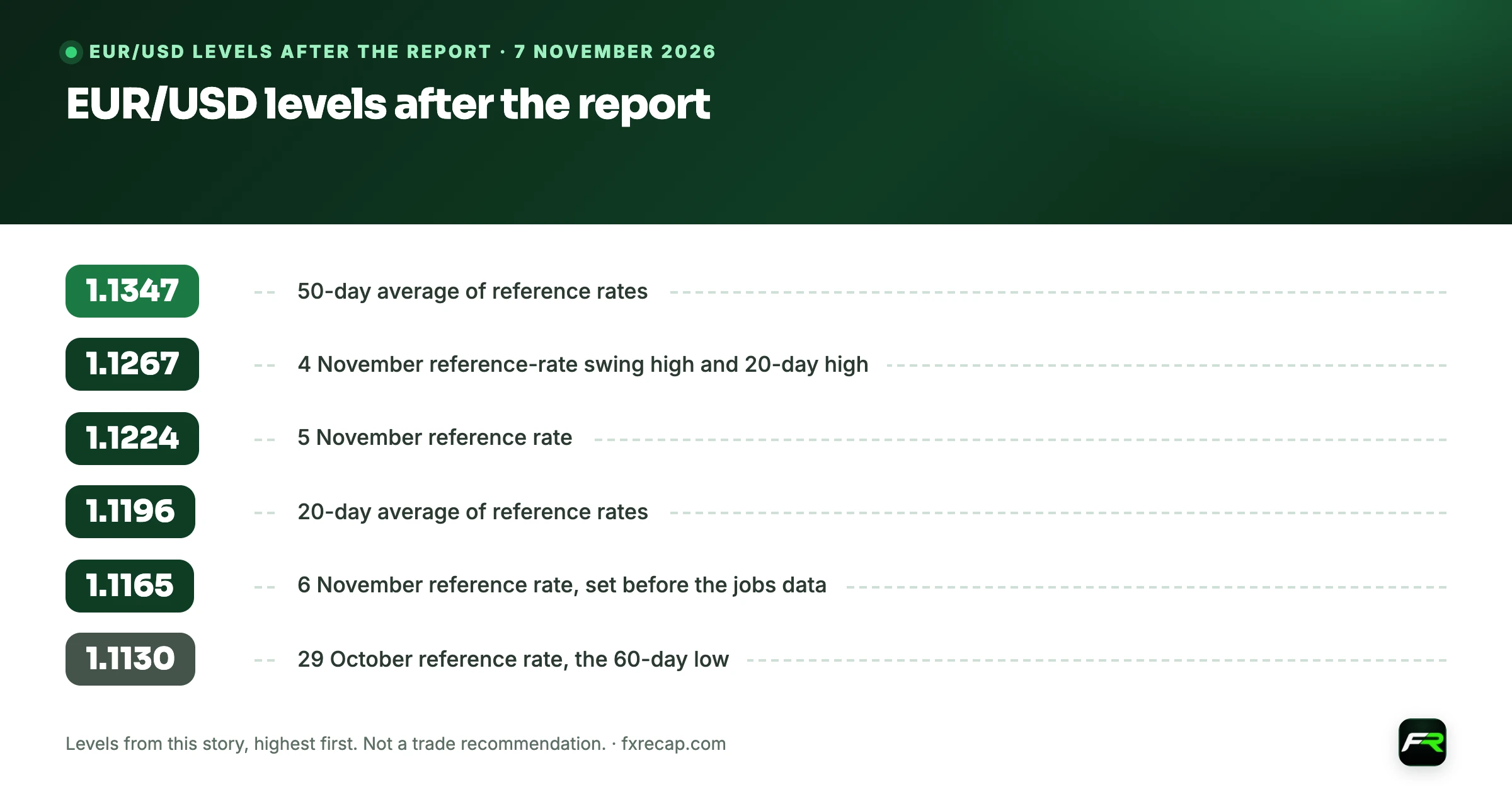
The European Central Bank (ECB) sets its euro reference rate at about 13:15 UTC, a quarter of an hour before US data, so Friday's fixing of 1.1165 shows where EUR/USD stood just before the jobs report, not after it. Monday's fixing will be the first official rate to include the reaction. The levels below come from those reference rates; they are not intraday highs or lows.
| Level | Why it matters |
|---|---|
| 1.1347 | 50-day average of reference rates |
| 1.1267 | 4 November reference-rate swing high and 20-day high |
| 1.1224 | 5 November reference rate |
| 1.1196 | 20-day average of reference rates |
| 1.1165 | 6 November reference rate, set before the jobs data |
| 1.1130 | 29 October reference rate, the 60-day low |
The euro had already lost ground before the release, slipping from 1.1267 on Wednesday to 1.1165 on Friday, and its 14-day relative strength index (RSI) on reference rates fell to about 42. A jobs report that lifts US yields usually adds to that kind of pressure, which puts the 60-day low at 1.1130 in focus. A close back above the 20-day average near 1.1196 would suggest the dollar's push has stalled.
USD/JPY was 158.33 on Friday's derived reference rate, near the top of its 20-day range, and it tends to follow the 2-year yield closely. Gold, which pays no interest, often struggles when yields rise, yet spot gold was about $4,072 at 03:31 UTC on Saturday (gold-api.com), up from roughly $4,046 a day earlier. That resilience is worth noting, but one day is not a trend.
What it means for traders
- Expect the dollar to trade on inflation data next week. US consumer prices for October come out on Tuesday 10 November at 13:30 UTC, and after a strong jobs report a high reading would matter more than usual.
- Treat revisions as part of the headline. The 84,000 upward revision changed the story of the last three months as much as October's own number.
- Watch the 2-year yield around 4.58% to 4.61%, the levels of earlier this week. A move back there would show markets leaning towards a December rise.
- Follow the live price and our levels on the EUR/USD analysis, and check release times in your zone on the economic calendar.
Say you think the dollar's strength continues and plan to sell EUR/USD near the 20-day average at 1.1195, with a stop at 1.1270, 75 pips away above the swing high. On a $4,000 account risking 1%, your maximum loss is $40, so each pip can be worth about $0.53, roughly 5,300 units. If you are wrong and inflation data pushes the pair through 1.1270 with a 20-pip gap, the loss becomes about $50. Work out the size before the trade with our <a href="/position-size-calculator">position size calculator</a>.
Moves after jobs and inflation releases can be fast and can gap past stop orders. Leverage magnifies losses as well as gains, so only trade money you can afford to lose. This article is news and education, not a recommendation to buy or sell.
Payrolls, unemployment, earnings, revisions and industry detail are from the US Bureau of Labor Statistics Employment Situation for October 2026 and its summary table B. Yields are Treasury daily par yield curve rates. EUR/USD and USD/JPY are ECB reference rates or derived from them; spot gold is from gold-api.com. Fed details are from the 28 October Federal Open Market Committee (FOMC) statement.
Cite this guide
FX Recap, "US Payrolls Jump 165,000 in October as Unemployment Dips to 4.1% and Pay Rises 0.4%", updated 7 November 2026, https://fxrecap.com/forex-news/top-stories/us-payrolls-165000-october-2026
Free to quote with a link. Journalists: data and comment in our press room.
Frequently asked
How many jobs did the US add in October 2026?
Nonfarm payrolls rose by 165,000 in October 2026, according to the Bureau of Labor Statistics. August and September were revised up by a combined 84,000, to 186,000 and 60,000.
What is the US unemployment rate now?
The unemployment rate was 4.1% in October 2026, down from 4.2% in September. It has stayed between 4.1% and 4.3% since March.
How fast are US wages rising?
Average hourly earnings for private workers rose 0.4% in October to $38.00 and were 3.1% higher than a year earlier. September's monthly rise was revised up to 0.3%.
When is the next US jobs report?
The BLS publishes the November 2026 Employment Situation on Friday 4 December at 08:30 New York time, which is 13:30 UTC, five days before the Fed's 9 December decision.
Sources: US Bureau of Labor Statistics: Employment Situation, October 2026 · US Treasury: daily par yield curve rates · ECB: euro foreign exchange reference rates · Federal Reserve: FOMC statement, 28 October 2026 · US Bureau of Labor Statistics: Employment Situation summary table B
The team behind this guide
Researched, checked and approved by five forex specialists
Every guide is written, fact-checked and edited before it goes live, and updated when the facts change. Spotted an error? Tell us.