 IC Markets




































 WriterAbir KhanWriterWrites the guides · checks every figure against primary sources View profileAbout Abir →
 Written byAbir KhanWriter
 Market analysisTanbir Habib RiyadForex & Crypto AnalystForex and crypto analyst · technical and fundamental analysis View profileAbout Tanbir →
 Market analysis byTanbir Habib RiyadForex & Crypto Analyst
 Fact-checking & riskJannatul FerdaushFact-Checker & Risk AnalystFact-checks every figure · risk analysis · Applied Statistics, University of Dhaka View profileAbout Jannatul →
 Fact-checked byJannatul FerdaushFact-Checker & Risk Analyst
 Trading reviewJowel RanaCo-Founder & Forex TraderCo-founder · forex trader · reviews guides from a trader's view View profileAbout Jowel →
 Reviewed byJowel RanaCo-Founder & Forex Trader
 Final approvalRanjan NiskrityFounder, Owner & Forex TraderFounder and owner · forex trader · signs off every guide View profileAbout Ranjan →
 Approved byRanjan NiskrityFounder, Owner & Forex Trader
Last verified Against each broker's own terms
CFDs are complex instruments and carry a high risk of losing money rapidly due to leverage. A bonus does not reduce that risk. Offers change often, so confirm the live terms on the broker's site before you deposit. Some links below are affiliate links; they never change which offers we list or how we rate them.
Forex deposit bonus offers checked this month
Each offer below comes from a broker we have reviewed, and each figure is taken from the broker's own promotion page or terms document. The table gives the headline numbers; the cards underneath show the condition that decides whether the bonus is worth having.
| Broker | Match | Max bonus | Min. deposit | Type | Bonus cashable? |
|---|---|---|---|---|---|
 HFM HFM | 100% | $50,000 | Varies by region | Tradable | No |
 IC Markets IC Markets | 100% | $1,000 on the first deposit | $50 | Credit | No |
 XM XM | 50%, then 20% | $5,000 ($500 + $4,500) | $5 | Tradable | No |
 LiteFinance LiteFinance | 30% | $5,000 | $50 | Tradable | After 50 trades |
 Blueberry Blueberry | 20% | $2,000 | $100 | Credit | No |
 AvaTrade AvaTrade | 20% | $10,000 | Set in the current promotion terms | Tradable | After a volume target |
 RoboForex RoboForex | Flat $30 | $30 | $10 by bank card | Welcome credit | No |
HFM 100% Supercharged Bonus
HFM regional entities, including HF Markets SA (FSCA) and HFM Kenya (CMA)
- Max bonus
- $50,000
- Min. deposit
- Varies by region
- Bonus withdrawable
- No
- Profits withdrawable
- Yes
The catch: Each withdrawal removes bonus credit dollar for dollar. The $2 per lot rebate on gold is capped at $8,000 and ignores trades held under a minute.
IC Markets 100% First Deposit Bonus
Raw Trading Ltd, the Seychelles (FSA) entity behind IC Markets Global
- Max bonus
- $1,000 on the first deposit
- Min. deposit
- $50
- Bonus withdrawable
- No
- Profits withdrawable
- Yes
The catch: Only the first qualifying deposit earns the 100% rate, one profile per person, and the credit cannot be combined with other offers.
XM 50% + 20% Deposit Bonus
XM Global, the group's international entity
- Max bonus
- $5,000 ($500 + $4,500)
- Min. deposit
- $5
- Bonus withdrawable
- No
- Profits withdrawable
- Yes
The catch: Any withdrawal, profit or principal, removes the bonus in proportion to the share of balance you take out. Ultra Low and Shares accounts are excluded.
LiteFinance 30% Deposit Bonus (code EASYSTART)
LiteFinance's international entity
- Max bonus
- $5,000
- Min. deposit
- $50
- Bonus withdrawable
- After 50 trades
- Profits withdrawable
- Yes, straight away
The catch: Usable twice per client and valid for six months. Pulling out your own money cuts the bonus in proportion, and the account cannot join copy trading.
Blueberry 20% Trade Credit
Blueberry Markets (V) Ltd (VFSC) and Blueberry Markets (Mauritius) Ltd
- Max bonus
- $2,000
- Min. deposit
- $100
- Bonus withdrawable
- No
- Profits withdrawable
- Yes
The catch: Margin only: the credit keeps positions open but never pays for a loss. It lands within 24 hours of the deposit.
AvaTrade 20% First Deposit Bonus
AvaTrade's international (non-EU) entity
- Max bonus
- $10,000
- Min. deposit
- Set in the current promotion terms
- Bonus withdrawable
- After a volume target
- Profits withdrawable
- Yes
The catch: The bonus unlocks only after you trade a set volume for every $1 of bonus, and AvaTrade has changed that ratio over the years. Read the live terms before depositing.
RoboForex $30 Welcome Bonus
RoboForex's international entity
- Max bonus
- $30
- Min. deposit
- $10 by bank card
- Bonus withdrawable
- No
- Profits withdrawable
- Yes, no volume rule
The catch: Only ProCent and Pro accounts in USD or EUR qualify, the code expires after 30 days, and past welcome-bonus users are excluded. Prepaid cards do not count.
No bonus at Exness: several large brokers, Exness among them, pay no deposit bonus anywhere. Their offshore entities compete on spreads and fast withdrawals instead, which can be worth more to an active trader than a credit that shrinks every time you cash out.
More promotions from brokers we list
Beyond the deposit bonuses above, the brokers we cover run cash rewards, loyalty schemes, competitions and referral offers. Each card links to our full write-up of the terms.
 LiteFinanceCash reward
LiteFinance 50% Cash Reward (Trade Smart)
A cash reward of 50% of your deposit if you make 50% profit in 30 days while staying inside four risk limits.
 OANDAWelcome bonus
OANDA Welcome Bonus up to $25,000 (US and Canada)
$250, $2,500 or $25,000 for US and Canadian clients who deposit and trade enough within 90 days. Register by 31 October 2026.
XMLoyaltyXM Traders Club: Earn XM Coins
Earn XM Coins on every real-account trade across five statuses, then redeem them for cash, tradable bonuses or tools.
 IUXCashback
IUX LotBack Rebate Program
0.5 to 1.5 points per standard lot, each worth $0.50, on trades held at least five minutes; tiers rise with trading days.
XMCompetitionXM Trading Competitions
Free demo contests, including a $25,000 weekly pool for 100 winners and a Daily Arena of up to $5,000, plus a $5 paid daily contest.
 EightcapTrade credit
Eightcap Trading Credit Bonus up to $1,000
Up to $1,000 of credit for selected new clients, converted to real money at $1 per standard FX lot traded.
How a forex deposit bonus works
A forex deposit bonus is promotional credit a broker adds after you fund a live account. Deposit $1,000 with a 50% offer and the platform shows $1,500 of equity: $1,000 of your money plus $500 of credit. That extra $500 lets you open bigger positions or ride out a deeper drawdown before a margin call.
What you cannot do is take that $500 home. Brokers book it in a separate credit field, and every offer on this page treats it as non-withdrawable in its raw form. Some convert part of it to cash once you have traded enough lots; others never do, and it simply disappears when your balance runs out or you close the account.
Your own deposit stays yours at every point. Withdrawing it is allowed, but most terms cut the bonus in the same proportion, so pulling half your balance usually wipes half the credit. HFM goes further and removes credit dollar for dollar on any withdrawal.
You will also see the same offer sold as a welcome bonus, first deposit bonus, match bonus or trading credit. The label changes; the mechanics above do not.
Deposit bonus and lot calculator
Enter the offer's numbers to see the credit you would get, the lots needed to unlock it and what a withdrawal would cost you. Use the lot rule from the broker's terms; many offers are written as a dollar amount of bonus released per standard lot.
Types of forex bonus
"Deposit bonus" covers several different mechanics. Two offers with the same percentage can behave in opposite ways once a trade goes against you, so it pays to know which kind you are claiming.
| Bonus type | Suits | How it works | Example |
|---|---|---|---|
| Welcome or first deposit bonus | New live accounts | 20% to 100% of the first deposit, with a cap | IC Markets, AvaTrade |
| Reload bonus | Clients topping up | A lower rate on later deposits, often time limited | XM's 20% second tier |
| Tradable bonus | Traders wanting a loss buffer | Counts as equity, so it can absorb drawdowns | HFM, XM, LiteFinance |
| Credit (margin-only) bonus | Traders wanting more headroom | Holds trades open but never pays a loss | Blueberry |
| No-deposit bonus | Testing a new broker | $10 to $100 free, with tight profit caps | See our no-deposit list |
| Cashback or rebate | High-volume traders | Money back per lot, usually withdrawable | See our cashback list |
The split that matters most is tradable versus credit. A tradable bonus counts toward equity and can soak up part of a losing run. Margin-only credit, like Blueberry's, only widens the room you have to open or hold trades; your own balance pays every loss.
Bonus terms that decide the value
Headline percentages sell the offer. These eight clauses decide what it is worth, and all of them sit in the terms document rather than on the promotion banner.
Lot or volume target
Offers that convert the bonus to cash tie it to trading volume, such as a number of trades or lots per dollar of credit. Divide the credit by the lot rule and compare that with the lots you place in a normal month.
Withdrawal clawback
Proportional removal is standard: withdraw 40% of your balance and 40% of the credit goes. A dollar-for-dollar rule, like HFM's, is harsher on small accounts.
What happens at stop out
Once your own balance is gone, most brokers remove the credit and close whatever is still open. A bonus delays a margin call; it does not cancel one.
Expiry date
LiteFinance gives six months and RoboForex's code lasts 30 days. Unconverted credit is removed on the deadline, and open trades can be stopped out when it goes.
Eligible accounts
Raw, ECN, swap-free and share accounts are often excluded. XM leaves out Ultra Low and Shares accounts, so pick the account type before you deposit.
Payment method rules
Some offers only count certain funding routes. RoboForex needs a bank card and rejects prepaid ones, while other brokers skip e-wallet deposits entirely.
One claim per person
Every broker here limits the bonus to one verified client. A second account, a relative's account or a shared device can void the credit and the profits made with it.
Strategy and leverage limits
Terms often ban arbitrage, hedging across accounts and bonus farming, and some cap leverage while a bonus is active. LiteFinance, for instance, sets a 1:1000 ceiling.
Worked example: where the bonus went
- Deposit
Rafi funds a new account with $1,000. The 50% tier pays $500 of credit, so his equity starts at $1,500.
- First month
Trading 0.2 to 0.3 lots on EUR/USD and gold, he finishes the month $180 up. Balance: $1,180. Credit: still $500.
- Withdrawal
He asks for $590, half his balance, to cover rent. Half the credit goes with it, leaving $250.
- Result
Net, he banked $180 of profit but gave up $250 of margin buffer he had planned to lean on during an NFP week.
Rafi's mistake was timing, not the bonus. Had he withdrawn only the $180 profit, roughly 15% of his balance, he would have kept about $424 of credit. Plan withdrawals around the clawback rule before you claim.
Where forex bonuses are banned or allowed
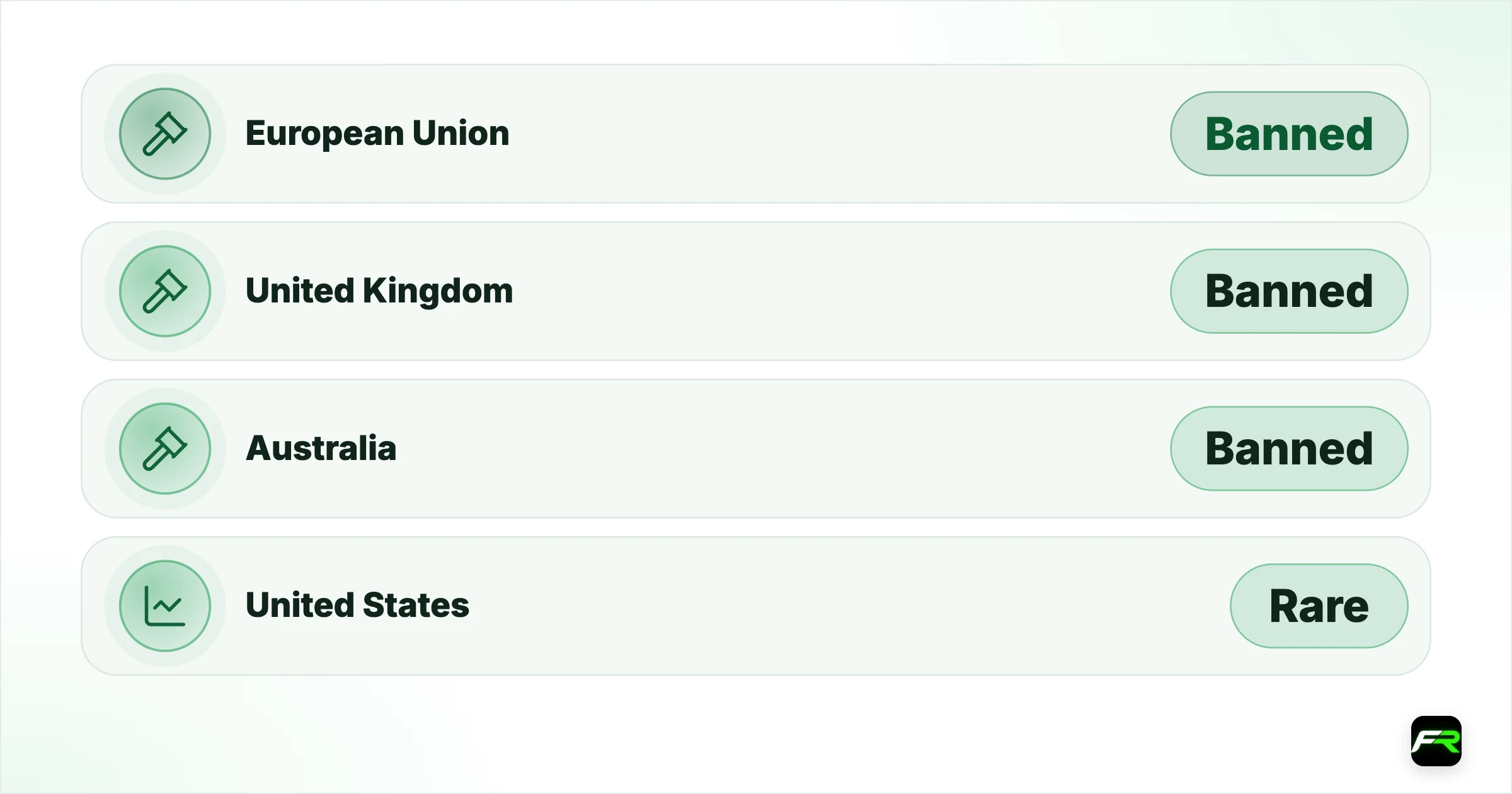
Your country, not the broker's brand, decides if you can claim. Regulators in three major markets treat bonuses as an inducement that pushes retail clients to over-trade, and they banned them outright.
| Region | Regulator | Status | Detail |
|---|---|---|---|
| European Union | ESMA and national regulators such as CySEC | Banned | Banned for retail clients since ESMA's 2018 CFD product intervention, now written into national rules. |
| United Kingdom | FCA | Banned | Banned for retail clients. The FCA made the ESMA restrictions permanent in 2019 (policy statement PS19/18). |
| Australia | ASIC | Banned | Banned since 29 March 2021 under ASIC's CFD product intervention order, which targets inducements to trade. |
| United States | CFTC and NFA | Rare | Occasional cash offers from US dealers. Offshore bonus brokers seldom accept US residents. |
| South Africa | FSCA | Allowed | Allowed, provided the offer is clear and does not push reckless risk. HFM runs its Supercharged bonus through its FSCA entity. |
| Kenya | CMA | Allowed | Allowed. HFM publishes Supercharged bonus terms for its Kenyan entity. |
| Offshore hubs | FSA Seychelles, FSC Mauritius, VFSC Vanuatu, FSC Belize | Allowed | Allowed, and home to most bonus-paying entities. Oversight is lighter, so check the entity's licence number yourself. |
Large brokers run several licensed companies at once. Your country of residence decides which one onboards you, and that company sets the promotions you are shown. An XM client in Germany signs with the CySEC entity and gets no offer; a client in Kenya or Bangladesh signs with XM Global and does.
Deposit bonus trends in 2026
Four shifts stood out when we re-checked every offer this month. Each one changes how much a bonus is worth to you.
Loyalty points are replacing match bonuses
Brokers now lean on programmes that pay per lot instead of a one-off credit: XM Traders Club, IUX LotBack and HFM's per-lot rebate. They reward steady trading, and the payouts are usually cash you can withdraw. Compare them on our cashback page.
Offers now differ country by country
A single brand can run a 50% bonus in one market, a flat credit in another and nothing in a third. LiteFinance and Blueberry both publish long lists of excluded countries, so check the terms against your own residence first.
Regulators are chasing bonus promoters
In June 2025 the FCA, ASIC and seven other regulators ran a joint week of action against unlawful "finfluencer" promotions, with more than 650 takedown requests. A bonus pushed hard on social media is a reason for caution, not comfort.
Tighter one-client checks
Phone or SMS verification, one bonus per IP address and a single verified profile are now standard. XM's no-deposit terms spell out the IP rule, and a second account in the household can void every credit on both.
Is a forex deposit bonus worth claiming?
A bonus is worth taking when it fits how you already trade. Changing your plan to chase the credit is where most traders lose more than the offer was ever worth.
Good fit if
- You already trade enough lots each month to clear the volume target without changing your plan.
- Money will stay in the account for months, with few withdrawals planned.
- The entity paying the bonus holds a licence you can verify on the regulator's own register.
- You want a margin buffer for swing trades and understand it will not stop a loss.
Skip it if
- You would need to trade bigger or more often than usual just to unlock the credit.
- A withdrawal is likely soon, and the clawback would erase most of the value.
- The offer is 200% or more, or the broker has no licence you can check.
- You plan to use copy trading or an account type the terms exclude.
Seven checks before you claim
- Confirm the legal entity and its licence number on the regulator's website
- Read the bonus terms on the broker's own site, not an affiliate summary
- Work out the lots needed and compare them with your normal monthly volume
- Check whether withdrawals remove the credit proportionally or dollar for dollar
- Note the expiry date and what happens to open trades when it passes
- Make sure your account type and payment method qualify
- Test a small withdrawal of your own funds before you scale up
Bonus red flags
Unlicensed brokers use oversized bonuses as bait. Walk away if you see any of these.
Large multiples usually come with volume targets no retail trader reaches, and they are a favourite hook of unlicensed firms.
Legitimate terms lock the credit, never your own money. A broker that refuses to return your deposit until you trade a target is a warning sign.
If the rules exist only in a chat window or a Telegram message, you have nothing to hold the broker to.
Calls urging you to deposit more to unlock a bigger bonus follow the script used by scam brokers.
A company number from an offshore registry is not a financial licence. Look the entity up on the regulator's register.
Spotted one? Check the firm against our scam broker blacklist and the regulator's own register before sending money.
Deposit bonus terms, defined
Bonus terms borrow a handful of account words. These are the ones that decide what happens to your credit.
- Balance
- Your deposited money plus closed profits, minus closed losses. The only part you can withdraw.
- Credit
- The bonus amount, held in a separate field. It supports margin but is not cash.
- Equity
- Balance plus credit plus or minus open profit and loss. Margin levels are measured against it.
- Margin level
- Equity divided by used margin, shown as a percentage. Brokers warn you at the margin call level and close trades at the stop-out level.
- Volume requirement
- The trading needed to unlock a bonus, written as lots, trades or turnover per dollar of credit.
- Clawback
- The share of credit removed when you withdraw, either in proportion to your withdrawal or dollar for dollar.
- Promo code
- A code such as LiteFinance's EASYSTART that you enter in the client area to activate an offer.
- Entity
- The licensed company you sign with. It decides your protections and which bonuses you are offered.
Forex deposit bonus FAQs
What is a forex deposit bonus?
A forex deposit bonus is extra trading credit a broker adds when you fund a live account, usually 20% to 100% of the deposit up to a cap. It raises your usable margin, so you can open larger positions or survive a deeper drawdown. The credit itself is not cash, and it is removed when you withdraw or when your own balance runs out.
Can I withdraw a forex deposit bonus?
Not directly. Every offer we checked treats the bonus as non-withdrawable credit. Profits you make while it is active can be withdrawn, and a few brokers, such as LiteFinance, convert the credit into withdrawable cash after you meet a trading target. XM, IC Markets and Blueberry keep it as credit only.
How many lots do I need to trade to unlock a bonus?
It depends on the broker's formula. Some use trades per bonus (LiteFinance asks for at least 50 trades), others use a volume ratio per $1 of credit. Divide your bonus by the stated rule and compare the answer with your usual monthly lots. Our calculator on this page does that sum for you.
Does a deposit bonus protect me from a margin call?
Only for a while. A tradable bonus adds equity, so it takes longer to hit your margin call level. Once your own money is gone, most brokers remove the credit, and positions close at the stop-out level. A margin-only credit, such as Blueberry's, never absorbs a loss at all.
What happens to my bonus if I withdraw money?
Most terms cut the credit in proportion to the share of balance you take out, so withdrawing 30% of your balance removes 30% of the bonus. HFM removes credit dollar for dollar on any withdrawal. Plan withdrawals before you claim, because the clawback often costs more than traders expect.
Why can't I get a deposit bonus in the UK, EU or Australia?
Regulators there ban them for retail clients. ESMA restricted incentives on CFDs in 2018, the FCA made that rule permanent in 2019, and ASIC's product intervention order banned inducements from 29 March 2021. Brokers licensed in those regions serve local clients with no bonus, while their offshore entities serve everyone else.
Is a 100% deposit bonus better than a 30% one?
Not automatically. A 100% credit with a dollar-for-dollar clawback and a short expiry can be worth less than a 30% bonus that converts to cash after 50 trades. Compare the withdrawal rule, the volume target and the expiry before the headline percentage.
What is the difference between a deposit bonus and a no-deposit bonus?
A deposit bonus is paid on money you put in, so it scales with your deposit. No-deposit bonuses are small fixed credits, usually $10 to $100, paid just for opening and verifying an account, with a tight cap on the profit you can withdraw. RoboForex's $30 offer sits between the two because it needs a $10 card deposit.
Are brokers that offer bonuses safe?
Some are and some are not. Bonuses come from offshore entities with lighter oversight, which is legal but offers less protection than an FCA or ASIC account. Check the paying entity's licence on the regulator's own register, read the terms on the broker's site, and start with a small withdrawal test.
Sources: ESMA CFD product intervention (2018), FCA PS19/18, ASIC CFD product intervention order, XM Global bonus terms, HFM Supercharged Bonus terms (HF Markets SA), IC Markets deposit bonus terms, LiteFinance EASYSTART terms, Blueberry trade credit, RoboForex welcome bonus rules, AvaTrade first deposit bonus terms.