IC Markets





































Best Trading Hours for Asian Retail Traders, by Time Zone
The session overlaps that matter, by city: Jakarta, Manila, Mumbai, Bangkok, Singapore and Tokyo, and the best window for part-time traders.
 WriterAbir KhanWriterWrites the guides · checks every figure against primary sources View profileAbout Abir →
 Market analysisTanbir Habib RiyadForex & Crypto AnalystForex and crypto analyst · technical and fundamental analysis View profileAbout Tanbir →
 Fact-checking & riskJannatul FerdaushFact-Checker & Risk AnalystFact-checks every figure · risk analysis · Applied Statistics, University of Dhaka View profileAbout Jannatul →
 Trading reviewJowel RanaCo-Founder & Forex TraderCo-founder · forex trader · reviews guides from a trader's view View profileAbout Jowel →
 Final approvalRanjan NiskrityFounder, Owner & Forex TraderFounder and owner · forex trader · signs off every guide View profileAbout Ranjan →
The forex day runs in overlapping sessions: Sydney, then Tokyo, then London, then New York, then round again. The best conditions for most retail strategies are during the busiest hours, which are the Tokyo open and, above all, the London-New York overlap. What those clock times are for you depends on your city. Here is the map.
The key windows in GMT
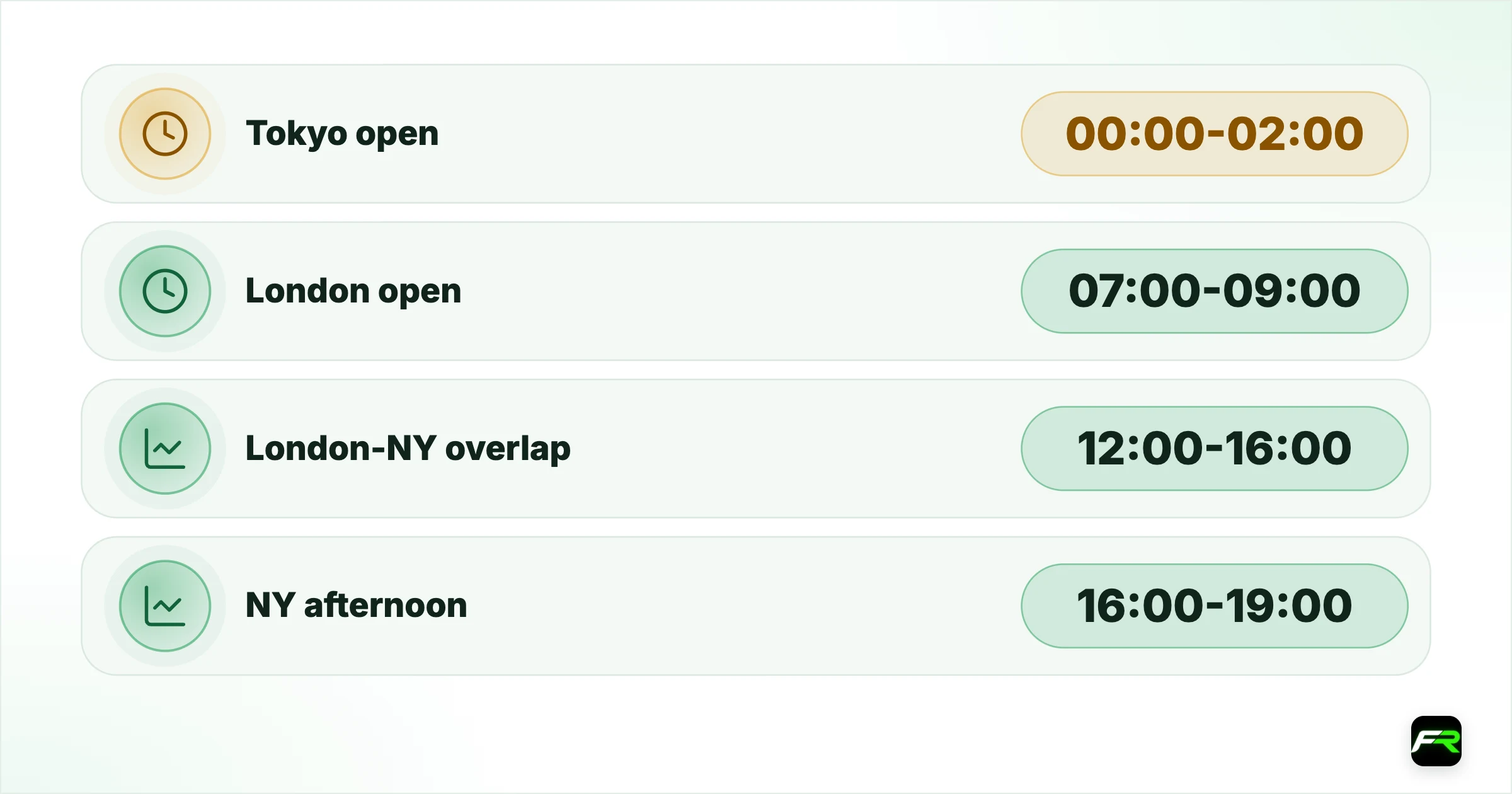
| Window | GMT | Why it matters |
|---|---|---|
| Tokyo open | 00:00-02:00 | Most active part of the Asian session; range often sets here |
| London open | 07:00-09:00 | First big volume and directional push of the day |
| London-NY overlap | 12:00-16:00 | Deepest liquidity, tightest spreads, largest moves |
| NY afternoon | 16:00-19:00 | Fading; Fed decisions land at 18:00-19:00 |
Converted to Asian cities
| City (offset) | Tokyo open | London open | London-NY overlap |
|---|---|---|---|
| Tokyo, Seoul (GMT+9) | 09:00-11:00 | 16:00-18:00 | 21:00-01:00 |
| Manila, Singapore, KL (GMT+8) | 08:00-10:00 | 15:00-17:00 | 20:00-24:00 |
| Jakarta, Bangkok, Hanoi (GMT+7) | 07:00-09:00 | 14:00-16:00 | 19:00-23:00 |
| Dhaka (GMT+6) | 06:00-08:00 | 13:00-15:00 | 18:00-22:00 |
| Mumbai, Colombo (GMT+5:30) | 05:30-07:30 | 12:30-14:30 | 17:30-21:30 |
One note on Indonesia: the table above uses Jakarta time (WIB, GMT+7), which covers the great majority of the population and most brokers' local marketing. Indonesia actually spans three time zones, and eastern provinces on WIT run two hours ahead of Jakarta, so adjust the table by that difference if you are trading from further east.
How daylight saving time shifts this table
Every window above is anchored to GMT, but GMT itself does not move, London and New York do, on their own separate daylight-saving calendars, while the cities in the table below largely do not observe DST at all. For a few weeks each spring and autumn, while the UK and the US are on different clocks from each other (Europe and America change on different dates), the London-New York overlap actually sits at a different GMT hour than the 12:00-16:00 used throughout this guide. Check the current GMT time of the overlap around late March and late October/early November rather than assuming this table is fixed year-round.
Rollover timing and the economic calendar
Two more things this table does not show. Most brokers charge triple the daily swap on Wednesdays to account for the weekend, so a position held overnight through a Wednesday rollover costs three days' financing in one hit. And "stay flat around scheduled US releases" only helps if you know when they land: the FX Recap economic calendar lists every scheduled release by time, so check it before committing to a session.
Which window for a day job
For most of Southeast Asia, the London-NY overlap falls in the evening, roughly 19:00 to 24:00 local. That is the deepest, most tradeable window and it is available after work. The trade-off is that it is fast: JPY pairs, gold and the majors can do 100-plus pips in an hour, and US data lands in the middle of it. So you trade it with wider stops, smaller positions sized for the volatility, and a rule to stay flat around scheduled US releases if you cannot watch closely. The session volatility guide covers the sizing adjustment.
The alternative is the Tokyo open, which for GMT+7 and GMT+8 cities is early morning. It is slower and more range-bound, which suits a patient strategy and a trader who prefers calm. It is a good window to trade before work if you can be up for it, and it is where a lot of Asian traders build their first consistent results. It is also the thinner half of the Asian day outside its first two hours, the Tokyo session liquidity guide covers exactly where that cutoff sits.
Farah works 9 to 6. She tried trading the Tokyo open at 08:00 local before work and found she was rushed and distracted. She switched to the London-NY overlap, 20:00 to 23:00 local, which is calmer for her mentally even though the market is faster. She sizes for the volatility, avoids the 20:30 to 21:30 window on US data days, and does most of her trading in a focused two-hour block. Her results are steadier than when she was fitting trades around the morning rush.
Hours to avoid
- The middle of the Tokyo session, roughly 03:00-05:00 GMT: quiet, choppy, wide spreads, lots of false breakouts.
- Late New York into the Sydney open, roughly 20:00-23:00 GMT: the thinnest hours of the day, gappy, avoid unless a specific event is in play.
- The Friday New York close and the Sunday-into-Monday open: low liquidity and weekend gap risk.
- The first few minutes after any major scheduled release, when the two-way spike makes fills unreliable, check the economic calendar before you sit down to trade, not after.
Pick one window and learn it deeply rather than trading across all of them. Traders who scatter their attention across every session tend to overtrade the marginal hours. One good two-hour block, most days, is enough.
Frequently asked
What is the single best time to trade forex from Asia?
The London-New York overlap, 12:00-16:00 GMT, which for most of Southeast Asia is the evening (roughly 19:00-24:00 local). It has the deepest liquidity, tightest spreads and the largest, most tradeable moves.
Is the Tokyo session good for beginners?
Yes, because it is slower and more range-bound, which gives more time to think and a simpler market to learn on. For GMT+7 and GMT+8 cities it falls in the early morning.
Can I trade forex with a full-time job in Asia?
Yes. The London-NY overlap is in the evening for most of the region and is the best window, available after work. Trade it with wider stops for the volatility and avoid it around major US data if you cannot watch.
Why avoid the middle of the Tokyo session?
Roughly 03:00-05:00 GMT is the quietest part of the day for forex: thin liquidity, wide spreads, choppy price and frequent false breakouts that clip stops on strategies that would work in the active hours.
Does daylight saving time change these hours?
Yes. London and New York move their local clocks on their own DST schedules while GMT and most of Asia stay fixed, so every window in this guide can shift by an hour in GMT terms for a few weeks each spring and autumn. Check the current GMT time of the overlap rather than assuming the table is permanent.
What time is the London-New York overlap in my city?
Add your city's GMT offset to 12:00-16:00 GMT. The city table above converts it directly for Tokyo, Seoul, Manila, Singapore, Kuala Lumpur, Jakarta, Bangkok, Hanoi, Dhaka, Mumbai and Colombo.
Is it better to trade the Tokyo open or the London-NY overlap?
The overlap has more liquidity and bigger moves but runs later in the evening for most of Southeast Asia. The Tokyo open is calmer and fits a before-work routine for GMT+7/+8 cities. Many traders start on the Tokyo open and move to the overlap once they are comfortable sizing for a faster market.
Should I trade multiple sessions?
Most part-time traders do better focusing on one window and learning its behaviour deeply. Trading across every session tends to lead to overtrading the marginal hours.
Related reading
The team behind this guide
Researched, checked and approved by five forex specialists
Every guide is written, fact-checked and edited before it goes live, and updated when the facts change. Spotted an error? Tell us.