IC Markets






































RBA's Hauser Says the Inflation Outlook Looks 'Materially Worse' as Australian CPI Nears
Two senior RBA officials warned this week that inflation is not beaten, just days before Wednesday's CPI and the 3 November rate decision.
 WriterAbir KhanWriterWrites the guides · checks every figure against primary sources View profileAbout Abir →

 Market analysisTanbir Habib RiyadForex & Crypto AnalystForex and crypto analyst · technical and fundamental analysis View profileAbout Tanbir →

 Fact-checking & riskJannatul FerdaushFact-Checker & Risk AnalystFact-checks every figure · risk analysis · Applied Statistics, University of Dhaka View profileAbout Jannatul →

 Trading reviewJowel RanaCo-Founder & Forex TraderCo-founder · forex trader · reviews guides from a trader's view View profileAbout Jowel →

 Final approvalRanjan NiskrityFounder, Owner & Forex TraderFounder and owner · forex trader · signs off every guide View profileAbout Ranjan →

Two senior Reserve Bank of Australia officials have spent the past week preparing the public for more bad news on prices. Deputy Governor Andrew Hauser told an investment conference in Sydney on 21 October that “the inflation outlook looks materially worse than we projected in the August report.” Four days later, on Sunday 25 October, Assistant Governor Sarah Hunter told the 60 Minutes programme that higher rates have not yet done enough: “Unfortunately, not quite yet.”
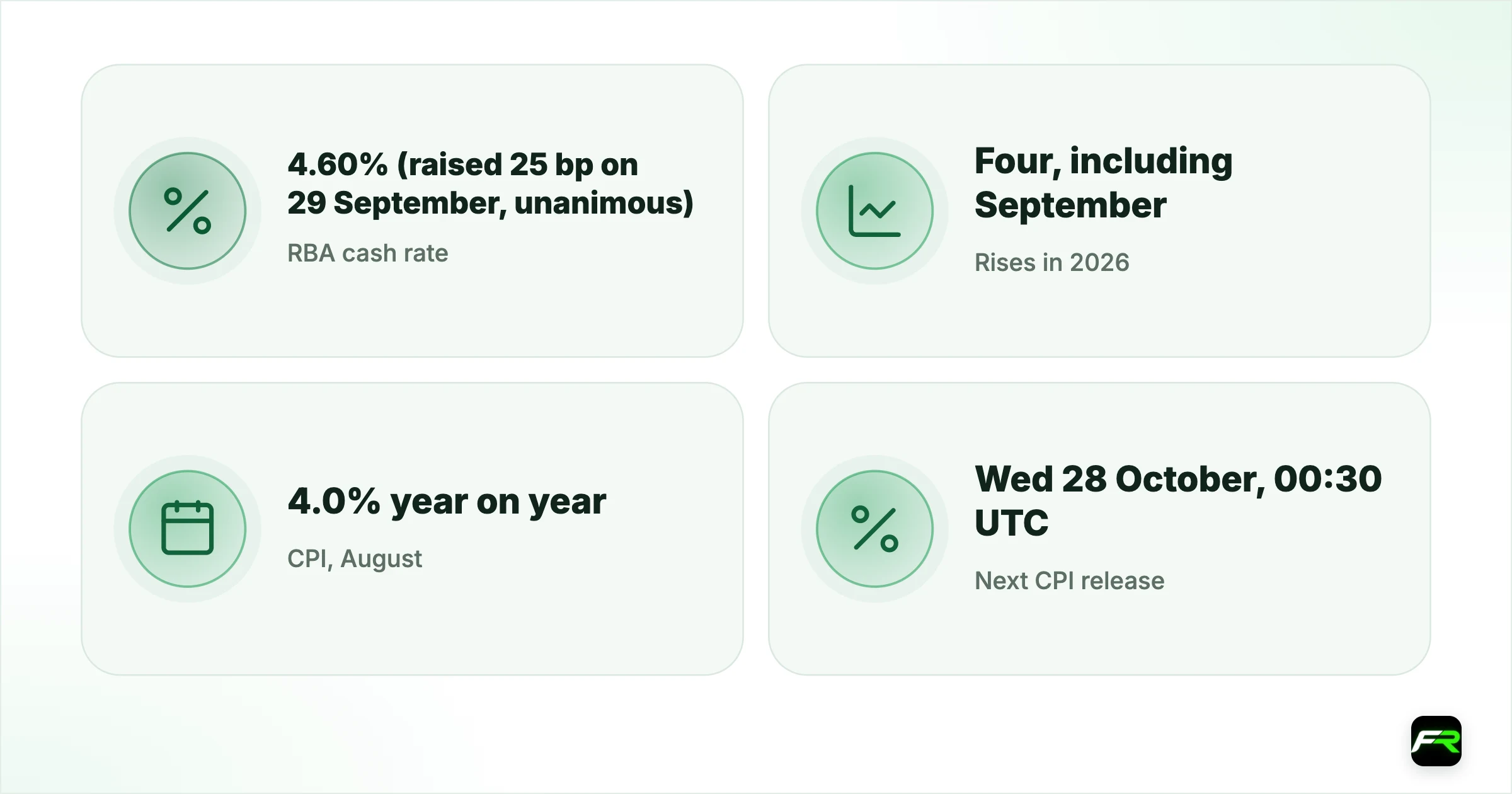
Both sets of remarks matter for the Australian dollar because of what comes next. The Australian Bureau of Statistics publishes September consumer prices, which complete the third-quarter reading, at 11:30 Canberra time on Wednesday 28 October (00:30 UTC). The RBA's Monetary Policy Board then decides on Tuesday 3 November with a new set of forecasts. The cash rate stands at 4.60% after four rises this year.
The RBA publishes transcripts of both appearances on its website, so every quotation below is taken from the bank's own record. Hunter's interview was pre-recorded on 21 October, the same day as Hauser's fireside chat.
| RBA cash rate | 4.60% (raised 25 bp on 29 September, unanimous) |
|---|---|
| Rises in 2026 | Four, including September |
| CPI, August (ABS) | 4.0% year on year; trimmed mean 3.6% |
| Next CPI release | Wed 28 October, 00:30 UTC (September and Q3) |
| Unemployment, September | 4.7%; employment −39,300 |
| Next RBA decision | Tue 3 November, 03:30 UTC |
| AUD/USD reference rate | 0.7022 on 23 October (derived from ECB rates) |
What Andrew Hauser said about inflation
Hauser, who is also Deputy Chair of the Monetary Policy Board, spoke at Citi's Australia and New Zealand Investment Conference. He said the staff were still finalising their forecasts, but that “a few things are clear.” He listed three upside risks the bank had flagged in August: a prolonged Middle East crisis, the boom in AI and technology spending, and tighter domestic capacity. By September, he said, the Board “judged that those three risks had crystallised.”
He then put a number on the oil shock. “Oil prices are even higher, about a third higher than we assumed in the August projection,” he said. Tech prices linked to AI were also feeding into the CPI, and the parts of the index rising fastest, such as market services, were the ones most closely tied to capacity pressure in the economy.
His strongest words were about expectations. Hauser said a survey the RBA runs with Macquarie University shows “an increasing share of businesses who are thinking that maybe three to three and a half per cent is the new normal.” He added: “that is the central banker's nightmare. We can't allow expectations to shift away from the target.”
Asked by a Reuters reporter about the quarterly CPI, he said that “absent a very, very big downside surprise in the last month of the quarter, the quarterly number is going to be bigger than we assumed in the August report.” He also noted that all data matter but none has a coefficient of one, a reminder that a single release will not decide the outcome on its own.
The hard choice the Board faces
Hauser did not say what the Board will do. Instead he set out the dilemma plainly. The bank can do more to tackle inflation, accepting a weaker economy and labour market, or it can “hold our horses to protect the labour market” and accept the risk that high inflation becomes embedded and costlier to fix. “Those are hard choices,” he said, adding that this is what the Board faces as it meets.
He also described how the economy is responding. Monetary policy is working, the labour market is easing and consumer spending growth is “quite tepid,” in his words. Housing is going through a major correction and household confidence is very weak. Against that, demand from Asia has been stronger than expected and a data centre construction boom is lifting business investment.
Early in the session, the moderator noted that market pricing that morning implied only about eight basis points of tightening for November. That figure was the questioner's, not the RBA's, and it shows how far traders had leaned towards a pause before these remarks were widely read.
What Sarah Hunter told 60 Minutes
Hunter, the Assistant Governor for economics, faced tougher questions about the cost to households. Asked whether the bank had done enough, she replied that the Board “have put through four rate hikes this year,” and that rates do work, “but it does take a bit of time.” On when the pain will end, she said: “we've got a little bit longer to go before it starts to get better.”
She pointed to the same pressures as Hauser. Petrol and diesel prices have gone up a lot in recent weeks, she said, and that rise is “starting to come through in our data,” with signs of it getting more embedded in supply chains such as construction costs. She also said demand in Australia is a bit too strong relative to what the economy can sustainably supply.
Hunter would not give a signal on the next move. Asked about an “early Christmas present,” she said: “I'm not going to front run what the Board might or might not do with interest rates.” She added that the bank is not trying to cause a recession and that “we don't see any signs of that yet in any of the data that we track.”
Wednesday's CPI: the numbers to watch
The September release is the last monthly print of the quarter, and the ABS now publishes the quarterly figures, including a quarterly trimmed mean, alongside it. In August, annual CPI inflation rose to 4.0% from 3.5% in July, while trimmed mean inflation held at 3.6%. Both are well above the RBA's 2% to 3% target band.
The jobs market gives the Board some reason for caution. ABS figures for September showed employment fell by 39,300 and unemployment edged up to 4.7%, while participation slipped to 66.8%. Our Australian jobs story covers the detail. Hauser described that data as “a little bit weaker than people had expected.”
| Indicator | Latest | Why it matters for 3 November |
|---|---|---|
| CPI, year on year | 4.0% (August) | A higher September print adds pressure for a fifth rise |
| Trimmed mean | 3.6% (August) | The RBA's main gauge of underlying inflation |
| Unemployment rate | 4.7% (September) | Rising joblessness argues for patience |
| Cash rate | 4.60% | Four rises in 2026 so far |
What it means for AUD/USD
The Australian dollar has been steady against the US dollar since the September hike. Using the ECB's euro reference rates, AUD/USD worked out at 0.7005 on 29 September and 0.7022 on Friday 23 October. The pair's 20-day range on those rates ran from 0.6911 on 15 October to 0.7034 on 21 October, well below the 2026 high of 0.7257 on 7 May.
Officials talking down any early relief tends to support a currency, because it keeps the gap between Australian and US rates in view. A hot CPI print on Wednesday would strengthen that case. A soft one would hand the argument to those who see the labour market as the bigger risk, and the Australian dollar could lose ground quickly. The Fed decides later the same day, so the US side of the pair can change just as fast.
- Mark 00:30 UTC on Wednesday for CPI and 03:30 UTC on 3 November for the RBA on our economic calendar.
- Read the trimmed mean first. Headline inflation is being pushed up by fuel, while the trimmed mean shows whether the rise is spreading.
- Keep position sizes small around 00:30 UTC. Liquidity in the Asian morning is thinner and spreads can widen.
- Track the daily levels in our AUD/USD analysis, which uses official reference rates.
Say you want to buy AUD/USD at 0.7020 after a hot CPI print, with a stop at 0.6980, 40 pips away. On a $3,000 account risking 1%, you can lose $30, so each pip can be worth 75 cents, which is a position of 7,500 units. If the spread jumps to 4 pips at the release, wait a few minutes for it to settle rather than paying it on entry. The <a href="/position-size-calculator">position size calculator</a> does this sum for you.
Inflation data and rate decisions can move the Australian dollar sharply within seconds, and prices can gap past stop orders. Leverage magnifies losses as well as gains, so trade only with money you can afford to lose.
Quotations come from the RBA's published transcripts of Andrew Hauser's fireside chat on 21 October 2026 and Sarah Hunter's 60 Minutes interview, aired on 25 October and pre-recorded on 21 October. Policy details are from the RBA's 29 September statement. Inflation and jobs data are from the Australian Bureau of Statistics. AUD/USD levels are derived from ECB euro reference rates (EUR/USD ÷ EUR/AUD). The market pricing figure was stated by the conference moderator. This is news, not investment advice.
Frequently asked
What did RBA Deputy Governor Andrew Hauser say about inflation?
On 21 October 2026 Hauser said the inflation outlook looks materially worse than the RBA projected in August, with oil prices about a third higher than assumed. He warned that businesses starting to see 3% to 3.5% inflation as normal would be a central banker's nightmare.
When is Australia's September 2026 CPI released?
The Australian Bureau of Statistics publishes it on Wednesday 28 October 2026 at 11:30 Canberra time, which is 00:30 UTC. The release also includes the third-quarter figures and the quarterly trimmed mean.
What is the RBA cash rate and when is the next decision?
The cash rate target is 4.60% after a 25 basis point rise on 29 September 2026, the fourth increase this year. The Monetary Policy Board next announces a decision on Tuesday 3 November 2026 at 14:30 Sydney time (03:30 UTC).
Did the RBA say it will raise rates in November?
No. Hauser described a hard choice between tackling inflation and protecting the labour market, and Assistant Governor Sarah Hunter said she would not front run what the Board might do.
Sources: Reserve Bank of Australia: Fireside Chat by Andrew Hauser, Deputy Governor (21 October 2026) · Reserve Bank of Australia: Interview on 60 Minutes, Sarah Hunter (25 October 2026) · Reserve Bank of Australia: Monetary Policy Decision, 29 September 2026 · Australian Bureau of Statistics: Consumer Price Index, Australia · Australian Bureau of Statistics: Labour Force, Australia, September 2026 · Reserve Bank of Australia: Board meeting schedules
The team behind this guide
Researched, checked and approved by five forex specialists
Every guide is written, fact-checked and edited before it goes live, and updated when the facts change. Spotted an error? Tell us.