IC Markets





































Reserve Bank of India Rate Decisions and USD/INR: What to Watch
USD/INR reacts less to the RBI's rate than to its tolerance for rupee moves, intervention and the inflation outlook. What to follow.
 WriterAbir KhanWriterWrites the guides · checks every figure against primary sources View profileAbout Abir →
 Market analysisTanbir Habib RiyadForex & Crypto AnalystForex and crypto analyst · technical and fundamental analysis View profileAbout Tanbir →
 Fact-checking & riskJannatul FerdaushFact-Checker & Risk AnalystFact-checks every figure · risk analysis · Applied Statistics, University of Dhaka View profileAbout Jannatul →
 Trading reviewJowel RanaCo-Founder & Forex TraderCo-founder · forex trader · reviews guides from a trader's view View profileAbout Jowel →
 Final approvalRanjan NiskrityFounder, Owner & Forex TraderFounder and owner · forex trader · signs off every guide View profileAbout Ranjan →
Key takeaways
- The RBI's intervention, not the repo-rate decision, is what really moves USD/INR. The pair tends to grind inside ranges the RBI defends, then step to a new range when it stops defending.
- Rate decisions are usually priced in; the tone on inflation and any hint about the exchange rate matter more than the rate itself.
- Oil prices, foreign portfolio flows, the dollar index and US yields move the rupee on days the RBI is quiet.
- For Indian residents, rupee derivatives on the NSE and BSE through a SEBI-registered broker are the regulated route; offshore USD/INR trading raises FEMA questions.
USD/INR is one of the more managed currency pairs a retail trader will encounter. The Reserve Bank of India actively smooths the rupee’s movements through intervention in the spot and forward markets, so USD/INR often grinds in a tight range for weeks, then moves in steps when the RBI adjusts how much it is willing to defend. For Indian residents, direct retail trading of USD/INR through offshore brokers sits in a legal grey area; exchange-traded currency derivatives on the NSE and BSE are the regulated route. This guide is about the drivers, not a recommendation to trade it offshore.
What the MPC decides
The Monetary Policy Committee sets the repo rate and the policy stance (accommodative, neutral, or withdrawal of accommodation) roughly every two months. It also publishes inflation and growth projections. The rupee’s immediate reaction to the rate is usually small, because the RBI telegraphs its moves and the market prices them in. The larger reactions come from the tone: a hawkish shift on inflation, or any signal about the RBI’s comfort with the current exchange rate.
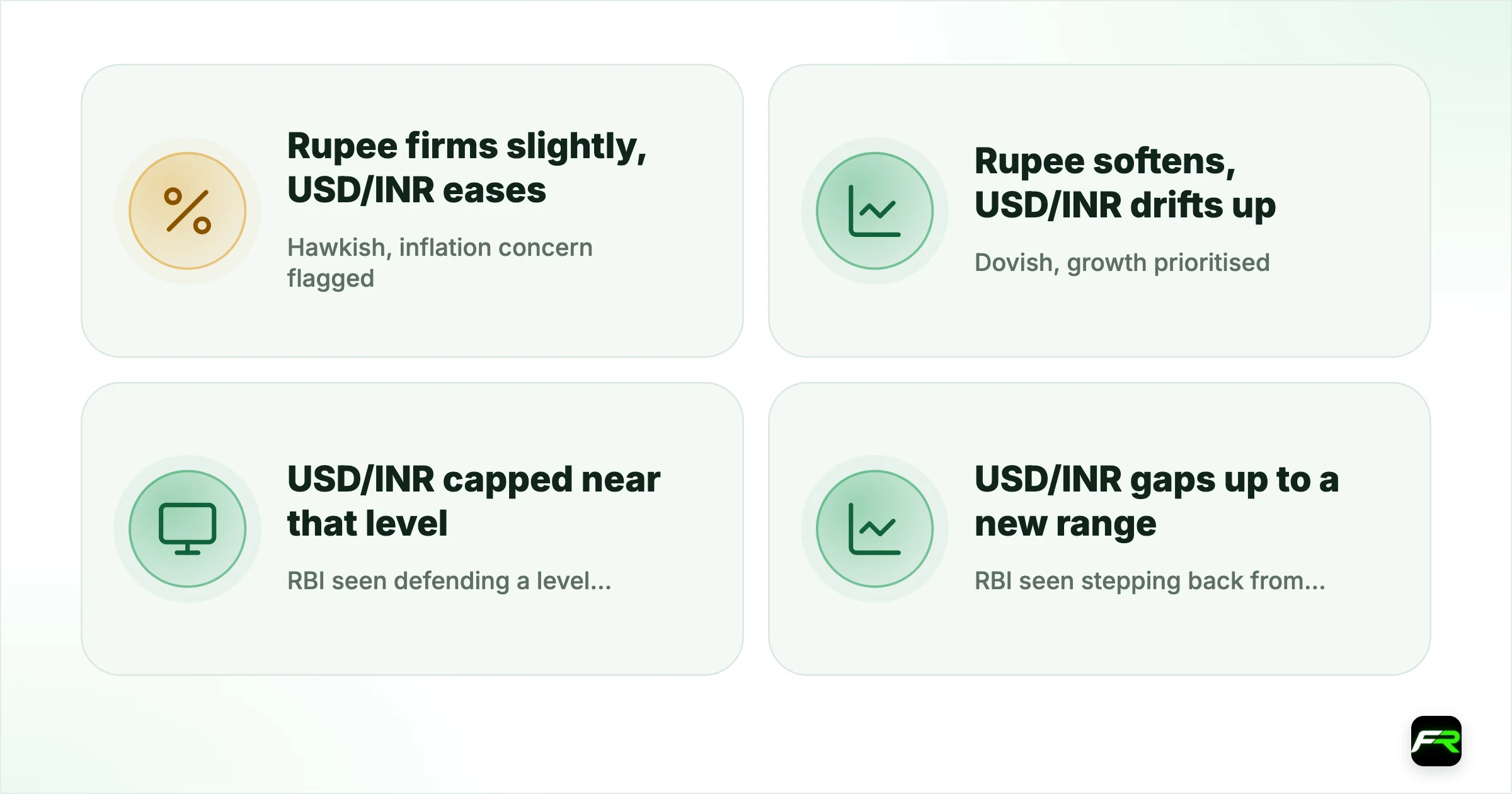
| Signal | Typical USD/INR reaction |
|---|---|
| Hawkish, inflation concern flagged | Rupee firms slightly, USD/INR eases |
| Dovish, growth prioritised | Rupee softens, USD/INR drifts up |
| RBI seen defending a level aggressively | USD/INR capped near that level |
| RBI seen stepping back from defence | USD/INR gaps up to a new range |
Intervention is the real driver
The RBI holds large foreign exchange reserves and uses them to lean against sharp rupee moves in both directions. When USD/INR rises toward a level the RBI is uncomfortable with, state-run banks are often seen selling dollars on its behalf, which caps the move. When the rupee strengthens too fast, the RBI buys dollars to rebuild reserves. The practical effect is that USD/INR trades in RBI-defined ranges, and the tradeable events are the moments the RBI shifts those ranges, not the two-monthly rate decision.
Deepak trades exchange-traded USD/INR futures on the NSE. He found the RBI decisions themselves were rarely worth trading; the pair barely moved. What mattered was the running commentary about where the RBI was defending. When reports suggested the RBI had allowed USD/INR through a level it had held for months, that step-change was the trade, and it had little to do with the formal policy meeting.
Other things that move the rupee
- Crude oil prices. India imports most of its oil, so a rising oil price widens the trade deficit and pressures the rupee.
- Foreign portfolio flows. Large inflows into Indian equities and bonds support the rupee; outflows during global risk-off weaken it.
- The dollar index. Broad dollar strength pushes USD/INR up regardless of anything domestic.
- US rates. Higher US yields pull capital toward the dollar and away from emerging markets, including India.
What to watch on decision day
The MPC statement and the governor’s press conference are released together, usually in the morning India time. Read the inflation projection and the stance language. But keep the intervention picture in mind: even a clearly hawkish or dovish statement produces a muted USD/INR move if the RBI is actively holding the pair in a range. The bigger signals come between meetings, when the RBI’s defended levels shift.
Indian residents can legally trade currency derivatives involving the rupee on recognised exchanges (NSE, BSE) through a SEBI-registered broker. Trading USD/INR through an offshore broker is a different matter under FEMA. See our broker guide on whether forex is legal in India.
Sources and where to check it yourself
- RBI monetary policy statements: every MPC resolution and the governor's statement, in full
- RBI reference rate archive: the official daily USD/INR reference rate history
- Financial Benchmarks India (FBIL): the administrator of India's official FX benchmark rates
Frequently asked
How often does the RBI decide on rates?
The Monetary Policy Committee meets about six times a year, roughly every two months, on a published schedule, and announces the repo rate and stance along with updated projections.
Why doesn’t USD/INR move much on RBI decisions?
Because the RBI telegraphs its moves and intervenes to smooth the exchange rate. The pair is largely range-bound between RBI-defined levels, so a rate decision alone rarely produces a large move.
Can I trade USD/INR as an Indian resident?
Legally, through exchange-traded currency derivatives on the NSE or BSE via a SEBI-registered broker. Offshore retail forex trading of USD/INR sits in a grey area under FEMA and most offshore brokers are on the RBI’s Alert List.
What matters more, the rate or the oil price?
Over weeks and months, oil prices and foreign portfolio flows often move the rupee more than the RBI rate does, because the RBI actively counteracts sharp moves while it lets the trade balance and flow picture play out.
What is RBI intervention?
The RBI buying or selling dollars (often through state-run banks) to slow rupee moves it considers too fast in either direction. It uses its large foreign exchange reserves to do this.
Related reading
The team behind this guide
Researched, checked and approved by five forex specialists
Every guide is written, fact-checked and edited before it goes live, and updated when the facts change. Spotted an error? Tell us.