 IC Markets





























Forex Risk Management To Protect Trading Capital
Risk management is what keeps you in the game long enough to learn. The core idea is simple: never bet big on one trade. Most traders risk only 1 to 2 percent of their account per trade, use a stop-loss to cap losses automatically, and size positions so one bad run can’t wipe them out. Protecting your capital matters more than chasing wins, because you can’t trade with money you’ve already lost.
 WriterAbir KhanWriterWrites the guides · checks every figure against primary sources View profileAbout Abir →
 Market analysisTanbir Habib RiyadForex & Crypto AnalystForex and crypto analyst · technical and fundamental analysis View profileAbout Tanbir →
 Fact-checking & riskJannatul FerdaushFact-Checker & Risk AnalystFact-checks every figure · risk analysis · Applied Statistics, University of Dhaka View profileAbout Jannatul →
 Trading reviewJowel RanaCo-Founder & Forex TraderCo-founder · forex trader · reviews guides from a trader's view View profileAbout Jowel →
 Final approvalRanjan NiskrityFounder, Owner & Forex TraderFounder and owner · forex trader · signs off every guide View profileAbout Ranjan →
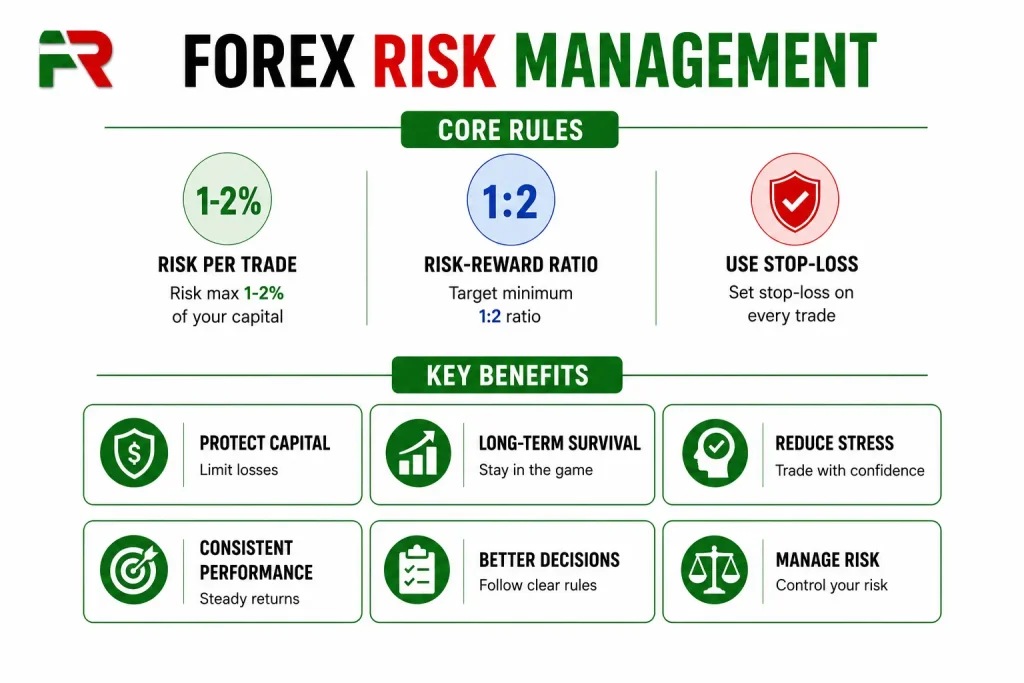
Forex risk management is the set of rules a trader uses to decide how much money can be lost on a single trade, a single day, and across an entire account, before that loss causes real mar. In practice, that means risking a small, fixed percentage of account capital per trade (commonly 1 to 2 percent), sizing each position around a specific stop-loss distance rather than a round number of lots, and capping how much can be lost in a day or a week regardless of how the trades are performing.
None of this removes risk from trading. Currency prices move on news, liquidity gaps, and central bank decisions that no chart pattern predicts with certainty. What proper risk management does is make sure a bad week doesn’t turn into a blown account, and that a sound strategy gets enough trades to prove itself before the money runs out.
What Forex Risk Management Covers
Risk management often gets reduced to “use a stop-loss,” but that’s one piece of a larger system. A full plan usually covers four separate layers: how much to risk on one trade, how that risk translates into a position size, how many trades can be open on correlated pairs at once, and how much the account is allowed to lose in a day or week before trading stops for that period.
Skipping any one of these layers weakens the others. A trader who risks 1 percent per trade but holds five correlated GBP pairs at once is effectively risking far more than 1 percent on a single move in the pound.
The 1 to 2 Percent Rule
The most repeated principle in forex risk management is to risk no more than 1 to 2 percent of total account capital on any single trade. On a $10,000 account, that’s $100 to $200 per trade, regardless of how confident the setup looks.
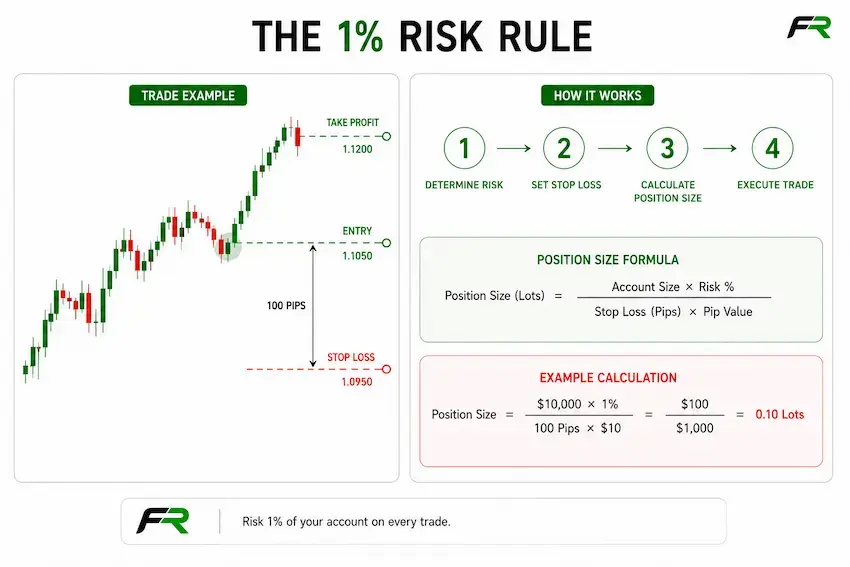
The logic is about survival, not caution for its own sake. At 1 percent risk per trade, a run of ten straight losses costs 10 percent of the account, something most strategies recover from. At 10 percent risk per trade, the same losing streak wipes out the account entirely. Confidence in a setup has no bearing on whether it actually wins, so risk per trade needs to stay fixed no matter how good the trade looks going in.
Position Sizing: The Math That Protects Capital
Risk percentage only works once it’s converted into an actual position size, and that conversion depends on where the stop-loss sits, not on a fixed lot size.
Position size (in lots) = Risk amount ÷ (Stop-loss in pips × Pip value per lot)
On a $10,000 account risking 1 percent ($100 per trade), with a standard pip value of $10 per lot on EUR/USD, the numbers work out like this:
| Stop-Loss Distance | Position Size | Amount Risked |
| 10 pips | 1.00 lot | $100 |
| 20 pips | 0.50 lots | $100 |
| 50 pips | 0.20 lots | $100 |
| 100 pips | 0.10 lots | $100 |
The amount risked never changes. What changes is the position size, shrinking as the stop gets wider and growing as it tightens. Traders who size positions this way, working backward from a fixed dollar risk, avoid the common trap of picking a lot size first and hoping the stop-loss happens to fit it.
Stop-Loss Placement: Structure-Based vs Arbitrary
A stop-loss set a fixed number of pips from entry, with no reference to the chart, is one of the more common ways traders undermine their own risk management. A 30-pip stop might be too tight on a volatile pair like GBP/JPY and unnecessarily wide on a calmer one like EUR/CHF.
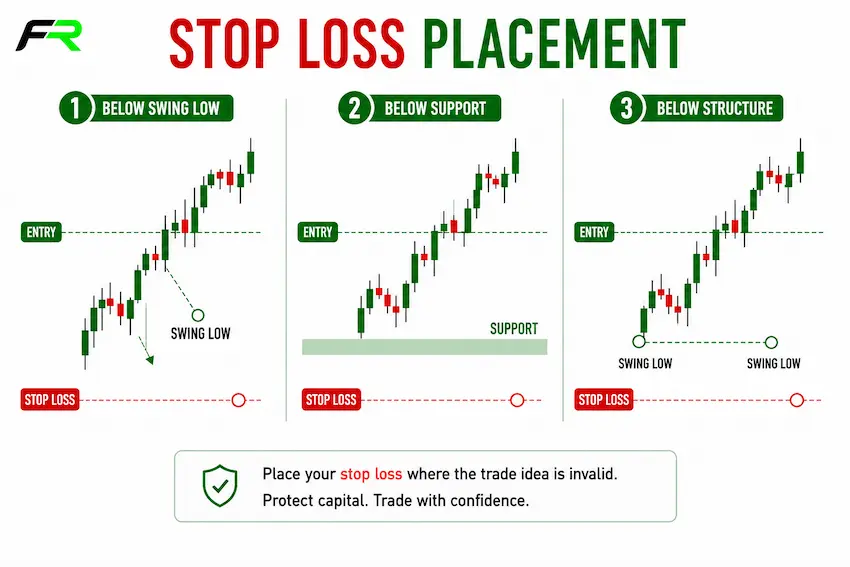
A stop tied to market structure, placed beyond the last swing high or low, beyond a support or resistance zone, or outside the average true range for that pair, reflects the point where the trade idea is actually proven wrong. If price reaches that level, the setup failed. An arbitrary pip count doesn’t carry that same meaning; it’s just a number that can get clipped by normal volatility long before the trade idea itself is disproven.
Risk-to-Reward Ratio
Risk-to-reward compares what’s risked on a trade against what it stands to gain. A trade risking 20 pips to make 60 pips has a 1:3 ratio.
A favorable ratio matters because it changes how often a trader needs to be right. At 1:1, a trader needs to win more than half their trades just to break even after costs. At 1:3, a 35 to 40 percent win rate can still turn a profit over a large sample of trades. This is why traders with average accuracy often outperform traders with a high win rate who take poor risk-to-reward setups. Being right on a trade isn’t the same as being profitable if the math behind it doesn’t hold up.
Leverage and Margin
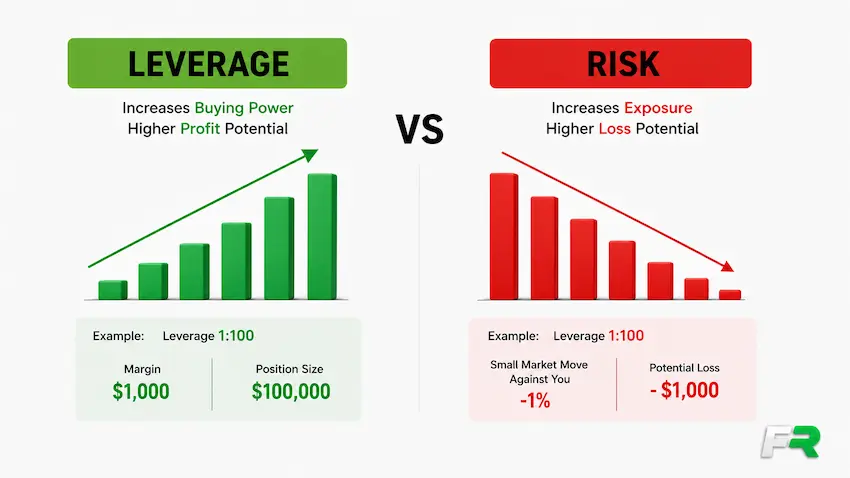
Leverage lets a trader control a position larger than their account balance, and it’s the single biggest reason small accounts get wiped out fast. A trader using 1:500 leverage on a $1,000 account can open a position worth $500,000, and a small adverse move on that size can trigger a margin call long before the trader’s actual risk tolerance would call for an exit.
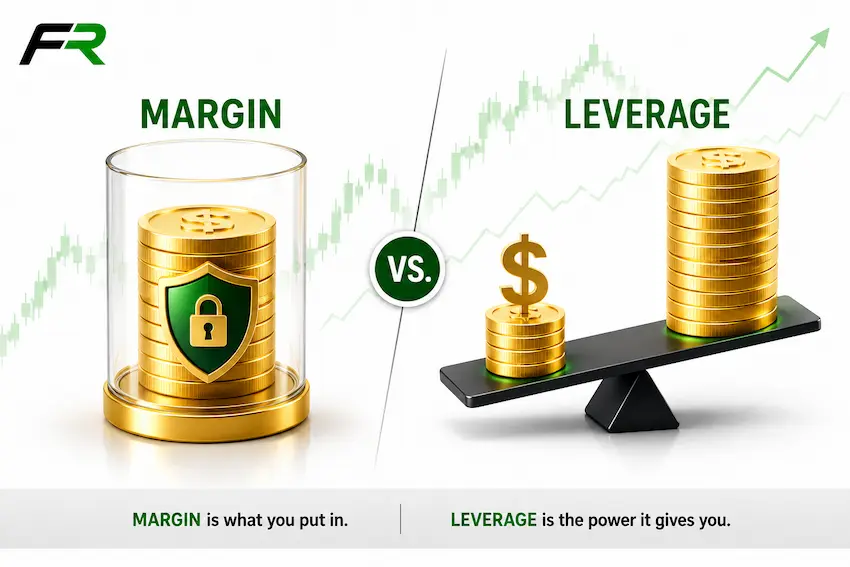
High leverage isn’t inherently dangerous on its own. It becomes dangerous when a trader sizes positions based on how much leverage is available rather than on the fixed percentage of capital they intended to risk. The leverage a broker offers is a ceiling, not a target. Sound risk management ignores that ceiling and sizes every trade off account equity and stop-loss distance instead.
Correlation Risk
Currency pairs that share a base or quote currency often move together. EUR/USD, GBP/USD, and AUD/USD frequently rise and fall in the same direction against the US dollar, since all three are essentially bets on dollar strength or weakness.
A trader risking 1 percent on each of three correlated pairs at the same time isn’t really risking 3 percent independently. If the dollar makes one strong move, all three positions can lose together, turning what looked like spread-out risk into a single concentrated bet. Treating correlated positions as one combined risk unit, rather than three separate 1 percent risks, keeps total exposure honest.
Daily and Weekly Loss Limits
A per-trade risk limit controls one trade. It doesn’t stop a trader from taking ten trades in a bad session and losing 10 percent of the account in a single day while still staying within the 1 percent rule on each individual trade.
A daily loss limit (commonly 3 to 5 percent of account capital) and a weekly limit (often double the daily figure) act as a circuit breaker. Once the limit is hit, trading stops for that period regardless of how good the next setup looks. This single rule prevents the kind of revenge trading that turns one bad trade into an account-ending session.
Drawdown and the Math of Recovery
Losses and gains aren’t symmetrical, and this is where many traders underestimate how much damage a large drawdown actually does. A 10 percent loss only needs an 11.1 percent gain to recover. A 50 percent loss needs a 100 percent gain just to get back to even.
| Drawdown | Gain Needed to Recover |
| 10% | 11.1% |
| 20% | 25% |
| 30% | 42.9% |
| 50% | 100% |
| 75% | 300% |
| 90% | 900% |
This is the mathematical reason fixed, small risk per trade matters more than any entry technique. A method that keeps drawdowns shallow gives a trader far better odds of recovering than one that occasionally posts a large win but exposes the account to steep pullbacks along the way.
Emotional Control and the Trading Journal
Rules on paper only work if they survive contact with an open, losing position. Fear and greed push traders to move stops further away mid-trade, double position size after a loss to win it back, or close a winning trade early out of nerves, all of which quietly break whatever risk plan was set before the trade opened.
A trading journal, recording the entry reason, stop and target, position size, and what actually happened, makes these patterns visible. Most traders don’t lose money because their strategy fails outright. They lose because they abandon their own risk rules under pressure, and a journal is usually the fastest way to catch that happening before it becomes a habit.
Building a Risk Management Plan Step by Step
1. Set a fixed risk percentage per trade, typically 1 to 2 percent of account capital, and apply it to every trade without exception.
2. Decide the stop-loss location first, based on market structure or volatility, before calculating position size.
3. Calculate position size using the risk amount and stop-loss distance, not a preset lot size.
4. Check correlation across any other open positions before adding a new trade in the same currency.
5. Set a daily and weekly loss limit, and stop trading once either is hit.
6. Log every trade in a journal, including the reasoning, the outcome, and whether the original plan was followed.
Common Mistakes
• Sizing a position first and figuring out the risk afterward instead of the other way around.
• Moving a stop-loss further away once a trade starts losing, rather than accepting the original invalidation point.
• Treating a broker’s maximum leverage as a target position size rather than a ceiling.
• Ignoring correlation and treating several same-direction trades as separate, independent risks.
• Increasing position size right after a loss to try to recover it faster.
People’s Most Asked
What percentage of capital should I risk per forex trade?
Most professional traders risk 1 to 2 percent of account capital per trade. Conservative traders often go lower, around 0.5 percent, especially on accounts they can’t easily replenish.
How do I calculate position size in forex?
Divide the dollar amount you’re risking by the stop-loss distance in pips multiplied by the pip value for your position size. This gives the lot size that keeps the risk at your intended dollar amount regardless of how wide the stop is.
What is a good risk-to-reward ratio in forex?
1:2 or higher is a common target, meaning the potential profit is at least twice the amount risked. This lets a strategy stay profitable even with a win rate below 50 percent.
Does high leverage increase risk in forex trading?
Leverage itself doesn’t create risk directly, but it makes it easier to open a position size that’s too large for the account, which increases the impact of normal price swings. Risk gets controlled through position sizing, not through avoiding leverage altogether.
How much drawdown is considered dangerous?
Drawdowns beyond 20 to 30 percent require increasingly large gains just to recover, and become harder to trade through psychologically. Keeping typical drawdowns under 15 to 20 percent is a common target among traders who prioritize account survival.
Should I stop trading after a losing streak?
A predefined daily or weekly loss limit, set before the losing streak happens, works better than deciding in the moment. Stepping away once that limit is hit prevents emotional decisions from compounding the damage.
Final Word
Risk management doesn’t make a trading strategy profitable. It decides whether a profitable strategy survives long enough to prove itself, and whether a losing streak stays a manageable setback instead of the end of an account. The traders who last in this market usually aren’t the ones with the most accurate entries. They’re the ones who never let a single trade, or a single bad week, put the whole account on the line.
The team behind this guide
Researched, checked and approved by five forex specialists
Every guide is written, fact-checked and edited before it goes live, and updated when the facts change. Spotted an error? Tell us.
Related Articles
 Education
8 min read
Education
8 min read

 Education
8 min read
Education
8 min read
 Education
25 min read
Education
25 min read
 Education
6 min read
Education
6 min read
 Education
9 min read
Education
9 min read
 Education
7 min read
Education
7 min read