 IC Markets





























Stop Loss and Take Profit in Forex
Stop loss and take profit orders are two of the most commonly used order types for managing trading risk and locking in profits. This guide covers how to set them correctly using chart structure, ATR, and risk-to-reward ratios, with real trade scenarios and position sizing calculations. Understanding how to use these orders correctly can help traders manage risk more consistently over time. Using stop loss and take profit orders consistently can help traders manage risk more effectively over time.
 WriterAbir KhanWriterWrites the guides · checks every figure against primary sources View profileAbout Abir →
 Market analysisTanbir Habib RiyadForex & Crypto AnalystForex and crypto analyst · technical and fundamental analysis View profileAbout Tanbir →
 Fact-checking & riskJannatul FerdaushFact-Checker & Risk AnalystFact-checks every figure · risk analysis · Applied Statistics, University of Dhaka View profileAbout Jannatul →
 Trading reviewJowel RanaCo-Founder & Forex TraderCo-founder · forex trader · reviews guides from a trader's view View profileAbout Jowel →
 Final approvalRanjan NiskrityFounder, Owner & Forex TraderFounder and owner · forex trader · signs off every guide View profileAbout Ranjan →
A common mistake among new traders is ignoring a stop loss after expecting the market to reverse. Most often they thought USD/GBP would recover after a sharp drop. The experience showed that using a stop loss is an essential part of managing trading risk. It is the difference between controlling risk and suffering major losses
Poor risk management, including the absence of a defined exit plan, is one of the common reasons many retail traders experience significant losses. Stop loss and take profit orders are not advanced tactics reserved for professionals. They are fundamental risk management tools used by traders to help control losses and protect trading capital.
The global forex market turns over more than $7.5 trillion every single day (BIS, 2023). In a market that moves this fast, even a moment of hesitation or an unprotected position can cause significant losses. This guide explains stop loss and take profit with real scenarios, actual calculations, and strategies you can apply to your very next trade.
Stop Loss: Why It Protects More Than Just Money
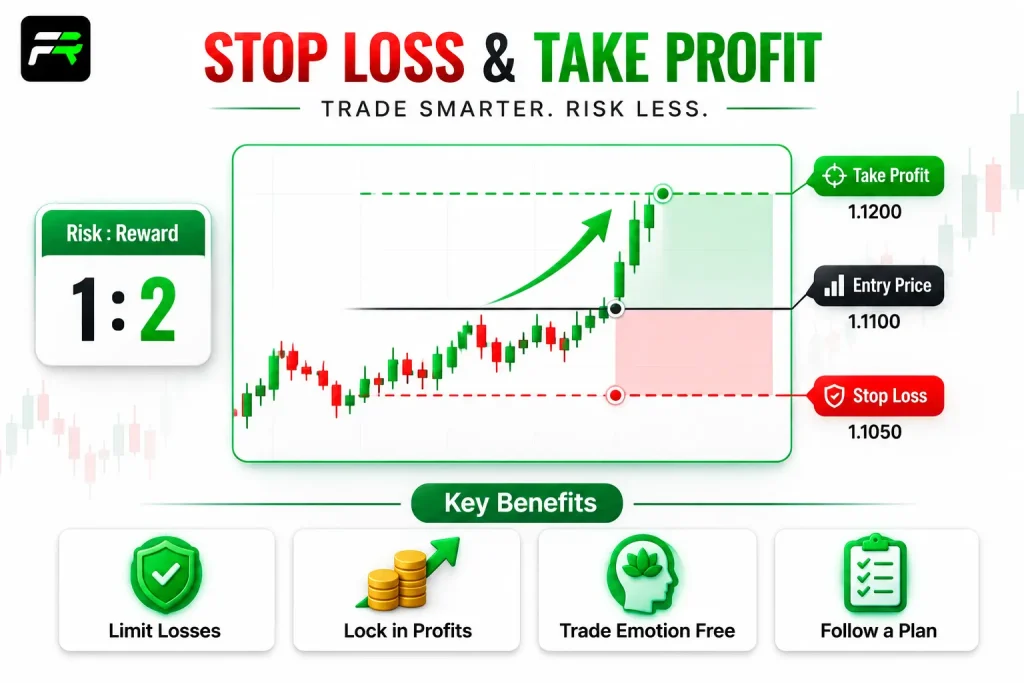
A stop loss is an automated instruction you give your broker to close a trade once price reaches a level you define. If you enter EUR/USD at 1.1000 and set your stop loss at 1.0950, your broker closes the position the moment price hits 1.0950, capping your loss at 50 pips. Without a stop loss, losses may become significantly larger if price continues moving against your position. The actual loss depends on the market movement and position size.
A stop loss helps protect both trading capital and risk discipline. Trading without a stop loss can expose your account to substantially larger losses, especially during periods of high volatility or market gaps. That single unprotected loss can erase previous profits. Many professional traders emphasise that disciplined risk management is more important than trying to predict every market move.
If you are still getting familiar with the mechanics of how trades work, it helps to first understand what forex trading is and how pips are calculated, since both are central to setting stops correctly.
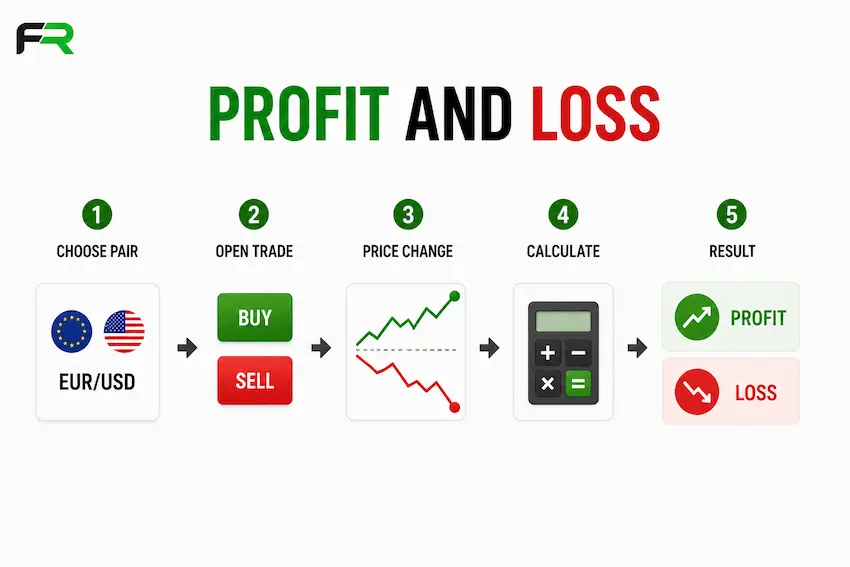
The Main Types of Stop Loss Orders
Not every stop loss works the same way. The type you choose affects how and when your position closes.
Fixed Stop Loss: You set a specific price level. The trade closes when price hits it. Simple and predictable.
Percentage-Based Stop Loss: You risk a fixed percentage of your account per trade, usually 1 to 2 percent. This approach helps maintain consistent risk exposure across different account balances.
Volatility-Based Stop Loss (ATR Method): You use the Average True Range indicator to set a stop that accounts for how much a pair typically moves. Many traders use stops based on 1.5 to 2 times the ATR, although the appropriate multiple depends on the trading strategy, timeframe, and market conditions.
Support and Resistance Stop Loss: You place the stop just below a key support level for long trades, or above a resistance level for short trades. This is a technically driven approach that follows key technical support or resistance levels.
| FXRecap Insight: Using chart structure, volatility, or technical analysis generally provides a more objective basis for placing a stop loss than selecting an arbitrary pip distance. Always anchor your stop to a meaningful level, not just a round number of pips. |
Take Profit: Locking Gains Before the Market Takes Them Back
Take profit is the other side of the exit plan. It is the price level where you instruct your broker to close a winning trade and secure the gain. Without a predefined exit, profitable trades may reverse before gains are secured.
One of the most common beginner mistakes is staying in a trade past its natural target, expecting further price movement. Market prices naturally fluctuate as trends develop. A trade that hits 60 pips of profit and then reverses 80 pips leaves you with a net loss on what was briefly a winner.
Setting a take profit level before entering a trade helps traders follow a predefined trading plan. Once the order is placed, the gain is protected regardless of what you feel in the moment.
Real Trade Scenarios with Numbers
Scenario One: Smith and the USD/JPY Spike
Smith shorted USD/JPY at 146.50. His analysis pointed to a drop ahead of a Bank of Japan policy announcement. He placed his stop loss at 147.00, 50 pips above entry.
The announcement produced unexpected market volatility. Price spiked to 147.10 in seconds. Smith’s stop loss triggered at 147.00, and his loss was 50 pips. Without the stop, he would have been watching a 300-pip move against him with much larger loss.
| This example shows that unexpected news events can invalidate even well-planned trades. The lesson is that even well-reasoned trades can be destroyed by news events. Stop loss is the protection you put in place for the scenarios you did not predict. |
Scenario Two: The GBP/USD Risk-to-Reward Trade
A trader buys GBP/USD at 1.3000. Stop loss sits at 1.2980, 20 pips below entry. Take profit is at 1.3050, 50 pips above. The risk-to-reward ratio is 1:2.5.
Assuming consistent trade sizing and a 1:2.5 risk-to-reward ratio, a 40% win rate would produce a positive expectancy before transaction costs. The strategy remains profitable because the average winning trade exceeds the average losing trade. That is the core logic behind combining stop loss and take profit correctly.
| Pips | Result | |
| Entry | 1.3000 | Long trade |
| Stop Loss | 1.2980 | 20 pip risk |
| Take Profit | 1.3050 | 50 pip reward |
| Risk:Reward | 1:2.5 | |
| Win Rate Needed | ~29% to break even |
Position Sizing: Matching Your Stop to Your Risk
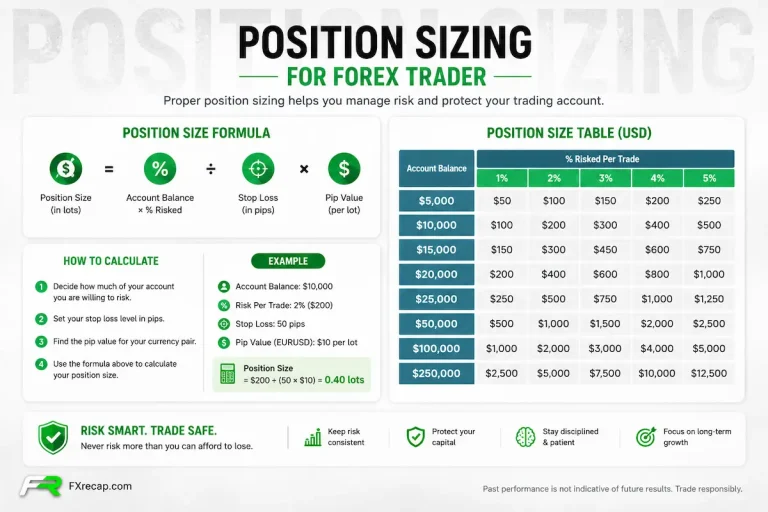
A stop loss only works properly when the trade size matches the risk you are willing to take. If you are willing to risk 2 percent of a $1,000 account, your maximum loss per trade is $20. Understanding forex lot sizes is essential for calculating the correct position size.
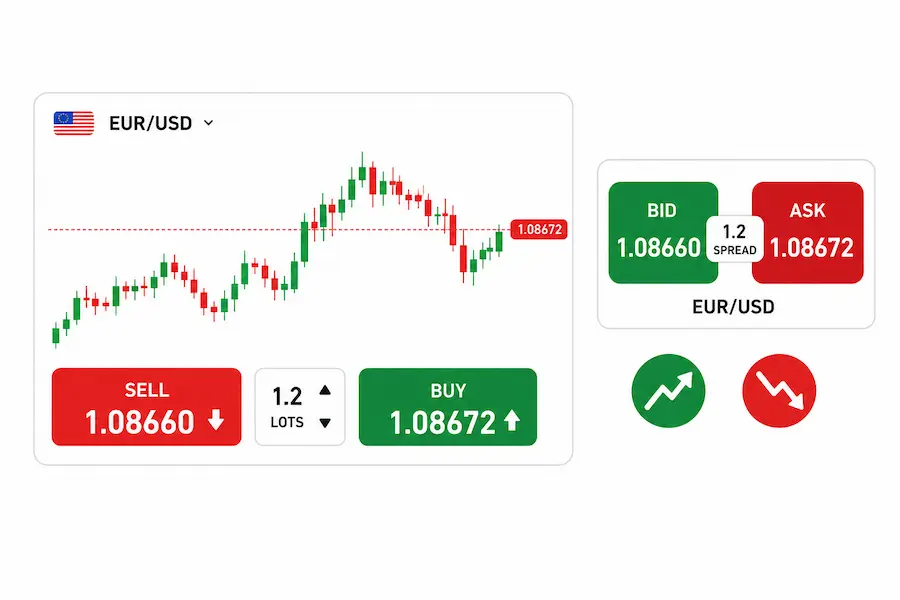
With a stop loss of 40 pips, your pip value needs to be $0.50 per pip to stay within a $20 loss limit. That translates to a micro lot on most platforms.
If you trade too large, a technically appropriate stop loss still results in a disproportionately large loss. Position sizing helps align stop placement with acceptable risk into a properly risked trade.
| Account Size | Risk % | Max Loss | Stop (pips) | Pip Value Needed |
| $1,000 | 2% | $20 | 40 | $0.50 |
| $5,000 | 2% | $100 | 50 | $2.00 |
| $10,000 | 1% | $100 | 25 | $4.00 |
If you are uncertain how leverage affects your position sizes, review what forex leverage is and how margin requirements factor into every open trade.
The Most Common Stop Loss Mistakes
Stops Set Too Tight
A stop placed too close to the entry price may be triggered by normal market volatility or the spread, particularly on instruments with wider spreads. The prices require room for normal fluctuations. Stops that are placed too close to the entry price may increase the likelihood of being triggered by normal market volatility.
Stops Set Too Wide
A 200-pip stop on a micro account might protect the direction of a trade but exposes the account to a loss that takes weeks to recover. Wide stops must be matched with smaller position sizes. If the position size stays the same and only the stop widens, the financial risk increases.
Moving the Stop in the Wrong Direction
Moving a stop further away from price when a trade goes against you is a common risk management mistake in trading. It turns a predefined risk into an open-ended one. The original stop level was set when thinking was clear. Moving it during a loss is almost always influenced by emotion rather than analysis.
Placing Stops at Obvious Round Numbers
Large numbers like 1.3000 or 147.00 attract areas where stop orders may be concentrated. Prices often react around widely observed support, resistance, and psychological price levels where many stop orders may be placed. Place your stop a few pips beyond a significant level rather than exactly on it.
| FXRecap Tip: Use the ATR indicator to assess how far normal market movement reaches before setting your stop. A stop inside the ATR range will often be triggered by normal market fluctuations. |
How Emotions Destroy Good Trades Without You Noticing?
Trading psychology is where most well-built strategies fall apart. Emotions such as fear, greed, and frustration can influence trading decisions if risk management rules are not followed consistently.
Stop loss and take profit orders do not just manage money. They remove the moment of decision from a period of heightened emotion. Once the orders are placed, the the trade follows the predefined plan rather than feelings.
Dr. Brett Steenbarger, who has worked extensively with professional traders, argues that the psychological discipline of consistent trading is not prediction but process. Placing stops before entering a trade is part of that process.
Many risk management frameworks recommend limiting risk to around 1–2% of account equity per trade, although the appropriate level varies by trader. A loss becomes a minor setback rather than a crisis. That mental stability improves gradually into steadier decision-making.
If emotional trading has been a challenge, reviewing forex trading strategies with defined entry and exit rules can help bring more structure to your approach.
Risk-to-Reward Ratios: The Math Behind Long-Term Profit
A risk-to-reward ratio tells you how much you aim to earn relative to how much you risk. A 1:2 ratio means for every dollar risked, two dollars are targeted. This single metric, applied consistently, determines whether a trading strategy is profitable over time even if it does not win the majority of trades.
Buy EUR/USD at 1.1000. Stop loss at 1.0980 (20-pip risk). Take profit at 1.1040 (40-pip reward). The ratio is 1:2. Assuming consistent execution and ignoring trading costs, a 45% win rate with a 1:2 risk-to-reward ratio would produce a positive expectancy.
Traders who skip this calculation often have no idea whether their strategy has positive expectancy over time. They focus on individual wins and losses instead of cumulative expectancy.
| Ratio | Win Rate to Break Even | Example (100 trades) |
| 1:1 | 50% | 50 wins, 50 losses |
| 1:2 | 33% | 34 wins, 66 losses still profits |
| 1:3 | 25% | 26 wins, 74 losses still profits |
You also need to know how spreads affect each trade and bid and ask pricing helps you factor the true cost of each trade into your ratio calculations.
Trailing Stops and Partial Take Profit
Trailing Stops
A trailing stop moves with the price as a trade moves in your favor. If you buy AUD/USD at 0.6800 and set a trailing stop of 30 pips, the stop starts at 0.6770. When price moves to 0.6850, the stop moves to 0.6820. When price moves to 0.6900, the stop is at 0.6870. If price then reverses, the trade closes at 0.6870, locking in 70 pips.
Trailing stops are particularly useful in trending markets where holding a position longer captures more of a move. They allow you to stay in a winning trade without needing to monitor it constantly.
Partial Take Profit
Partial take profit means closing a portion of your position at an earlier target and letting the rest run. Sell 50 percent at the first target, move the stop on the remaining position to breakeven, and let the second half aim for a larger reward.
This reduces the psychological pressure of watching an open profit. Part of the gain is secured. Moving the stop loss to breakeven removes the original downside risk, although the remaining position is still exposed to market fluctuations. This approach works especially well in volatile markets where initial targets are hit frequently but extended moves are less predictable.
| Buy AUD/USD at 0.6800 > Take partial profit at 0.6850 (50 pips) > Move stop to breakeven on remaining position > Trail the stop as price continues higher. Result: secured partial profit with open upside. |
How AI Tools Are Supporting Exit Strategy
AI-driven trading tools now analyze volatility patterns, trend strength, momentum indicators, and market sentiment to suggest stop and take profit levels in real time. These tools do not replace judgment but they analyse large amounts of market data more quickly than any individual trader can.
For retail traders, the practical benefit is a reduction in emotional influence during order placement. When an algorithm suggests a stop level based on ATR plus recent support structure, it is less likely to change without reason placing it somewhere else simply because the risk looks smaller.
FXStreet and other institutional research bodies have noted that some institutional firms and trading platforms use AI-assisted analytics to support risk management, but adoption varies across firms and trading environments. Retail platforms are steadily bringing similar capabilities to individual traders.
AI-generated analysis should be considered alongside independent market analysis and sound risk management. AI tools can assist with data analysis, while traders remain responsible for making the final trading decision.
How to Set Stop Loss and Take Profit Step by Step
- Determine your maximum risk per trade. Most traders use 1 to 2 percent of their account.
- Calculate the dollar amount that represents. On a $2,000 account at 2 percent, that is $40.
- Identify the technically appropriate stop loss level. This should be below support for long trades, above resistance for short trades, or set using ATR.
- Calculate pip distance from entry to stop. Divide your dollar risk by the pip distance to find the required pip value.
- Use the pip value to determine your lot size.
- Set your take profit based on the next significant resistance (for longs) or support (for shorts). Aim for a minimum 1:2 ratio.
- Place both orders before entering the trade. Not after. Not when the trade is already moving.
If you are newer to the mechanics of order execution, reading about forex market basics and going through a demo trading account first will give you a risk-free practice environment to practice placing these orders without risking real capital.
Conclusion
Stop loss and take profit are not optional features to a trading strategy. They are the structure that makes a strategy function over time. Without them, even the best trading advantage gets eliminated by a single uncontrolled loss or a profit that was never secured.
The traders who stay in forex long enough to develop long-term trading ability are not the ones who are always right. They are the ones who manage what happens when they are wrong and make sure they protect realised profits when they are right.
Set your levels before entering the trade. Base them on the chart structure. Size the position to match the risk. Stick to the plan once it is placed.
A solid understanding in forex risk management, combined with a clear knowledge of forex trading strategies, gives every trade a clearly planned entry, management, and exit. That structure is what encourages disciplined trading rather than speculative decision-making.
Key Takeaways
- Stop loss and take profit protect both capital and mental clarity.
- Risk-to-reward ratios determine whether a strategy is profitable over time, not just in individual trades.
- Position sizing ensures the dollar risk per trade matches your actual tolerance, not just a pip number.
- Trailing stops and partial take profit allow you to capture more from winning trades while protecting existing gains.
- Placing orders before entering a trade removes emotion from exit decisions.
- Market-informed stop levels outperform arbitrary pip distances every time.
The team behind this guide
Researched, checked and approved by five forex specialists
Every guide is written, fact-checked and edited before it goes live, and updated when the facts change. Spotted an error? Tell us.
Related Articles
 Education
16 min read
Education
16 min read

 Education
7 min read
Education
7 min read
 Education
8 min read
Education
8 min read
 Education
9 min read
Education
9 min read
 Education
9 min read
Education
9 min read
 Education
7 min read
Education
7 min read