IC Markets

































How to Check a Forex Broker Is Regulated
A logo is not a licence. Here is how to verify a broker’s regulation in five minutes, and how to spot the tricks brokers use to look more regulated than they are.
 WriterAbir KhanWriterWrites the guides · checks every figure against primary sources View profileAbout Abir →
 Market analysisTanbir Habib RiyadForex & Crypto AnalystForex and crypto analyst · technical and fundamental analysis View profileAbout Tanbir →
 Fact-checking & riskJannatul FerdaushFact-Checker & Risk AnalystFact-checks every figure · risk analysis · Applied Statistics, University of Dhaka View profileAbout Jannatul →
 Trading reviewJowel RanaCo-Founder & Forex TraderCo-founder · forex trader · reviews guides from a trader's view View profileAbout Jowel →
 Final approvalRanjan NiskrityFounder, Owner & Forex TraderFounder and owner · forex trader · signs off every guide View profileAbout Ranjan →
Key takeaways
- Find the exact legal entity in the footer or client agreement, not the brand name.
- Look the licence up on the regulator's own register; certificate images on a broker's site are easy to fake.
- Confirm the entity exists, the licence covers forex dealing and it is current.
- Check which entity your account actually opens with; from Asia it is often an offshore one.
Most forex scams and most of the brokers that quietly fail were never regulated in a way that meant anything. The good news is that checking takes about five minutes, and the checks are the same wherever you are in Asia. This is the process. For a reference on the regulators themselves, see our global forex regulators guide.
Step 1: find the exact legal entity
Scroll to the footer of the broker’s website, or open the client agreement. You are looking for a sentence like “[Brand] is a trading name of [Company Ltd], registered in [country], licence number [X], regulated by [regulator]”. Big brokers run several companies, one under a strong licence and others under weak or offshore ones. The entity you are onboarded to is the one that matters, and it is often not the one in the marketing.
Step 2: look the licence up on the regulator’s own site
Do not trust a certificate image on the broker’s site, because those are trivially faked. Go to the regulator directly:
| Regulator | Where to check | Tier |
|---|---|---|
| FCA (UK) | register.fca.org.uk | Top |
| ASIC (Australia) | connectonline.asic.gov.au | Top |
| CySEC (Cyprus) | cysec.gov.cy (regulated entities) | Strong (EU) |
| FSCA (South Africa) | fsca.co.za | Mid |
| FSA (Seychelles) | fsaseychelles.sc | Light-touch |
| FSC (Mauritius) / BVI / Vanuatu | regulator site | Light-touch |
Search the company name or licence number. Confirm three things: the entity exists, the licence covers dealing in investments or forex (not just “company registration”), and it is current, not lapsed or withdrawn.
Step 3: check which entity accepted you
This is where people get caught. A broker advertises its FCA or ASIC licence, but when you sign up from Asia you are onboarded to the Seychelles or Mauritius entity, which offers higher leverage and far weaker protection. Read the client agreement you accept. It will name the entity and the regulator. If it is a light-touch jurisdiction, that is your real level of protection, whatever the homepage said.
Step 4: check for clone and warning notices
- Search the regulator’s warnings or “unauthorised firms” page for the broker’s name and domain.
- Check your own country’s alert list, such as the RBI Alert List (India), Bank Negara Financial Consumer Alert (Malaysia), SEC Investor Alert (Thailand), or Bappebti blocked sites (Indonesia).
- A “clone firm” warning means scammers are using a real broker’s licence details. If you see one, only use links you typed yourself, never a link from an ad or a message.
Step 5: sanity-check the basics
- Client funds held in segregated accounts, stated plainly.
- A real registered address, not just a PO box in an island jurisdiction.
- Withdrawal terms that do not depend on trading volume or “bonus” conditions.
- A domain that is more than a year or two old (a WHOIS lookup takes seconds).
What a strong licence protects
Regulation is not a guarantee you will make money, and it does not stop a broker from going out of business. What a strong licence such as the FCA, ASIC or CySEC does is impose rules that reduce the specific ways brokers harm clients: client money must be segregated from company money, the firm must hold minimum capital, marketing cannot promise returns, and there is a complaints process with teeth. Some jurisdictions also run a compensation scheme that pays out a capped amount if the broker fails.
A light-touch licence, from somewhere like Seychelles, Vanuatu or Saint Vincent, imposes far fewer of those requirements. The company is registered, and there may be a nominal capital rule, but segregation, marketing conduct and dispute resolution are weakly enforced or not enforced at all. That is why brokers route Asian clients there: it lets them offer 1:1000 and pay affiliates aggressively, at the cost of your protection.
Red flags that override everything
- No entity name or licence number anywhere on the site or in the agreement.
- A licence number that, when checked, belongs to a different company or a lapsed registration.
- The broker is on your country’s alert list, or carries a clone-firm warning.
- You reached the site through an ad, a Telegram link or a “mentor”, and there is pressure to deposit fast.
Farhan almost funded a broker showing an FCA number in its footer. He looked the number up on the FCA register: it belonged to a payments company, not a broker, and the FCA had a clone-firm warning attached with the exact domain he was on. He had reached the site through a Telegram link. He never deposited, and later saw the same site rebranded under a new name.
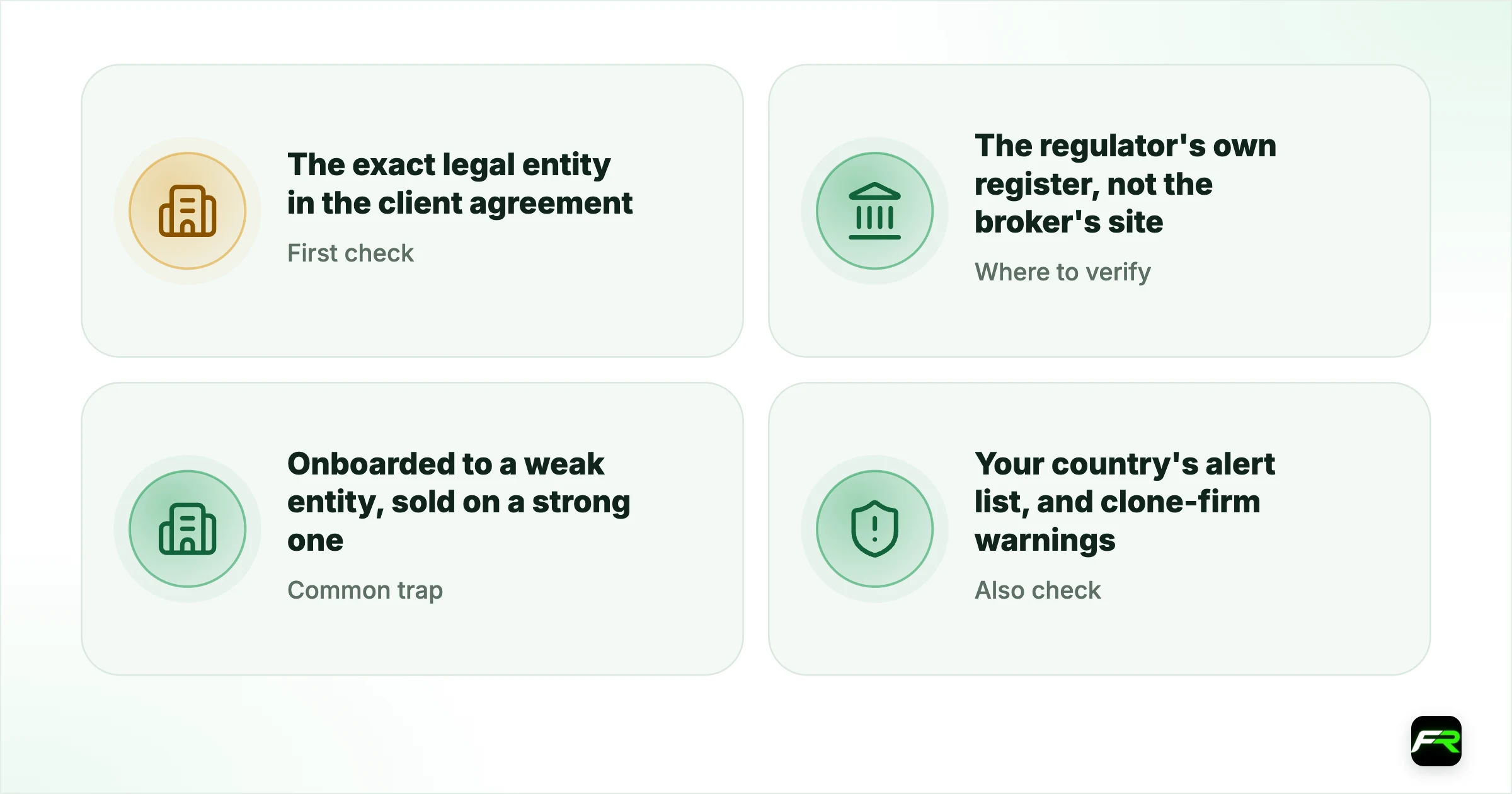
| First check | The exact legal entity in the client agreement |
|---|---|
| Where to verify | The regulator’s own register, not the broker’s site |
| Common trap | Onboarded to a weak entity, sold on a strong one |
| Also check | Your country’s alert list, and clone-firm warnings |
| Time needed | About five minutes |
If you cannot find the broker on any regulator’s register, the answer is not “maybe it is fine”. The answer is that it is unregulated, and you should treat any money you send as money you might not see again.
Sources and where to check it yourself
- FCA Financial Services Register: UK-authorised firms and their permissions
- ASIC Connect: Australian financial services licensees
- CySEC regulated entities: Cyprus investment firms serving the EU
- FSCA: South African licensed providers
Frequently asked
How do I know if a forex broker is regulated?
Find the exact legal entity in the client agreement, then look up its licence number on the regulator’s own website. Confirm the licence exists, covers dealing in forex, and is current. Check your country’s alert list and any clone-firm warnings.
Is a CySEC or ASIC licence enough?
Those are strong licences, but only if the entity you personally signed up with holds one. Many brokers onboard Asian clients to a Seychelles or Mauritius entity with much weaker protection while advertising the strong licence.
What is a clone firm warning?
It means scammers are impersonating a legitimate regulated broker, using its real licence details on a fake site. If a regulator has issued one for a broker, only use links you typed yourself.
Are offshore licences like Seychelles or Vanuatu worthless?
Not worthless, but light-touch. They allow higher leverage and impose fewer requirements on client-fund handling and dispute resolution. Know that this is your real level of protection if that is the entity you signed with.
How long should a legitimate broker’s domain have existed?
There is no hard rule, but a brand-new domain combined with heavy advertising and high-pressure onboarding is a warning sign. A WHOIS lookup shows the registration date in seconds.
The team behind this guide
Researched, checked and approved by five forex specialists
Every guide is written, fact-checked and edited before it goes live, and updated when the facts change. Spotted an error? Tell us.