IC Markets

 3:09
 2:39
 2:10
 2:18
 3:43
 8:42





































Forex Week Ahead: RBA and Bank of England Decide, Then Euro Inflation and US Jobs Follow
Sydney decides on Tuesday and London on Thursday, with flash euro prices between them and American payrolls closing a busy five days.
 WriterAbir KhanWriterWrites the guides · checks every figure against primary sources View profileAbout Abir →

 Market analysisTanbir Habib RiyadForex & Crypto AnalystForex and crypto analyst · technical and fundamental analysis View profileAbout Tanbir →

 Fact-checking & riskJannatul FerdaushFact-Checker & Risk AnalystFact-checks every figure · risk analysis · Applied Statistics, University of Dhaka View profileAbout Jannatul →

 Trading reviewJowel RanaCo-Founder & Forex TraderCo-founder · forex trader · reviews guides from a trader's view View profileAbout Jowel →

 Final approvalRanjan NiskrityFounder, Owner & Forex TraderFounder and owner · forex trader · signs off every guide View profileAbout Ranjan →

Last week brought five central bank decisions. The coming week brings two more, plus the data that will shape the December meetings. The Reserve Bank of Australia announces its decision on Tuesday 3 November, Eurostat publishes flash euro area inflation on Wednesday 4 November, the Bank of England decides on Thursday 5 November, and the US jobs report follows on Friday 6 November.
Both decisions come with new forecasts, and both banks are dealing with the same problem: energy has pushed inflation up while growth and hiring look less secure. That makes the vote counts and the wording at least as useful as the rate itself. One practical warning before you open a chart: US clocks go back on Sunday 1 November, so American data arrives an hour later in UTC terms than it did last week.
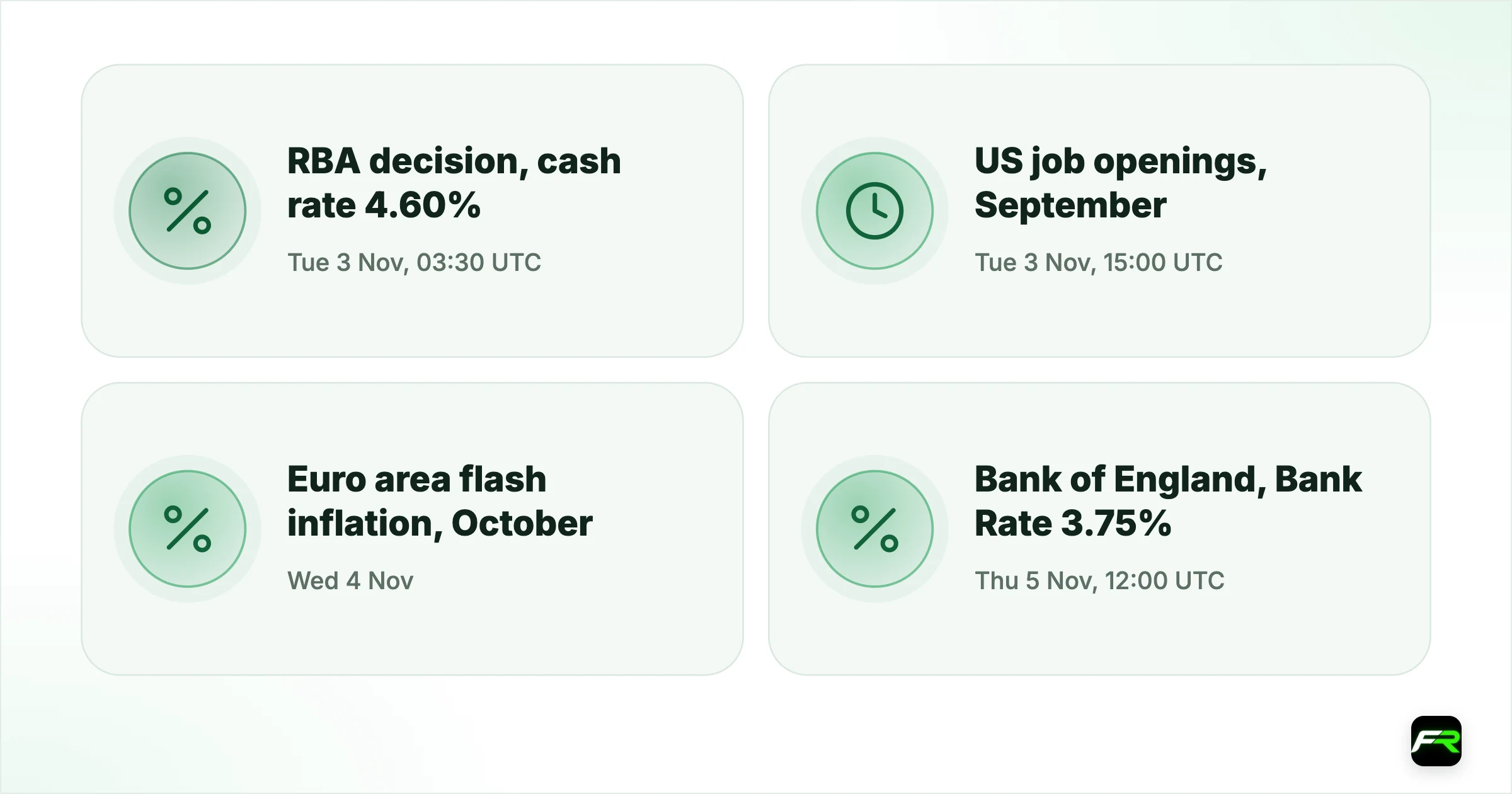
| Tue 3 Nov, 03:30 UTC | RBA decision, cash rate 4.60% |
|---|---|
| Tue 3 Nov, 15:00 UTC | US job openings, September |
| Wed 4 Nov | Euro area flash inflation, October |
| Thu 5 Nov, 12:00 UTC | Bank of England, Bank Rate 3.75% |
| Thu 5 Nov, 13:30 UTC | US productivity, third quarter |
| Fri 6 Nov, 13:30 UTC | US jobs report, October |
| Fri 6 Nov | Canada Labour Force Survey, October |
Where the week starts
The ECB's euro reference rate for EUR/USD was 1.1172 on Friday 30 October, a little above the 2026 low of 1.1130 set a day earlier and slightly below the 1.1193 of 23 October. Rates derived from the same ECB fixing put GBP/USD at 1.3399, up from 1.3368 a week before, USD/JPY at 157.25 against 156.80, and AUD/USD at 0.7025, almost unchanged from 0.7022. After five decisions, the major pairs finished close to where they began.
US Treasury yields did more of the moving. The 2-year par yield closed at 4.56% on Friday, down from 4.69% a week earlier, while the 10-year went from 5.00% to 4.94%. Gold was the sharpest mover we measured. Spot was $3,876 at 03:11 UTC on Saturday, according to gold-api.com, compared with $3,995 at about the same time on Friday and $4,045 in Thursday's reading. We found no official explanation for that drop, so we are not offering one.
Japan's Ministry of Finance added a quiet data point on Friday. Its monthly release shows intervention of ¥0 between 29 September and 28 October, the second month running with nothing spent. That tells you what happened up to 28 October and nothing about what officials may do next.
RBA: would a fifth rise this year surprise anyone?
The Monetary Policy Board finishes its two-day meeting on Tuesday and publishes its decision and the quarterly Statement on Monetary Policy at 14:30 Sydney time, which is 03:30 UTC. The media conference starts an hour later. The cash rate is 4.60% after four increases this year, the latest on 29 September.
The evidence since then has not helped the doves. Australian consumer prices rose 4.3% in the 12 months to September, and the quarterly trimmed mean reached 3.7%, both above the 2% to 3% target band. Deputy Governor Andrew Hauser said on 21 October that “the inflation outlook looks materially worse than we projected in the August report.” You can read the detail in our Australian CPI story.
We have no forecast to give you, and a hold would not by itself mean the tightening is finished. Look at three things in the release: the new inflation path, whether the statement still leans towards more rises, and any change in the jobs outlook. Hauser speaks again in Canberra on Thursday at 06:45 UTC, so the message could be refined within two days.
Bank of England: three votes for a rise last time
Thursday's decision arrives at 12:00 UK time, which is also 12:00 UTC, alongside the Monetary Policy Report. In September the committee held Bank Rate at 3.75% by six votes to three. Megan Greene, Catherine Mann and Huw Pill wanted 4%. The summary called the risks to inflation “tilted to the upside” and said the committee “stands ready to act as necessary.”
Figures published since then pull in different directions. UK inflation jumped to 3.5% in September from 3.1%, and services inflation climbed to 3.7%. Unemployment, on the other hand, fell to 4.7% in the three months to August, while vacancies dropped and total pay growth slowed to 3.7%. Our UK CPI report covers the price side.
The split is the first thing to check. A move from three dissenters to four or more would suggest the committee is drifting towards a rise, while fewer would point the other way. After that, read the report's inflation projections and how much weight the committee puts on second-round effects in wages and prices, the risk it singled out in September. The following decision is on 17 December.
Euro inflation: the first of two prints before December
Wednesday's flash estimate is the first of the two October and November inflation readings that will land before the ECB meets on 17 December. Headline inflation was 3.8% in September, up from 3.2% in August, with energy doing most of the work. Eurostat's flash showed energy at 18.8% and services at 3.2%.
President Christine Lagarde said on 29 October that a rate rise had been debated, so a further increase in the headline would strengthen the case for one. Services and core numbers matter more than usual here, because the ECB's stated reason for waiting was that underlying inflation had stayed broadly stable. Eurostat's latest growth figures, published on Friday, make the choice harder. They are covered in our euro area GDP story.
US jobs: can hiring pick up from 29,000?
Friday's employment report comes out at 08:30 New York time, which is 13:30 UTC now that US clocks have changed. In September, payrolls rose by just 29,000 and unemployment was 4.2%. Job openings for September arrive first, on Tuesday at 15:00 UTC, and productivity and unit labour costs follow on Thursday at 13:30 UTC, shortly after the Bank of England.
The Fed held its target range at 3.75% to 4.00% on 28 October, with two voters asking for a rise, and Chair Kevin Warsh said “inflation is too high.” Friday's Employment Cost Index gave both camps something to work with: civilian compensation rose 0.8% in the third quarter and 3.4% over the year, yet real wages and salaries fell 0.6% over the year. A soft jobs number would give the case for waiting more weight. Strong hiring would make the 9 December meeting more open. October CPI follows on 10 November.
Other dates worth marking
- Friday 6 November: Statistics Canada's Labour Force Survey, the first jobs report since the Bank of Canada raised its rate to 2.50% on 28 October.
- Thursday 5 November: minutes of the Bank of Japan's September meeting. The Summary of Opinions from the 8-1 October hold follows on Tuesday 10 November.
- Monday 9 November, Sydney time: RBA Assistant Governor Sarah Hunter speaks at a conference, the week after the decision.
How to prepare without guessing the outcome
- Convert the times. The UTC gap to New York widens by an hour from Sunday, so an alert set by habit may fire at the wrong moment.
- Check open positions before each event. AUD pairs are exposed early on Tuesday, sterling at lunchtime in London on Thursday, and nearly everything on Friday.
- Expect wider spreads around releases, when liquidity can thin out for a few minutes.
- Size trades for the gap, not for a calm market. A stop order may fill well beyond its level when prices jump.
Suppose you hold a GBP/USD position into Thursday with a stop 80 pips away, on a $5,000 account with a 1% risk limit. You can lose $50, which works out at about $0.63 a pip, or about 6,250 units. If the stop fills 40 pips late after a surprise vote, the loss would be about $75, not $50. Our <a href="/position-size-calculator">position size calculator</a> does the first part of that sum for any pair.
Release times in your own time zone are on the economic calendar, and levels for the main pairs are on our AUD/USD analysis and GBP/USD analysis pages, which next update on Monday.
Rate decisions and jobs reports can move currencies sharply, and prices can gap past stop orders. Leverage magnifies losses as well as gains, so trade only with money you can afford to lose.
Dates and times come from the published calendars of the RBA, Bank of England, US Bureau of Labor Statistics, Eurostat, Statistics Canada and Bank of Japan, and may change. UTC conversions are ours. Exchange rates are ECB euro reference rates or derived from them. Gold is from gold-api.com. Yields are US Treasury par yields. This is news, not investment advice.
Cite this guide
FX Recap, "Forex Week Ahead: RBA and Bank of England Decide, Then Euro Inflation and US Jobs Follow", updated 31 October 2026, https://fxrecap.com/forex-news/top-stories/forex-week-ahead-rba-boe-us-jobs
Free to quote with a link. Journalists: data and comment in our press room.
Frequently asked
When is the next RBA decision?
The Reserve Bank of Australia publishes its decision and Statement on Monetary Policy on Tuesday 3 November 2026 at 14:30 Sydney time, which is 03:30 UTC. The cash rate is 4.60%.
When does the Bank of England decide in November 2026?
On Thursday 5 November 2026 at 12:00 UK time, with the Monetary Policy Report. Bank Rate is 3.75%, and three of the nine members voted to raise it to 4% in September.
When is the US jobs report for October 2026?
The Bureau of Labor Statistics publishes it on Friday 6 November 2026 at 08:30 New York time, which is 13:30 UTC after US clocks change on 1 November. September payrolls rose by 29,000.
When is euro area flash inflation for October published?
Eurostat's next flash estimate is due on Wednesday 4 November 2026. Euro area inflation was 3.8% in September, up from 3.2% in August.
Sources: Reserve Bank of Australia: calendar · Bank of England: upcoming MPC dates · US Bureau of Labor Statistics: November 2026 release schedule · Eurostat: euro area flash inflation, 2 October 2026 · Bank of England: Monetary Policy Summary and minutes, September 2026 · US Bureau of Labor Statistics: Employment Situation, September 2026 · US Bureau of Labor Statistics: Employment Cost Index, September 2026 · Japan Ministry of Finance: intervention operations, 29 September to 28 October 2026 · Bank of Japan: Monetary Policy Meetings schedule · Statistics Canada: release schedule · ECB: euro foreign exchange reference rates · US Treasury: daily par yield curve rates
The team behind this guide
Researched, checked and approved by five forex specialists
Every guide is written, fact-checked and edited before it goes live, and updated when the facts change. Spotted an error? Tell us.