IC Markets






































UK Inflation Jumps to 3.5% in September as Fuel Prices Hit a Four-Year High
Petrol and diesel drove the biggest monthly rise in a year, and services and core prices sped up too, a hard read for the Bank of England.
 WriterAbir KhanWriterWrites the guides · checks every figure against primary sources View profileAbout Abir →

 Market analysisTanbir Habib RiyadForex & Crypto AnalystForex and crypto analyst · technical and fundamental analysis View profileAbout Tanbir →

 Fact-checking & riskJannatul FerdaushFact-Checker & Risk AnalystFact-checks every figure · risk analysis · Applied Statistics, University of Dhaka View profileAbout Jannatul →

 Trading reviewJowel RanaCo-Founder & Forex TraderCo-founder · forex trader · reviews guides from a trader's view View profileAbout Jowel →

 Final approvalRanjan NiskrityFounder, Owner & Forex TraderFounder and owner · forex trader · signs off every guide View profileAbout Ranjan →

UK consumer prices rose 3.5% in the 12 months to September, up from 3.1% in August, the Office for National Statistics said on Wednesday 21 October. That is the highest annual rate since October 2025. Prices rose 0.4% in the month alone, against almost no change in September last year, and the gap between those two monthly moves explains most of the jump.
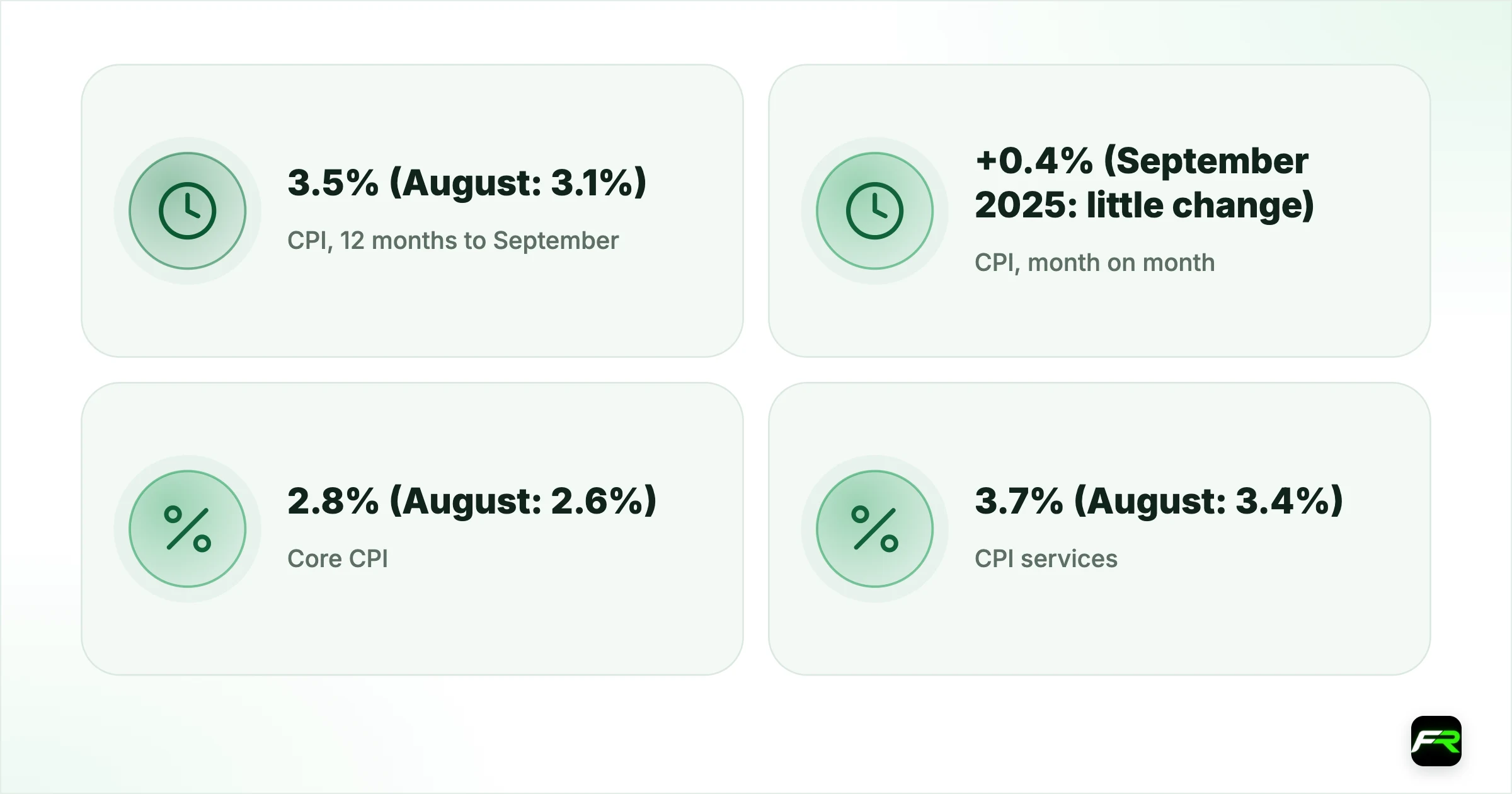
Fuel led the way. Petrol averaged 169.5 pence a litre in September and diesel 192.5 pence, both the highest since the summer of 2022, and motor fuel prices were 29.8% higher than a year earlier. The rise was not confined to the pump. Core inflation, which leaves out energy, food, alcohol and tobacco, climbed to 2.8% from 2.6%, and services inflation, the measure the Bank of England watches most closely, rose to 3.7% from 3.4%.
Sterling barely reacted at first. GBP/USD touched 1.3381 in the first minutes after the 06:00 UTC release, slipped to 1.3366 within ten minutes and was back near 1.3377 at 06:30 UTC. EUR/GBP briefly dipped to 0.8382 and returned to about 0.8389. A move that small suggests the jump in fuel prices, visible at the pump for weeks, did not change many minds about the Bank of England on its own. The pound firmed later in the London morning, and GBP/USD stood near 1.3398 at 10:00 UTC.
| CPI, 12 months to September | 3.5% (August: 3.1%) |
|---|---|
| CPI, month on month | +0.4% (September 2025: little change) |
| Core CPI | 2.8% (August: 2.6%) |
| CPI services | 3.7% (August: 3.4%) |
| CPI goods | 3.2% (August: 2.7%) |
| CPIH | 3.6% (August: 3.3%) |
| Motor fuels, year on year | +29.8% (August: +23.0%) |
| Bank Rate | 3.75%, next decision 5 November |
What the ONS reported
Two measures sit at the top of the release. CPI is the target measure for the Bank of England, whose goal is 2%. CPIH adds the costs of owning a home, which make up about 18% of that index, and the ONS calls it its most comprehensive measure. Both moved up sharply: CPIH reached 3.6% from 3.3%, and owner occupiers' housing costs rose 4.0%, up from 3.9%.
Six of the twelve spending categories pushed the annual rate higher, and three pulled it lower. Transport made the largest upward contribution, with recreation and culture and housing and household services also adding to it. Restaurants and hotels did the most to offset the rise, as hotel prices grew more slowly than a year earlier.
Goods and services both sped up. CPI goods inflation rose to 3.2% from 2.7%, and on the CPIH measure goods inflation hit its highest rate since September 2023, mostly because of motor fuels and kerosene. CPIH services inflation reached 3.9%, with the largest push from transport services, particularly air fares.
Fuel drove the jump
Transport prices rose 6.6% over the year, up from 4.6% in August. Petrol went up 8.2 pence a litre between August and September, while a year earlier it fell 0.2 pence. Diesel rose 10.7 pence, against a fall of 0.4 pence in September 2025. Monthly rises of that size feed straight into the annual rate, because last year's comparison month was flat.
Air fares added to the push in a less obvious way. Fares fell 19.5% between August and September, as they usually do after the summer holidays, but the drop was smaller than last year's 28.8% fall, so the annual rate rose. The ONS said the effect came mainly from European routes. It also noted that all flight prices it has collected since 28 February were gathered after the outbreak of the conflict in the Middle East.
Heating oil jumped as well. Kerosene prices rose 22.7% in the month, against a 1.4% fall a year ago, which added to the housing category.
| Measure | August 2026 | September 2026 |
|---|---|---|
| CPI, all items | 3.1% | 3.5% |
| CPIH, all items | 3.3% | 3.6% |
| Core CPI | 2.6% | 2.8% |
| CPI services | 3.4% | 3.7% |
| CPI goods | 2.7% | 3.2% |
| CPIH transport | 4.6% | 6.6% |
| CPIH food and soft drinks | 1.3% | 1.3% |
Source: Office for National Statistics, Consumer price inflation, UK: September 2026. Annual rates, 12 months to the month shown.
Services and core prices rose too
A fuel-driven rise is something a central bank can sometimes look past, because oil prices can fall as quickly as they rise. The harder part of this report is the rest of the basket. Core CPI rose by 0.2 points to 2.8%, up from 2.6% in August, and services inflation rose by 0.3 points to 3.7%.
Some of that came from one-off timing. Recreation and culture prices rose 0.7% in the month, led by live music, where prices edged up this year after falling 8.6% a year ago, and by computer game downloads, up 40.0%. Package holidays and cultural events added smaller amounts. Swings like these often unwind the following month.
Food went the other way. Prices for food and soft drinks were 1.3% higher than a year earlier, the same rate for a third month; it was last lower in September 2021. The ONS pointed out that groups such as the Food and Drink Federation expect food inflation to arrive later and last longer, as manufacturers struggle to pass higher costs on.
What it means for the pound and the Bank of England
The Bank of England held Bank Rate at 3.75% on 17 September, with six members voting to hold and three wanting a change. Its next decision is on 5 November, and this report makes a cut much harder to argue for. Inflation is now 1.5 points above the 2% target and rising, and the measures that reflect domestic pressure, services and core, both moved up.
Tuesday's jobs data offered some balance. The ONS said unemployment fell to 4.7% but vacancies dropped to 691,000 and total pay growth slowed to 3.7%, and private sector regular pay grew only 3.0%. Slower wage growth should, in time, cool services prices. Until it shows up in the inflation data, though, the Bank is likely to focus on today's numbers.
For sterling, firmer inflation usually means higher rate expectations, which tends to support the currency against the dollar and the euro. The risk is that energy-driven inflation also squeezes spending and growth, which would limit how far the pound can rise. September retail sales, due at 07:00 UK time on Friday, will show how households are coping.
What traders can take from it
A hot inflation number can move the pound fast, but the follow-through depends on what is driving it. These points help keep the release in proportion.
- Look at services and core as well as the headline. Fuel explains most of the jump, but services at 3.7% and core at 2.8% are what move Bank of England expectations.
- Watch oil. Petrol and diesel are at four-year highs, and a fall in crude would take pressure off next month's figure quickly.
- Expect base effects in the months ahead. Last year's October CPI rose 0.4% in the month, so the comparison gets tougher from here.
- Read EUR/GBP as well as GBP/USD. A rise in the pound against the euro shows the move is about UK data, not just the dollar.
- Keep size small before Friday's retail sales and the 5 November decision. Two more UK events can shift the view on rates before the Bank meets.
Say you buy GBP/USD at 1.3380 after the CPI release, with a stop at 1.3340, 40 pips below. A standard lot of 100,000 units is worth about $10 a pip, so the stop risks about $400 per lot. On a $10,000 account with a 1% limit of $100, the right size is 25,000 units. If you plan to hold through Friday's retail sales, consider halving it, because a weak spending report could undo the inflation move in minutes.
For today's levels, see our GBP/USD analysis. Yesterday's UK jobs story covers the labour market data, and the economic calendar lists every release before the Bank of England meets. Size each trade with the position size calculator.
UK data releases can move sterling sharply in the first minutes, and spreads often widen at 07:00 UK time. Leverage magnifies losses as well as gains, so trade only with money you can afford to lose.
All price figures are from the Office for National Statistics release of 21 October 2026, with August figures from the ONS August bulletin. Bank Rate, the September vote and the meeting date are from the Bank of England, and the jobs figures from the ONS labour market release of 20 October. Currency levels are market data built from 5-minute and hourly bars to about 10:00 UTC on 21 October and differ slightly between providers. Comments on the pound and policy are FX Recap's own reading. This is news, not investment advice.
Frequently asked
What is the UK inflation rate for September 2026?
UK CPI inflation was 3.5% in the 12 months to September 2026, up from 3.1% in August, according to the Office for National Statistics. It is the highest rate since October 2025. CPIH, which includes owner occupiers' housing costs, was 3.6%.
Why did UK inflation rise in September 2026?
Motor fuels were the biggest reason. Petrol rose 8.2 pence a litre in the month to 169.5 pence and diesel 10.7 pence to 192.5 pence, both the highest since 2022. Air fares, recreation and kerosene also added to the rise.
What are UK core and services inflation for September 2026?
Core CPI, which excludes energy, food, alcohol and tobacco, rose 2.8% in the year to September 2026, up from 2.6%. Services CPI inflation rose to 3.7% from 3.4%, and goods inflation to 3.2% from 2.7%.
When is the next Bank of England rate decision?
The Bank of England announces its next decision on 5 November 2026 at 12:00 UK time. Bank Rate is 3.75% after the 17 September hold. The ONS publishes October inflation on 18 November.
Sources: Office for National Statistics: Consumer price inflation, UK: September 2026 · Office for National Statistics: Consumer price inflation, UK: August 2026 · Bank of England: Bank Rate · Office for National Statistics: Labour market overview, UK: October 2026
The team behind this guide
Researched, checked and approved by five forex specialists
Every guide is written, fact-checked and edited before it goes live, and updated when the facts change. Spotted an error? Tell us.